By LouG on September 1, 2015 / Book Lists, Common Core & NGSS, Fiction, For Kids, For Librarians, For Parents, For Teachers, For Writers, MUF Contributor Books, News, Nonfiction, Publishing & Promotion
Ready to FALL into some great reads? I’m especially looking forward to CONFESSIONS OF AN IMAGINARY FRIEND A MEMOIR BY JAQUES PAPIER by Michelle Cuevas and CRENSHAW by Katherine Applegate. Hey, I still have imaginary friends – lots of them! I’m also excited for HOT PINK, about revolutionary designer Elsa Schiaparelli, because in middle school I was voted “Most Likely to Become a Fashion Consultant.” (My kids have a hard time believing that one.) Look for these awesome books HOT off the press!
Let’s begin with our own Jen Swanson’s BRAIN GAMES: THE MIND-BLOWING SCIENCE OF YOUR AMAZING BRAIN that releases September 8th from National Geographic Kids! Congratulations, Jen! 
QUICK: Name the most powerful and complex supercomputer ever built. Give up? Here’s a hint: It’s housed in your head and it’s the one thing that makes you YOU. Your brain is mission control for the rest of your body and steers you through life. Not bad for something the size of a softball that looks like a wrinkled grey sponge!
In this fascinating, interactive book — a companion to the National Geographic Channel hit show – kids explore the parts of the brain and how it all works, brainy news nuggets from a neuroscientist, plus fun facts and crazy challenges.
THE BLACKTHORN KEY by Kevin Sands from Aladdin, September 1st
 Following a series of murders, an apothecary’s apprentice must solve puzzles and decipher codes in pursuit of a secret that could destroy the world in this suspenseful debut novel.
“Tell no one what I’ve given you.”
Until he got that cryptic warning, Christopher Rowe was happy, learning how to solve complex codes and puzzles and creating powerful medicines, potions, and weapons as an apprentice to Master Benedict Blackthorn–with maybe an explosion or two along the way.
But when a mysterious cult begins to prey on London’s apothecaries, the trail of murders grows closer and closer to Blackthorn’s shop. With time running out, Christopher must use every skill he’s learned to discover the key to a terrible secret with the power to tear the world apart.
HiLO BOOK 1: THE BOY WHO CRASHED TO EARTH a Graphic Novel by Judd Winick from Random House Books for Young Readers, September 1st
 D.J. and his friend Gina are totally normal kids. But that was before a mysterious boy came crashing down from the sky! Hilo doesn’t know where he came from, or what he’s doing on Earth. (Or why going to school in only your underwear is a bad idea!) . . . But what if Hilo wasn’t the only thing to fall to our planet? Can the trio unlock the secrets of his past? Can Hilo survive a day at school? And are D.J. and Gina ready to save the world?
HILO is Calvin and Hobbes meets Big Nate and is just right for fans of Bone and comic books as well as laugh-out-loud school adventures like Jedi Academy and Wimpy Kid!
THE SECRETS TO RULING SCHOOL (WITHOUT EVEN TRYING): BOOK 1 (MAX CORRIGAN) by Neil Swaab from Abrams/Amulet, September 1st
It’s the first week of middle school, i.e., the Worst Place in the Entire World. How do you survive in a place where there are tough kids twice your size, sadistic teachers, and restrictions that make jail look like a five-star resort? Easy: with the help of Max Corrigan, middle school “expert” and life coach. Let Max teach you how to win over not just one, but all of the groups in school, from the Preps to the Band Geeks. Along the way, Max offers surefire advice and revealing tips on how to get through universal middle school experiences like gym class, detention, faking sick, and dealing with jocks and bullies.
In an innovative format that is part narrative and part how-to, acclaimed illustrator Neil Swaab has created a hilarious new reading experience that is reminiscent of video games and sure to engage even the most reluctant reader.
HOT PINK: THE LIFE AND FASHIONS OF ELSA SCHIAPARELLI by Susan Goldman Rubin from Abrams Books for Young Readers, September 8th
Shocking pink—hot pink, as it is called today—was the signature color of Elsa Schiaparelli (1890–1973) and perhaps her greatest contribution to the fashion world. Schiaparelli was one of the most innovative designers in the early 20th century. Many design elements that are taken for granted today she created and brought to the forefront of fashion. She is credited with many firsts: trompe l’oeil sweaters with collars and bows knitted in; wedge heels; shoulder bags; and even the concept of a runway show for presenting collections. Hot Pink—printed with a fifth color, hot pink!—explores Schiaparelli’s childhood in Rome, her introduction to high fashion in Paris, and her swift rise to success collaborating with surrealist and cubist artists like Salvador Dalí and Jean Cocteau. The book includes an author’s note, a list of museums and websites where you can find Schiaparelli’s fashions, endnotes, a bibliography, and an index.
CONFESSIONS OF AN IMAGINARY FRIEND A MEMOIR BY JACQUES PAPIER by Michelle Cuevas from Dial Books, September 8th
 Jacques Papier has the sneaking suspicion that everyone except his sister Fleur hates him. Teachers ignore him when his hand is raised in class, he is never chosen for sports teams, and his parents often need to be reminded to set a place for him at the dinner table. But he is shocked when he finally learns the truth: He is Fleur’s imaginary friend! When he convinces Fleur to set him free, he begins a surprising, touching, and always funny quest to find himself—to figure out who Jacques Papier truly is, and where he belongs.
THE ENTIRELY TRUE STORY OF THE UNBELIEVABLE FIB by Adam Shaughnessy from Algonquin Books, September 8th
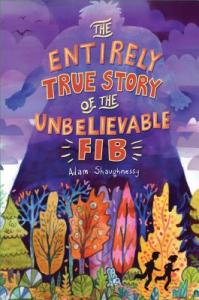 “What is the Unbelievable FIB?” That’s the question eleven-year-old Prudence Potts discovers on a baffling card no one else in Middleton–except ABE, a new kid at school with a knack for solving riddles–seems to see. Then a mysterious man asks for ABE and Pru’s help investigating mythical beings infiltrating the town, and that’s just the first of many things Pru finds hard to believe.
Soon Pru and ABE discover another world beneath their quiet town, where Viking gods lurk just out of sight. And when the pair find themselves locked in a battle against a dangerously clever enemy, they must race to secure the Eye of Odin, source of all knowledge–and the key to stopping a war that could destroy both human and immortal realms.
THOMAS JEFFERSON GROWS A NATION by Peggy Thomas and Stacy Innerst from Calkins Creek, September 8th
Thomas Jefferson was more than a president and patriot. He was also a planter and gardener who loved to watch things grow—everything from plants and crops to even his brand-new nation. As minister to France, Jefferson promoted all things American, sharing corn and pecans with his Parisian neighbors. As secretary of state, he encouraged his fellow farmers to grow olives, rice and maple trees. As president, he doubled the size of the nation with the Louisiana Purchase. Even in his retirement, Jefferson continued to nurture the nation, laying the groundwork for the University of Virginia. In this meticulously researched picture book for older readers, author Peggy Thomas uncovers Jefferson’s passion for agriculture and his country. And Stacy Innerst’s incredibly original illustrations offer the right balance of reverence and whimsy. This is Thomas Jefferson as he’s never been seen before! Back matter includes an author’s note on Jefferson’s legacy today; timeline, bibliography; place to visit (Monticello); and source notes.
THE MARVELS by Brian Selznick from Scholastic, September 15th
Two seemingly unrelated stories — one in words, the other in pictures — come together with spellbinding synergy! The illustrated story begins in 1766 with Billy Marvel, the lone survivor of a shipwreck, and charts the adventures of his family of actors over five generations. The prose story opens in 1990 and follows Joseph, who has run away from school to an estranged uncle’s puzzling house in London, where he, along with the reader, must piece together many mysteries. How the picture and word stories intersect will leave readers marveling over Selznick’s storytelling prowess. Filled with mystery, vibrant characters, surprise twists, and heartrending beauty, and featuring Selznick’s most arresting art to date, The Marvels is a moving tribute to the power of story.
CRENSHAW by Katherine Applegate from Feiwel & Friends, September 22nd
Jackson and his family have fallen on hard times. There’s no more money for rent. And not much for food, either. His parents, his little sister, and their dog may have to live in their minivan. Again.
Crenshaw is a cat. He’s large, he’s outspoken, and he’s imaginary. He has come back into Jackson’s life to help him. But is an imaginary friend enough to save this family from losing everything?
Beloved author Katherine Applegate proves in unexpected ways that friends matter, whether real or imaginary.
I AM DRUMS by Mike Grosso from Egmont, September 22nd
 While other kids dream about cars, sports, and fashion, all eleven-year-old Samantha Morris dreams about is playing the drums. But it’s hard to make her dreams come true when her parents are against it, she bangs on dictionaries because she can’t afford a real kit, and her middle school is cutting its music program.
Sam’s only hope to accomplish her dream is to find a private music teacher and pay for lessons herself — even if it means borrowing the family lawn mower without permission to make the money. But when one of her friends tells her she’s the worst percussionist in the band, she starts to wonder if she’s got what it takes. If Sam wants to become a real drummer, she must also overcome her own doubts if she wants to succeed.
JUMP BACK, PAULl: THE LIFE AND POEMS OF PAUL LAURENCE DUNBAR by Sally Derby and Sean Qualls from Candlewick, September 22nd 
Did you know that Paul Laurence Dunbar originated such famous lines as “I know why the caged bird sings” and “We wear the mask that grins and lies”? From his childhood in poverty and his early promise as a poet to his immense fame and his untimely death, Dunbar’s story is one of triumph and tragedy. But his legacy remains in his much-beloved poetry—told in both Standard English and in dialect—which continues to delight and inspire readers today. More than two dozen of Dunbar’s poems are woven throughout this volume, illuminating the phases of his life and serving as examples of dialect, imagery, and tone. Narrating in a voice full of admiration and respect, Sally Derby introduces Paul Laurence Dunbar’s life and poetry to readers young and old, aided by Sean Qualls’s striking black-and-white illustrations.
THE THING ABOUT JELLYFISH by Ali Benjamin from Little Brown, September 22nd 
After her best friend dies in a drowning accident, Suzy is convinced that the true cause of the tragedy was a rare jellyfish sting. Retreating into a silent world of imagination, she crafts a plan to prove her theory–even if it means traveling the globe, alone. Suzy’s achingly heartfelt journey explores life, death, the astonishing wonder of the universe…and the potential for love and hope right next door.
THE DOLDRUMS by Nicholas Gannon from Greenwillow Books, Septermber 29th
 Archer B. Helmsley wants an adventure. No, he needs an adventure. His grandparents were famous explorers . . . until they got stuck on an iceberg. Now Archer’s mother barely lets him out of the house. As if that would stop a true Helmsley. Archer enlists Adelaide the girl who, according to rumor, lost her leg to a crocodile and Oliver the boy next door to help him rescue his grandparents. The Doldrums whisks us off on an adventure full of sly humor, incredible detail, and enormous heart.
What books are you looking forward to adding to your library this month?
Louise Galveston is the author of BY THE GRACE OF TODD and IN TODD WE TRUST (Penguin/Razorbill).
Like this:
Like Loading...