Posts Tagged New Releases

DOUBLE DOSE of WNDMG!!! Author Interviews with Raidah Shah Idil and Yxavel Magna Dino!

Wndmg logo

WNDMG Reads

November’s typically filled with so much to do! Some households just finished celebrating Dia de Los Muertos, while others are saluting the veterans in their lives. Others are already planning Thanksgiving, Friendsgiving, or any other -Givings Day dinners!

Yet those in the bookish community simply wait for all the incredible new releases that embrace the family spirit. And what better way to celebrate family this month than with a double dose of WNDMG book releases!

We recognize that publishing is an incredibly difficult pursuit and that journey can be even harder for international authors. Yet, despite all odds, I have had the pleasure of sharing the virtual stage with not one, but two amazing MG authors who both have US/CANADA releases this month!

Without further ado, I present Raidah Shah Idil and Yxavel Magna Diño! Welcome ot the Mixed Up Files – We Need Diverse MG feature!


How to Free a Jinn book cover

How to Free a Jinn by Raidah Shah Idil

Raidah Shah Idil is the author of HOW TO FREE A JINN which released in the US and Canada on November 4! Here’s a summary of her Malaysian fantasy novel!

Insyirah’s calm, orderly world falls into chaos when her proud nenek (grandmother) has a bad fall, and Insyirah and her mother must move back to Malaysia to take care of her.

Her new home holds wild and dangerous mysteries, and while finding her feet, Insyirah discovers a shocking secret: the women in her family can control jinn—powerful, ancient jungle spirits—and, one day, she will inherit one of her own. What’s more, her new school is haunted by an evil spirit determined to force her out of Malaysia.

As Insyirah discovers the fascinating ways of the seen and unseen worlds, she finds danger around every corner. And when her family situation grows perilous, she must gather all her resilience to overcome unexpected obstacles and make a life-changing decision.


New Realeases Nov 2025

The Firefly Crown by Yxavel Magna Dino

Yxavel Magna Diño is the author of two amazing Filipino fantasy novels THE SERPENT RIDER (2024) and THE FIREFLY CROWN released in the states yesterday, November 11! Focusing on her sophomore novel for this interview, here’s the blurb for THE FIREFLY CROWN:

An unlucky sorcerer must learn to wield her insect magic in this charming middle grade fantasy that’s perfect for fans of Impossible Creatures and Witchlings.

In the empire, magic determines your fate. But Yumi is tired of being a failed Cricket. Their magic is lousy and boring. She dreams instead of the sparkling magic of Fireflies, whose powers rival the sun. If only she could harness her talents like other magicians . . . For now, Yumi is ignored by even the crickets who are supposed to follow her spells.

Then, Yumi gets a chance to prove herself sooner than expected when all sorcerers are summoned for the princess’s coronation. But everything falls apart when the Firefly Crown is stolen, leaving the empire defenseless against the Ghost Swarm, a horde of undead bugs. Worse, Yumi is blamed. Suddenly this lowly Cricket is the empire’s most wanted. To clear her name and protect her loved ones, Yumi must find the real thief. But can a Cricket really save the day?


Now enough with the pleasantries, let’s jump into this interview!


CHILDHOOD DREAMS


My first question for both of you: did you always want to become an author?

RAIDAH: Yes! I was always that kid who found socialization far too tricky, so I sought refuge in reading and writing books. I’ve lost track of the number of stories I’ve written, and all my unfinished manuscripts. I wrote fanfiction for years, too, which really helped me improve my writing craft.

YXAVEL: Yes! Ever since I was really young, “author” was always my answer whenever people asked me what I wanted to be when I grew up. I was the kid who would rather read books in the library at lunchtime rather than hang out with the other students (thank you to everyone who still talked to me even though I was super shy and quiet, haha!) I once told someone that if I could only publish one book, and have even just one person read and love it, I would be a very happy writer. So, I feel extremely blessed and lucky to be able to live out my dream of being a published author right now, and very grateful to all the family, friends, and industry professionals who made it possible.

So determined! This of course has me asking you to tell us a bit about your publication journey.

YXAVEL: Since fantasy novels were the books that first sparked my obsession with reading and writing, I knew I wanted to be a fantasy author first and foremost. However, when I started writing my own ideas, I struggled with discipline and sticking to a single idea. Back then it was super difficult for me to write a thousand words, let alone the tens of thousands that were needed for a full-length novel.

After high school, I decided to write a story that was truer to my identity than any of the Western fantasy-inspired novels I’d ever tried writing before: a story inspired by my Filipino heritage, its myths, and its folklore. In my first year of university, I started writing what would become my debut middle-grade fantasy novel, THE SERPENT RIDER. I finished the manuscript and started querying by the start of the following year and got an offer of representation, and my wonderful agent sold the book the year after that. After several rounds of edits, THE SERPENT RIDER released in September 2024 and my sophomore novel, THE FIREFLY CROWN, just landed this month!

RAIDAH: Buckle up, because it took YEARS! I had attended Hanna Alkaf’s author event, and her advice to me was to finish my first draft. I completed the first draft of HOW TO FREE A JINN while I was pregnant with my son. I knew I needed a solid draft before he was born, before I got swallowed up by the newborn haze all over again. My two daughters were both under 4 at the time, so while my oldest was in preschool and my middle daughter was with her grandmother, I’d go from restaurant to restaurant and write. It was such a fun process, especially because I’m a panster and had no idea where my story was going until I wrote THE END. I polished it as best I could, hired an editor to help me polish it even further, then started the arduous process of querying….two months after I gave birth to my son! I gave myself a deadline of a year – if I didn’t secure representation by then, I would shelve my book and write another. I had about 100 rejections by the time I secured a single agent offer. In October 2020, when my son was one year old, I signed with my agent, Alli Hellegers of Stimola Literary. After some edits with her, in 2021, she sent the then-YA version of my book to US editors, and we had a lot of complimentary rejections. I spent 2022 revising my book down from YA to MG. We finally landed my Australian book deal in late 2023, and then got published in Sept 2024!

applause hands

I’m not worthy to be in the presence of two agented international PHENOMES! Now, do you both strictly write fantasy? Or do you dabble across genres? Is there one genre you would (probably) NEVER try?

This image is a promotional poster for the 2018 Malaysian supernatural horror film, Munafik 2


RAIDAH: Not at all! I read very widely and reflect that in my own writing practice e.g. I also write non-fiction, poems, romance, mysteries, adventures….One genre I would probably never try is straight up horror. Suspense and psychological thrillers are something I’d love to experiment with, but I’m far too squeamish for gore and horror.


Fluffy cupid


YXAVEL: I’m a fantasy writer at heart, but I love consuming media in all different genres including sci-fi, horror, psychological thrillers, and literary! I’d love to be a multi-genre author one day. Although I don’t think I could ever write a purely romance-oriented book, as that requires a skillset which I doubt I currently have (for now at least … but hey maybe one day!)

REPRESENTATION GOALS


Diverse ReadsAs a Thai-American MG author, I personally love discovering the commonalities between different Southeast Asian cultures. What are some key cultural elements or traditions from Malaysia and the Philippines you knew you had to include in your stories?

RAIDAH: I wanted to include tasty Malaysian food and our obsession with jinn stories. I also wanted to include spiritual practices like reading Ayatul Kursi for protection. My intention was to always weave these seamlessly into my narrative, as a way to invite the reader into Insyirah’s lived experience.

YXAVEL: It’s super fascinating how Southeast Asia is so diverse yet there are so many values our cultures share! THE SERPENT RIDER features several mythical creatures from Filipino folklore, while THE FIREFLY CROWN’s magic system is inspired by the mambabarang, or traditional Filipino insect magicians. Aside from these aspects, one element of Philippine culture I knew I had to include in my stories is the concept of bayanihan: the deep bonds of family, friends, community, and the sense of “we’re all in this together” that permeates Filipino society even today. The importance of community and connection across Southeast Asian cultures is something you also explore very well in your own books, Patchree!

Thanks for kind words, Yxavel! Borrowing the sentiment from our colleague, Annie McCann, do you feel like a trailblazer for your culture when it comes to representation?

Southeast Asian MG Cover Banner

YXAVEL: In writing my novels, my goal was to spread the word about Filipino myths and hopefully encourage young readers to want to learn more about them! I’m so glad to be a fellow author alongside Annie, whose book MY HARIMAU KING does this with Indonesian legends; with Raidah Shah Idil whose novel HOW TO FREE A JINN explores Malaysian culture; and with you, who absolutely blew me away with your Thai-inspired SKYLIGHT! Since there’s an underrepresentation of Filipino-inspired books in the kidlit space, writing about our culture does make me feel like a trailblazer in that sense—although I’m definitely not the first person to do it!

An amazing writer-sister of mine, Caris Avendaño Cruz, wrote MARIKIT AND THE OCEAN OF STARS, as well as her second novel released earlier this year, THE BOY, THE MOUNTAIN, AND THE SERPENT WHO ATE THE MOON (which features the Filipino moon-eating sea serpent that also appears in my book THE SERPENT RIDER). Caris is a brilliant author who writes our myths with a poetry and charm I can only dream of. I’ll always recommend those books!

RAIDAH: I think so. I’d like to think that I’m building on the foundation set by Southeast Asian authors who have been published before me, like Hanna Alkaf and Jesse Sutanto. I admire Hanna Alkaf’s books, which reflect a deep love for Malaysian families, food and culture. My experience is different because of my returnee diaspora experience. I’m Malay, but not Malaysian. I’m Australian, but I’m definitely not white. I still occupy this liminal space of being between worlds. I wanted to emphasize the healing power of coming back to my ancestral home after struggling with a lot of anti-Islam, anti-Asian sentiment growing up as a minority in the West.

Representation matters so much and ALL children need to see themselves in the stories they read. We’ve still got a long way toward balancing our libraries, but at least we’re taking up the challenge to make our cultures present and accounted for!

Group of five chibis

Designed by FreePik

Now, I’ve got a question just for Raidah! While most writers feel like we can revise forever (some begrudgingly!), what did the revision process look like for you between the original version of HOW TO FREE A JINN and the upcoming US/Canadian release?

RAIDAH: Where do I even start? The original version of HOW TO FREE A JINN was actually a YA novel! Insyirah started off as being 16. One of my American beta readers said that she sounded closer to 12, and that was the winning tweak that I suggested to my agent, who enthusiastically agreed. I had to brutally cut out many subplots and characters (including Insyirah’s dad, stepmother and stepsister haha) to get to the heart of my story. That was the version that landed my first book deal with Allen and Unwin.

Once my book got acquired by my Australian publisher, I had a little bit more polishing to do with my Australian editor, Kate Whitcher. Once I got my American book deal with Salaam Reads (an imprint of Simon & Schuster), I fleshed out my story even more with my American editor, Deeba Zargapur. I hope to get a UK book deal too, and I’m looking forward to strengthening my book with my UK editor.


Who knew the process was so complicated! Now, Yxavel, here’s a question just for you! Since all writers dream of getting every story published, how did the publishing journey of THE FIREFLY CROWN differ from THE SERPENT RIDER? Did you experience any sophomore release nerves?

Mambabarang

YXAVEL: With THE SERPENT RIDER, I had all the time in the world to come up with the initial draft, but THE FIREFLY CROWN was the first book I’ve ever had to write on deadline and I really felt the challenge! It helped that I decided to write a main character who shares a lot of traits with me—Yumi is a quiet Cricket magician who comes from humble beginnings, but is forced to prove her innocence when the empire’s most treasured possession, the magical Firefly Crown, goes missing and the blame lands on her. My initial attempt at a manuscript was pretty messy, so I’m thankful to my editor for being very forgiving with the first draft, and for writing a brilliant edit letter that helped me improve the story so much!

A lot of people who enjoyed THE SERPENT RIDER are Filipino readers who know our myths exceptionally well, so I’m a little (read: EXTREMELY) nervous about what they will think of THE FIREFLY CROWN. Here’s hoping you all will enjoy it too!


My goodness! I am blown away but both of your journeys! Last question, what’s one key takeaway you want readers to take away from your work?

RAIDAH: I hope that Insyirah’s story, and all of my future stories, will show the complexity and humanity of Muslim families, and how we deserve to go on fun adventures too. The dehumanization and demonisation of Muslims in mainstream media has real-life harmful and often fatal consequences. Writing joyful Muslim stories is my resistance.

YXAVEL: A recurrent theme across both my novels is having the courage to forge your own path, no matter who or what may stand in your way. I sincerely hope that anyone who reads my work will feel inspired to do just that.


Here, here! I love these messages and agree with both of you wholeheartedly. Publishing takes courage and joy is resistance! Thank you both so much for sharing with us today! Be sure to support these amazing authors and grab their books today! Check out their socials and book links below!

Raidah Shah Idil

Raidah Shah Idil


Author Bio:Raidah Shah Idil was born in Singapore; grew up in Sydney, Australia; worked in Amman, Jordan; and now lives in Petaling Jaya, Malaysia, with her husband, three children, and mother-in-law. Raidah earned her BA in English and BSc in Psychology from the University of New South Wales and her Diploma of Counselling from the Australian Institute of Professional Counsellors. Raidah loves ginger tea and noodle soup and dreams of uninterrupted sleep. HOW TO FREE A JINN is her first book.


Yxavel Magna Dino

Yxavel Magna Dino


Author Bio: Yxavel Magno Diño is the author of The Serpent Rider and The Firefly Crown. She was born in the Philippines before moving to Australia at a young age, where she soon discovered that almost nobody there knew how to say her name. To make up for it, she spent her time daydreaming about fantasy worlds filled with characters who had more unusual names than she did. Now, she writes stories about her Filipino heritage and its fantastical folklore. When she’s not writing, you can find her drinking copious amounts of black tea or getting lost in the pages of a book.

Author/Illustrator Spotlight: Allan Wolf and Jose Pimienta

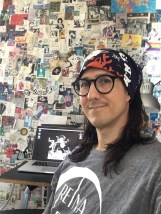
Illustrator Jose Pimienta

Author Allan Wolf

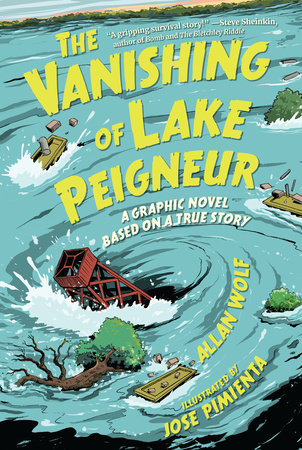
In today’s Author/Illustrator Spotlight, Landra Jennings chats with author Allan Wolf and Illustrator Jose Pimienta about their new middle-grade novel, The Vanishing of Lake Peigneur: A Graphic Novel Based on a True Story (Candlewick Press, October 7). They share the inspiration behind the novel, their creative processes and a little advice for those just starting out!

A Junior Library Guild Selection
Publisher’s Weekly Top 10 Middle Grade Graphic Novels, Fall ’25
“A riveting page-turner that will have readers eager to learn more about the topic.” —Kirkus Reviews (starred review)

Book Summary:

The strange, true tale of a Louisiana lake that vanished—taking with it every fish below and every boat and barge above—told in a gripping and accessible graphic format.
Home to catfish and crawdads, shrimp and spoonbills, even a gator or two, Lake Peigneur—pronounced “your pain,” only backward—bustles also with human life. Each day, the bean-shaped freshwater lake and its shores hum with folks going about their work: a devoted gardener’s apprentice and his dogs, fishermen, oilmen drilling at Well P-20, and the fifty-one miners employed by the Diamond Crystal Salt Mines. For most, November 20, 1980, began as “just another day on the lake.” But as the lake itself reflects, humans had, over time, left behind a honeycomb of salt highways deep beneath its surface, and water and salt mix all too well. Bracing, suspenseful, and packed with dramatic illustrations and dense end matter, this story of a catastrophic accident—narrated with the homespun voice of a “tall” tale, but true nonetheless—will amaze science and history buffs alike.


Interview with Allan Wolf and Jose Pimienta

LJ: Welcome to the Mixed-Up Files, Allan and Jose! Thanks for joining us today. I’m so intrigued by this new book and I can’t wait to hear your thoughts on its development. Let’s start with you, Allan. Where did you get the initial inspiration for The Vanishing of Lake Peigneur

AW: Back in 2007, while visiting schools and libraries in southern Louisiana, I noticed there was a chimney sticking up from the surface of Lake Peigneur, near New Iberia. So, I started asking questions.

I learned that Texaco, while exploring for oil in 1980, sent a 14-inch drill bit into the bed of a shallow1200-acre freshwater lake, piercing a salt-mine below, causing 3.5 billion gallons of water to drain like a bathtub. The resulting whirlpool and sinkhole, sucked in eleven barges, two oil derricks, a couple houses, a tugboat, a fishing skiff, and sixty-eight acres of a nearby ornamental garden. The disaster also created a 400-foot geyser and a 150-foot waterfall. The lake drained in four hours, then began to refill, via the Delcambre Canal, with saltwater drawn from the Gulf of Mexico, nine miles away! The A&E Channel featured the story in 2003 or so, but otherwise it seemed like very few people had even heard of this event. The details were so compelling, I had to tell it.

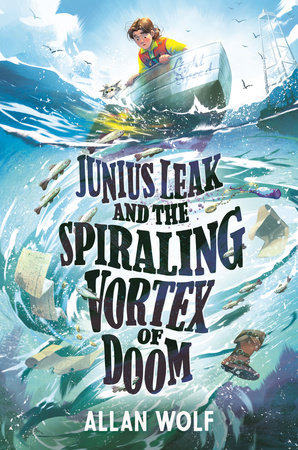
Junius Leak and the Spiraling Vortex of Doom

LJ: Allan, how does this title relate to your other recent release, Junius Leak and the Spiraling Vortex of Doom?

AW: The Vanishing of Lake Peigneur and Junius Leak and the Spiraling Vortex of Doom are siblings, raised together in the same house but choosing to grow in different directions. Junius Leak is a middle-grade historical fiction novel in prose, using the facts of the Lake Peigneur disaster as a backdrop for the book’s fictional characters. Junius Leak is a twelve-year-old kid sent to live with his mysterious uncle in a houseboat on Lake Peigneur near Delcambre, Louisiana.

The factual disaster becomes a symbol of Junius Leak’s own coming of age. But to make the world of Junius Leak as authentic and historically accurate as possible, I had to do a lot of research. Then to synthesize my research, I wrote a 60-page prose story of what actually happened so that I could elegantly combine my fictional plot with the factual events. My historical fiction novels often have very extensive back matter. Long-story-short, the back matter of Junius Leak was so compelling, that it demanded we turn it into a book of its own. And that’s how The Vanishing of Lake Peigneur was born. It was my editor at Candlewick Press, Katie Cunningham, who suggested we tell the story in graphic form.

On a somber note, Katie Cunningham passed away this July 4th. Just three days after Junius Leak was published. And three months before the publication of The Vanishing of Lake Peigneur. She was 43. I miss her terribly.

Learning about the Lake

LJ: I love hearing about the relationship between the two books though I am so sorry to hear about Katie. What kinds of research did you do to be true to this story?

AW: I read every newspaper article I could find from the 1980s, along with many government documents reporting and analyzing what took place. The newspapers would sometimes contradict one another, so I looked to official documents from the Mining Safety and Health Administration (MSHA) to get my final numbers. I stalked my way through a labyrinth of Cajun names on FaceBook. I looked at several hundred photographs. I interviewed, in person, a handful of survivors and their relatives—including the 95-year-old captain of the tugboat, Charlie, who narrowly escaped being flung from a waterfall formed by the collapsing earth. Since I started my research in 2007, a few interesting podcasts have added to the story as well. But the in-person conversations I had with first-hand witnesses was my most valuable research tool.

To the Heart of The Vanishing of Lake Peigneur

LJ: What do you hope readers take away from this novel?

AW: Over all I’d like readers to see how it is possible to act courageously even when we are afraid. That is the very definition of courage: to take action in spite of fear and self-doubt. In their own individual ways, both The Vanishing of Lake Peigneur and Junius Leak and the Spiraling Vortex of Doom are stories of ordinary people acting heroically in the face of extraordinary circumstances. That’s when we find out who we really are.

Also, Junius Leak models for us how we don’t have to hide our true selves to make others more comfortable. Sometimes you get tired of trying to fit in. Sometimes you just want to be yourself. It is your choice to make.

On Writing

LJ: What’s your favorite thing about being a writer and story-teller?

AW: I have always identified with “being a writer,” but the early romance has always butted heads with the mundane needs of life. Being a professional writer for kids these days requires a lot of social media, marketing, conferences, bookstore events, school visits—all of it with only a tangential relationship to the actual act of writing books. But that writing itch always lurks. We all need to be the makers of something. If that need isn’t met, we whither. I guess the thing I really love about being a writer is the writing. I can write my way to discover that place, that spot, that just-right, water-tight safe space inside my head where I can go to find myself in my imagination.

What’s Next for Allan?

LJ: Is there anything else you’d like us to know?
AW: Yes. The year 2025 has been a big one for me. In addition to the two books discussed here, I have a new poetry collection out, The Gift of the Broken Teacup: Poems of Mindfulness, Meditation, and Me. It is brilliantly and beautifully illustrated by Jade Orlando. These are fun yet thoughtful poems about self-regulation, self-care, and self-esteem. Of all my poetry collections to date, this one is the most personal. This book was my chance to explore what it means to have character and an intrinsic sense of self-worth. And it gave me a chance to share the ways I have learned to deal with anxiety and to practice self-care. The Gift of the Broken Teacup is sort of an owner’s manual for the soul.

The Illustrations

LJ: Now to you, Jose. The illustrations are phenomenal, starting with the cover. There’s so much energy that jumps right off the page. What excited you most about this project?

JP: The defining factor that excited me the most was that the story’s narrator would be the lake itself. I love stories about places, so, as much as there are many amazing people in this story, the point of view being the land drew me in, immediately.

LJ: How did this project differ from some of your other titles?

JP: This story is non-fiction, which is a first for me. Also, it involves so many people, so, keeping track of a large cast of characters was something I had never done. And! this is the first book I’ve drawn where all the characters are adults. Most of my books feature either teenagers or kids with some adults in there. This one was all grown-ups. But there’s puppies, so…

Jose’s Creative Process for Illustration

LJ: We all love puppies! What is your creative process like? What time of day do you do your best work and what medium do you use?

JP: For the most part, I like to listen to music related to the topic of the story I’m working on. I helps me to stay in the tone of the story. Unless I have errands to run or other engagements, I like to start drawing as soon as possible in the day, right after I finish cleaning up after breakfast. And I like it when drawing is the last thing I do before going to sleep. Everything in between can be different depending on the day. So, I draw a while, goof for a bit, run errands, meet with friends, draw some more, go for a bike ride, eat something, draw more, and so on.
Generally, I draw with a mechanical pencil on 9×12 Bristol board or drawing paper. Then I ink my drawings with microns and brush pens. After that, I scan the pages and letter my comics digitally, because I do a lot of re-writes, so… this helps keeping the dialogues flexible. Lastly, I color digitally because it’s faster. I also prefer to do each book in passes. I like to do the entire book in pencil and then ink the whole book, and so on. Some people prefer to work in batches or one finished page at a time, and that’s great- but I can’t. I want to minimize the amount of gear shifting I do.

For writing, my process is an entirely different story. But more on that some other time.

The Path to Becoming an Illustrator

LJ: How did you get started along the path to becoming an illustrator?

JP: I’m not sure when it started. A cliché answer is “I never stopped drawing. I’ve just been doing this my whole life.” And that’s mostly correct. But as a professional, I can’t think of a definitive starting point. I went to art school, where I met a lot of amazing people I wanted to collaborate with, and that got me some work, but I also wanted to write and draw my own stories, so I did that as well. After art school, I came to Los Angeles in the hopes to work in the film industry, and I kept getting work here and there while I was making my own comics. At some point, I realized I was making a living drawing, so “Yay!”

I guess how I got started is I just kept telling people I wanted to draw and I showed them what I was working on. Some of that lead to work and some of it didn’t. Along the way, I made cool friends and got to collaborate with wonderful artists.

Advice for Those Just Starting Out in Illustration

LJ: What advice would you have for a beginning illustrator?

JP: Hmm… first I’d ask the illustrator what their goals are. Then, I’d hope I have useful advice for their specific path, or at least point them in the direction of other illustrators who do something similar so they can get better guidance. But as a general advice, I go with this:

Explore. Try things out. Find what works for you and approach everything with genuine curiosity. Experiment with mediums and see what catches your interest. Learn as much as you can from experts, but dare to go further than they have. Also- get comfortable with failure. Learning requires it. But pay attention and ask if it’s worth trying again. Lastly, Make friends. Be friendly. Be kind. Be sincere. Most people want to collaborate with someone they know or someone they like. So, show your work. No one’s going to hire you if they haven’t seen what you do. Oh! And of course: keep practicing the fundamentals.

I hope that’s useful, but if not, ask other illustrators. (And that’s my point: Ask and talk to as many as you can. We all want to see more art. So we’d love to see yours.)

Visiting the Lake

LJ: Is there anything else you’d like us to know?

JP: Only what you’d like to ask me, hehe. I’m not sure how to answer this, other than working with Allan was fantastic and this book was a phenomenal project. I’m so happy I got to draw this. Oh! Big story I like to share. When I first started drawing this, I wasn’t sure how to research this, since it’s non-fiction. I wanted to get as many details as possible correct, so, on a whim, I went to see the actual lake and I can’t tell you how much help that was. Visiting the lake was a terrific experience. Big thank you to everyone who answered my questions and their meals are top notch. If you get a chance to visit the area, by all means, it’s a delight.

Lightning Round Questions:

No MUF interview would be complete without our lightning round, so here we go…

For Allan Wolf:

Coffee or tea? Both.

Sunrise or Sunset? Sunrise.

Favorite city (besides the one you live in): Asheville, NC

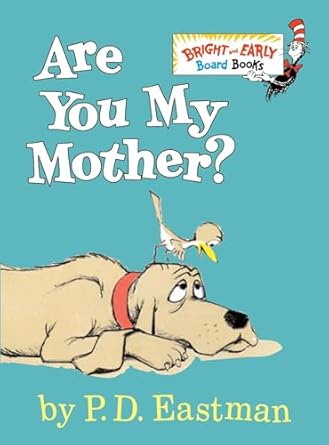
Favorite books from childhoodAre You My Mother? By P.D. Eastman and Mike Mulligan and His Steam Shovel by Virginia Lee Burton.

Favorite ice cream flavor: Banana

If you could choose a superpower, what would it be? The ability to flood others with any emotion so that emotion then becomes their own.

For Jose Pimienta:

cup of teaCoffee or tea? Tea.

Sunrise or Sunset? Sunset.

Favorite city (besides the one you live in): (In the world?) Hamelin, in Germany. But if we’re doing US only: Los Angeles (I live in Burbank).

Favorite book from childhood: “Matias y el Pastel de Fresas” by Jose Palomo.

Favorite ice cream flavor: Ube. Or anything chocolate.

If you could choose a superpower, what would it be? I’m very serious about this: Scent manipulation. Being able to control smells would amazing. Had a bad day? Not when it smells like a bakery in here. Supervillain attacking you? Make it smell so bad they’re incapable of focusing. Did you pass gas in public? No one ever has to know. OR teleporting, whichever is easier to acquire.


Thank you so much Allan and Jose for sharing with us!


About the Author and Illustrator

Allan Wolf

Two time winner of the North Carolina Young Adult Book Award, as well as Bankstreet College’s prestigious Claudia Lewis Award for Poetry, Allan Wolf is the author of picture books, poetry, and young adult novels. Booklist has named his historical verse novel, The Watch That Ends the Night, one of “The 50 Best Young Adult Books of All Time.”

Also a skilled and seasoned performer of 30 years, Allan Wolf’s dynamic author talks and poetry presentations for all ages are meaningful, educational and unforgettable. Florida Reading Quarterly calls Wolf “the gold standard of performing poetry.” Wolf believes in the healing powers of poetry recitation and has committed to memory nearly a thousand poems.

Wolf has an MA in English from Virginia Tech where he also taught. He moved to North Carolina to become artistic and educational director of the touring group Poetry Alive!. Wolf is considered the Godfather of the Poetry Slam in the Southeast, hosting the National Poetry Slam in 1994, forming the National Championship Team in 1995, and founding the Southern Fried Poetry Slam (now in it’s 27th year).

Jose Pimienta

Jo Pi’s almost full name is Jose Pimienta. They reside in Burbank, California where they draw comics, storyboards and sketches for visual development. They have worked with Random House Graphic, Iron Circus Comics, Dark Horse Comics, Disney Digital Network, and more.

During their upbringing in the city of Mexicali, Mexico Jo was heavily influenced by animation, music and short stories. After high school, they ventured towards the state of Georgia where they studied at Savannah College of Art and Design. 

For Comics work, they are represented by Elizabeth Bennet of Transatlantic Agency.

WNDMG Author Interview: Pablo Cartaya

Let’s give a warm welcome to Pablo Cartaya for joining us at the Mixed-Up Files blog. Pablo is an internationally acclaimed author, screenwriter, speaker, and educator. His work has been featured in the New York Times, Washington Post, NBC, and on Oprah’s Booklist. Thank you so much for joining us! It’s a pleasure to have you. Let’s talk about your books and writing!

Pablo! You have had some of the coolest jobs! Umm, Ricky Martin’s body double, for one? When do you find the time to write? Seriously, do you have a daily schedule, or is it buckle down because the book is due, or somewhere in between?

I’ve had some pretty fun, wild jobs (movie equipment truck driver, Spanish dubbing actor, hand model), there’ve been a lot of odd jobs. I think when you endeavor to work in a creative field, you have to figure out any way to keep working to support the dream you have to be a creative. I’ve learned over many years of working odd jobs that if I wanted to dedicate time to my craft, I had to compartmentalize myself and the responsibilities I had. I don’t really do daily schedules per se, but I do have “assignments” that I know I have to complete. Those assignments could be book deadlines, answering interview questions (which, by the way, thank you!), or any number of speaking gigs I may have. And I’ve learned to put each “assignment” into a category, and I set out to check them off one by one. That way, the amount of work never feels overwhelming. Can it get overwhelming even with this compartmentalized structure? Oh, for sure. But the guideline helps!


Speaking of writing schedules, let’s talk about how you write. You write all of your drafts in longhand. Do you just get the draft out, or do you also edit as you go in longhand? Once you type it into the computer, are you working in Word, or do you use a program like Scrivener?

I like the tactile process of writing longhand. Is it an efficient way to write when there are deadlines and loads of planning to do to organize a novel? Probably not. But I think artists need to find the way of working that suits them and go with that. I love the way a pen glides across a paper. I love doodles and scribbles and seeing words crossed out. Because of time constraints, I don’t try to write an entire draft longhand anymore, but I do begin every story I write with a pen and a pad. Then, I open Word and begin drafting what I call my messy draft. I actually call it something else, but this is a family blog. I don’t worry about that draft being perfect. I just need it to be on my computer. My long-time editor said to me once, “The purpose of a first draft is to merely exist.” I think that was a nice way of saying my draft was total garbage, but the idea stuck with me. I don’t need the draft to be perfect. I just need it to exist. From there, the revisions are where I uncover all the things I’m trying to say in the story. I love the art of discovering the story.


Having had all of these exciting life experiences, how many of them come into play when you’re writing? How much of your life shows up on the page?

There aren’t always direct life experiences that show up on the page. But there are amalgamations of feelings, family history, experiences, and things that I read that inspire the questions I’m trying to answer when I write a story. I read a great deal. Newspapers, magazines, books. Loads of books. I believe that’s a great way to understand what you like, what you’re questioning, and what you want to learn more about. From there, feelings take a central role in the process, and I guide my writing from that space. Then, my editor comes in and tells me to clean everything up. Haha.


Did you always want to be a writer? You have so many credits as a performer. Was that your first choice? How did you land your first credit as a professional writer?

I always wanted to be a storyteller. And that has taken many forms throughout my life. I played sports up to college and loved the drama and excitement of competition. As an actor, I was always drawn to the interiority of a role I was playing. Even if it was an extra in a commercial. I wanted to know the character’s story. Writing was a natural progression of that love of storytelling. I took a break from acting when my daughter was born. And I co-wrote a picture book with a pastry chef friend called Tina Cocolina: Queen of the Cupcakes. When the book came out, I visited schools and gave interactive performances, and loved how the kids responded to not only the book but the performance. After graduate school, I turned my focus to writing books about the middle-grade years and began to travel the country talking to middle schoolers about those books. But I did it in a performative way that spoke to the storytelling aspects of writing and being inspired by life’s experiences. Now I travel everywhere talking to kids, educators, and parents in communities all over the world about the power of storytelling. I’ve gotten to blend the performance side of me with the writing to be the kind of storyteller I always hoped to be. I even get to play ball sometimes with kids when I visit a school. It’s pretty dope.


Let’s talk about your latest book, A Hero’s Guide to Summer Vacation (Penguin May 2025). How did the idea for the book come about?

Remember my editor’s kind words about the purpose of a first draft is to merely exist? Yeah, well, the first draft of A Hero’s Guide to Summer Vacation had that kind of first draft. To be honest, it wasn’t good. I turned it in May 2020, and it didn’t have my very best work in it. Then, draft after draft, I kept dealing with many personal tragedies, and I just couldn’t find my way to finishing. But I was on a contract, and I had to deliver something. So, I started collecting all the iterations of drafts I had started and stopped, and tried to understand what I was trying to say with the variations of the story I was attempting to finish. I gave myself a guidepost (using the Hero’s Journey) to help frame the story. And then I began using different narrators to help guide the story along. Adding a road trip gave me a clear start and stop to work with. Gonzalo, the thirteen-year-old main character, starts in Mendocino, California, and has to drive cross-country with his ornery and very famous children’s book author grandfather, Alberto, down to Miami, Florida. By keeping them in a confined space like an old car with no air-conditioning, I was able to dive into what the characters were trying to tell me. From there, I discovered the characters were using their art to try and give a voice to their grief. And as my main character, Gonzalo, travels across the country, he discovers his own voice and becomes the hero of his own story. It wasn’t a straight line to get to the end, but we got there. Like any good road trip.


How much did the book change from inception to finished draft?

Like I mentioned above, the book changed quite a bit, but also didn’t really change at all. It became a journey. The variations of drafts became foundational pieces to the story that was ultimately trying to be told. I’m eternally grateful to my editor and the team at Kokila for their patience and faith in me to get it done.


What do you love about writing for middle graders (as opposed to YA or picture books)?

I love the blunt honesty of middle graders. They are emotional, rowdy, hilarious, and don’t suffer fools. I respect the heck out of them. I love the littles (the picture book ages). And I admire the YA readers tremendously. But there’s something about middle graders that I just love. Probably because I remember what it was like to be in middle school. I want to talk to them and write stories for them in a way I would’ve wanted someone doing for me at that age.


What advice would you give to those wanting to write for middle graders?

If you’re an adult writing for middle graders, keep your adult voice out of the story. Kids can tell when someone is trying to talk down to them. Be honest. Be respectful. Have a little fun. Don’t take yourself too seriously, but treat your story with respect.


What are you working on now? What big adventures do you have planned next?

Oh, I CANNOT WAIT to tell you!!! It’s gonna be super cool. Check back in with me in a bit. 😊


Bonus Question: What’s the most memorable comment you’ve received about your work?

I’ve received so many wonderful comments over the years. I’m grateful to every educator, parent, and kid who has ever honored me with reading or hearing and connecting with my stories. One time, my son’s principal called me into the office. She was crying while holding one of my books. The office staff was looking like, what the heck is happening? The principal approached and stretched out the book towards me, then said, “Thank you for this.” Then she said, and I’m paraphrasing, something like, “Our family used your book as a way to finally say goodbye to our grandmother.” It was very special. During one of my school visits, an educator said after a presentation, “He speaks middle school.” Heck yeah, I do. And I think one of my favorites is a kid standing up in the middle of one of my talks and saying, “Pero, like, why is your story exactly like mine??” I love my job.