
Posts Tagged middle-grade nonfiction

STEM Tuesday: STEAMing Up your Summer Reading List!

STEM TUESDAY from the mixed up files


Are you settling in to those dog days of summer? The sun. The heat. The pool and the sand? Well, don’t forget to pack a book in your bag for the beach. A great book can provide hours of fun. Why not add some STEAM or STEM books to your summer reading list? Here are some great ones for you to check out.


A wacky and unique way to experience science:


Flying Machines: How the Wright Brothers Soared by Alison Wilgus  Illustrator Molly Brooks (First Second Books)

* A 2017 NSTA Best STEM book

Take to the skies with Flying Machines

Follow the famous aviators from their bicycle shop in Dayton, Ohio, to the fields of North Carolina where they were to make their famous flights. In an era of dirigibles and hot air balloons, the Wright Brothers were among the first innovators of heavier than air flight. But in the hotly competitive international race toward flight, Orville and Wilbur were up against a lot more than bad weather. Mechanical failures, lack of information, and even other aviators complicated the Wright Brothers’ journey. Though they weren’t as wealthy as their European counterparts, their impressive achievements demanded attention on the international stage. Thanks to their carefully recorded experiments and a healthy dash of bravery, the Wright Brothers’ flying machines took off.
 

Support Independent Bookstores - Visit IndieBound.org
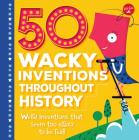
50 Wacky Inventions Throughout History: Weird inventions that seem too crazy to be real! by Joe Rhatigan (Author), Celeste Aires (Illustrator) – (Walter Foster Jr)

With 50 Wacky Inventions Throughout History, history has never been so fun–or wacky

Have you ever heard of a bike TV? Or a bird diaper? 50 Wacky Inventions Throughout History describes 50 inventions that seem too crazy to be true–but are Whether useful, entertaining, or just plain silly, these mind-boggling inventions and gadgets from yesterday, today, and tomorrow will surprise and delight fun-fact lovers of all ages.


Learn about the Creatures you might find in the Ocean:


Sea Creatures by Seymour Simon (HarperCollins)

Dive into the wonderful world under the sea with Sea Creatures, a gorgeous informational picture book from award-winning science writer Seymour Simon!

Ranging from tiny single-celled creatures to the larger-than-life whales, the ocean is filled with life. Some sea animals live in the darkest depths of the ocean, while others live close to sunlight. From camouflage to way of communicating to existing symbiotically, sea creatures are some of the most adaptable animals on Earth.

With clear, simple text and stunning full-color photographs, readers will explore the deep blue sea and meet all types of aquatic friends.


Support Independent Bookstores - Visit IndieBound.org
Absolute Expert Dolphins by Jennifer Swanson (NGKids Books)

Kids who have a laser focus on dolphins will learn everything they’ve ever wanted to know about them in an eye-catching, page-turning book for aspiring experts, featuring exclusive content from a National Geographic explorer currently in the field.Hey, dolphin fin-atics Get ready to dive into the world of your favorite fabulous marine mammals in this action-packed book chock-full of awesome facts, photos, and fun Join National Geographic explorer and dolphin expert Justine Jackson-Ricketts to get the latest, most up-to-date dolphin intel straight from the field, plus fun facts, in-depth info, and awesome trivia about every kind of dolphin under the sun (and beneath the waves). It’s the ultimate book to help YOU become an absolute expert on one of your favorite topics.


Quiz your friend with fun facts about scientists!

Support Independent Bookstores - Visit IndieBound.org
Galaxy Girls: 50 Amazing Stories of Women in Space
by Libby Jackson (Harper Collins)

Filled with beautiful full-color illustrations, a groundbreaking compendium honoring the amazing true stories of fifty inspirational women who helped fuel some of the greatest achievements in space exploration from the nineteenth century to today—including Hidden Figure’s Mary Jackson and Katherine Johnson as well as former NASA Chief Astronaut Peggy Whitson, the record-holding American biochemistry researcher who has spent the most cumulative time in space.


Support Independent Bookstores - Visit IndieBound.org


Up & Down: The Adventures of John Jeffries, First American to Fly
by Don Brown (Charlesbridge Publishing)

The incomparable Don Brown chronicles the ballooning misadventures of John Jeffries, scientist and aviation pioneer.

Swept up by the European ballooning craze of the 1780s, Dr. John Jeffries longed to become the first person to fly across the English Channel. But first he had to outwit a rascally copilot, keep the balloon from bursting, and avoid crashing into the sea. The good doctor’s quick-thinking solutions will surprise young readers–and keep them giggling. Orbis Pictus and Sibert Honor winner Don Brown tells this quirky true story with his usual accuracy and heart.


Discover interesting info on animals all around you!

Support Independent Bookstores - Visit IndieBound.org
The Hyena Scientist by Sy Montgomery (HMH BFYR)

This myth-busting new addition to the critically acclaimed Scientists in the Field series by Sibert medal winning team Sy Montgomery and Nic Bishop is perfect for nonfiction readers looking for more female scientist narratives, or a fresh perspective on an underrepresented animal–Hyenas

Timely and inspiring, The Hyena Scientist sets the record straight about one of history’s most hated and misunderstood mammals, while featuring the groundbreaking, pioneering research of a female scientist in a predominately male field in this offering by Sibert-winning duo Sy Montgomery and Nic Bishop.


Support Independent Bookstores - Visit IndieBound.org


Beastly Brains by Nancy Castaldo (HMH BFYR)

In Beastly Brains, Castaldo delves into the minds of animals and explores animal empathy, communication, tool use, and social societies through interviews and historical anecdotes. Researchers from Charles Darwin to Jane Goodall have spent years analyzing the minds of animals, and today’s science is revolutionizing old theories and uncovering surprising similarities to our own minds. Humans are not alone in our ability to think about ourselves, make plans, help each other, or even participate in deception. You’ll think differently about the animals on this planet—maybe it’s their world and we’re just living in it!


Enjoy some science with your fiction book!


Support Independent Bookstores - Visit IndieBound.org The Miscalculations of Lightning Girl by Stacy McAnulty (Random House BFYR)

A lightning strike gave her a super power…but even a super genius can’t solve the problem of middle school. This smart and funny novel is perfect for fans of The Fourteenth Goldfish, Rain Reign, and Counting by Sevens.

Lucy Callahan was struck by lightning. She doesn’t remember it, but it changed her life forever. The zap gave her genius-level math skills, and ever since, Lucy has been homeschooled. Now, at 12 years old, she’s technically ready for college. She just has to pass 1 more test–middle schoolLucy’s grandma insists: Go to middle school for 1 year. Make 1 friend. Join 1 activity. And read 1 book (that’s not a math textbook ). Lucy’s not sure what a girl who does calculus homework for fun can possibly learn in 7th grade. She has everything she needs at home, where nobody can make fun of her rigid routines or her superpowered brain. The equation of Lucy’s life has already been solved. Unless there’s been a miscalculation?


Support Independent Bookstores - Visit IndieBound.org


Lucy’s Lab: The Colossal Fossil Fiasco by Michelle Houts (Sky Pony Press)


Lucy accidentally overhears her parents talking about the family getting a second pet. But what pet should they get?At school, Lucy’s class is learning about fossils and the plants and animals that left them behind.One afternoon, Lucy finds a special rock, and Miss Flippo gets very excited But when Lucy’s precious fossil goes missing, everyone in Room 2C is a suspect. . . .


Know of a great STEM/STEAM book to recommend? Add it below. Happy Science Reading!


****

This post created by Jennifer Swanson, award-winning author of 35 nonfiction books for kids. When not writing, Jennifer can be found reading about cool science facts. You can find her at www.JenniferSwansonBooks.com


STEM Tuesday – Shining the Light on Technology, Engineering, and Math — Writing Craft & Resources

TEM From An “S” Guy

When I first saw the June STEM Tuesday June topic, Shining the Light on the TEM in STEM, I did a double take. Being a scientist, I felt left out. I threw stuff. I cursed. I ranted to my friendly Aeromonas bacterial cultures in the lab about feeling left out.

Fortunately, my cultures are good listeners and the wise bacteria kindly pointed out the fact that, if looked at from a neutral eye, the “S” in STEM actually does get a lion’s share of the STEM attention. I took this prokaryotic wisdom into consideration, returned the agar plate to the incubator, and went home to contemplate the need to shine a light specifically on the technology, engineering, and mathematics side of STEM.

It turns out that the science component of STEM does appear to hog the limelight and push the TEM to the shadows. The “T”, the “E’, and the “M” often get a bad rap. So I’ve changed my tune. Welcome to June, TEM! Glad to give you guys a moment in the electromagnetic energy waves of the solar spectrum.

But I also want to ask the TEM what we can do better to present and teach technology, engineering, and mathematics so they don’t seem quite so foreign to the majority of us. What can we do to make these things easier for young people to grasp? What can we do to help the young people who gravitate toward the TEM?

TEM Brain Muscle

TEM thinkers are often put into their own lane from the time they are young and kept there safely in that lane as they mature. Instead of expanding their knowledge base and widening their talents, TEM thinkers are often pigeon-holed to their specific skill set. Is this because they look at the world through the somewhat unique lenses of logic, design, and formula? Is there a certain level of trepidation for us to guide others down this TEM path when we ourselves are uncomfortable guiding them in those subjects?

What can we do to draw the non-TEM thinkers into at least an understanding of basic ideas and power of technology, engineering, and math? On the other hand, how can we develop TEM thinkers without slotting them down a narrow, pocket-protector lane in life?

Both TEM-phobics and TEM-philics need to be given problems to solve instead of shown the solutions. Allow them to develop their brain muscles and unique skills through problem-solving rather than simply giving them the names and uses of the tools in the toolbox. They need the space to try. They need the freedom to fail. They need an environment where mistakes are a step in the learning process and not an environment where the learning process is gauged solely by counting the mistakes.

Story

I’ve been preaching for years that the scientific method is not a series of lifeless, formulated steps but is a full technicolor philosophy of problem-solving. It’s scientific storytelling! The scientific method is to problem-solving as plot and story structure is to a writer. It gives us a plan. It gives us a beginning, a middle, and an end.

Instead of looking at TEM as solely a conglomeration of code, circuits, calculations, and formulas, we should look at the code, circuits, calculations, and formulas as tools we use to tell a story.

Unfortunately, we often get caught up and confused by the tools instead of focusing on telling the problem-solving story. The story/solution is more important than the tools. For example, what’s more important when writing a simple program to calculate the slope of a line, the programming logic or the programming language? The language is the tool we can reference or find as needed, but the logic and the design are where the real magic lies.

Is it enough to only know that the Slope = (y2-y1) / (x2-x1) or can we be a better problem solver by understanding that the rise and run of the line numerically define the slope? By defining the slope in measurable terms, we define the characteristics of the line. Once we understand the characteristics of the line, we can use that knowledge to develop a ramp to help Mrs. Hays transport her gigantinormous suitcase of books easily up the school stairs and into her classroom each and every day. Now that’s a story!

Framing the TEM (and the “S”!) in terms of telling the story of the way something works or how a problem is solved can help young thinkers expand their STEM skills without getting tangled up in the sometimes confusing toolbox.

Novel Engineering

Novel engineering is a pretty cool concept I first learned about at the 2017 nErDcampKS. I wandered into this session with no idea what novel engineering was, and as a non-teacher, no idea of its power. The concept is surprisingly simple. The teachers use a text or a story and assign the students a problem to solve from the story. The students then work in groups or as individuals to analyze, design and build a solution to the problem. Makerspace rooms or areas in the schools can be set up to give the students the resources needed.

Linda Sue Park’s A LONG WALK TO WATER was a popular choice for middle school novel engineering projects. The teachers in the session talked about how the kids worked out solutions on how to find, carry and store water more effectively.

Another upper-elementary teacher gave the example of how she used the Rapunzel fairy tale in her classroom as a novel engineering project. The goal for the students was to design an alternative system for Rapunzel (a Barbie doll) to escape the four-foot tower built in the classroom without the aid of any knights in shining armor. This teacher said her students really got into the project and came up with great solutions, including an adventurous escape from the tower on a zip line.

Thinkers & Tinkerers

In the classroom, in the lab, or in the home, let young minds be thinkers and tinkerers. No matter what letter of the STEM acronym these young minds gravitate toward, they need the platform and the space to learn. Provide books and lessons and leadership to promote a maker environment for our STEM learners. Teach them to how to use the tools of code, structures, pathways, classifications, circuits, calculations, and formulas, to help them solve problems, not get trapped or intimidated by them.

The tools don’t solve problems, problem solvers do.

Thinkers and tinkerers rule!

Now back to work. Hopefully, those Aeromonas bacteria will allow me some of my own thinking space to work through the experimental problems I’m currently experiencing.

Have a great TEM month!

Mike Hays, STEMologist, Class I


The O.O.L.F Files

The Out Of Left Field files this month focus on the TEM of STEM. I have to admit, there’s some pretty cool stuff listed below to check out. Readers and teachers, if you have any interesting O.O.L.F. files links you’d like to share, please leave them in a comment below. The STEM Tuesday community appreciates it! We’re all in this together!


STEM Tuesday – Shining the Light on Technology, Engineering, and Math — In the Classroom

Last week, the STEM Tuesday team featured this month’s Book List on the topic Shining the Light on Technology, Engineering, and Math. Click here to go back to that list.  It’s a broad-ranging list, certainly, which mades this week’s post about classroom applications even more fun! I’ve narrowed the focus to three amazing science topics.

CODING:

   Girls Who Code: Learn to Code and Change the World is by Reshma Saujani.  Saujani is not only the author of an amazing book, but she’s also the founder of a worldwide organization by the same name. Girls Who Code offers free summer programs and year-round clubs and is more than 90,000 girls strong! After sharing this book in your classrooms and libraries, visit the Girls Who Code website and find out how to start a club in your school or community.

And, the book? You’ll have see it to believe it. Half how-to, half graphic novel, this is the most clearly written, interactive, and non-intimidating explanation of coding of I’ve ever seen. As an adult reader, I was fascinated. Middle-graders – boys or girls – won’t find a more thorough introduction into coding anywhere.

ARCHITECHTURE:

From the temples of Greece to the Chrysler Building in New York City to the Sydney Opera House, The Story of Buildings is a visual feast paired with fascinating detail and information about dozens of the most famous buildings in the world.

Do a “Before You Go” Project:  Every school is different when it comes to field trips and travel opportunities for middle-graders. Some schools take an annual trip to Washington, DC, where the focus is often American history, but the opportunity for architectural study abounds.  My own children, who all attended a very rural public school, had the fortune to spend a weekend in Chicago as fifth graders, where everyone took the Chicago River Architectural Boat Tour.  Urban students might only need to go out their school’s front doors and look up to find inspiring examples of architecture.  Whether your class field trip takes you miles or minutes from home, consider using this book as a “before you go” learning experience.  The prior knowledge will shine through as your students recognize structural and design elements in every building they see.

ROBOTICS:

When it comes to robotics, classroom applications are seemingly endless! Below is a list of possible activities to explore after reading Jennifer Swanson’s Everything Robotics from National Geographic Kids.

  • Find a workshop, event, or online challenge for teams and individuals by clicking here to go to Robot Events, a web service of The Robotics Education & Competition Foundation, which exists to connect students, mentors, and schools in every community to a variety of successful and engaging technology-based programs.
  • LEGO fun. Click here to go the LEGO Middle School Education page.
  • Enlist NASA’s help! Visit NASA’s Robotics Alliance Project page for 6th – 8th graders for a list of links you’ll love!
  • Robot Scavenger Hunt – Robots are all around us. Start small. See if students can find any robots at work in their school or community. On a larger scale, take a look at robots in manufacturing. This interesting article will help you and your students locate which states rely most heavily on robotics to produce the goods we use every day.
  • Predicting the future:  Brainstorm in small groups what the future of robotics might hold. What are some potential practical uses of robotics that might make life better?
  • Hold a debate.  Are robots the key to a productive future? Or do they threaten jobs once filled by humans? Is there a possibility that robots could become too intelligent?  Here’s a great resource for holding classroom debates. I’d like to be a fly on the wall in a middle-grade classroom for this one!

Can you add to the conversation? In what ways have you been shining a light on Technology, Engineering, and Math? Comment below and share an idea!

Today’s STEM Tuesday post was prepared by Michelle Houts, wanna-be-coder, fan of architect Frank Lloyd Wright, future robot owner, and author of the Lucy’s Lab Chapter Books from Sky Pony Press.