
Posts Tagged middle-grade fiction

Are You There Judy? It’s Me, Melissa

***Exciting update!****

Everyone here at MUF is freaking out over news of the new film adaptation of Are You There God? It’s Me, Margaret, slated for release in theaters on April 28, 2023. See you then, wearing shoes. AND NO SOCKS!

Watch the Are You There God? It’s Me, Margaret trailer here:

Read Melissa’s full feature below on her love of Judy Blume:

**********

Anyone who’s crossed my path knows how I feel about Louise Fitzhugh’s 1964 classic, Harriet the Spy. If not, I’ll tell you this: I’ve read the book at least 300 times, collect vintage editions, and have more Harriet paraphernalia (journals, coasters, framed prints, pins) than most sellers on eBay. And if I were to get a tattoo…?

Yup.

Yes, my love borders on obsession (“I’m your number one fan!”), but I will grudgingly admit that I have room in my heart for other middle-grade books. Or, to be specific, a middle-grade author: The one and only, Judy Blume.

For many readers of MG fiction, particularly those who grew up in the ’70s and ’80s, Judy Blume is an author of iconic proportions. She’s a rock star. A legend. The woman we all want to know. The woman we think we do know, because she knows us. Our darkest secrets, our wildest dreams. Judy just…gets it.

A 2009 collection of essays entitled Everything I Needed to Know About Being a Girl I Learned from Judy Blume corroborates this theory. In the book, twenty authors wax poetic about their childhood literary idol, sharing fond reminiscences and quoting lines from Blume’s books verbatim. Clearly, there’s something about Judy Blume that touches readers profoundly, and it’s easy to see why. Making the awkward leap from childhood to adolescence—along with the physical and emotional changes that accompany puberty—is unspeakably difficult. But again, Judy gets it. Every time.

The first Judy Blume novel I read, Are You There God? It’s Me, Margaret, was purchased at my local bookstore, in midtown Manhattan, with my allowance. My purchase set me back $1.25, which in those days could buy you a pack of gum and a Dynamite magazine. But still, I wanted that book. How could I not? The word ‘period’ was printed on the back cover, in black and white, for all the world to see! Not only that, the novel was about a flat-chested only child whose name began with the letter M. Sold, and sold!

T

The minute I got home, I raced into the living room, curled up in an overstuffed armchair, and began to read. And then I got to page 85: Norman Fishbein’s party. Philip Leroy was blowing mustard through a straw (“Watch this, Freddy!”), when Mrs. Fishbein came downstairs…. And then Laura went back to work.

Wait. What…?

Yes, pages 86-116 were missing. My carefully chosen book with the word ‘period’ on the back cover was defective! But what was I supposed to do? I needed to finish that book!

Naturally I begged my mom to let me go back to the bookstore, and naturally she said yes. (This was the late 1970s, remember, when kids were as free range as organic-farm chickens.) I returned with a perfectly intact copy, resumed my position in the overstuffed armchair, and finished the book. (Spoiler alert: Margaret gets her period.)

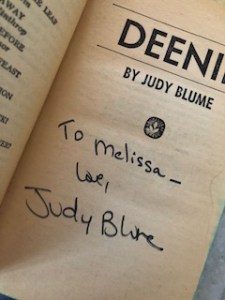
After Margaret, more Judy Blume titles followed: Deenie, which deals with scoliosis, first crushes, and a frank discussion of masturbation (which, most likely, would never make it onto the page today); Then Again, Maybe I Won’t, about 12-year-old Tony Miglione who has wet dreams and out-of-the-blue erections (ditto); It’s Not the End of the World; which centers on divorce; Iggie’s House, which addresses the ugliness of racism; and Blubber, which tackles bullying. I read Blume’s other titles—Starring Sally J. Freedman as Herself; the Fudge books—but they didn’t grab me the way Margaret and the others did.

And then I read Forever.

Whoa! This is a young-adult title, so for the purpose of this post, I won’t dwell. Let’s just say this: After reading the book, I knew I could never name my kid Ralph.

Over the years, I read hundreds (thousands?) of middle-grade books, but I always returned to Judy Blume. I returned to her again while I was writing my debut MG novel, Kat Greene Comes Clean. Not to steal Judy’s ideas (heaven forefend!), but to learn from the master. No one writes dialogue like Judy Blume or gets into a character’s head the way she does, with pitch-perfect authenticity. And she makes it look so effortless! How does she do that? I longed to ask her.

And then I got my chance… at the ophthalmologist’s office.

I was sitting in the waiting room with a dog-eared copy of Time, when who should walk in but the Queen of MG herself! As Margaret would have said, I almost died. My first instinct was to grab Judy (or should I say, Ms. Blume?) in a bone-crushing hug, but that would have bordered on Annie Wilkes territory. No, I needed to exercise restraint. So I watched her every move from behind my magazine. First, she checked in with the receptionist. Then she sat down. Then she rifled through her purse, searching for her phone or maybe some Tic-Tacs. But why would Judy Blume need a Tic-Tac? Chances are, she brushed—and flossed—with great care before her appointment. Maybe she just needed a tissue.

Stop, Melissa, I told myself. You are being exceptionally creepy. Why not go over and introduce yourself? Tell Ms. Blume how profoundly her books have influenced you, as a reader and a writer? Or simply say, “I love your work.” That’s what you’re supposed to say to famous actors, right?

But I couldn’t do it. Invading Judy Blume’s privacy was not something I was willing to do, no matter how much I loved her. Even literary icons need to get their eyeballs dilated in peace. So I left her alone, even though it killed me.

Maybe I should have said something—or given her a Kat Greene bookmark (now, that’s not creepy!). But disturbing my childhood literary idol in the ophthalmologist’s office? Not happening.

 That’s not to say I’ll never see Ms. Blume again. Chances are, I will, especially if my eye allergies are acting up, or if I have conjunctivitis or a stye. And when that day comes? I’ll smile and thank her for everything she’s done for the kidlit community: as a writer, as a bookseller, as a crusader against censorship, and as someone who just… gets it.

Then again… Maybe I won’t. 🙂
MELISSA ROSKE is a writer of contemporary middle-grade fiction. Before spending her days with imaginary people, Melissa interviewed real ones, as a journalist in Europe. In London, she landed a job as an advice columnist for Just Seventeen magazine, where she answered hundreds of letters from readers each week. Upon returning to her native New York, Melissa contributed to several books and magazines, selected jokes for Reader’s Digest, and got certified as a life coach. She lives in Manhattan with her husband, daughter, and the occasional dust bunny. Kat Greene Comes Clean (Charlesbridge, 2017) is her debut novel. Visit Melissa’s website, and find her on Facebook, Twitter, and Instagram.

Interview with Merrill Wyatt and giveaway of her latest mystery, Tangled Up in Nonsense

Merrill Wyatt is the author of Ernestine, Catastrophe Queen, and Tangled Up in Luck. Her newest, Tangled Up in Nonsense, (Margaret K. McElderry Books, release date November 29) has young detectives Sloane and Amelia trying to crack a case that happened over a hundred years ago. Set in a creepy mansion during a peony competition, Sloane and Amelia work together to piece together the clues to attempt to find out who kidnapped a dog and where millions of dollars are stashed. The Kirkus review raves, “A warmhearted, very funny, madcap caper.”

Merrill Wyatt

Welcome to From the Mixed-Up Files of Middle-Grade Authors, Merrill!

It is such a pleasure to interview an author who lives in my backyard. (Well, not quite, but you live here in my city of Toledo.) Speaking of backyard, Tangled Up in Nonsense is your second novel that features Northwest Ohio in the plot. What made you choose our beautiful area as the backdrop for your mystery?

There’s so much history and mystery in this area! Not only was Toledo a major stop on the
Underground Railroad, it was a hotbed of crime in the 1920s and 1930s. As in major robberies,
hidden gambling dens, gangster shootouts from speeding automobiles, and bootlegging – so much
bootlegging. If you were into crime in the 1920s, Toledo was the place to be. Which is why Sloane
and Amelia are searching for Bootleggin’ Ma Yaklin’s Missing Millions.

Young sleuths Sloane and Amelia run into all kinds of nonsense as they try and solve several mysteries nearly a hundred years ago; who kidnapped a bootlegger’s dog and where is the two million dollars that disappeared around the same time. What, or who inspired you to create this plot?

I’m a big animal lover, so animals frequently pop up as minor characters in my books. The bootlegging piece is straight out of Toledo’s history. If you talk to anyone who was alive during the 1920s or 1930s, they all have stories to tell you about gangsters and bootleggers. There’s a restaurant just down the street from where I live – I could walk to it – and one time, my dad casually said, “That was a big gangster hangout back when I was a baby. Licavoli and his guys went there all the time.” Licavoli was a major Toledo gangster with ties to other gangs all over the country.

Sloane and Amelia are rather fearless. What scares you?

Everything! Dolls creep me out – yet I love dollhouse miniatures. I can’t explain that. There’s a scene in Tangled Up in Nonsense in which Sloane and Amelia go upstairs to check out an attic in the middle of the night. As originally written, it swung between creepy and hilarious as Amelia convinced Sloane that there was probably an army of haunted dolls on the other side of the attic door. I had to cut a lot of that out because – even though it was funny and creepy – it slowed down the plot too much. There’s still a little bit of it in there, though. I couldn’t bring myself to cut out everything. I mean, if I was in the attic of a one-hundred-year-old mansion, I would definitely be worried about haunted dolls. We once had raccoons break into the attic of our very-normal house, and all the thudding and bumping woke us up in the middle of the night. But neither my husband nor I had the courage to go upstairs and check it out until it was daytime.

The mystery resolves around a time that many young people may not be that aware of…Prohibition of alcohol and bootlegging as a result. What drew you to this time frame? Are there history lesson tie-ins with the topic?

My grandmother could remember that time period very clearly, and even my parents have memories of what Toledo was like not long afterward. It really was the city’s big, shining moment. A lot of the city’s beautiful, older neighborhoods like Old Orchard, Ottawa Hills, West Moreland, and a lot of the developments along River Road date to around that time. Plus, the downtown area was gorgeous during that time. If you google “Toledo 1930s”, you’ll be able to see all these stunning buildings that are no longer with us.

If you’re looking for history lessons, a lot of the federal policing structures took shape around this time. Without Prohibition and the bootlegging that resulted, you wouldn’t have the FBI. That came directly as a result of all the crime Prohibition caused. And speaking of the FBI, one of its early directors once referred to Toledo as the most corrupt city in the country! Apparently, the mayor and the police knew they had all these gangsters living here, but they didn’t care because it brought business to the city! Also, this is when the police first got police cars. They didn’t really have them before the 1930s. But the gangsters did, and so the police would be trying to chase after them on horseback as the bootleggers drove off in cars. It didn’t work well.

 The shenanigans of the various characters reminded me of some of the Three Stooges’ antics, which my kids loved when they were younger. What slapstick comedians did you have in mind when creating the characters?

You know, I loved The Three Stooges when I was a kid too! There’s just something timelessly funny about physical comedy. I was definitely thinking of them as I was writing this. And to be honest was definitely inspired by a lot of the slapstick comedy you see on Disney and Nickelodeon shows, too. I watched so many of those with my daughter, and you can tell they are inspired by the Stooges, too. I would also add Charlie Chaplin and Buster Keaton. You can find their movies on YouTube, and they still hold up well even a hundred years later. Slapstick comedy is timeless.

I know you work full-time, are married, and have a teenage daughter. How do you balance it all? What does your writing process look like? Are you a plotser or pantser…do you plot out your storyline, or fly by the seat of your pants in writing your novels?

I start with a general plot and try to map out as much as I can. As you mentioned, I’m super busy every second of every day. I have to snatch the writing time whenever I can get it. Having a well-mapped-out plot helps with that. That being said, sometimes I’m really detailed in that process and sometimes my notes include things like, “and then something happens. Figure it out later.” Other times, once I start writing, I find that the story very naturally progresses in a different path than I thought it would. If that seems to be working, I try to follow it as much as I can while still bringing it back to my main goal. Typically, when I start writing, I have a clear beginning and a clear end. I sometimes refer to the middle as the “soggy middle” or the “squishy middle” because it’s the part that changes the most. 

I know that writing fiction requires research, and I imagine you studied the Stranahan home which served as the inspiration for the mansion where the peony competition takes place, as well as Prohibition. Could you share your research techniques with readers?

You can do a lot of research online. I usually start with just general searches, reading blogs and looking at a lot of pictures. Images definitely inspire me. After that, I start to get more detailed. I’ll only focus on online library archives and historical societies because they are more factual and trustworthy. The Lucas County Library has a terrific collection of online photographs that include details about them. Next, I’ll go to the library itself and start pulling books. The Main Library in downtown is absolutely fabulous, with incredibly knowledgeable librarians. I also went to the Stranahan Mansion at Wildwood, which is open to the public year around, though the best time to go is at Christmas when it’s decorated for the holidays. If I could, I’d be like Amelia and dress up as Nancy Drew. In fact, when I was writing Tangled Up in Nonsense, I checked out “Nancy Drew clothes” on Pinterest – and that led me down a wormhole that it took hours to get out of. I almost ended up with an adorable cloche hat and houndstooth cape. But they were sold out, sigh.

Is there a third mystery in the works?

There is! It’s called TANGLED UP IN MAYHEM, and it takes place at Cedar Point. Sloane and Amelia are hired to investigate a lost time capsule. They’re thrilled that someone actually wants to pay them for their detective work – until both their nemesis Mackenzie and a ghost show up to stop them.

Thank you for your time, Merrill!

Merrill has agreed to give away a complimentary copy of Tangled Up in Nonsense to a random winner. To enter, click here.


Ukraine for Middle-Grade Readers

Before Putin’s Russia invaded Ukraine on February 24, 2022, many people elsewhere knew only a little about the country. Recent nonfiction and fiction books on Ukraine for Middle-Grade readers can help them understand what Ukrainians are fighting so fiercely to defend.

Most of these books appeared in 2022, and many of their publishers will contribute sales profits to Ukrainian relief.

NONFICTION:

Ukraine is known for  the beautiful golden-domed architecture of its cities and the richness of its culture and language. It is also called “The Breadbasket of Europe” because other countries in Europe and the world depend on its abundant harvests of grain for food.

Blue Skies and Golden Fields: Celebrating Ukraine, by Ukrainian children’s author Oksana Lushchevska (Capstone Press, 2022), covers Ukraine’s  history of withstanding invasion and domination by other countries, including Russia.  Lusgchevska also aims to immerse young readers in the Ukrainian culture. There is one whole section on sunflowers, the national flower and symbol of Ukraine. She includes instructions on how to plant your own sunflower and a Ukrainian poem to recite while you water it! Ukrainian Easter eggs are world-famous, and she tells how to dye eggs with natural dyes. She’s even included a guide to learning the Ukrainian alphabet and some key phases. Bright photographs illustrate Blue Skies and Golden Fields.

More list-like  is The Great Book of Ukraine: Interesting Stories, Ukranian History & Random Facts About Ukraine, by Anatolly Drahan (Independently published, 2022). Learn here not only about Ukraine’s past, but about pop culture, folklore, food, music, religion, celebrities & symbols, and why Ukranians celebrate two different New Years.

Ukrainian is  one of the most lyrical languages in the world. Enjoy learning some of it from Ukrainian Picture Dictionary Coloring Book: Over 1500 Ukrainian Words and Phrases for Creative and Visual Learners of All Ages (Lingo Mastery 2022).

FICTION:

These four Middle-grade novels take place in other times of great conflict and invasion in Ukraine’s past. The situations the young characters must face are grim and terrifying. But these are stories of resilience, courage, and hope, the qualities most needed in war-torn Ukraine today.

The Memory Keeper of Kyiv, by Erin Litteken (Boldwood Books, 2022), takes place in the 1930s, a time known as The Holodor, The Great Starvation. Russia’s Soviet ruler, Joseph Stalin, occupied Ukraine and tried to erase its culture. The Soviets claimed all grain produced in that fertile country and starved  4 million Ukrainians to death. In The Memory Keeper of Kyiv, 16-year old Katy at first sees village neighbors disappear for resisting the Soviets. Soon she herself is engaged in the struggle for survival. Author Litteken is the granddaughter a Ukrainian refugee from World War II.

Winterkill, by Canadian/Ukrainian author Marsha Forchuck Skrypuch (Scholastic, 2022), also  takes place in the time of the Great Starvation. In this gripping story, young Nyl is struggling to stay alive. Alice, whose father has come from Canada to work for the Soviets, sees that what is happening to the people is terribly wrong. Nyl and Alice come up with a daring plan. Will they survive long enough to carry it out?

In April of 1986, the nuclear reactor in Chernobyl, not far from Kyiv, melted down, poisoning the environment. In Helen Bates’ graphic novel, The Lost Child of Chernobyl (Otter Barry Books, 2021) two stubborn old ladies refuse to evacuate. Nine years later, forest wolves bring a ragged child to their door. The child has been living with the wolves in the forbidden toxic zone. Will the two be able to find his family after all this time?

In the suspenseful novel, The War Below, by Marsha Forchuk Skrypuch (Scholastic, 2020),  a Ukrainian boy smuggles himself out of a Nazi forced labor camp during World War II. He has to leave behind his dear friend Lida, but vows to find her again someday. IF he survives. Racing through the countryside, he struggles to evade both the Nazis and Soviet agents and finds himself in the line of fire.

MORE BOOKS ON UKRAINE FOR MIDDLE-GREAD READERS ARE COMING SOON: A NOVEL AND A WORDLESS BEAUTY

Maya and Her Friends: A Story About Tolerance and Acceptance To Support the Children of Ukraine (Studio Press, 2023) takes place in 2017. In that year, Russia conquered Crimea and annexed it from Ukraine. They also temporarily occupied parts of Donetsk and Luhansk. This is the story of families with children in Crimea, all with different family backgrounds. It shows how living under occupation and the shadow of war has impacted their lives. Ukrainian author Larysa Debysenk wrote this novel in Kyiv, with the roar of Russian gunfire in the background. She says, “I want to shout that the children of my country need international protection. The world needs to understand this.”

Yellow Butterfly: A story from Ukraine  will come out from Red Comet Press in January, 2023. Without words, and using the yellow and blue symbolic colors of Ukraine, children’s book illustrator Oleksandr Shatokhin shows a young girl’s view of the military conflict: her fear, her anger and frustration, and finally her hope.

Let’s hope, too, that by the time these last two books appear, the fighting in Ukraine may be over and rebuilding can begin!  Slava Ukrajini!