
Sydney Taylor Book Award Blog Tour — Interview with Honor Book Award-winner Author Sofiya Pasternack

The Mixed Up Files Blog is proud to be a host for the Sydney Taylor Book Award.
The Sydney Taylor Book Award is presented annually to outstanding books for children and teens that authentically portray the Jewish experience. Presented by the Association of Jewish Libraries since 1968, the award encourages the publication and widespread use of quality Judaic literature. Gold medals are presented in three categories: Picture Books, Middle Grade, and Young Adult. Honor Books are awarded silver medals, and Notable Books are named in each category. To learn more about this prestigious award and to see a list of all of the winners, please visit this website: https://jewishlibraries.org
Today we are thrilled to introduce Sofiya Pasternack, author of the Black Bird, Blue Road (published by Versify,
an imprint of HarperCollins Publishers
a Sydney Taylor Honor Book in theMidd le Grade Category. CONGRATULATIONS Sofiya!

In this historical fantasy novel, praised as a “rich, omen-filled journey that powerfully shows love and its limits*” and “propulsive, wise, and heartbreaking,”** Ziva will do anything to save her twin brother Pesah from his illness—even facing the Angel of Death himself. From Sydney Taylor Honor winner and National Jewish Book Award finalist Sofiya Pasternack.
Pesah has lived with leprosy for years, and the twins have spent most of that time working on a cure. Then Pesah has a vision: The Angel of Death will come for him on Rosh Hashanah, just one month away.
So Ziva takes her brother and runs away to find doctors who can cure him. But when they meet and accidentally free a half-demon boy, he suggests paying his debt by leading them to the fabled city of Luz, where no one ever dies—the one place Pesah will be safe.
They just need to run faster than The Angel of Death can fly…
Review
Pasternack shows how Ziva’s love of justice drives her, while depicting a world in which spirits are manifest, healers come in many forms, and a bold girl can literally bargain with the Angel of Death. Tenderly rendering Ziva’s feelings of responsibility—including around Pesah’s physical care and amputating his infected fingers and toes—Pasternack imagines a rich, omen-filled journey that powerfully shows love and its limits. — Publishers Weekly (starred review)
Pasternack’s story is rich in the rhythms, values, and deep magic of Jewish culture and life in the Turkic Jewish empire of Khazaria. It revels in an often overlooked mythology, deploying exciting fantasy elements with ease. More than simply an adventure, this is a story about grief and illness and arguing with the rules of the world, enduring and enjoying the living that happens between now and the end, threaded through with the profound, unshakeable love of two brave siblings. Propulsive, wise, and heartbreaking. — Kirkus Reviews (starred review)
Pasternak’s historical fantasy weaves Jewish mythology and traditions into this heroine’s journey that asks readers to contemplate issues of life and death. Readers will be intrigued by the ravens that follow Pesah everywhere, the details of the city of Luz (where no one dies), and Pesah’s vision that the Angel of Death will visit him on Rosh Hashanah. This works as an adventure, but it should also prompt discussions about the ethics of preserving life at all costs. — Kay Weisman — Booklist (starred review)
Set in Khazaria, a medieval empire of the Eurasian steppes, this moving tale steeped in Jewish lore is a welcome addition to middle grade fantasy shelves. Ziva is a fierce, appealing heroine, driven by her deep love for her brother, a profound sense of justice, and an unwillingness to accept the status quo—qualities that serve her well but sometimes keep her from seeing those around her clearly. An omniscient narrator addresses the reader in interludes that lend the text a mythic feel, while the main narrative is a rousing adventure and coming of age story inflected by Ziva’s internal struggles. — Bulletin of the Center for Children’s Books (starred review)
Pasternack (Anya and the Dragon) writes with a storyteller’s cadence without sacrificing liveliness, keeping emotions front and center (“She’d jab the Angel of Death in every single one of its eyeballs if that meant keeping Pesah safe”). – SHOSHANA FLAX www.hbook.com — Horn Book Magazine
Thanks so much for joining us today at the Mixed-Up Files, Sofiya!
Booklist said of your book, “Pasternack’s historical fantasy weaves Jewish mythology and traditions into this heroine’s journey that asks readers to contemplate issues of life and death.” You weave these topics so skillfully together. Can you tell us more about why you chose to write about these topics?
Well, I write historical fantasy because it’s fun! History is full of amazing stories all over the place, and as a lifelong fantasy enthusiast, including some magic makes really fascinating history just a little more amazing. I write Jewish mythology because it’s not terribly common and I want to see more of it; sometimes, I’ll see a Jewish story that’s had all the Jewishness taken out of it (Corpse Bride is one that comes to mind!), and I aim to put the Jewishness back in. As for why I wanted to write about life and death, it was a way of processing not only the cycle of life and death that I saw at the hospital every day (as an ICU nurse), but also my own dad’s death. Death is a difficult topic, and I think the more stories we have about the topic, the better able we’ll be to face it when it shows up in our lives.
You often set your books in these wonderful, vivid and mythical settings. Why?
I like settings that are mostly like the regular world, but if you pay attention, they’re not. I’ve been to incredible places that are totally real (I’m pretty sure, anyway), but are also so magical that if an elf or a sheyd or a wizard showed up, you wouldn’t really be that surprised. Recreating these in fiction is a great challenge: can I approximate the feeling of the fog racing me down the street on the Pacific Coast? Or watching the sun rise over the High Atlas Mountains? Or squeezing through the Roman aquifers under Naples? I sure hope so.
This book depicts a strong and supportive relationship between siblings. It seems as if family plays a big part in all of your books. Is there a significance to that?
Generally, I write a family I wish I’d had. Ziva’s family is a little bit different, because a large part of her growth was that she needed to challenge her preconceived snap judgements about people—including her own family. She made some assumptions about her family members, and then was forced to reconsider them. She also needed to consider that people are rarely all bad or all good. I hope to explore all kinds of families in my stories, from Anya’s supportive and close-knit family, to Ziva’s family fractured by terminal illness, to someone’s future family that looks like something entirely different.
Your books all have a wonderful world-building aspect to them. What drew you to this world in particular?
The Byzantine Empire was something I didn’t pay much attention to when I learned about it in middle school, but as I grew up and started to appreciate history a little bit more, that time period and place got more and more interesting. The Byzantines are well covered though, so I kind of directed my attention elsewhere for inspiration. The Empire of Khazaria is fascinating because it was and remains mysterious, and is fabled to have been an empire of (some? mostly? all?) Jewish converts. An ancient empire of once-nomads on the wide steppe around the Caspian Sea? The world erupts to life all around me!
Do you have any tips for aspiring writers (of all ages)?
It seems cliché, and I’m sure you’ve all heard it before: keep writing. Keep creating. Keep imagining. Sometimes it feels like you’re screaming (writing?) into the void, but every line written makes the next one better, and if you want to read a certain story, it’s basically guaranteed that a whole ton of other people want to read it too. Don’t give up!
What are you working on next?
I have a whole bunch of projects lined up! One is about Maria Hebraea, the first alchemist. Another is set during the year 536 CE, which was called “the worst year” by historians because a huge volcanic eruption blocked out the sun for a year and a half! There are a couple more, but for sure there will be more history, more fantasy, and more Jewish magic from me!




 A vignette can refer to a short, standalone piece of writing; it can also mean a standalone performance, like one of a series of monologues or scenes in a nonlinear play. But vignettes appear all the time in narrative storytelling as well; look for them as brief sketches or descriptions that don’t contribute to the plot directly but work to more fully convey characterization, setting, or mood.
 occurs. Think of a vignette as a time-standing-still moment in which you get to take a good look around. Sometimes the author stops time to build suspense or prolong and heighten emotion, like in this moment early in Sharon M. Draper’s Stella by Starlight:
 Allusions are brief references to something that exists outside the scene, typically calling to mind some recognizable name or element from mythology, history, religion, culture, or another story. They are layered with meaning and rely on the reader “getting” the content based on their general familiarity with the topic. They are a quick and punchy shot-in-the-arm of interest for the reader who recognizes them, too, making them perfect for MG—middle graders enjoy coming across an unexpected mention of some bit of knowledge they already know. And you can communicate a complex idea with just a mention of an allusion—sometimes more easily than in explanation.
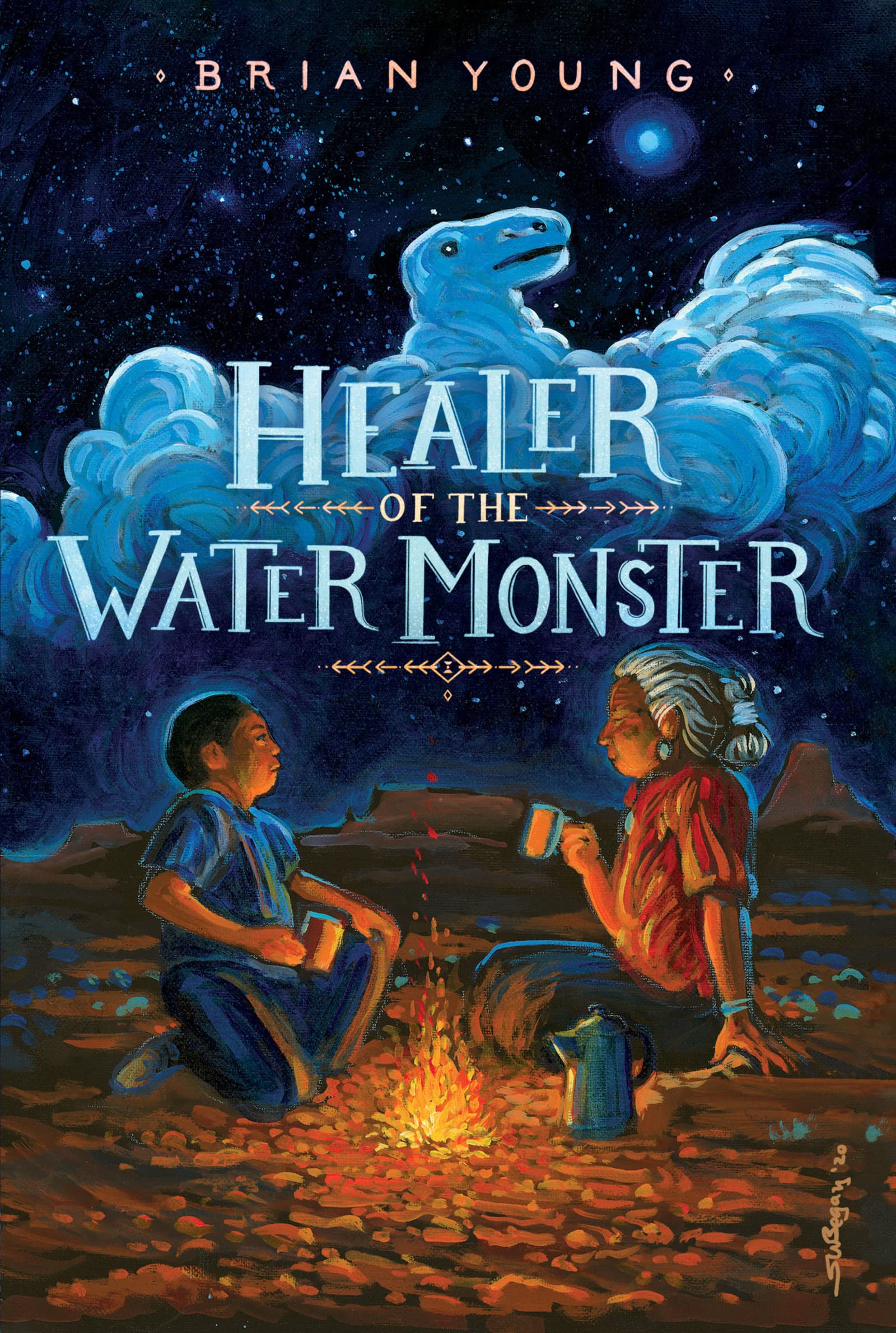 In a more recent example, Brian Young uses juxtaposition to set the stage in his Healer of the Water Monster, starting with the Navajo legend revealed in the Prologue (the gentle Water Monsters who keep the waters “tranquil” and “nourishing” become violent and destructive when Coyote kidnaps one of their infants) and continuing with protagonist Nathan’s big change in summer plans from bonding time with his father on a trip to Las Vegas to—instead—a long stay with his grandmother Nali in her mobile home in the desert. Even the chapter headings show juxtaposition of language with the number first in Navajo, then in English.