Posts Tagged librarians

How I Became a Ghost by Tim Tingle

Well done, Mr. Tingle.

Imagine a class full of anxious 5th graders sitting on the rug at your feet begging for the next chapter in our read aloud, How I Became a Ghost by Choctaw native and story teller Tim Tingle.

As a teacher, I incorporate every moment into a teaching moment, and storytelling is no different. This is my third year reading this book aloud and a common comment after each session is how much my students love this story.

A couple of years ago, I sent two students on an errand, and they later burst through the classroom doors out of breath. They said they had run as fast as they could across the campus to get back before I started reading. I realized then, that I shouldn’t send kids on errands or make kids do catch-up work when we were visiting the land of the Choctaw on the Trail of Tears.

How I Became a Ghost is not only entertaining, it is also brutally honest. It is a tale of the Trail of Tears, when  Native Americans were forced to leave their homes in Mississippi and relocate to land now called Arkansas and Oklahoma.

The story is told through the eyes of Issac, a ten-year old Choctaw. In the very beginning, Isaac announces to his readers (or listeners in this case) that he is going to be a ghost soon. And because of his condition, premonitions of grisly events begin to plague him.

This is where the brutally honest part comes in. There are many disturbing scenes that are so well-told, that the kids shriek in shock. But they get it. And they are anxious for you to keep reading. For example, during one of Isaac’s premonitions, he sees an old Choctaw couple burning in flames. Soon after, the same couple die when soldiers sneak into the neighborhood at night to set everyone’s homes on fire. And then there is the premonition of pus-filled sores covering some of the tribe’s bodies. You guessed it. Soldiers ride into camp and offer the shivering population blankets exposed to Smallpox.

Choctaws were removed west of the Mississippi started in 1831. Louisiana Indians Walking Along a Bayou by Alfred Boisseau was painted in 1846.

Smallpox became a huge topic in the classroom and I had to teach a mini-lesson on communicable diseases (which ties into our Health curriculum) and the use of diseased blankets.  The bigger story, which we discussed several times, was the relationship between native tribes, societal beliefs, and the government in the 1830s.

Because Tim Tingle is a master storyteller, tie-ins to Native American culture are seamlessly woven into the story. We learn how the spiritual world is part of the family unit and how those who have passed on look after and protect those still walking the earth.  When Isaac becomes a ghost, his story does not stop there. As a ghost he is able to assist the living as they continue their fight to stay alive while walking the trail.

As with most great books, and one that has won many awards, the literary elements are rich. Besides profound sayings worthy of insightful discussion, we examined how imagery comes from the imagination. The scene goes from text on paper to an image inside our heads. In the following scene, Isaac’s feet are frozen in a puddle, and when he pulls his feet up the skin tears off. The kids cringe when this happens, but they understand how bitter cold can affect the body and the desperate conditions of the Choctaw. It is interesting to see imagery taking shape through the imagination of a fifth grader.

Some conversations: What is the author saying? Why does the author make a point of one hundred footprints turning into a thousand? Why were the footprints bloody and not regular footprints?

Isaac looking back and seeing a bloody trail of footprints.

Isaac covered with a blue blanket leaning against a tree with his feet frozen in ice.

One of the reasons I originally chose to read a book on Native American history is because it helps students to build a broader concept of how the U.S. was formed. Books can be powerful tools and it is a tool that sits at the top of my teacher toolbox.


STEM Tuesday — Pair Up! Comparing Nonfiction Titles — Writing Craft and Resources

Going Deep

Today we are diving deep into two books that intrigue me. Books about a horrific medical epidemic. Books that both use narrative and expository plus characters to carry readers through the story. Books that plunge into history and science plus ethical and moral questions.

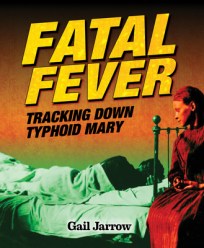
Fatal Fever: Tracking Down Typhoid Mary, by Gail Jarrow

Terrible Typhoid Mary: A True Story of the Deadliest Cook in America, by Susan Campbell Bartoletti

Support Independent Bookstores - Visit IndieBound.org

Here’s a quick recap. In the early 1900s Mary Mallon carried typhoid but didn’t display any of the symptoms. She worked as a cook, was definitively linked to the infections of 49 people plus three deaths, was quarantined for decades, and became the brunt of a tabloid scandal. Both books look at the entangled story of her life, medical professionals who tracked her down, legal charges against her, and implications for constitutional rights.


Support Independent Bookstores - Visit IndieBound.org

In two books on the same topic, published in the same year, written with similar audiences in mind, there is much to compare and contrast. What I find most intriguing is that both bring the science and history to light while posing enduring questions.

Dive In

Let’s look at how these books each handle one of those enduring questions. Get ready for some close reading!

After years of quarantine, Mary was finally released on parole. The terms of her release specified that she take precautions to not infect others, not work as a cook, and report regularly to the health department. But Mary broke those terms, resulting in another major outbreak and her own exile until death. The question these authors chase: Why did she risk it?

Turn to pages 133-135 of Terrible Typhoid Mary and Page 118-120 of Fatal Fever to read the texts. Here are some things to look for. I’ve included a few things I noticed and am eager to hear what you discover.

Whose story is told first?

  • Fatal Fever:
    • “Mary had no lawyer to help her.”
  • Terrible Typhoid Mary
    • “Mary never said why she broke the conditions . . .”

What words are chosen to set the tone?

  • Fatal Fever:
    • “A Witch!”
  • Terrible Typhoid Mary
    • “. . . she struggled . . .”

In what way are other characters’ reactions used? Do those reactions support or denigrate Mary’s choice?

  • Fatal Fever:
    • “The sympathy that people once felt toward Mallon evaporated.”
  • Terrible Typhoid Mary
    • “Her temerity galled Soper.”

What words or phrases convey doubt or leave interpretation open?

  • Fatal Fever:
    • “Maybe she didn’t see the harm in it, . . .”
  • Terrible Typhoid Mary
    • “Is it possible that Mary simply didn’t understand . . .”

Are you caught up in this conundrum? Of how Mary, who had been presented as a person who stepped in to care for children when needed, could do such a thing? I am.

Where do these passages leave you emotionally? Did the balance between narrative and expository impact your reaction? Does either passage affect you more? Why?

On Your Own

Now, pursue a similar close reading on your own. There are plenty of other parallel topics in these books. Try the discussion of gall bladder removal: Fatal Fever (page 93) and Terrible Typhoid Mary (pages 136-137).

How do these authors use sequencing, language, and other characters? How do their skillful use of nonfiction devices impact you as a reader?

—-

By Heather L. Montgomery

Heather L. Montgomery writes for kids who are WILD about animals. Her latest book, Bugs Don’t Hug: Six-Legged Parents and Their Kids, is a perfect picturebook for a close read.

www.HeatherLMontgomery.com


The O.O.L.F. Files

Resources for Writers

https://www.rhymezone.com/

This site might have been designed with rhyming in mind but it has many other uses. Need a thesaurus? Angling for alliterative words? Looking for lyrics? Rhymezone’s got you covered.

https://www.google.com/alerts

Needing to go deep on a topic? Set up a Google alert on your topic. Day after day it will deliver the freshest posts straight to your inbox.

http://www.bluebulbprojects.com/MeasureOfThings/default.php

When you need a measurement comparison, The Measure of Things is your best friend! How large is 110 cubic inches?

  • 9/10th the size of a human stomach
  • 1/3rd the size of a bowling ball
  • 1 1/10th the size of an ostrich egg!

The first annual STEM Tuesday CoSTEM contest!

STEM TUESDAY from the mixed up files


Greetings STEM Tuesday fans!! I know you’re all thinking…  this isn’t a Tuesday. You’re right.

We were SO EXCITED about our

ONE YEAR ANNIVERSARY CONTEST,

that we had to take over a  Thursday post to announce it.


Q. What do you get when you cross a costume contest with STEM Tuesday?

A. The First Annual October CoSTEM contest!


Muwahahaha (Cue eerie, ghostly music)


As a way to celebrate one whole year of STEM Tuesday blogs, we thought we would do a mash-up of literacy and STEM costumes. So drag out your favorite books, take a good look at the theme, then create an amazing, one-of-a-kind, spectacular costume.

Contest Rules: 

  • This contest is open to all school-aged students, ages 5 and up. 
  • Submit a jpeg of yourself or  your class dressed as your favorite STEM book.
  • Be sure to let us know the title and the author of the book. 
  • The book must be for readers ages 8 and up. 
  • All submissions are due by midnight EST November 6th, 2018. (no exceptions!) 
  • Submissions MUST come from an adult who will grants us permission to post this image on the Mixed Up Files website. 
  • All images will be judged by the STEM Tuesday team. We will be looking for creativity, subject (how close you are to the theme of the book), and authentic (how exact is the STEM theme displayed)
  • Winners will be posted on the STEM Tuesday blog on November 8th, 2018. 
  • Send your images to the following email:  stemmuf@gmail.com


Need suggestions for how do create a CoSTEM? Take a look at some of our examples below:


2 girls dressed in plastic                                    Book that inspired this


1 girl dressed as a black hole                   Book that inspired this


Are you starting to see a pattern?  Good!

I suppose you want to know about the prizes. Well, here they are:

1st Place —  Receives 5 autographed STEM Books from our STEM Tuesday team + $25 Barnes & Noble Gift card

2nd Place — Receives 3 autographed STEM Books from our STEM Tuesday team + $15 Barnes & Noble Gift card

3rd Place—   Receives 2 autographed STEM Books from our STEM Tuesday team  +$10 Barnes & Noble Gift card


Here are just a few of the books you could win:


Have questions? Direct them to the same email as above:  stemmuf@gmail.com

We hope you will ALL participate!  Let’s celebrate a STEM- Literacy MASH-UP, CoSTEM style!!