Posts Tagged homeschool

STEM Tuesday– Deserts –Writing Tips & Resources

Hello from my desert home, Utah, and welcome to STEM Tuesday. I’m Stephanie. I took this photo several years ago at Snow Canyon State Park in Saint George and it really encapsulates what I love about life sciences. Nature gives us these unexpected—but beautiful—moments. This is the desert!

A tree growing in a crevice at Snow Canyon in Saint George, Utah. Photo credit: Stephanie Jackson

A tree growing in a crevice at Snow Canyon in Saint George, Utah. Photo credit: Stephanie Jackson

Before I get into writing tips and resources, I wanted to highlight some recent and forthcoming nonfiction desert books:

  1. First up, Weird, Wild, Amazing! Desert by Tim Flannery, published in 2022. Written by an Australian scientist in his unique blend of strange factoids and clear explanations, this book is a must-read for desert explorers ages 7-10.
  2. Second, for children 8-10, Deserts in Danger (A True Book: The Earth at Risk) by Cody Crane, publishing September 3, 2024 with Children’s Press / Scholastic Trade Publishing. This title highlights the impacts of climate change.
  3. Next, you may enjoy A Day in the Life of the Desert by Roxie Munro, publishing on September 17, 2024 with Holiday House. Although it’s being marketed as a picture book, it’s nonfiction, and the text is accordingly verbose. It’s packed full of desert facts, and as the subtitle says, “6 Desert Habitats, 108 Species, and How to Save Them.”
  4. Fourth is Desert Tree Finder (2nd Edition) by botanist May Theilgaard Watts, publishing on October 8, 2024 with AdventureKEEN. As field guides go, this is as practical and as beginner-friendly as they come, covering the American southwest.
  5. And lastly, a visual smorgasboard in the form of this 320-page coffee table book, Deserts: The world’s most fascinating places by photographer Philippe Bourseiller, publishing on November 26, 2024 with teNeues. Truly exquisite images.

Writing Tips and Resources

Okay, so writing and deserts. Immediately I think of ecopoetry which, simply defined, is poetry about nature. (If you’re interested in exploring the genre further, check out The Ecopoetry Anthology.)

For beginning writers, there are multiple entry points. By no means are these the only ways to write ecopoetry; however, I’ll discuss three possible approaches, chosen specifically for upper elementary kids.

  1. The form method. Because the blank page can be so intimidating, choosing a template for a poem narrows the options considerably, and many writers find it frees the mind to write toward a specific “recipe” of syllables. For example, haiku. A simple 5-7-5 pattern helps produce work like this:from the pocks and cracks
    in vermilion rock: a
    tree flourishes, free
  2. The photograph method. Technically called ekphrasis, poems like this work to distill an ineffable image—intrinsically worth 1,000 words—into a linguistic dopplegänger of the original art. You may have noticed that my haiku was an ekphrastic poem based on my own photograph. Even if you’re not a photographer, you can find royalty-free images from websites like Pexels to work from. (And maybe check out that coffee table book!)
  3. The appreciation method. Writers begin with a topic and, through discovery writing, develop a message, or at least a vibe. An example would be an ode, which is like a toast, usually addressing a noun. (But then again, Ross Gay wrote an ode to sleeping in his clothes, so there are exceptions to everything in art.) Topics appropriate for desert-based poems might include desert animals like kangaroo rats or armadillos. I’d love to read a poem entitled “Ode to a Kangaroo Rat,” wouldn’t you? It’s so oddly specific, I’d have to see what it was about. Even the most poetry-averse writer could take facts and appreciate them, turning them into a poem with stylistic creativity.

And a note about poetry, especially… please teach it with joy. If there’s anything that I’ve learned about art, it’s that there’s no wrong way to do it, except with misery.

Whether you’re an educator, homeschooler, librarian, or writer, I wish you all the best with your desert unit studies. If you enjoyed today’s post, please jump on over to my blog to read about my favorite desert-themed picture books!

Best,

Stephanie Jackson

A nature-loving creative, Stephanie Jackson writes poemsarticles, picture books, and middle-grade novels. Her nonfiction has been published in Cricket magazine and her poems have been published in various literary journals including Touchstones, where she’s been a contributing poetry editor. Professional affiliations include the Society of Children’s Book Writers and Illustrators (SCBWI)The Authors Guild, the American Night Writers Association (ANWA), and the Women’s Fiction Writers Association (WFWA). She expects to graduate from Utah Valley University in Spring 2025 with her undergraduate English degree, emphasis in creative writing. She interacts with the kidlit community on Twitter as @canoesandcosmos, and you can read more at StephanieWritesforKids.com.

STEM Tuesday– Deserts — Book List

From the Antarctic to the Sahara, deserts cover about twenty percent of our planet. Despite harsh conditions, plenty of plants and animals – even people – have found a way to live in the desert.

Weird, Wild, Amazing! Desert: Exploring the World’s Incredible Drylands by Tim Flannery; illustrated by Sam Caldwell

Welcome to the weird wildlife you might find in a desert, from ants to lizards, rattlesnakes to scorpions. Each of the seventeen animal profiles is filled with in-depth and sometimes bizarre facts that highlight issues like climate change and conservation or explain more about evolution and habitats.

A Walk in the Desert (Biomes of North America) by Rebecca L. Johnson, illustrated by Phyllis V. Saroff

A lower middle grade text, this book uses photographs, notebook-like illustrated sidebars, and an engaging text to explore various North American deserts and the ways numerous plants and animals have developed strategies to exist in these challenging conditions. It also explores the interconnected food web and provides ideas for further research.

Keystone Species that Live in Deserts by Bonnie Hinmans

After introducing the concept of keystone species, the photo illustrated book explores the role of the desert tortoise, the addax, Indian vulture, Australian dingo, and guanaco within their desert ecosystems. Resources include extensive footnotes and bibliography, as well as a glossary and index.

Desert (Earth’s Biomes) by Tom Warhol

With a conversational tone and fun photos, this text defines the uniting definition and features of deserts. Then it explores the unique landforms, plants, and animals found in deserts around the world, dividing them into hot desert, temperate deserts, and costal deserts. Concluding with a short discussion about the threats they each face, as well as helpful resources and a glossary.

Desert Ecosystems (Earth’s Ecosystems) by Mirella S. Miller

This is a quick introduction to how deserts are formed and where they are found. Sections focus on animals, insects, birds, and plants. The last two chapters discuss desertification and how people can help save the world’s deserts.

Desert Biomes Around the World by M. M. Eboch

Deserts may be hot or cold, but the one thing they all have in common is that they are dry places. This book looks at deserts around the world and the adaptations that allow plants and animals to survive.

Cactus Queen : Minerva Hoyt establishes Joshua Tree National Park by Lori Alexander

What if you knew a place that was filled with thorny, spiny beauty and dainty wildflowers, but all other people saw was a wasteland? In the early 1900s that’s how people thought of the Mohave desert. But Minerva Hoyt saw the desert as a habitat worth saving, and she went all the way to Washington to let the Park Service know.

Death Valley National Park by Nate Frisch

Death Valley is the hottest, driest, lowest place in the U.S. It’s the place to go if you want to see sunbaked earth, salt flats, and sand dunes. It’s also filled with plants, from cacti to pine trees, birds, reptiles and mammals, and a rich history of human habitation.

Deserts (Explorer Travel Guides) by Nick Hunter

Inviting the reader on an exploration, this lower middle grade book uses engaging sidebars to offer packing and survival tips, amazing facts and figures, descriptions of previous explorers, and conservation notes. Stunning photographs highlight the landforms, plants, animals, and people who live in the deserts. The book also contains interviews with an explorer and a conservationist, a world map, fact file, places to visit, and suggestions for further research.

The Great Victoria Desert (Deserts Around the World) by Lynn Peppas

This is part of an engaging six-book series (largely written by Molly Aloian) which includes the Atacama, Gobi, Kalahari, Mojave, and Sahara deserts. Each book opens with a map, description, and fascinating facts about the specific desert. A discussion of the unique geography, features, plants, and animals is followed by a look at human habitation and development throughout the centuries. They all contain photos, “notable quotations” pertaining to the specific desert, fun sidebars, a timeline, and additional resources.


This month’s STEM Tuesday book list was prepared by:

Sue Heavenrich, author

Sue Heavenrich, who writes about science for children and their families on topics ranging from space to backyard ecology. Bees, flies, squirrel behavior—things she observes in her neighborhood and around her home—inspire her writing. Visit her at www.sueheavenrich.com.

Maria Marshall, a children’s author, blogger, and poet who is passionate about making nature and reading fun for children. When not writing, critiquing, or reading, she watches birds, travels the world, bakes, and hikes. Visit her at www.mariacmarshall.com.

Digital Media Ideas– I Was a Kid with Author Karen Romano Young

Big News, STEAM fans!

First of all, welcome to the every-once-in-a-while regular I Was A Kid posting from me, Karen Romano Young.  You may know me from novels like The Beetle and Me: A Love Story, graphic novels like Doodlebug: A Novel in Doodles, and science books like the Try This! Series, Antarctica: The Melting Continent, and Whale Quest.   I Was A Kid is a new multimedia project dedicated to sharing the stories of STEAM students and professionals, such as…

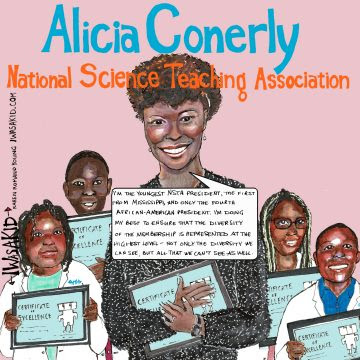
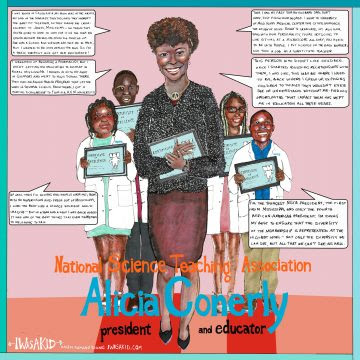
Second piece of news: The National Science Teaching Association’s new president, Dr. Alicia S. Conerly, took office June 1.  Right on time is I Was A Kid with a STEAM profile of her.

Dr. Conerly grew up in rural Mississippi, and after a twisty path through potential science and medical careers and studies, became a science teacher dedicated to improving opportunities for kids like herself.  At a conference, a fire alarm placed her in the way of a woman who would become her mentor, helping her to find her way into the NSTA and the teacher-support grants that came with it… and onward to the presidency!

Visit Dr. Conerly’s profile on the I Was A Kid website at iwasakid.com/aliciaconerly. You’ll learn all about her, while getting a taste of what’s available through my project:  going on 50 profiles of folks from previously marginalized communities, including race, religion, socioeconomic background, gender, sexuality, physical and mental ability.

My project developed at an intersection of concern by the STEAM world about the need for new and diverse perspectives in their fields; from my wish to show today’s kids that they too can have exciting research and creative lives and adventures;  and from a long standing philosophy of representation in media for young people.

Here’s a third and key piece of news: all the materials at IWasAKid.com are available free, including downloads of comics and trading cards.  To stay up to date, follow @IwasakidSTEAM on Instagram — and watch for another I Was A Kid post in September.

Finally, how about some free I Was A Kid posters — all printed out and beautiful? Subscribe at iwasakid.com and you’ll be entered EACH MONTH to win a set of 12 posters.