
Posts Tagged fantasy

Author Spotlight: Anh Do

If you haven’t heard of Anh Do, it’s for one reason, and one reason only: you haven’t spent time in Australia. There, he’s a beloved TV personality, stand-up comic, artist, memoirist, and yes…  bestselling children’s author. His wildly popular Wolf Girl series, which features Gwen, a plucky, slingshot-toting tween and her pack of furry and feathery friends, has sold over a million copies Down Under.

The second installment in the series, The Great Escape, is now available in the U.S. from Harper, along with Book 1, Into the Wild, which came out last year.

But first…

The Great Escape: A Summary

After spending four years alone in the wild, Gwen is overjoyed to see another human being. But all that changes when she’s thrown into the back of a van and taken to a remote prison camp. The situation looks dire. How will her pack of loyal animal friends find her? Where are her parents and sister? Are the other kids in the camp friends or enemies? And, above all, how will she escape?

And now, without further ado…

ANH DO!

MR: Welcome to the Mixed-Up Files, Anh! It’s an absolute pleasure to have you here!

AD: Thank you, Melissa. It’s a real joy to be here!

MR: Although American readers may not be familiar with the Wolf Girl series, the books have sold more than a million copies in Australia. What’s the secret to writing a series with such strong reader appeal? It’s no mean feat, especially in today’s competitive market.

AD: I have a super short attention span, which was a problem when I was a kid, sitting in class. But  now it’s my superpower. My books have to be fascinating to me, first and foremost, so my children’s books have truckloads of awesome things that happen. Every few pages there is something amazing, or moving, or surprising, or funny. I guess this keeps my readers totally engaged and delighted.

Anh’s Inspiration

MR: What was your inspiration for the series, and for your plucky protagonist, Gwen? She’s quite a force of nature.

AD: When I was a kid, my family owned a farm. We had seven dogs that helped keep foxes at bay and look after the other animals. They became like my little band of buddies. I spent entire days wandering around the forest with my pack of dogs.

About 30 years later, I was watching my three-year-old daughter, sitting with her soft toys and talking to her fluffy dog toys, when suddenly the idea of Wolf Girl popped into my head: a little girl who gets lost in the forest and befriends a wolf puppy and a bunch of adorable dogs. Over the years they become family, and the dogs teach her how to become more in tune with her senses and how to detect danger, the way dogs do. Some people have said that Wolf Girl is a bit like Tarzan but with dogs instead of apes, and a young girl instead of a muscle-bound man.

Kindness in the Face of Adversity

MR: In The Great Escape, Gwen is taken to a prison camp, where children are forced to work as unpaid laborers. There, she meets Rupert, a fellow inmate who shows compassion to Gwen by sneaking her food. What were you trying to say about the nature of kindness, particularly in the face of adversity?

AD: I think human beings are innately kind. Of course there are exceptions, but whenever you see a natural disaster, like a hurricane or fire, people will help other people who are total strangers. I have found that in my childhood. I grew up very poor and was raised by a single mum. Many people, young and old, helped me and I wouldn’t be where I am today if it wasn’t for their kindness.

Animal Friends

MR: Gwen shares the spotlight with a pack of heroic animal friends: a wolf, four dogs, and an eagle who serve as her protectors. As Gwen says, “If not for my animals, I don’t know if I would have survived.” Can you elaborate?

AD: Gwen is about eight years old when she befriends the lost animals and they become her family. The dogs and eagle help her hunt for food and provide her with warmth when she curls up amongst them. But they also provide her with emotional comfort. The animals mean that she is not totally alone.

Vietnam to Australia

MR: While we’re on the subject of survival, your 2010 memoir, The Happiest Refugee, chronicles your family’s perilous journey by boat from war-torn Vietnam to Sydney, Australia. How did that experience shape you as a writer and influence your books?

AD: Yes, I am a refugee and my family lived through the Vietnam war. In fact, my father and uncles fought alongside American soldiers, so I grew up with stories told at the dinner table every night. Every story was life and death, kindness and betrayal, love and loss and danger. All these things are now deeply infused in my books.

Renaissance Man
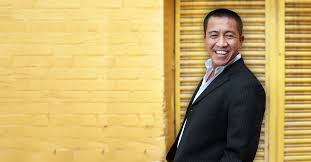
MR: Switching gears, I think it’s fair to say that you’re the true definition of a Renaissance man. Not only have you written dozens of books for children and adults, but you’re also a stand-up comic, an actor, an artist, and have even competed on Dancing with the Stars! Is there anything you’re not good at, Anh?

AD: I can’t swim. Tried loads of times but I sink really quick!

MR: As a follow-up, with so many things going on in your life—including a multi-city comedy tour—how do you juggle it all?

AD: I love everything I do, so it doesn’t feel like work. It feels like pursuing a hobby. When something stops feeling like fun, I drop it pretty quick; otherwise it will sap my energy.

MR: Rumor has it that Wolf Girl is being adapted into a film, with actress Rose Byrne as the producer. Can you tell us more? Also, will you be in it? 🙂

AD: I can’t tell you too much, except to say that I am super excited about Wolf Girl as well as many of my other titles being turned into TV or film adaptations!

Anh’s Writing Routine
MR: What does your writing routine look like, Anh? Do you have a particular time during the day when you prefer to write? Any habits or rituals?

AD: I write everywhere, on planes, in taxis, even whilst shopping. If an idea pops into my head when I’m shopping, I stop and type the idea into my phone to capture the idea before it flies off with the wind. I was once in a gift store and I saw a statue of the three monkeys who are blocking their eyes, ears. and mouth. You might’ve seen this kind of statue before. Suddenly an idea popped into my head: imagine a trio of villains called ‘Senseless’ who can walk into a bank and make everyone in the bank momentarily lose their sight, hearing, and verbal ability? Wouldn’t that be a scary trio of villains? So they are now the main villains in my series Skydragon.

The Secret Cave

MR: The final book in the Wolf Girl trilogy, The Secret Cave, is coming out in March 2026. Can you give readers of taste of what’s to come? (No spoilers, of course! 🙂)

AD: The Secret Cave has an Indiana Jones kind of adventure vibe. By the way, Book 3 is not the final Wolf Girl book. In Australia, Wolf Girl is up to 14! The series is a sweeping tale told over many years and there is heartbreak and family reunions and betrayal and love and loss and everything in between!

MR: What are you working on now, Anh?

AD: Another 100 books. I’ve released over 100 books in Australia. Now for the next hundred.

Lightning Round!

MR: And finally, no MUF interview is complete without a lightning round, so…

Preferred writing snack? Nuts

Coffee or tea? Coffee

Superpower? Laughter

Best piece of writing advice? Do whatever it takes to get really, really good.

Favorite joke? Why is 6 scared of 7? Because 789.

Favorite place on earth? Tuscany

If you were stranded on a desert island with only three things, what would they be? A nice yacht, a helicopter, and a submarine

MR: Thank you for chatting with me, Anh—and congratulations on the publication of The Great Escape. I can’t wait to read book #3, when it comes out next year!

AD: Thank you, Melissa. It’s been so much fun!

Author Melissa Roske smiling and signing a book at a bookstore event. She is seated at a wooden table in front of bookshelves, wearing a sleeveless purple dress.

Melissa Roske is a writer of middle-grade fiction. Before spending her days with imaginary people, she interviewed real ones as a journalist in Europe. In London she landed a job as an advice columnist for Just Seventeen magazine. Upon returning to her native New York, Melissa contributed to several books and magazines, selected jokes for Reader’s Digest (just the funny ones), and received certification as a life coach. In addition to her debut novel Kat Greene Comes Clean (Charlesbridge), Melissa’s short story “Grandma Merle’s Last Wish” appears in the Jewish middle-grade anthology, Coming of Age: 13 B’Nai Mitzvah Stories (Albert Whitman). Learn more about Melissa on her Website and follow her on Facebook and Instagram.

MAGICAL STORIES WITH TRANS AND NONBINARY HEROES

Summertime!  A time to dream of adventures, heroes, magic, and saving the world – all ingredients found in a good book.

“Trans kids lives, not only matter, but their lives and stories are magical.” – Aiden Thomas

In this list, you will discover stories that feature trans and nonbinary characters who champion loyalty, self-worth, kindness, friendship and, especially, the power of community. These entertaining titles affirm the experience of queer and trans readers.

For an extensive list of titles featuring trans and queer heroes check out We Need Diverse BooksThey have launched MAGICAL STORIES FOR EVERYONE, a program offering trans and nonbinary communities Magic Care Packages containing a diverse magical book from their curated list, messages of hope from authors, and swag.

Consider supporting their efforts. Link: https://diversebooks.networkforgood.com/projects/251105-magical-stories-are-for-everyone

A World Worth Saving by Kyle Lukoff, Penguin Random House, 2025.

A., with the help of a golem and a band of queer friends, is chosen to fight demons. The Save Our Sons and Daughters believe trans kids are going through a craze and resort to ‘alternative treatments’ to get their children ‘back’. As A. uncovers the larger motives behind the increasing anti-trans actions, he is joined with spirits from Jewish Mythology. A gripping adventure full of wisdom and surprises.


Ice Apprentices by Jacob North, Simon and Schuster, 2025.

Oswin Fields wants to prove he belongs in Tundra, the only stable place in the harsh world of ice and snow. He is transgender,  a stray, disliked by his fellow students at the Magic school, resented for using up scarce resources, and he’s got asthma. Overcoming these obstacles, Oswin is driven to battle the monsters threatening the community’s survival.


Splinter & Ash by Marieke Nijkamp, Harper Collins, 2025.

What do you get when a disabled princess teams up with a gender-nonconforming squire? A page-turning quest to save the kingdom. The entertainment factor of hidden tunnels and unexpected secrets is non-stop, while the themes of bravery and loyalty will stick with readers.


Wishbone by Justine Pucella Winans, Macmillan, 2024.
At first Ollie’s biggest challenge is dealing with his anger over begin bullied by his ex-BFF and coping with parents’ never ending fighting. After Ollie gets sucked into the Backward Place, a demonic realm, he meets Wishbone, the two-tailed cat who grants his wishes, but at a price. Readers wishing for a horror fantasy with a trans hero who, with the help of his sister and newly found friends, a magical cat, and battles against an evil wizard trying to take over the world, need look no further.


Tales From Beyond the Rainbow collected and Adapted by Pete Jordi Wood, Penguin 2025.

Ten LGBTQ+ tales as old as time span ten world cultures are told with sensitivity, knowledge, humor and love. These stories full of princes and princesses, sorcerers and soldiers, all feature positive portrayals of queer characters and delve into themes of transformation, identity and hope. Each story features artwork created by an artist whose heritage matches the country of their origin. A gorgeous, accessible book that encourages readers to seek out forgotten stories to retell and share.


WNDMG Author Interview with Meg Eden Kuyatt

WNDMG Author Interview with Meg Eden Kuyatt

When I fell in love with the prose in Meg Eden Kuyatt’s first novel, Good Different, then learned she was writing a ghost story of sorts, I. COULD. NOT. WAIT!
I had the esteemed pleasure of sitting down to interview Meg. Here’s the inside scoop on both the author and her book…

KATE: Our Mixed-Up-Files readers would love the inside scoop on your latest novel-in-verse, The Girl in the Walls. Can you tell us a bit about where the idea for this story came from?

MEG: I tend to start my stories in a feeling. This one started when I saw something very upsetting happen to someone I cared about. I tried to write about it directly, but when that didn’t work and felt a little too real, I knew I needed to try another angle (like Emily Dickinson, to tell it slant). I started asking what if questions, like: what if V could time travel? What if she met a ghost? The ghost helped bring this magic wonderland world of the walls, giving me distance. It also gave me an outlet for me to process all my feelings, giving an option for what I could be like if I held onto them forever and didn’t try to work through them. That warning made me really want to work through my feelings all the more and find healing on the other end.

KATE: I love that you write books which make me cry (I’m looking at you too, Good Different). And by this, I don’t mean you write emotional books, I mean you write books with big emotions. How easy is it for you to tap into a young character’s emotions while creating universal connections to your readers?

MEG: Thank you so much, Kate! That’s the part I feel like is my strength. As an autistic person, I feel things so big, and so channeling those feelings into my characters is easy. I just write what I’m feeling now, and what I felt at that age (often they’re very similar things, just maybe wearing different outfits). When I ask things like: what am I struggling with now? What did I struggle with then?, I try to be as specific as possible, and ironically, the more specific we are, the more universal we get because we’re tapping into the human experience.

KATE: In discussing some of those emotions just a bit further, I think many readers will be able to relate to Valeria, a girl who has been hurt by the actions and comments of others. Afterall, who hasn’t wished someone else a taste of their own medicine? How did you decide this would be her driving force?

MEG: I write what I’m feeling and struggling with in the moment. I knew I needed to write this book when, like V, I was hurt and angry at someone else. I knew I needed to try to see them with more empathy. But to get there, I knew I needed to be honest with where I was in my feelings and let that fuel the story.

KATE: You have two characters giving Valeria art guidance – one who says to draw art as you see it. Another who says to draw art as you feel it. When you write, which advice registers closest for you?

MEG: I think there’s truth to both, for V and for my writing. We need to be informed by what we feel, but also what is true. Sometimes these intersect, but sometimes feelings are unreliable narrators, so we need to open our eyes to get perspective and ask, what is true?

KATE: There’s a great parallel in your novel between ghosting someone and being a ghost oneself. Talk to us about how you wove in the concept of being seen.

MEG: I think as the story progresses, V realizes she’s been holding in feelings, but so has the house—to embody how the family has been holding in hurt from generational trauma and ableism. When we’re ghosted, it hurts, and if we don’t acknowledge those feelings, if we don’t move forward, we can become ghosts in a sense, trapped in a cul de sac of looping feelings. We can also give that as an inheritance to the next generation. And if we don’t acknowledge those feelings, they build and fester and get worse. They wound, and can create really malignant patterns for the generations to come. In a few ways, this becomes a literal threat V has to deal with, because as things escalate, they can become real obstacles. I wanted V to break those generational patterns and pave forward another option.

KATE: We often hear about family curses. How important was it for you to make this story generational?

MEG: That was the main thing I wanted to explore here: generations. What do we inherit from our families? The people who dig at us the most, is it in part because we see ourselves in them? What legacy do we want to leave forward? How can we take the good and oppose the evil in the legacies we inherit?

KATE: It’s often fun to read about the baddies of a book, and your baddie is certainly up there on that list! How fun was it for you to write this antagonist?

MEG: Not fun! 😉 But very healing. Sometimes you have to write very real things, that aren’t necessarily fun, because they hit a little too close to home. But it’s really important. It was fun, in a sense, exploring the complexities of the antagonist: the yes, but what if…?

KATE: You and Valeria share many things in common, I’m sure, one in particular is being neurodivergent. Can you tell MUF readers about neurodivergence and how this connection to Valeria helped you in your story development?

MEG: I’m neurodivergent and I don’t know what it’s like to not be ND. I used to try to write neurotypical leads to satisfy a previous agent, but I learned I’m a bad actor, and don’t know what it’s like to be neurotypical! So I write what I know, and my best writing is what I know. For V, I particularly wanted to channel my insecurities as a neurodivergent person in a neurotypical world, how I have so much joy in who I was created to be until something happens and someone makes me doubt myself.

Especially because in Good Different, Selah grows to love her autism, I wanted to show the other end, because it’s not always that simple. Usually there’s a mix of joy and internalized ableism. I don’t want people to stop at Selah’s story and think we’ve “fixed ableism.” It’s still there, all the more obvious by RFK Jr’s recent disturbing comments. There is joy, but there’s also a lot of hurt, and for kids struggling with that, I wanted them to see themselves in V’s story, and see it doesn’t have to end there.

KATE: Can you describe your writing process and, can you give us an example of something you cut, changed, or reworked from draft to publication?

MEG: Goodness, so much changed. The basic bones of the emotional arc have always been there, but there were pranks that had to get cut, lots of conversations between the ghost and V, a lot of internal poems..I was really challenged by my editor to focus, to escalate, and keep things active, since I can get so lost in my head sometimes.

KATE: Thank you for taking the time to share the inside scoop on The Girl in the Walls. Is there something beyond Valeria’s world you can hint at? Perhaps a new project in the works?

MEG: I’m so excited to have a Good Different companion novel in the works currently called PERFECT ENOUGH, and a YA with two autistic leads (that I’ve been working on for over ten years now, so it’s such a joy to know it’s coming out into the world)! Being undiagnosed for most of my life, I’m really enjoying exploring what it means to be autistic and how to be a healthy autistic person in a neurotypical, often ableist world. So we’ll see where that leads me as I play with future ideas!

KATE: Where can readers best find you if they want to reach out?

MEG: megedenbooks.com! I love hearing from readers!


Lightning Round


And….no MUF interview is complete without a lightning round, so…

Favorite place to write? – patio, or Chick-fil-a

Dark chocolate or milk chocolate? – dark chocolate all the way

Superpower? – flying! or timetravel.

Rollerblades or bike? – bike!

Dream job when you were a kid? – being an artist or a manga-ka

House pet? – cat

Favorite piece of advice for writers? – persist!