
In this month’s new releases post, I’m highlighting titles which reflect current events, issues, challenges and opportunities. With both fiction and nonfiction works that address women’s suffrage, racism, sexism, sexual abuse, war, immigration, and emotional well-being, young readers may dive into topics that impact all of us. The books offer opportunities to share and discuss as a family, providing learning experiences for all ages. Make sure to order your copies through the bookshop.org links or by stopping by your favorite local book seller.
Finish the Fight!: The Brave and Revolutionary Women Who Fought for the Right to Vote, by Veronica Chambers. Published by HMH books, August 11.

Who was at the forefront of women’s right to vote? We know a few famous names, like Susan B. Anthony and Elizabeth Cady Stanton, but what about so many others from diverse backgrounds—black, Asian, Latinx, Native American, and more—who helped lead the fight for suffrage? On the hundredth anniversary of the historic win for women’s rights, it’s time to celebrate the names and stories of the women whose stories have yet to be told.
Gorgeous portraits accompany biographies of such fierce but forgotten women as Yankton Dakota Sioux writer and advocate Zitkála-Šá, Mary Eliza Church Terrell, who cofounded the National Association of Colored Women (NACW), and Mabel Ping-Hua Lee, who, at just sixteen years old, helped lead the biggest parade in history to promote the cause of suffrage.
The Talk: Conversations about Race, Love and Truth, by Wade Hudson and Cheryl Willis Hudson. Published by Random House Children’s Books, August 11.

https://bookshop.org/books/the-talk-conversations-about-race-love-truth/9780593121610
This powerful collection of short stories, essays, poems, and art is a call-to-action that invites all families to be anti-racist and advocates for change.
Thirty diverse, award-winning authors and illustrators—including Renee Watson (Piecing Me Together), Grace Lin (Where the Mountain Meets the Moon), Meg Medina (Merci Suarez Changes Gears), and Adam Gidwitz (The Inquisitor’s Tale)—engage young people in frank discussions about racism, identity and self-esteem. Featuring stories and images filled with love, acceptance, truth, peace, and an assurance that there can be hope for a better tomorrow, The Talk is an inspiring anthology and must-have resource published in partnership with Just Us Books, a black-owned children’s publishing company that’s been in operation for over 30 years. Just Us Books continues its mission grounded in the same belief that helped launch the company: Good books make a difference.
So, let’s talk.
Fighting Words, by Kimberly Brubaker Bradley. Published by Penguin Young Readers Group, August 11.

https://bookshop.org/books/fighting-words/9781984815682
A candid and fierce middle grade novel about sisterhood and sexual abuse, by Newbery Honor winner and #1 New York Times best seller Kimberly Brubaker Bradley
“Fighting Words is raw, it is real, it is necessary, a must-read for children and their adults—a total triumph in all ways.” —Holly Goldberg Sloan, New York Times bestselling author of Counting by 7s
Ten-tear-old Della has always had her older sister, Suki: When their mom went to prison, Della had Suki. When their mom’s boyfriend took them in, Della had Suki. When that same boyfriend did something so awful they had to run fast, Della had Suki. Suki is Della’s own wolf—her protector. But who has been protecting Suki? Della might get told off for swearing at school, but she has always known how to keep quiet where it counts. Then Suki tries to kill herself, and Della’s world turns so far upside down, it feels like it’s shaking her by the ankles. Maybe she’s been quiet about the wrong things. Maybe it’s time to be loud.
In this powerful novel that explodes the stigma around child sexual abuse and leavens an intense tale with compassion and humor, Kimberly Brubaker Bradley tells a story about two sisters, linked by love and trauma, who must find their own voices before they can find their way back to each other.
How to Be a Girl in the World, by Caela Carter. Published by HarperCollins Publishers, August 11.

https://bookshop.org/books/how-to-be-a-girl-in-the-world/9780062672704
From the critically acclaimed author of the ALA Notable and Charlotte Huck Honor Book Forever, or a Long, Long Time comes a poignant coming-of-age novel about the complicated parts of growing up, finding your voice, and claiming your space. Perfect for fans of Rebecca Stead, Laurel Snyder, or Ali Benjamin!Lydia hasn’t felt comfortable in her own skin since the boys at her school started commenting on the way she looks in her uniform. Her cousin and friends think she should be flattered, but the boys—and sometimes her mom’s boyfriend, Jeremy—make Lydia uncomfortable and confused. Even more confusing is when Jeremy hovers too close and hugs a little too long.Then her mom surprises her by buying a dilapidated house in their neighborhood. Lydia hopes to find a little bit of magic in their new home. But just like the adults in her life, and God, and her friends, the magic Lydia deeply believes in eventually loses its power to keep her safe.And as seventh grade begins, Lydia wonders: Is there a secret to figuring out how to be a girl in the world?
Psychology: Why We Smile, Strive and Sing, by Julie K. Rubini. Published by Nomad Press, August 15.

https://bookshop.org/books/psychology-why-we-smile-strive-and-sing/9781619309111
A fascinating exploration of why we do the things we do, according to science! Dive into the psychology of the human brain with STEM activities and research projects that get readers excited about learning their own minds.
Psychology: Why We Smile, Strive, and Sing introduces students to the science behind behavior. From the developing teenage brain to genetics, psychology, and social environments, readers ages 12 to 15 gain a greater understanding of the complexities behind how we behave. Why does one person react to test anxiety by studying harder while another person gives up? As with all other behavior, the answer depends on many things: genetics, cultural and family expectations, previous behaviors, and a person’s own special blend of attitudes and values. Plenty of text-to-self and text-to-world connections provide a foundation for deeper learning.
• Hands-on STEM activities and research projects such as testing teenage risk-taking thought processes, conformity experiments, and exploring mindfulness and empathy engage readers beyond the text.
• Psychology includes graphic novel style illustrations, fascinating sidebars, and interesting trivia.
• Psychology integrates a digital learning component by providing links to primary sources, videos, and other relevant websites. Text-to-self and text-to-world connections make learning applicable and fundamental.
Game Changers: A Benchwarmers Novel, by John Feinstein. Published by Farrar, Strauss and Giroux, August 25.

https://bookshop.org/books/game-changers-a-benchwarmers-novel/9780374312053
Trouble is about to tip off for Jeff and Andi’s sixth-grade basketball teams in Game Changers, a standalone second book in the middle-grade Benchwarmers series by #1 New York Times bestselling sportswriter John Feinstein.
From a new coach’s flagrant racism to a teammate’s endless sabotage, best friends Andi Carillo and Jeff Michaels start basketball season mired in controversy.
To make matters worse, the local media smells more than one juicy story. Will Andi and Jeff be able to help each other power through and find a way to put both their teams back on track?
Letters from Cuba, by Ruth Behar. Published by Penguin Young Readers Group, August 25.

https://bookshop.org/books/letters-from-cuba/9780525516477
Pura Belpré Award Winner Ruth Behar’s inspiring story of a young Jewish girl who escapes Poland to make a new life in Cuba, while she works to rescue the rest of her family
The situation is getting dire for Jews in Poland on the eve of World War II. Esther’s father has fled to Cuba, and she is the first one to join him. It’s heartbreaking to be separated from her beloved sister, so Esther promises to write down everything that happens until they’re reunited. And she does, recording both the good—the kindness of the Cuban people and her discovery of a valuable hidden talent—and the bad: the fact that Nazism has found a foothold even in Cuba. Esther’s evocative letters are full of her appreciation for life and reveal a resourceful, determined girl with a rare ability to bring people together, all the while striving to get the rest of their family out of Poland before it’s too late.
Based on Ruth Behar’s family history, this compelling story celebrates the resilience of the human spirit in the most challenging times.
The Places We Sleep, by Caroline DuBois. Published by Holiday House, August 25.

https://bookshop.org/books/the-places-we-sleep/9780823444212
It’s early September 2001, and twelve-year-old Abbey is the new kid at school. Again.
I worry about people speaking to me / and worry just the same / when they don’t.
Tennessee is her family’s latest stop in a series of moves due to her dad’s work in the Army, but this one might be different. Her school is far from Base, and for the first time, Abbey has found a real friend: loyal, courageous, athletic Camille.
And then it’s September 11. The country is under attack, and Abbey’s “home” looks like it might fall apart. America has changed overnight.
How are we supposed / to keep this up / with the world / crumbling / around us?
Abbey’s body changes, too, while her classmates argue and her family falters. Like everyone around her, she tries to make sense of her own experience as a part of the country’s collective pain. With her mother grieving and her father prepping for active duty, Abbey must learn to cope on her own.
Written in gorgeous narrative verse, Abbey’s coming-of-age story accessibly portrays the military family experience during a tumultuous period in our history. At once personal and universal, it’s a perfect read for fans of sensitive, tender-hearted books like The Thing About Jellyfish.
The Girl From Over There, by Sharon Rechter, illustrated by Karla Gerard. Published by Sky Pony, August 25.

In the aftermath of the Holocaust and World War II, a young Jewish immigrant struggles to fit into her new home as she combats bullying and jealousy from the other children
Israel—A group of young school girls are sitting together, when a stranger appears. They take in the girl’s ragged dress, long hair, and tattered purple teddy bear. And they immediately hate her. Who is she? Why is she here? Is she from over there?
Follow this captivating historical fiction story, where we are introduced to the children living in a small kibbutz, a type of community in Israel, soon after the events of World War II and the Holocaust. When Miriam, an immigrant from Poland, arrives, the other children are immediately suspicious and wary—none more than Michal, the class queen, who is immediately jealous of the new girl when her boyfriend befriends her and the adults rally around her.
The Girl from Over There follows the relationship between Michal and Miriam, as the latter struggles to fit in with the other kids. Meanwhile, Michal struggles to come to terms with both her jealousy and the horrors that Miriam, as well as friends and other newcomers, faced during the events of World War II.
Written by the Israel-born author when she was just 11 years old, this story pieces together both fiction and actual testimonies and memories of her Holocaust-survivor family members. Despite detailing the horrific treatment on Jews in war-torn Europe, this compelling narrative will leave you hopeful for a better future.
The Artifact Hunters, by Janet Fox. Published by Penguin Young Readers Group, August 25.

https://bookshop.org/books/the-artifact-hunters/9780451478696
Isaac Wolf can travel through time. But he’s also in a race against it.
With tensions in Prague rising at the height of World War II, Isaac Wolf is forced to leave home with nothing more than a small backpack and a pendant in the shape of an eternity knot. His parents believe the pendant will keep him safe—if he can discover what it really means.
This clue leads him to Rookskill Castle, home of the Special Alternative Intelligence Unit where gifted children can learn to harness their powers to support the Allies’ cause. With the help of his new friends and an antique watch that allows him to travel through time, Isaac must unlock his own powers and uncover the true meaning of the eternity knot. The only way he can do that, though, is by hunting for a series of magical artifacts that are scattered throughout the past . . . and Isaac isn’t the only artifact hunter. Soon he finds himself in a race against a threat just as deadly as the war itself—one that his parents had been trying to shield him from all along.

 Welcome to STEM Tuesday: Author Interview & Book Giveaway, a repeating feature for the fourth Tuesday of every month. Go Science-Tech-Engineering-Math!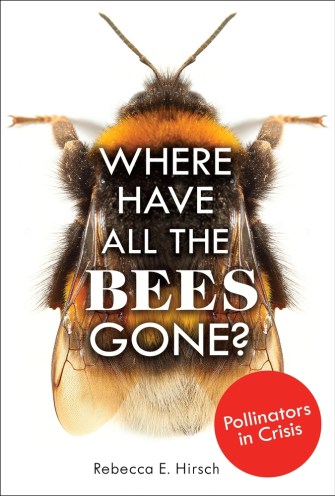


 Where Have all the Bees Gone? Pollinators in Crisis, by Rebecca E. Hirsch
 Bugs in Danger, by Mark Kurlansky
 Turn this Book into a Beehive, by Lynn Brunelle
 Attracting Native Pollinators: The Xerces Society Guide, Protecting North America’s Bees and Butterflies, by The Xerces Society
 How to Raise Monarch Butterflies: A Step-by-Step Guide for Kids (How It Works) by Carol Pasternak
 Pollinators: Animals Helping Plants Thrive by Martha London
 Know Your Pollinators: 40 Common Pollinating Insects including Bees, Wasps, Flower Flies, Butterflies, Moths, & Beetles, with Appearance, Behavior, & How to Attract Them to Your Garden by Tim Harris
 National Geographic Birds, Bees, and Butterflies: Bringing Nature Into Your Yard and Garden by Nancy J. Hajeski
 The Pollinator Victory Garden: Win the War on Pollinator Decline with Ecological Gardening; Attract and Support Bees, Beetles, Butterflies, Bats, and Other Pollinators by Kim Eierman
 Bug Lab for Kids: Family-Friendly Activities for Exploring the Amazing World of Beetles, Butterflies, Spiders, and Other Arthropods (Lab Series), by John W. Guyton
 Maria is a children’s author, blogger, and poet passionate about making nature and reading fun for children. She’s been a judge for the Cybils Awards from 2017 to present. And a judge for the #50PreciousWords competition since its inception. Her poems are published in The Best Of Today’s Little Ditty 2017-2018, 2016, and 2014-2015 anthologies. When not writing, critiquing, or reading, she bird watches, travels the world, bakes, and hikes. Visit her at