Posts Tagged children’s books

Interview with Author Patti Kim + Giveaway

I was introduced to Patti Kim’s books when we were on a panel together at the ALA Summer conference in 2018 and immediately fell in love. From just reading the opening paragraphs of her debut middle-grade novel, I’M OK, I knew I’d love the book and I was right. Patti blends laugh out loud humor with such deep heart. So when I heard Patti had a new MG novel out, I wanted to know more about it.

Here’s more about Patti:

Patti Kim

Patti Kim

Born in Busan, South Korea, Patti Kim immigrated to the United States on Christmas Day, 1974. Convinced at the age of five that she was a writer, she scribbled gibberish all over the pages of her mother’s Korean-English dictionary and got in big trouble for it. But that didn’t stop her from writing. She is the author of A CAB CALLED RELIABLE, HERE I AM, I’M OK, an APALA Literary Honor Book, and IT’S GIRLS LIKE YOU, MICKEY. Patti lives in University Park, Maryland with her husband, two daughters, and a ferocious terrier.

And onto our interview:

Patti, welcome to From The Mixed Up Files. Thank you for being here. Tell us about your new middle-grade novel, IT’S GIRLS LIKE YOU, MICKEY.

IT’S GIRLS LIKE YOU, MICKEY is about Mickey McDonald first seen in my previous book, I’M OK as Ok Lee’s unforgettable friend. Bursting with personality, she urged me to take a deeper look into her life and character. This book begins with the first day of 7th grade, and the bold Mickey we know is not feeling so great. Ok has moved. Her dad has left. Back-to-school shopping didn’t happen. Her mom is in a mood. With such a precarious home life, Mickey is all nerves and not so sure about herself. And turning 13 is no stroll in the park. What she really wants is a best friend, and she finds one in the new girl, Sun Joo. The two girls truly hit it off, but other forces soon interject, leaving Mickey with first major friend breakup.

It's Girls Like You. Mickey by Patti KimThis is a companion book to your debut MG novel, I’M OK. Tell us about that book too and how the books are connected.

The two books are connected by Mickey and Ok’s friendship. In I’M OK, Mickey forces a friendship with Ok which ends up playing a pivotal part in helping Ok open up about the death of his father as well as helping his mother find him when he runs away. She becomes his first real friend.

What made you want to write this companion book following Mickey’s character instead of a sequel with Ok?

Mickey loves the spotlight. It truly felt like she wanted her story to be told. So many intriguing details about Mickey’s life kept emerging in Ok’s book like her many animals, her little brother, her irritable mother, her often absent truck-driving father, her past pageant life, and the sheer force of her positivity. Her need and love for attention called to me.

What were the biggest challenges to writing this second book in the same world?

The biggest challenge was keeping echoes of Ok in Mickey’s story without him taking center stage. I had him move out of the neighborhood which made perfect sense since his mother remarried. I kept them connected as pen pals through postcards and letters. This ended up working quite well since the writing process plays a significant part in Mickey developing an introspective and reflective voice. It’s challenging to strike that balance of keeping a previous protagonist in the picture in a meaningful way, while not diverting the story. I also wanted to see these kids do all right without each other. So much of growing up is being able to say goodbye.

I'm Ok by Patti KimWhat are some things that surprised you about writing IT’S GIRLS LIKE YOU, MICKEY, compared to writing I’M OK?

It was surprising how much I actually enjoyed the revision process. This is a big deal because I used to absolutely hate revising. After my first draft returned with my editor’s notes, I couldn’t wait to get back into that world and revise. The sensation felt like a blurry image gradually coming into focus. It was incredibly fun.

You write about some issues that haven’t been in MG novels for a while, like dealing with getting a period. Why do think it’s important to have characters going through these issues in MG novels?

Yes, the period scene. If these taboo topics aren’t covered in books, then where? Getting my period was shrouded in secrecy and shame, and that attitude informed the relationship I ended up having with my body. No body confidence whatsoever for me at that age. I really wanted Mickey to be Mickey about her period and to be an inspiration and encouragement, demonstrating a more positive narrative around getting your period. I couldn’t imagine writing a book about a girl, especially a girl like Mickey, turning 13 without making a big deal about it. Come on, we’re talking about Mickey.

I love the title, even if it does have me singing for the rest of the day. What gave you the idea of naming the book after an ‘80s song?

Since the original song is about a guy who breaks hearts, don’t you just love the idea of re-purposing the title to elevate a girl? And it’s so catchy. I couldn’t resist.

Agreed! What can we look forward to next from you?

I’ve been thinking a lot about Sun Joo Moon. I think she’s asking for stage time. Unlike Mickey, she’s quiet about it, but there’s a real depth to her that feels worth exploring.

Can’t wait to read that one!

Thank you, Patti, for being on From The Mixed Up Files today.

Check out IT’S GIRLS LIKE YOU, MICKEY on Bookshop.org, and enter the giveaway below for your chance to win an advanced reader copy (ARC).

a Rafflecopter giveaway

STEM Tuesday — Pollinators — In the Classroom


Happy Summer! What a great time to get outdoors and immerse yourself in nature. But if you can’t do that right now, you can always use books to investigate the world. For teachers and parents who are looking at ways to engage their kids in science and STEM possibly virtually this fall, these books are the best way to get your kids some hands-on pollinator experience!

Many schools raise butterflies as part of their science curriculum. And why not? It’s fun and also a great way to see science in action. But you could raise butterflies in your house, too. This book tells you just how to do it.

Or you can also find information on the internet here at Save Our Monarchs.org

Why would you do this? First of all, it’s COOL! But also because it is a great way to learn about life cycles of organisms. The best part is at the end, you will have some amazing new butterflies to release into the world.


If you want to introduce your students/kids to all kinds of pollinators, check out this awesome book :

It has activities to explore beetles, butterflies, spiders, and other arthropods. WOW!  The book starts out by introducing the reader to the different bugs that are out there and then goes through ways to observe them safely. You can even create a bug net, and set up a a bug trap. like the one outlined below:


Image from the book Bug Lab for Kids by John Guyton (Quarry Books)


Be sure that when you capture the bugs, you observe them for a short time. Maybe keep a journal of what the bug does while you have it. How does it move? What does it eat? Does it interact with other bugs (assuming you’ve caught a few at a time).  Consider drawing the bug in your journal, too.

Consider coming up with your own experiment. For example, if you introduce a bit of material that isn’t in their environment, like a piece of paper or a strip of cloth, watch how they react to it. Do you think they will ignore it completely or perhaps they will appear to inspect it. Make a hypothesis and then observe the bug. Gather data by making notes and drawing pictures. Then come up with a conclusion. Was your hypothesis correct? Why or why not?


Finally, if you want to have your students or kids do an entire virtual experience with bees, have them read the Turn This Book into a Beehive!  book

It gives kids a peek inside the real life of a beehive, by explaining the individual bees and their jobs within the colony. How they all interact, and even explains how bees move about and make the buzzing sound. This book is TONS of fun. You could have kids do a few of these projects and then write up their observations. Or even, if you are doing a virtual science class, have them present the buzzers they made to the class.


image from Turn the Book Into a Beehive by Lynn Brunelle (Workman Publishing)


Perhaps assign every kid a certain bee in the colony and have them write a few sentences or a short paragraph about what they did that day. You know, a day in the life of a forager bee or a court bee… well you get the idea!


Whatever you do, have FUN with it! Kids will enjoy the hands-on aspect of these books and they will also be learning a ton of great facts along the way. Happy Sciencing!

*******************************

Jennifer Swanson is the founder of STEMTuesday and the award-winning author of over 40 book for kids, mostly about STEM. A huge science geek, Jennifer encourages kids (of all ages) to engage their curiosity and DISCOVER the Science all around them! You can learn more about her and book her for speaking engagements and school visits at www.JenniferSwansonBooks.com

EXTINCT! Facts & Fiction for Middle-Grade Readers

Many kids in this age group can rattle off more dinosaur names and the details about more species than most other twelve people put together. And they have learned much of this on their own, through eager reading! What could be more exciting during this pandemic, when schools are closed and normal summer activities are limited, than for young readers to find books that hold their avid interest for hours and days?

More books on the ever-hot topic of dinosaurs come out every year. I’ve been writing a book about extinct American animals and have been looking at just about everything available for middle-grade readers on the subject. I recommend the following page-turners:

Stephen Brusatte is a leading young paleontologist, but also an engaging author of books for children and adults. In his Day of the Dinosaurs: Step Into a Spectacular Prehistoric World (Wide-Eyed Editions, 2016), readers witness over 100 prehistoric creatures of the land, sea and air through 2nd-person narrative. Older middle graders might also enjoy his best-selling adult book, The Rise and Fall of the Dinosaurs (William Morrow, 2019)

Kelroy Pim and Jack Horner both fell in love with dinosaurs as kids and now have become leading scientists in the field. In their book, Dinosaurs—The Grand Tour: Everything Worth Knowing About Dinosaurs from Aardonyx to Zuniceratops (The Experiment, 2nd Ed., 2019), readers will find many of the mind-changing latest discoveries. The book also includes Jack Horner’s working field notes and suggestions for how and where readers might go to make their own prehistoric finds.

Extraordinary animals lived and went extinct millions of years before and after those great dinosaur beasts. This may be a whole new area for dino-fans to explore. Fortunately there are a number of wonderful books to help them get a sense of our vast natural history. One is Matt Sewall’s Forgotten Beasts: Amazing Creatures That Once Roamed the Earth ( Pavilion Children’s , 2019). The well-known and little-known creatures featured in this stunningly illustrated book span half a billion years, ending with the extinction of the Tasmanian Tiger in the 1930s.

In their well-researched, humorous, and visually compelling book, Prehistoric Ancestors of Modern Animals: If Extinct Beasts Came to Life, (Hungry Tomato, 2017), Mathew Rake and Simon Mendez use digital photography to show what modern animals might be like if they still had the attributes of their prehistoric ancestors. See also their Prehistoric Giants, Prehistoric Sea Beasts, and Prehistoric Predators, all published in 2017.

 For comprehensive, visually appealing reference books for this age group, you can’t miss with anything published by the Smithsonian or by DK Eyewitness books. Some examples: William Lindsay, Prehistoric Life: Discover the Origins of Life on Earth from the First Bacteria to the Coming of Humans (DK Eyewitness Books, Reprint ed., 2012). Or Paul Taylor, A History of Life in 100 Fossils (Smithsonian Books, 2014).

Would readers like to dig up some fossils of their own? Thousands of prehistoric animal and plant remains lie underfoot waiting to be found all over this country (except maybe in Rhode Island where, because of glaciation, fossil hunters may only come up with a trilobite or two and some Carboniferous cockroaches).  Amateur fossil hunters, (including children!),  have made many scientifically important finds

Mathew Rake and Dan R. Lynch’s Fossils for Kids: Finding, Identifying and Collecting (Adventure Publications, 2020) covers all those topics, but also explains how to collect responsibly so that you preserve the scientific record. Albert Dickas‘s 101 American Fossil Sites You’ve Gotta See (Mountain Press Publishing, 2018) shows state-by-state where to see prehistoric animals on display, or observe expert digs in progress, or dig on your own.

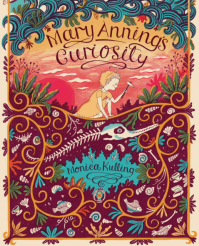
Would they like to read fiction about fossils? Try Monica

Kulling’s Mary Anning’s Curiosity (Groundwood Books, 2017), a fictionalized account of the childhood of the 19th century shell-collector who revolutionized paleontology 
with her discoveries. Or read Roger Reid’s Time: A Jason Caldwell Mystery (NewSouth Books, 2011) set in a world-famous Paleozoic Footprint site in northern Alabama.

At a moment when there is much uncertainty in the present and about the future, it may be refreshing for readers to focus on the long time of Earth’s natural past. At the very least, they can have fun reading about some fascinating ages and creatures. Please pass this list of books along to any middle-graders you know. There are many more titles that I could have included, but they will find them. I wish there were a reading equivalent of “Bon appétit!”