Posts Tagged Author Interview

Going Backstage on How GUITARS Was Made

Hi Mixed-Up Filers! Recently, I had the opportunity to talk to Patricia Lakin, an award-winning author who writes both fiction and nonfiction for toddlers to middle-graders. We discussed Guitars, the latest book in her Made By Hand series from Simon & Schuster. It’s a fun book filled with great facts about how guitars are made and two activities that show kids how to make their own instruments.

Tell us a little bit about Guitars and the Made By Hand series? How did 4 Covers from the Made By Hand Series: Skateboards, Bicycles, Steel Drums, and Guitars, or more broadly, the Made By Hand series, come about? Did you select the subjects? If so, why?

The story of how Made By Hand came about is a true tale of admiration. An editor I have worked with in the past has a great love of hand-made objects. She knew that I shared that same love. It was this editor, Karen Nagel at Simon & Schuster, who created the Made By Hand series and asked me to be the writer.

The editorial team decided they wanted to focus on two objects used for transportation—one of wood and one of metal and use the same materials for two musical instruments. And that is how the book on Bicycles, Skateboards, Steel Drums and Guitars was born.

Did you actually visit Coloma Guitars? Or do you have any fun stories from researching the book?

The story of how I learned about the oh-so-talented Meredith Coloma is, I think, a New York story.  I happened to pass by Chelsea Guitars, a famous guitar store that is located at the equally famous Chelsea Hotel. I entered the long narrow shop and marveled at the guitars hanging on all the walls, from the ceiling etc. and asked the fellow behind the counter if he knew of a female luthier. [The three other books all had male makers and I wanted to highlight a woman for this book.]

The man behind the counter confirmed with another gentleman that I should contact luthier, Meredith Coloma—which is exactly what I did. She lives in Vancouver, BC. She was delighted to be a part of this project and so I put her in touch with the editorial department at Simon and Schuster.

Meredith and I spent a fair amount of time doing telephone interviews during which she shared her story—how she became a musician and decided to become a luthier—the latter all occurred because of a violin maker she happened to come to know. He only spoke Yiddish. His wife translated but he and Meredith spoke the language of music. It was that elderly gentleman who showed her the brochure of a luthier school not far from her home in British Columbia. I thought her story of becoming a luthier was magical and had to be included in the book.

We had extensive conversations and Meredith shared pictures of how step-by-step she creates an acoustic guitar as well as an electric guitar. I had no idea how complicated and how delicate the process is to create an acoustic guitar.


Guitars book cover

How did you approach the research and writing of Guitars?

I feel fortunate to live very close to New York Public Library of the Performing Arts at Lincoln Center.  There, I found so many books in circulation that dealt with the history of guitars, guitar greats and the science behind guitars.

I was able to bring those books home to do extensive research. Between those books and the wealth of information I found on the internet from a variety of guitar periodicals, I had tons of material to read and educate myself on the history of guitars.

Most nonfiction writers tell us that they learn so much about a subject that not all of it can fit into one book. Are there any fun facts that you learned that didn’t make it into Guitars?

That is so true. Each evening I’d recount to my husband all of the fascinating facts I’d learned about the guitar. Although I will admit that, since I’ve never studied an instrument and can’t read music, some of the facts on the number of strings on an acoustic guitar and the sound differential was too confusing to understand…plus, I knew that would make the book too technical to include. What I did find I had to cut was the longer history on how electric guitars were really influenced by Hawaiian ukuleles but I was able to include a few fun facts.

Do you play an instrument? If so, what do you play?

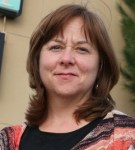
Patricia Lakin Publicity Photo 2021

As a child, I studied ballet and in college continued with dance classes, jazz and then tap and never studied a musical instrument.

If you could have a custom guitar made for you, what would it look like? Would it be acoustic or electric?

If I did own a guitar it would most likely be the guitar that Meredith made with a gorgeous tree inlaid on the acoustic guitar’s back. It’s on page 15 of the Guitar book.

I read on your bio that you’re inspired by movies. What is your favorite movie, and why?

Wow! I am such a movie fan that I don’t think I could pick a favorite. Going to the movies as a child, and now, even as an adult, is a special treat for me. Sitting in a darkened theatre, having those images up on the screen, larger than life—speaks to me in ways that I find totally magical.


Thank you for a fun interview! For more information about Patricia Lakin and her books, please check out her website. And don’t forget to check out Guitars and The Made By Hand series. For more information about, please visit Simon & Schuster’s Made By Hand page.


STEM Tuesday– Award-Winning MG STEM Titles– Your Turn: A Wish for 2022

Welcome to STEM Tuesday: Author Interview & Book Giveaway, a repeating feature for the last Tuesday of every month. Go Science-Tech-Engineering-Math!

Normally this would be the time of the month when I would choose an author from a list identified by our STEM Tuesday team and conduct an interview. This month’s theme was award winning books but I’ve been on both sides of that equation. So I decided, as we head into 2022 to do something different. I want to issue a call to action for those who don’t get awards instead.

Over the past two years authors I interviewed for STEM Tuesday have taught me about spider silk made from genetically modified goats, women who were denied a spot in the astronaut program despite performing better than their male counterparts, and implicit bias in archeology that may skew what we know about ancient civilizations. One author/illustrator judged an MIT contest showcasing implausible scientific ideas. Another learned to dive with a photographer in order to better understand the nature of ocean conservation. And while the world knows about the women showcased in Hidden Figures, one author published a book about fifty additional African American women whose STEM contributions changed the world.

If I were to ask you to name the above authors, would you be able to do it without looking at my interviews? That’s my concern in a nutshell. A select few of these authors have been recognized with awards, but most have not. Nonfiction is a staple for helping young readers develop executive functioning and learn more about the world around them, but the authors are not often celebrated in proportion to their contributions to children’s literature. Even with awards, most authors are still struggling to become household names let alone achieve financial stability.

Writing STEM is hard. The research often rivals an academic research paper. Many of us write for magazines, textbooks, trade publishers and educational publishers. What is often true is that authors need to log a lot of hours in the library, speaking to experts and researching in the field to determine how to best present the subject matter in a way a student can understand. In a sense, we have to do a deep dive to understand the material before we can explain it coherently to someone else. Unique to children’s publishing there are additional rules to follow. There’s an art to working within those constraints. I’ve been asked to do planet books of 4,000 words for upper elementary students and recast those same facts for a beginner readers using only 300 words. It’s not just the word count but the choice of words. For instance, with younger students we have to be mindful about sentence length, how many multisyllabic words in a sentence, and words common for that reading level and Lexile range.

After the books are printed and in circulation, awards are tricky. For every author that receives recognition, there are many equally skilled authors that don’t. And remember, the industry celebrates winners, not runners up. A different committee, on a different day, might have picked a different book entirely from the same pile. I know, because I’ve been on a number of awards committees. There are epic battles and painstaking discussions before a consensus is reached.  I’ve also noticed that the attention paid to award winning fiction authors is sustained much longer than for nonfiction authors. Those awards often translate into more work for fiction authors and higher compensation but not necessarily for their nonfiction counterparts.

I’ve been luckier than most of my peers in this respect. I’ve published more than 90 books for children and have more under contract. So I wanted to raise my voice to challenge the readers of this blog to change the nature of the game. The industry pays attention to where the money is flowing. Publishing pays attention to social media chatter and reviews. You can help my STEM peers by doing the following.

Once a month:

  1. Check out a book (or two) from the library. If you need a place to start, we have great recommendations on our STEM Tuesday site. Books that are checked out stay in circulation longer.
  2. If you’re in a school district, consider adding a book to the school library or classroom. I know budgets are small, but even one book is a boon for that author.
  3. Write a review. It only takes five minutes. Amazon, Goodreads, Barnes and Noble.
  4. Give a shout out to an author whose work you admire. Try to pick someone who isn’t getting a lot of marketing support from publishers. The ones the awards committees didn’t announce. I’m all for boosting underdogs. That shout-out will make an author’s day.


Win a FREE copy of the book of your choice.

It’s the holiday season so let’s do something positive to start 2022.

This month, instead of me telling you who I found fascinating…this time you tell me.

What nonfiction book have you loved?

What’s next on your wish list?

Enter the giveaway by leaving a comment below.

The randomly-chosen winner will be contacted via email and asked to provide a mailing address (within the U.S. only) to receive the book.

Good luck!


Christine Taylor-ButlerYour host is Christine Taylor-Butler, MIT nerd and author of many nonfiction books for kids. You can read about her philosophy  on STEM in this article for the Horn Book. Christine has recently finished a short story for a speculative anthology on Marie Curie’s teen years (2023), a children’s afrofuturism book for Benchmark Publishing set in the Trappist-1 solar system (it exists, look it up!), and a new nonfiction series not yet announced. She is also the author of the middle grade sci-fi series The Lost Tribes. Follow @ChristineTB on Twitter and/or @ChristineTaylorButler on Instagram


Author Spotlight: Daphne Benedis-Grab + a GIVEAWAY!

Today, author Daphne Benedis-Grab chats about her latest middle-grade novel, I KNOW YOUR SECRETout from Scholastic tomorrow, December 7–and shares her writing secrets. She also tells us all about her role as a public-school librarian (spoiler alert: she loves it) AND and there’s a chance to win a copy of Daphne’s book if you enter the giveaway. Scroll down for details! 👇👇👇

Summary of I Know Your Secret

The email arrives Sunday night: Do exactly what I say, when I say it, or I will reveal your secret.

On Monday morning, seventh graders Owen, Gemma, Ally, and Todd, who have nothing in common and barely know each other, must work together and follow the instructions of an anonymous blackmailer. None of them want to go along with the blackmailer’s instructions, but each of them have a secret they must protect at all costs.

Set during a single day of school, the students race against the clock to complete a disquieting set of tasks, with fast-paced chapters detailing each moment of the day interspersed with a later interview-style recording made by the quartet.

Interview with Daphne Benedis-Grab

MR: Welcome to the Mixed-Up Files, Daphne! Thanks for joining us today.

DBG: I am completely delighted to be here! I am a longtime fan of Mixed-Up Files.

Book Inspiration

MR: First, I need to tell you how much I enjoyed I Know Your Secret—so much so, I gobbled it up in one sitting. What was the impetus for writing it?

DBG: It makes my heart sing to hear this! I wanted to write a book that was hard to put down, and I was inspired by Lois Duncan to try and write such a book. When I was growing up, her thrillers kept me up all night–even the second (and third) readings. So, two-and-a-half years ago, when I began a graduate program to become a school librarian and suddenly found it hard to write stories, I realized I needed to create a story idea I’d find so fun that it would always pull me back in–even after long days with my kiddos, and my homework. I thought about what I’d loved when I was middle-grade age, and that was when I decided I wanted to try my hand at writing a thriller. My goal was to work on a story that was hard to put down while writing it—and that readers would find it hard to put down, too!

Dancing Dialogue

MR: As above, your novel is fun to read and incredibly fast-paced, with loads of twists and turns along the way. What is the secret to writing a book that kids (and MG-loving adults 🙂) can’t put down?

DBG: Thank you so much for that! I think writing a story that is fun to work on every day, that has bits of dialogue dancing in your head when you are on the subway or washing dishes and that makes you happy to think about, is my secret. Another element that makes a book un-put-downable to me is characters who struggle with real things, who are flawed and feel different but come to see that those flaws help them grow—and that those differences are what make them gloriously unique and essential to the world. So, working to create such characters is writing secret number two.

Multiple narrators: Owen, Todd, Ally, and Gemma

MR: The book is written from the perspective of four seventh-grade characters: Owen, Todd, Ally, and Gemma. Each has a secret, and each is terrified of having his or her secret exposed. How did you come up with these four characters? And how were you able to make their voices distinct?

DBG: I discovered when writing a previous MG novel, The Angel Tree, that I love creating books with multiple narrators. As humans when an event takes place, we tend to think we see all sides of it; that our narrative is the narrative. This is in fact almost never true. Any event has multiple perspectives, elements we may not see, and a past leading up to it that we are completely unaware of. With multiple narrators, I can show different sides of the same story so that readers see the complexity of any given event or person.

Talking about Todd…

Todd came to me first; he’s seen by the other characters (and everyone at his school) as a violent kid who lashes out with little provocation. We see this version of the narrative from Gemma, Owen, and Ally—but then we learn Todd’s story: what he is dealing with, why his fuse is so short, and how desperately he needs help. The readers get to see this early on, and then have the satisfaction of the other characters slowly coming to see it too—and seeing how learning Todd’s story changes their narratives and reshapes everything. I started with each character thinking they know the whole story but come to see how much is actually missing, both in their perceptions of each other and the bigger story at play: who is blackmailing them, and why. When they are finally honest with each other, they are able to understand each other as nuanced, complex, and vulnerable beings.

…and Ally, and Owen, and Gemma

Todd is inspired by a boy I knew in elementary school who I always thought was misunderstood and pigeonholed unfairly. I wish I’d done something about it then, and maybe having him in this book is my way of apologizing. Ally is made up of my love of animals as well as grief I have experienced in my life (Ally lost her parents twice: first her birth parents and then the parents who adopted her). Owen is my goofy, silly, over-eager but well intended side. And Gemma is who I wanted to be when I was in middle school: grounded, confident, and never afraid to speak up. Each of them having their own story helped their voices stay distinct. And then there’s that bigger story: who is behind the sinister messages, and why. But that stays secret until you read the book!

Shh…It’s a Secret

MR: Speaking of secrets, the theme of secret keeping—hence, the title—is equally important. What is it about secrets that fills most of us with anxiety and dread? Also, what were you trying to say about secrets in general?

DBG: Ages ago I took a psychology class where we read an article about how evil grows in hidden darkness. The point was that the secrets we hide inside ourselves don’t shrink or disappear; they grow bigger and stronger inside us, revealing feelings that don’t serve us like isolation and shame. The thought of being exposed can be terrifying, but when we share secrets with people we trust, the power those secrets hold over us withers in the bright of day. Quite often we discover we are not alone, either in the feelings or experience, and that the people who care about us will still care about us, and do all they can to help us through.

Stamping Out Bullying

MR: Bullying is another important theme in your book. Although I’d like to think most schools are aware of the problem—and address it as best they can—it’s clearly a prevalent and ongoing problem. While doing research for the book, did you come across any anti-bullying strategies in schools that seemed particularly effective?  

DBG: This is such a good and important question! What can be especially challenging about bullying is that it happens in those liminal times when teachers are distracted. And that makes fear of payback for telling an adult very real. Because of that, I find the most effective strategies to be community based. Schools that value, teach, and embody inclusion tend to have fewer incidents of kids being bullied. Schools that educate about bullying, compassion, and teaching kids to be allies, are also places that have less bullying. I may be biased, but I think schools with libraries and librarians are in the best position to foster these kinds of communities. Few things cultivate compassion, inclusion, and allyship like books! {For another MG author’s insight on bullying, check out Melissa Roske’s interview with Helen Rutter here.}

Inspiration Behind Daphne’s Books


MR: Turning back to books and writing, I Know Your Secret is your fifth published middle-grade novel, and you’ve written a YA novel too. You’ve also published short stories. Where do you get your ideas and inspiration for your various projects? Is there a secret sauce you can share with Mixed-Up Files readers?

DBG: Ha, that question is wonderful! But I’m worried my answer may not be all that helpful to others, because I have a brain that does not turn off. I am always thinking, mulling things over, going off on thought tangents, wondering endlessly about everything… And the way I make sense of it all is by creating narratives. If a headline or a student’s actions or an exchange I overhear on the subway baffle me, I create a narrative to help me understand it. I also create narratives imaging how something that has happened—either in my life or the world or a book or movie—might have gone differently. And some of those many narratives are seeds of books!

The Writing Librarian

MR: In addition to being a children’s book author, you are a public-school librarian. How do you juggle your writing career with your day job? What does your writing routine look like? Do you have any particular writing rituals?

DBG: Honestly, I am still figuring that out. My kids are seniors in high school, so I try to be with them as much as possible—which leaves less time for other things. But I absolutely love being a librarian. I love my school. I love my administration. And I love, love, love my students! Work makes me very happy, even when it’s hard. And being happy makes me a better, more engaged writer. Plus, my students influence my writing, which is motivating as well. I try to write at least a little every day. I am more productive, and able to go deeper into my story, when writing is a habit: a muscle I use regularly.

My first draft ritual is to reread whatever I wrote the day before, and polish it a bit before breaking new ground. This is a less intimidating place to start, and it gets me back into the characters. I will also confess to another secret ritual: No matter how little time I have to write, I cannot start until I’ve messed around on the internet a bit—checking my socials and reading the latest Entertainment Weekly stories. I’d probably have written twice as many books if I’d managed to drop this particular ritual!

What’s Next for Daphne

MR: What are you working on now, Daphne? Enquiring minds want to know!

DBG: Details are still a secret, but I am writing a follow-up middle-grade thriller set in Snow Valley, where I Know Your Secret takes place. More to come soon!

Lightning Round!

MR: Finally, no MUF interview is complete without a lightning round, Daphne, so…

Preferred writing snacks?

Dark chocolate and granola bars.

Coffee or tea?

I like tea a lot but adore my coffee!

 Cat or dog?

Forever a cat lady (but like dogs a lot too).

Favorite mystery novel?

For the past five years or so that spot has been held by Kate Milford’s Greenglass House. The atmosphere is deliciously spooky, the plotting excellent, the characters realistic, and the main character, Milo, is adopted, which I love to see in books because my kids are adopted.

 Zombie apocalypse: Yea or nay?

It’s coming.

 Superpower?

Teleportation. I love to travel but am not a big fan of airplanes. I wouldn’t mind a faster commute to work either!

 Favorite place on earth?

Provincetown, Cape Cod, Massachusetts. As with the books of Lois Duncan, it has been a lifelong love affair. My parents started taking me when I was six months old (there was an unfortunate sand-eating incident, but otherwise it was a smooth trip), and we started bringing our kids when they were three.

If you were stranded on a desert island with only three things, what would they be?

Dark chocolate, an e-reader with an undying battery, and sunscreen (redheads burn super easily).

MR: Thank you for chatting with us, Daphne—and congratulations on the publication of I Know Your Secret. I thoroughly enjoyed it, and I know MUF readers will too!

DBG: Thank you so much for having me. This has been a thrill!

And now…

A GIVEAWAY!

For a chance to win a copy of I KNOW YOUR SECRET,  comment on the blog–and, if you’re on Twitter, on the Mixed-Up Files Twitter account, for an extra chance to win! Giveaway ends on Wednesday, December 8, at midnight EST. U.S. only, please.

About the Author

Daphne Benedis-Grab is the author of middle-grade books including Clementine for Christmas and The Angel Tree, and young-adult books including The Girl in the Wall. Her short stories have appeared in American Girl magazine. She earned an MFA at The New School and a School Media Library Specialist degree from the Palmer School of Library and Information Science. She lives in New York City with her husband, kids, and cat, and spends her days writing and being the librarian at PS32 in Brooklyn. Learn more about Daphne on her website and follow her on Facebook, Twitter and Instagram.