
Posts Tagged Author Interview

Interview with Sachi Ediriweera — Author of Enlightened

Author photoWe’re excited to have Sachi Ediriweera on here today to talk about his new release. Let’s start with learning a bit more about you, Sachi, and then we’ll talk more about Enlightened.

What was your life like growing up in Sri Lanka?

I grew up in the southern part of Sri Lanka, which is quite lush and tropical. And life was even more different for me as our home was in a little village an hour away from the main city. I grew up surrounded by nature, little lakes, rice paddy fields, and calming drizzles which were commonplace in April every year.

Can you tell us a little about how you first learned about the Buddha as a child?

Sri Lanka’s population is primarily Buddhist. It’s hard to miss seeing a statue of the Buddha wherever you go. You’re likely to see one in every Buddhist household, roadside shrines and even miniature ones on top of vehicle dashboards. However, my curiosity about the Buddha’s life began in Sunday school, which I didn’t enjoy attending at first as most of the lessons consisted of memorizing verses. However, the lessons about the Buddha’s life itself–his origins as a prince who had everything fascinated me. Learning about the Buddha became more than just memorizing verses and a challenge of understanding his mythos, which eventually influenced my work as well.

Did you have any childhood dreams for your adult life? If so, did they come true?

I wanted to become a movie director! I loved watching movies and learning how they were made even more. Movie DVDs where they had bonus content about how they made the movie was hard to come by in Sri Lanka and I would go out of my way to find them and spend hours re-watching those clips over and over. Apart from that I was experimenting with graphic design as well at the time. I did get to make my own short movies eventually, which screened in multiple international film festivals. However, I realized my passion was ultimately telling stories and I decided that graphic novels were a better medium to express my creativity. So yes, the dream did come true, for a while.

Did you love to read as a child? If so, can you tell us some favorite stories? 

My parents fueled my love for reading. Also going back to growing up in Sri Lanka, the village we lived in had terrible TV transmission reception so there wasn’t much for me to watch on screen. Instead I surrounded myself with books of all sorts. My favorites were Agatha Christie’s detective stories and anything that had to do with comics.

Sounds like not having much TV time turned out to be a big plus later on.

Did you have any early experiences where you learned that written language had power?

When I was 10 or so, our class had a monthly contest where the teacher gave a topic and you had to research and make a zine about it. These mostly revolved around the subjects we were learning. In one particular month, we were asked to make a story book and I remember writing an anthology of sorts with 3 stories. I won that month’s contest and was quite pleased about it.

What was your biggest fear when you were young? Did you get over it?

Being left behind, and I think it was largely due to growing up in a rural village in Sri Lanka. I had to put in extra effort if I wanted to learn anything–the TV air transmission signals were bad, and there was no internet. Eventually I moved to the city, and after that, I leaped at the opportunities–anything that would help me move my passion and career forward. It certainly helped me in the long run as I spent much of my twenties experimenting with my creativity–from film to illustrations.

What advice would you give to your younger self?

Be passionate about what you do and have faith in yourself.

When did you know you wanted to be a writer? 

When I wanted to direct movies. As I didn’t know any screenwriters, I had to do it myself.

What other careers have you had besides writing?

Apart from being a former filmmaker, I work in advertising as an experiential design lead.

What is your favorite or most challenging part of being a writer? 

The complete freedom you have on the page is probably my favorite part of being a writer. Sometimes you end up discovering a completely unplanned moment in your story, a minor character suddenly becomes a bigger supporting character, you figure out a plot twist that makes everything ten times better! Writing largely happens in solitude and when you suddenly see your story in a completely new angle, it makes that entire process rewarding.

It’s exciting to see words and pictures actually turned into a book. It also can be magical seeing others reading what you’ve written.

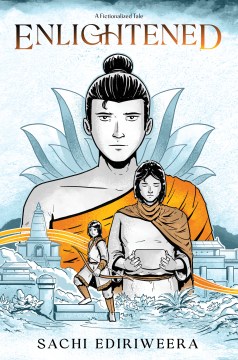
And now that we know more about Sachi, let’s find out about more about his book, Enlightened.Book cover of Enlightened
What inspired you to write about the Buddha?

Siddhartha’s journey from a young prince to discovering the truths of this world as an enlightened monk is one that has been retold by hundreds of authors through centuries. However, most of these stories approach the Buddha as a God-like figure whereas I knew there was a grounded version of the story in which we get to explore him as a man who wanted to understand the world better. As I was in-between projects and with the world going through a pandemic, I remembered the stories which fascinated me back in Sunday school and wondered if there was a way I could retell the mythos through my own voice.

We’re grateful you made good use of the shut-downs during the pandemic.

Where did you go to do your research?

I referred multiple textbooks which were written about the Buddha and his teachings as well as reached out to a couple of researchers who were well-versed in the subject.

What was one of the most interesting facts you learned while researching?

With the Buddha’s teachings being centuries old and spanning across multiple regions around the world, certain elements of the core mythos had their own interpretations depending on where the material was originating from. It was interesting to compare different versions of the same story elements and how they had shaped those cultures.

Can you tell us a little about how you wrote and designed your graphic novel?

Enlightened was particularly challenging as I was adapting a story which had hundreds of interpretations (including children’s books and movies!) and importantly, as the Buddha’s story is so vast, I had to map out which part of the story I was going to adapt and how it would still be intriguing from a narrative perspective. Of course, the process began with writing a story outline and then doing some character sketches. Once I was happy with those, I created 15-sample art pages which I used for my pitch.

The subtle use of blue and orange in the illustrations give the graphic novel a striking look. What inspired those complimentary colors? And do they have any significance to this story?

My original pages were only in different tones of blue. However, I had used the orange on the pitch cover, as a spot color for the Buddha’s robe. Greg Stadnyk. my wonderful art director at Atheneum came up with the brilliant idea of using it throughout the book. Orange color is often associated with Buddhism as it’s the color of robes worn by Buddhist monks.

What comes first for you—the words or pictures?

Mostly pictures, but I do try to keep it between a balance of both.

How do your filmmaking and design backgrounds influence your graphic novels?

Back when I was doing short films, I spent a lot of time doing pre-production on my own. This included storyboarding scenes, to make sure you have the right shots, which you use to create a shot list for the day of the actual shoot. A crucial part about filmmaking is that you learn to be economical with your shots (because filming things cost a lot of money!). For instance, if you want to show a car exploding, you can film a scene of a car passing a pedestrian and then show his reaction with a loud sound effect, reacting to an explosion, instead of actually blowing-up a car. It’s a similar challenge with sequential storytelling, where you have to figure the best possible way to visually tell the story you want.

It’s fascinating how shooting films and creating graphic novels use many of the same skills. I’m sure it also helped in laying out each picture because those are like framed camera shots.

What do you hope readers will take away from your book?

The story of the Buddha is much larger than it could be fit within these pages. If someone gets inspired to learn more about the Buddha’s teachings, that would be a win for me. Also, I do hope readers enjoy the story on its own.

I’m sure they will.

Can you tell us about your other books?

My two earlier books were self-published with my debut being a graphic novel called Lionborn, which was the first English language graphic novel published in Sri Lanka.

What are you working on now?

Enlightened took me almost two and a half years to make. So right now, I’m spending time exploring art styles and potential story ideas before diving into what I want to do next.

Thanks ever so much for agreeing to the interview, Sachi! I know our young readers, as well as teachers and librarians will enjoy learning more about you and Enlightened! And we look forward to seeing what you come up with next.

About Enlightened

Prince Siddhartha lives in a beautiful palace in the heart of Kapilavastu. His father, the king, ensures that he has the best of everything—he just can’t go outside. He is locked up away from the city, away from anything that might cause him pain. He knows nothing of illness, aging, sorrow, or death, yet Siddhartha feels the pain regardless, and it instills a burning curiosity to understand the world outside—and the nature of human suffering.

Based on the life of the real man who was known first as a prince, then as a monk, and now as the Gautama Buddha, Enlightened is about one boy’s quest to learn the truth that underpins our endless struggle against suffering—and in understanding, break the cyclic existence that perpetuates it.

About Sachi Ediriweera

Sachi Ediriweera is an accomplished designer, filmmaker, and comic book artist. He is the writer and artist of the graphic novels Lionborn, which was the first English language graphic novel produced in Sri Lanka, and Enlightened. Apart from his design and illustration work, he has also built a career in filmmaking as a writer, producer, and director of acclaimed short films that have screened in numerous film festivals around the world. When he’s not drawing or writing his third-act plot twist, Sachi enjoys reading art books and comics, eating pizza, and overthinking cosplay ideas for comic cons. He divides his time between Colombo, Sri Lanka, and Dubai.

Author/Illustrator Spotlight: Carole and Jeffery Boston Weatherford

You’ve in for a special treat, Mixed-Up friends! Joining us on the blog today are Carole Boston Weatherford and Jeffery Weatherford, the author-illustrator/mother-son duo behind the middle-grade verse novel, Kin: Rooted in Hope. The novel, which explores the history of Carol and Jeffery’s family tree, shaped by enslavement and freedom, has been hailed by Publisher’s Weekly as “a layered text that highlights the perseverance of the Weatherfords’ ancestors and the horrors that they endured,” and by Kirkus as “a striking work that reshapes the narrative around enslavement.” It’s out tomorrow, September 19, from Simon & Schuster.

A Summary of Kin: Rooted in Hope

Carole and Jeffery Boston Weatherford’s ancestors are among the founders of Maryland. Their family history there extends more than three hundred years, but as with the genealogical searches of many African Americans with roots in slavery, their family tree can only be traced back five generations before going dark. And so from scraps of history, Carole and Jeffery have conjured the voices of their kin, creating an often painful but ultimately empowering story of who their people were in a breathtaking book that is at once deeply personal yet all too universal.

Carole’s poems capture voices ranging from her ancestors to Frederick Douglass to Harriet Tubman to the plantation house and land itself that connects them all, and Jeffery’s evocative illustrations help carry the story from the first mention of a forebear listed as property in a 1781 ledger to he and his mother’s homegoing trip to Africa in 2016. Shaped by loss, erasure, and ultimate reclamation, this is the story of not only Carole and Jeffery’s family, but of countless other Black families in America.

Carole and Jeffery Boston Weatherford: The Interview

Carole and Jeffery… Welcome to the Mixed-Up Files. It’s honor to have you here! Carole: Kin is told from a fascinating array of perspectives. In addition to accounts from your ancestors, the Copper family, key figures include: Frederick Douglass and Harriet Tubman; your ancestors’ enslavers, the Lloyd family; an archeologist; Francis Scott Key, who wrote “The Star-Spangled Banner.” Non-human narrators are represented, too: Wye House; the Chesapeake Bay; a cemetery. How did you inhabit each character as deeply, and as authentically, as you did?

CBW: I realized after writing my first verse novel, Becoming Billie Holiday, which was in first person, that I had this ability to channel the voices of my subjects. I ask my characters to speak to and through me. It helped that I grew up visiting my great-grandparents’ house in the area. So, I was already rooted in the land long before writing Kin.

The Magic of Scratchboard Art

Jeffery: While we’re on the subject of illustrations, Kin features more than 40 black-and-white pieces of scratchboard art. Can you tell Mixed-Up Files readers more about this medium? What made you choose scratchboard for this particular book?

JBW: Certainly! Scratchboard art is a distinctive and evocative medium, offering a visual dance between darkness and light. At its core, scratchboard is a form of direct engraving where the artist scratches off dark ink to reveal a white or light-colored layer beneath. It’s a medium that requires precision, foresight, and an intimate understanding of light and shadow.

For Kin, I felt that scratchboard was the perfect choice because it mirrored the book’s underlying themes—the contrasting narratives of hardship and hope, of oppression and freedom, of the dark past and the light of progress. Much like our own stories where we strive to find clarity amidst confusion, scratchboard art involves meticulously carving out light from the darkness. It’s about finding and showcasing beauty, no matter how deeply it’s buried. The medium’s inherent contrasts and textures brought depth to the narrative, providing readers with not just a story to read, but an experience to feel.

Additionally, the tactile nature of scratchboard echoes the raw, visceral emotions and historical touchpoints present in Kin. Just as the book delves into the intricate tapestry of ancestry and legacy, the scratchboard technique, with its layers and intricacies, became a metaphor for the multifaceted journey of discovery and understanding.

(For more on the fascinating medium of scratchboard art, click here.)

I Call Their Names

Carole: Much of the material for Kin came from the Lloyd family’s ledgers, including the names of your ancestors, which you call out frequently—almost like an incantation: Yellow Molly; Chicken Sue; Prissy; Daphne; Old Suckey; Charity; Nurse Henny; Barnett; Peg Shaw… How do these names resonate with you? 

CBW: Wye House, the Lloyd’s flagship plantation, was once home to more than three hundred enslaved people. Their marginalized voices begged to be amplified and their stories to be told. I invoked the names of the enslaved residents of Wye House. Perhaps that was my way of asking their permission to channel their voices and conjure their stories.

Remembering… And Forgetting

Carole: Early on in the book, you reveal that your great grandfather never talked about his father-in-law, Isaac Copper, who fought in the Civil War after his enslavement at Wye House. You then pose the question: “Was forgetting less painful than remembering?” Could you elaborate on this?

CBW: I don’t know whether my great-great-grandfathers told my great grandparents about enslavement. History can be heart-rending—even traumatizing—especially when it comes to enslavement. As one formerly enslaved woman said in the 1930s, “My folks don’t want me to talk about slavery.” Sadly, many firsthand recollections of enslavement vanished before ever being passed down. On one hand is a reluctance to recall painful memories; on the other, the grief over what is forgotten or unknown. I wish I had inherited more stories.

Poetry in Motion

Jeffery: In addition to being a children’s book illustrator, you’re a performance poet. How has your experience as a poet guided your work as an illustrator—and vice-versa?

JBW: My journey as a performance poet has deeply enriched my perspective as an illustrator. Engaging in spoken word and poetry, I’ve been exposed to the raw, unfiltered emotions of an audience, and I’ve felt the weight of words in a room—the palpable tension, the riveting silences, and the roaring applause. This intimate dance with emotions and public vulnerability has emboldened me in my artistry.

It’s often said that public speaking is a fear greater than death, and if that’s true, then through my countless performances, I’ve confronted and embraced that fear many times over. This recurrent act of braving the stage has translated into an audacious spirit in my illustrations.

Art, much like poetry, is an act of audacious vulnerability. It necessitates the courage to mar a pristine canvas, to take risks, and to lay one’s soul bare for the world to witness. My poetry has taught me to speak, while my illustrations have taught me to visualize; and together, they’ve allowed me to weave narratives that are both visually and emotionally resonant. The synergy between both realms is profound—while my poetry gives voice to my emotions, my illustrations provide them a visual stage.

Fertile Ground for Creativity

Carole: You wrote many of the poems for Kin on your family’s farmstead in Copperville, Maryland. What was this experience like for you? Did this rural location help you feel connected to your ancestors in any way?

CBW: I sense ancestral spirits there. My great-great grandfather Phillip Moaney co-founded Copperville during the Reconstruction. The village is less than two miles from Wye House where my forebears were enslaved. My family’s small farm in Copperville is fertile ground not only for agriculture but also for creativity.

African Homecoming

Carole and Jeffery: In 2016, you travelled to Africa to learn more about your ancestors—some of whom descended from royalty. How did this trip deepen your understanding of your family’s history? How did it affect you personally?

CBW: The purpose of our African homecoming was to share our debut collaboration, You Can Fly: The Tuskegee Airmen. At the time, we had not begun work on Kin. Off the coast of Dakar, Senegal on Goree Island, we toured Maison des Esclaves (The House of Slaves). Shortly after our return, I learned from an art exhibition that my great-great grandfather descended from royalty and was known as the Royal Black. That knowledge filled me with pride and inspired me to research our roots.

JBW: The trip was NWA NWA, which means incredible, amazing, magnificent!  I felt like I was returning home. Getting to stand on the Goree Island I could feel the power of my ancestors and the light of their smiles. It returned something to me that I cannot explain.

It’s All in the Research

Carole: As a follow-up, what sort of research did you do for Kin? Without birth records, marriage licenses, and death certificates available to trace your family’s genealogy, it must have required a tremendous amount of time, patience, and skillful detective work.

CBW: I was researching family history long before I envisioned Kin. Once, I began work on the book, I studied plantation ledgers, letters, military records  archeological reports, the landscape and material culture to reconstruct my ancestors’ milieu. I also read Frederick Douglass’s firsthand account of enslavement at Wye House. Last but not least, I visited the burial ground for the plantation’s enslaved residents. Amidst unmarked graves in a grove of trees, I broke down and cried.

Jeffery: How did the research affect, and enrich, your artwork?

JBW: The research process has been instrumental in shaping the authenticity and depth of my artwork. By delving deep into historical accounts, personal narratives, and cultural contexts, I’ve been able to tap into a reservoir of emotions, experiences, and textures that might have otherwise remained elusive.

Family Affair

Carole and Jeffery: This isn’t your first children’s book collaboration, but I suspect it’s the most meaningful. How has Kin brought you closer, both as collaborators and mother and son? Also, how has this project differed from other books you’ve created together?

CBW: Kin was truly a family affair, conceived with collaboration in mind. Kin is the book of our hearts, an offering to our ancestors and to our offspring, born and unborn.

JBW: We have been working together for a long time, this book has allowed us to dive into family history on an entirely different level and share that experience with the rest of the family.

On the flip side, how do you handle disagreements when it comes to creative decisions? Does the mother-son dynamic ever get in the way? When it does, what are your strategies to resolve the problem?

CBW: I can’t recall a disagreement, maybe because I’m the boss. Joking! Seriously, I consider myself an illustrator’s author. My words are evocative enough for illustrators to express their vision for the art. I was blown away when I saw Jeffery’s art for Kin.

JBW: We don’t particularly argue about the process, to be honest–just about chores that need to be done for tidying up spaces. Kidding. I don’t have many chores from my mom anymore. All jokes aside, it’s been a wonderful experience working with her, and going all over the world to enrich the youth.

It’s Personal

Carole: You have written more than 70 award-winning books, but my research reveals that Kin is your most personal one yet. Was there a watershed moment, or inner force, that impelled you to share your family’s history?

CBW: In late 2016, I went to an exhibition of Depression-era paintings by Ruth Starr Rose, a white artist who came of age at Hope House, the former plantation where my great-great grandfather was the gardener. I was awestruck that Rose’s paintings depicted my relatives, whom the curator referred to as Maryland’s founding families. I suspect that one painting shows my father as a boy. The exhibition also featured a photograph of my great-great grandfather, whose face I had never before seen. The exhibition underscored for me the significance of my family’s history.

Carole and Jeffery: Thank you for chatting about KIN today. I know your book will resonate with readers as much as it did with me.

Bios

Carole Boston Weatherford

Carole has written many award-winning books for children, including You Can Fly, illustrated by her son Jeffery; Box, which won a Newbery Honor; Unspeakable, which won the Coretta Scott King award, a Caldecott honor, and was a finalist for the National Book Award finalist; Respect: Aretha Franklin, the Queen of Soul, winner of the Coretta Scott King Illustrator Award; and Caldecott Honor winners Freedom in Congo SquareVoice of Freedom: Fannie Lou Hamer, Spirit of the Civil Rights Movement; and Moses: When Harriet Tubman Led Her People to Freedom. Carole lives in North Carolina. Visit her at CBWeatherford.com.

Jeffery Boston Weatherford

Jeffery is an award-winning children’s book illustrator and a performance poet. He has lectured, performed, and led art and writing workshops in the US, the Middle East, and West Africa. Jeffery was a Romare Bearden Scholar at Howard University, where he earned an MFA in painting and studied under members of the Black Arts Movement collective AfriCobra. A North Carolina native and resident, Jeffery has exhibited his art in North Carolina, Georgia, Maryland, and Washington, DC. Visit him at CBWeatherford.com.

Author Spotlight: Landra Jennings + a GIVEAWAY


In today’s Author Spotlight, Jo Hackl chats with author Landra Jennings about her new middle-grade novel, Wand (Clarion Books, October 31). She’ll share her inspiration behind writing it, the works of literature that influenced it, and the surprising muse for the bird characters! Plus, there’s a chance to win a finished/signed copy of Wand if you enter the giveaway. Scroll down for details.


Book Summary:

A dazzling story of grief and found family wrapped in a spellbinding fairy tale, perfect for fans of Anne Ursu and Jodi Lynn Anderson.

Eleven-year-old Mira wishes everything could go back to the way it was. Before she changed schools and had to quit gymnastics. Especially before Papa died. Now she spends her days cooking and cleaning for her stepsisters and Val—who she still won’t call mom and still won’t forgive for the terrible thing she did.

When a mysterious girl named Lyndame appears out of the woods wielding a powerful wand, she makes Mira an offer she can’t refuse: she will grant Mira three wishes.

What if magic isn’t just pretend after all? What if these wishes could fix everything? But in the quiet town of Between, Georgia, where secrets lurk and rumors swirl of strange creatures, nothing is as it seems, and everything comes at a price.

Rising talent Landra Jennings weaves together an enchanting, modern fairy tale with eloquence and compassion about finding hope after loss—and finding belonging in the places we least expect.


Interview with Landra Jennings

JH: Welcome to the Mixed-Up Files, Landra! Thanks for joining us today.

LJ: Thank you so much for having me.

JH:  First I have to tell you how much I loved Wand. The story felt gothic and suspenseful, like your first book, and I loved the adventure. I enjoyed  the fairy tale elements. Can you please tell us about your inspiration to write it?

LJ: Thanks so much! You’re right about the fairy tale elements. I’d say I had three areas of inspiration. Firstly, this is my take on Cinderella for middle grade. I wanted to figure out what a happy ending looked like for eleven-year-old Mira, whose story starts in in modern-day Georgia. Her father has passed away, leaving her with a stepmother and two step sisters, and she’s still grieving. Similar to other modern interpretations of Cinderella, I wanted Mira to figure out her happy ending for herself versus finding a literal ‘prince.’ Secondly, I’ve also realized in the process of writing that I start stories with some big emotion and build from there. My first book was focused on the difficulty in detaching from that one friend (or sibling) that you’ve become too dependent on and learning how to become an independent person. Wand is about grief; how once we’ve experienced the pain of losing someone, whether it be through death or some other way, we can build those walls around ourselves to protect from future pain, and how that can isolate us from the world. We might really want something magical to fix everything and take our pain away versus facing the pain head-on. I wanted to explore the process of breaking down those walls from the perspective of a child. Finally, while I was editing Wand, I read The Hazel Wood by Melissa Albert, an amazing YA portal fantasy and that book started me on a binge of reading and re-reading portal fantasies, mostly middle grade works. So those other fantasies were also influential as I developed the plot.

Portal Fantasy Influences

JH: Why a portal fantasy? Please tell us more about that.

LJ: Portal fantasy is a very broad category, really. A character travels from one world to another through a “portal,” a passageway of some sort, whether it be a tornado as in L. Frank Baum’s The Wizard of Oz, or a mysterious wooden door, as in Neil Gaiman’s Coraline.

Sometimes the characters stumble onto the portal as in C.S. Lewis’s The Lion, The Witch and the Wardrobe. Sometimes they deliberately seek it out, as in the Hogwarts Express train in J.K Rowling’s Harry Potter and the Sorcerer’s Stone. Or sometimes (and this is really fun) they create the portal themselves as in Philip Pullman’s The Subtle Knife or in Kwame Mbalia’s Tristan Strong Punches a Hole in the Sky.

I’ve mostly been reading about portals where characters travel from our ordinary world to the fantasy world. Sometimes they’re escaping a bad situation or boredom, and other times they’re searching for something specific. As readers, a book can be an escape to begin with and I love the function of a portal in taking the reader that much further away from their reality. It’s a very different world readers enter and they can work out their big emotions in a place far removed from their own problems. In Wand, the portal to the other world is a pond. My main character, Mira, is searching for her true family and a place she can belong. Mira has built up those emotional walls, protecting herself. Leaving the modern world and going to a new one by jumping into the pond is a way of avoiding confronting her powerful emotions.

The Role of the Wand and Magic

JH: Let’s talk about the wand. It’s in the title obviously, and I noticed its significance in the story. What is the role of the magic wand in the book?

LJ: The wand in my book represents the wish to “magic away” your problems. And the use of the wand in the narrative tracks along with Mira’s journey of processing her grief. In many versions of Cinderella, like Disney’s version, the heroine does not have the ability to use the magic wand herself. She is dependent on powerful others, such as a fairy godmother, who can wield it. The fairy godmother character in Wand is a teen named Lyndame who offers to grant Mira wishes, misrepresenting the power of the wand and her purpose in offering the wishes. Once Mira figures that out, she does get the wand for herself and she can wield it. Even though Mira’s intuition tells her that she shouldn’t use it, she does use it, to disastrous effect.

Favorite Character

JH: Who was your favorite character to write?

LJ: Lyndame, the antagonist. She’s so independent, yet so angry. She is processing her grief very differently than Mira, becoming a cautionary tale and demonstrating the emotional wreckage that can happen if an individual can’t work through grief and move on.

Favorite Scene

JH: What was your favorite scene to write?

LJ: I think one of my favorites is the girls together, upstairs in Mira’s bedroom. Mira’s been sent to her room without dinner and her stepsisters bring up a board game and some mushy microwave pizza. There’s not a whole lot of dialogue and it’s not a complicated scene, but there’s a lot of sub-text about demonstrating care for someone else.

Inspiration for the fascinating bird characters

JH: Can you tell us about the inspiration for the bird characters in the book? I noticed there are actually two in the main cast!

LJ: I love birds of all sorts. That love started as a child. I remember when I was 10 years old, using my last 50 cents to buy a used bird cage at a garage sale and begging my mother to let me have a parakeet. She didn’t! (I now recognize the wisdom of this decision). As an adult, I was finally able to get a parakeet: Momo. He became a tiny and beloved member of our family, moving with us from Chicago to Greenville, and living for 11 years.

Lately, I’m fascinated by wild birds, like hummingbirds and crows. I loved the idea of a crow to support Mira in her journey. As Bandit the crow is from the ordinary world, it was important to me that he be an ordinary crow. However, there’s no reason to enhance crows from the way they actually are. They are extraordinary to begin with, very intelligent, and there is so much research available from which to draw. I read about some crow species using found objects as tools and I knew I had to include that behavior in the book.  Source: https://news.harvard.edu/gazette/story/2019/08/like-humans-crows-are-more-optimistic-after-making-tools-to-solve-a-problem/. I had a little more leeway with the character of Edwin, the golden bird who made it into the cover art. He’s from a magical land so I could make him a little more human-like. Overall, I enjoyed the parallel of having both the protagonist and the antagonist having bird companions.

To the Heart of Wand

JH: What would you most like for readers to take away from the book?

LJ: At its heart, the book is about family. However, you define family—whether it be the family you are born into or the one you find along the way. About recognizing that your family might not be perfect (can’t be perfect) but might be what you need to support you in your life, anyway.

Lightning Round!

No MUF interview is complete without a lightning round, so. . . .

Favorite cities (besides the one you live in):

Chicago. My kids were both born there.

 Scale of 1 to 10—How good of a driver are you?

Eh. Maybe an 8. I’m very cautious and slow (careful about distracted driving!) but my reflexes aren’t what they used to be.

Would you rather be able to speak every language in the world or talk to animals?

Talk to animals!

 Favorite ice cream?

Mint chocolate chip.

 Dawn or dusk?

Dusk. Such a gorgeous and mysterious time.

 Favorite childhood TV show?

Well, that really dates me. My favorite was Space Giants. When I look back on that now, it’s kind of an embarrassing choice because the scripts and special effects weren’t exactly top notch.

 What’s the best advice you ever received?

Be accountable. Follow through on what you’ve promised and if you make a mistake, apologize.


 JH: How can readers obtain a copy of the book? And for our educators and librarians, do you offer reading guides?

LJ: The book can be preordered at your local independent bookstores, Barnes and Noble, or Amazon, or any place books are sold. Personalized copies can be preordered at Fiction Addiction in Greenville, SC: https://www.fiction-addiction.com/quicksearch/author/landra%20jennings. And yes! I have an amazing curriculum supplement, with tons of fun and educational activities, to accompany my first book, and a curriculum supplement is soon to come for Wand. My multi-talented and multi-credentialed (EdS and M.Ed.) sister, Kinla Nelson, created both of these. And both will be available on my website.


And now. . . .


For a chance to win a signed copy of Wand, comment on the blog—and, if you’re on Twitter/X, on the Mixed-Up Files  Twitter/X account, for an extra chance to win!  (Giveaway ends September 18, 2023, MIDNIGHT EST.) U.S. only, please. Book will be mailed after publication. To enter, click here


About the Author 

Landra Jennings is a Greenville, South Carolina-based writer, author of middle-grade fantasy novels The Whispering Fog and the forthcoming Wand (October 31, 2023) published by HarperCollins Clarion Books. She holds an MBA from Northwestern University and an MFA in Writing for Children and Young Adults from Hamline University in Minneapolis where she won the Anne Tews Schwab Scholarship for Excellence in Critical Writing and the Walden Pond Press Scholarship in Middle Grade Fiction and Non-Fiction. She is passionate about encouraging a love of reading and writing in children. You can learn more about Landra on her website. You can follow her on Instagram and Goodreads.