
Happy March! Here are some of the of the fabulous books hitting the shelves this month, including our own Jen Swanson’s EVERYTHING ROBOTICS: ALL THE PHOTOS, FACTS, AND FUN TO MAKE YOU RACE FOR ROBOTICS which comes out March 8th from National Geographic. Congratulations, Jen!

 THE LAND OF FORGOTTEN GIRLS by Erin Entrada Kelly releasing March 1st from Greenwillow Books. Soledad has always been able to escape into the stories she creates. Just like her mother always could. And Soledad has needed that escape more than ever in the five years since her mother and sister died and her father moved Sol and her youngest sister from the Philippines to Louisiana. Then he left, and all Sol and Ming have now is their evil stepmother, Vea. Sol has protected Ming all this time, but then Ming begins to believe that Auntie Jove—their mythical, world-traveling aunt—is really going to come rescue them. Have Sol’s stories done more harm than good? Can she protect Ming from this impossible hope? Erin Entrada Kelly writes with grace, imagination, and deepest heart about the meaning of family and about finding hope in the hardest circumstances.
 DREAMBENDER by Ronald Kidd releasing March 1st from Albert Whitman & Company. Everyone in the City is assigned a job by the choosers–keeper, catcher, computer. Callie Crawford is a computer. She works with numbers: putting them together, taking them apart. Her work is important, but sometimes she wants more. Jeremy Finn is a dreambender. His job is to adjust people’s dreams. He and others like him quietly remove thoughts of music and art to keep the people in the City from becoming too focused on themselves and their own feelings rather than on the world. They need to keep the world safe from another Warming. But Jeremy thinks music is beautiful, and when he pops into a dream of Callie singing, he becomes fascinated with her. He begins to wonder if there is more to life than being safe. Defying his community and the role they have established for him, he sets off to find her in the real world. Together, they will challenge their world’s expectations. But how far will they go to achieve their own dreams?
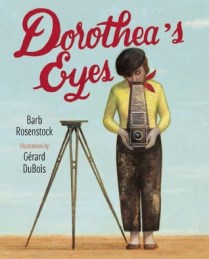 DOROTHEA’S EYES: DOROTHEA LANGE PHOTOGRAPHS THE TRUTH by Barb Rosenstock and illustrated by Gerard Dubois releasing March 1st from Calkins Creek. After a childhood bout of polio left her with a limp, all Dorothea Lange wanted to do was disappear. But this desire not to be seen helped her learn how to blend into the background and observe others acutely. With a passion for the artistic life, and in spite of her family’s disapproval, Dorothea pursued her dream to become a photographer and focused her lens on the previously unseen victims of the Great Depression. This poetic biography tells the emotional story of Lange’s evolution as one of the founders of documentary photography. It includes a gallery of Lange’s photographs, and an author’s note, timeline, and bibliography.
 THE MIDNIGHT WAR OF MATEO MARTINEZ by Robin Yardi releasing March 1st from Carolrhoda Books. Life is confusing for Mateo Martinez. He and Johnny Ramirez don’t hang out anymore, even though they used to be best friends. He and his new friend Ashwin try to act like brave, old-time knights, but it only gets them in trouble. His parents keep telling him to hold his sister’s hand when crossing busy streets, even though she’s the one who always runs ahead.
And last night, two skunks stole Mateo’s old trike. Wait—two skunks stole his trike? Mateo is too big for that rusty kid toy. He has a cool, shiny new bike anyway. But Mateo also has a neighborhood to protect. And he’s about to begin a big, stinky quest to catch the thieves. A quest that starts in the middle of the night
 ISABEL FEENEY, STAR REPORTER by Beth Fantaskey releasing March 1st from Houghton Mifflin Harcourt. It’s 1920s Chicago—the guns-and-gangster era of Al Capone—and it’s unusual for a girl to be selling the Tribune on the street corner. But ten-year-old Isabel Feeney is unusual . . . unusually obsessed with being a news reporter. She can’t believe her luck when she stumbles not only into a real-live murder scene, but also into her hero, the famous journalist Maude Collier. The story of how the smart, curious, loyal Isabel fights to defend the honor of her accused friend and latches on to the murder case like a dog on a pant leg makes for a winning, thoroughly entertaining middle grade mystery.
 EGYPTWORLD: DISCOVER THE WONDERS OF THE ANCIENT LAND OF TUTANKHAMUN AND CLEOPATRA by Stella Caldwell releasing March 1st from Carlton Kids. Unlock the secrets of an ancient and mysterious civilization. Through breathtakingly vivid images—including awe-inspiring CGI scenes—Egyptworld travels down the Nile River, through the land of the pharaohs. Return to a world where the desert sun sparks the gleaming tips of majestic pyramids, treasure-filled tombs hold mummified rulers, and colossal beasts of stone stand guard. This sumptuously illustrated book makes a perfect gift for all budding archaeologists!

HOUR OF THE BEES by Lindsay Eagar releasing March 8th from Candlewick Press. While her friends are spending their summers having pool parties and sleepovers, twelve-year-old Carolina — Carol — is spending hers in the middle of the New Mexico desert, helping her parents move the grandfather she’s never met into a home for people with dementia. At first, Carol avoids prickly Grandpa Serge. But as the summer wears on and the heat bears down, Carol finds herself drawn to him, fascinated by the crazy stories he tells her about a healing tree, a green-glass lake, and the bees that will bring back the rain and end a hundred years of drought. As the thin line between magic and reality starts to blur, Carol must decide for herself what is possible — and what it means to be true to her roots. Readers who dream that there’s something more out there will be enchanted by this captivating novel of family, renewal, and discovering the wonder of the world.
 MUTT’S PROMISE by Julie Salamon and illustrated by Jill Weber releasing March 8th from Dial Books. Luna is a farm puppy who loves to dance, and has only known a happy, serene life surrounded by her mother, Mutt, and her siblings, and cared for by Gilberto, the son of farm workers. But now Gilberto and his parents have moved on, and Mr. Thomas the farmer doesn’t feel he can take care of a whole family of dogs. He finds new homes for the puppies, not realizing that the man who took Luna and her brother does not have their best interests at heart. Luna and Chief, hungry and scared, are trapped in the smelly barn of a puppy mill—until they take matters into their own paws and find a way to escape. But can Luna and Chief find their way home?
 THE EYE OF MIDNIGHT by Andrew Brumbach releasing March 8th from Delacorte. On a stormy May day in 1929, William and Maxine arrive on the doorstep of Battersea Manor to spend the summer with a grandfather they barely remember. Whatever the cousins expected, Colonel Battersea isn’t it.
Soon after they settle in, Grandpa receives a cryptic telegram and promptly whisks the cousins off to New York City so that he can meet an unknown courier and collect a very important package. Before he can do so, however, Grandpa vanishes without a trace. When the cousins stumble upon Nura, a tenacious girl from Turkey, she promises to help them track down the parcel and rescue Colonel Battersea. But with cold-blooded gangsters and a secret society of assassins all clamoring for the same mysterious object, the children soon find themselves in a desperate struggle just to escape the city’s dark streets alive.
 EVERYDAY HERO by Kathleen Cherry releasing March 15th from Orca Books. Alice doesn’t like noise, smells or strangers. She does like rules. Lots of rules. Nobody at her new school knows she has Asperger’s, so it doesn’t take long for her odd behavior to get her into trouble. When she meets Megan in detention, she doesn’t know what to make of her. Megan doesn’t smell, she’s not terribly noisy, and she’s not exactly a stranger, but is she a friend? Megan seems fearless to Alice—but also angry or maybe sad. Alice isn’t sure which. When Megan decides to run away, Alice resolves to help her friend, no matter how many rules she has to break or how bad it makes her feel.
 THE EXTRAORDINARY SUZY WRIGHT: A COLONIAL WOMAN ON THE FRONTIER by Teri Kanefield releasing March 15th from Abrams. Children are taught much about the men who shaped early America, but history-shaping colonial women remain largely unknown and undiscussed. The Extraordinary Suzy Wright sets about to change that, telling the little-known story of Quaker Susanna (Suzy) Wright (1697–1784), a renowned poet and political activist. Suzy helped settle the Pennsylvania frontier, where she acted as legal counselor to her less literate neighbors, preparing wills, deeds, indentures, and other contracts. Surviving documents and correspondence between Suzy and a host of her contemporaries—including Benjamin Franklin; James Logan, Pennsylvania’s governor and chief justice; and a few signers of the Declaration of Independence—reveal that Suzy, from her home on the frontier, exerted considerable influence in the highest circles of Pennsylvania government. This fascinating and inspiring story includes an author’s note, bibliography, and index.
 THE CHARMED CHILDREN OF ROOKSKILL CASTLE by Janet Fox releasing March 15th from Viking. Something is not right at Rookskill Castle, a rundown Scottish manor shrouded in mystery. The castle is a temporary boarding school for children escaping the Blitz, but soon it’s clear there is something terribly wrong. There are clues hinting that a spy is in the house, and there are undeniable signs of a sinister magic. When the children in the castle’s temporary boarding school begin disappearing one by one, it’s a race against the clock for twelve-year-old Kat Bateson, her two younger siblings, and their new best friend.
 SUMMERLOST by Ally Condie releasing March 29th from Dutton Books for Young Readers. It’s the first real summer since the devastating accident that killed Cedar’s father and younger brother, Ben. But now Cedar and what’s left of her family are returning to the town of Iron Creek for the summer. They’re just settling into their new house when a boy named Leo, dressed in costume, rides by on his bike. Intrigued, Cedar follows him to the renowned Summerlost theatre festival. Soon, she not only has a new friend in Leo and a job working concessions at the festival, she finds herself surrounded by mystery. The mystery of the tragic, too-short life of the Hollywood actress who haunts the halls of Summerlost. And the mystery of the strange gifts that keep appearing for Cedar.
Which books are you looking forward to reading this month? Are there any that you’re excited about we might have missed? Happy Spring Reading!
Louise Galveston is the author of By the Grace of Todd, In Todd We Trust (Razorbill). She lives in southern Kansas with a passel of kids and a loud-mouthed parrot.

 Along with his MUF posts, T. P. Jagger can be found at
 His neighbors used to say that Abraham Lincoln loved to read, and would walk for miles to borrow a book. For having so little formal education, our 16th president was eloquent in both his writing and speeches, no doubt partly due to being such a fervent reader. We know Abraham Lincoln was a lover of great literature. But which books entertained him? What did he read for “fun?”
 Aesop’s Fables
 t of the Mohicans by James Fenimore Cooper