
Looking for great new titles you can fall back on this November? Here are some books that we’re looking forward to reading at MUF:
November 3rd:
RUBY REINVENTED by Ronni Arno (Aladdin) Ruby Miller has it made. As the only child of model-turned-TV-host Celestine Cruz and pro-baseball star Zack Miller, she has everythin g a twelve-year-old girl could want. Well, except for real friends.
After a disastrous birthday party where she discovers her supposed BFFs are only friends with her because her parents are uber-famous, she finds a place as far from fake and phony Hollywood as she can get: a boarding school in Camden, Maine. In her desperation to distance herself from her star-studded parents and the paparazzi who trail them, Ruby tells her new friends that she’s an orphan. She feels awful about lying, but once she starts, it’s hard to come clean. Plus, now that nobody’s comparing her to her perfect parents, Ruby can finally let her own talents as a dress designer take center stage.
When Ruby finds herself connecting with a cute boy who really did lose his parents, she’s torn between who she is and who she’s pretending to be. And with Parents’ Weekend approaching, she must find a way to keep her secret—without losing her new best friend, the trust of her first crush, and the chance to shine as the designer of her very own fashion show.
MY DIARY FROM THE EDGE OF THE WORLD by Jodi Lynn Anderson (Aladdin) Spirited, restless Gracie Lockwood has lived in Cliffden, Maine, her whole life. She’s a typical girl in an atypical world: one where sasquatches helped to win the Civil War, where dragons glide over Route 1 on their way south for the winter (sometimes burning down a T.J. Maxx or an Applebee’s along the way), where giants hide in caves near LA and mermaids hunt along the beaches, and where Dark Clouds come for people when they die.
To Gracie it’s all pretty ho-hum…until a Cloud comes looking for her little brother Sam, turning her small-town life upside down. Determined to protect Sam against all odds, her parents pack the family into a used Winnebago and set out on an epic search for a safe place that most people say doesn’t exist: The Extraordinary World. It’s rumored to lie at the ends of the earth, and no one has ever made it there and lived to tell the tale. To reach it, the Lockwoods will have to learn to believe in each other—and to trust that the world holds more possibilities than they’ve ever imagined.
DEAD POSSUMS ARE FAIR GAME by Taryn Souders (Sky Pony)  As the end of the school year approaches, the fifth-grade teachers at Victor Waldo Elementary conclude there’s not enough time to complete a new math unit before summer break. Great news for math-phobic Ella, right?
Wrong! The teachers decide instead to have their students host the first-ever Math Fair. And the fair project is worth two major math grades.
Add in one dead possum plus two horrible roommates who come to stay while their house is being renovated, and you have an equation for disaster. Ella is headed for summer school and math tutoring for sure. Can she stop her troubles from multiplying before it’s too late?
FAST BREAK by Mike Lupica (Philomel)  Forced to live on his own after his mom dies and her boyfriend abandons him, 12-year-old Jayson does whatever it takes to get by. He will do anything to avoid the foster care system. Besides, his real home has always been the beat-up basketball court behind the projects in the North Carolina hills, and his family has always been his friends and teammates. He manages to get away with his deception until the day he gets caught stealing a new pair of basketball sneakers. Game over. Within a day a social worker places him with a family from the other side of town, the Lawtons. New home, new school, new teammates.
Jayson, at first, is combatative, testing the Lawtons’ patience at every turn. He wants out, yet the Lawtons refuse to take the bait. But not everyone in Jayson’s new life is so ready to trust him–and even Jayson’s old friends give him a hard time now that he’s attending a school full of rich kids. It’s on Jayson to believe that he deserves a better life than the one he once had. The ultimate prize if he can? A trip to play in the state finals at Cameron Indoor Stadium–home to the Duke Blue Devils and launching pad to his dream of playing bigtime college ball. Getting there will be a journey that reaches far beyond the basketball court.
PRESIDENT OF THE WHOLE SIXTH GRADE by Sherri Winston (Little, Brown) In this sequel to PRESIDENT OF THE WHOLE FIFTH GRADE, Brianna navigates her toughest challenge yet: middle school.
 Brianna Justice is determined to raise enough money for the big class trip to Washington, D.C., but she’s up against a lot: classmates who all pretend to be something they’re not, a new nemesis determined to run her out of office, and the sinking feeling she’s about to lose her two best friends. But just when she begins to lose hope, she comes to realize that sometimes surprises can turn out even better than the best-laid plans.
November 10:
A BITTER MAGIC by Roderick Townley (Knopf) Everything is in place: the packed theater, the Amazing Thummel, and, center stage, the magician’s mysterious assistant. Some have called her the most beautiful woman in Euro pe.
pe.
Then, in a swirl of light, she vanishes!
An astounding illusion, but she never reappears. All that remains are a bloodstained white scarf and her daughter, Cisley, who lives in a glass castle and walks her pet lobster each morning by the sea.
Enter Cole, a rambunctious boy from town and Cisley’s first true friend. Together they hunt for clues to her mother’s disappearance. They puzzle over broken mirrors, ever-shifting labyrinths, a closet full of whispering ball gowns, and a fatal quest for a pure black rose.
Roderic Townley spins a deliciously spooky tale of one girl’s journey to discover what’s real and what is simply an illusion.
IN THE FOOTSTEPS OF CRAZY HORSE by Joseph Marshall, illus. by Jim Yellowhawk (Amulet) Jimmy McClean is a Lakota boy—though you would not  guess it by his name: his father is a white man and his mother is Lakota. When he embarks on a journey with his grandfather, Nyles High Eagle, he learns more and more about his Lakota heritage—in particular, the story of Crazy Horse, one of the most important figures in Lakota history. Drawing inspiration from the oral stories of the Lakota tradition and the Lakota cultural mechanism of the “hero story,” Joseph Marshall provides readers with an insider’s perspective on the life of Tasunke Witko, better known as Crazy Horse. Through his grandfather’s tales about the famous warrior, Jimmy learns more about his Lakota heritage and, ultimately, himself.
FINDING FORTUNE by Delia Ray (Farrar, Straus and Giroux) Running away from home isn’t as easy as Ren thinks it will be. At least she isn’t running very far-just a few miles to the ghost town of Fortune . . . or Mis-Fortune as everyone else calls it. Mis-Fortune on the Mississippi. Supposedly, there’s an abandoned school on t he outskirts with cheap rooms for rent. Ren knows her plan sounds crazy. But with only a few more weeks until Dad comes home from his tour of duty in Afghanistan, she also knows she has to do something drastic so Mom will come to her senses and stop seeing that creep Rick Littleton for good.
From the moment she enters the school’s shadowy halls, Ren finds herself drawn into its secrets. Every night old Mrs. Baxter, the landlady, wanders the building on a mysterious quest. What could she be up to? And can Mrs. Baxter’s outlandish plan to transform the gym into a pearl-button museum ever succeed? With a quirky new friend named Hugh at her side, Ren sets out to solve the mystery that could save Fortune from fading away. But what about her family’s future? Can that be saved too?
NINJA TIMMY by Henrik Tamm (Delacorte)  Timmy the cat, his pal Simon the mink, and the pig brothers Jasper and Casper are inventors, and they’re hoping to sell their fabulous new contraption to a local merchant. With high hopes, they haul their machine through the crowded streets of Elyzandrium—and are promptly robbed by a gang of bullies. With the help of two new friends, Alfred, a kindly old toymaker, and Flores, a skilled cat pilot, Timmy and his pals set out to get back what is rightfully theirs. As it turns out, they’re not the only victims of these dastardly criminals. But what can this band of misfits do?
In this action-packed adventure, the intrepid Timmy and his wily friends transform themselves into crime-fighting ninjas—and quite possibly heroes!
BORROWED TIME by Greg Leitich Smith (Clarion)  In this time-travel dinosaur adventure, Max Pierson-Takahashi and his friend Petra return to the days of the dinosaurs, where they must survive attacks from mosasaurs, tyrannosaurs, and other deadly creatures, including a vengeful, pistol-toting girl from the 1920s. The fast pace, mind-bending time twists, and Greg Leitich Smith’s light, humorous touch make this an exciting, fun choice for readers looking for adventure and nonstop action.
November 17:
ABRACADABRA: THE STORY OF MAGIC THROUGH THE AGES by H.P. Newquist, illus. by Olga and Aleksey Ivanov 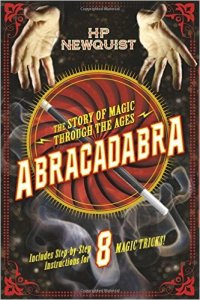 (Henry Holt) Magic is a word we use to describe something amazing, awe-inspiring, or spectacular. Truly great magic makes us believe in things we know can’t be real. In the hands of the greatest magicians, even a simple card trick can become truly wondrous.
Now, in this nonfiction narrative of magic through the ages, HP Newquist explains how the world’s most famous tricks were created. From the oracles of ancient Egypt and the wizards of medieval Europe on to the exploits of Houdini and modern practitioners like Criss Angel, this book unlocks the secrets behind centuries of magic and illusion.
Fully illustrated and including step-by-step instructions for eight classic magic tricks, this book will have middle-grade readers spellbound.
ON THE RUN by Tristan Bancks (Farrar, Straus and Giroux) Ben has always wanted to be a cop, so he’s intrigued when police officers show up at the door, asking for his parents. Then his parents arrive after the police leave and rush him and his sister into the car, insisting they are going on a vacation. Ben’s a little skeptical–his family doesn’t go on vacations. After they lose the police in a high-speed car chase and end up in a remote cabin deep in the woods, Ben discovers his parents’ secret: millions of dollars were deposited into their bank account by accident, and they took the money and ran off. Ben isn’t sure what to think. Are his parents criminals? And because he ran off with them, is he a criminal, too?
THE HUMAN BODY: THE STORY OF HOW WE PROTECT, REPAIR, AND MAKE OURSELVES STRONGER by H.P. Newquist (Viking)  Did you know the first blood transfusions were between people and lambs? Or that the first prosthetic hand with a hook was created so a French soldier could hold the reins of his horse in battle? Or that scientists recently grew a nose?
Invention & Impact, an exciting new series from PYRG-Smithsonian, introduces young readers to experiments, discoveries, and breakthroughs such as these, which have huge impacts on our world. Designed with exciting images from the Smithsonian’s vast collections, each highly visual book in the series starts with a big idea and then explores that concept through specific objects that give kids the micro and meta picture on how inventions and ideas connect over time.
The debut book in the series looks at one of the most complex systems on planet Earth: the human body. From artificial eyeballs to aspirin to 3-D printed body parts, The Human Body profiles the objects that scientists and tinkerers throughout history have invented (or cobbled together) to protect, repair, or improve our physical selves. And there are plenty of fascinating stories behind these objects!
Which of these or other middle-grade titles are you looking forward to reading? Let us know in the comments!


