Posts Tagged teachers

STEM Tuesday Field Work — In the Classroom

Exploring “In the Field”

When you think of scientists working in the field, what do you imagine? I imagine them venturing to remote, possibly dangerous sites. Then again, some field work is closer to home, less rugged. And, as this month’s books reveal, modern field work can sometime mean anxiously awaiting data and video feeds while a specially equipped drone or other remote sensing device ventures far from home. No matter what the exact circumstances may be, this month’s titles transport readers to many places and offer exciting tales of passionate scientists eager to answer their questions. Let’s begin diving into this theme with a look at underwater archaeology.

Support Independent Bookstores - Visit IndieBound.orgSubmerge Yourself in a Science Mystery

Secrets of a Civil War Submarine is packed with possible science learning connections. Especially relevant to this month’s theme is the archaeological practice of studying objects in situ, carefully documenting and noting the physical relationships among the artifacts at a site. Readers witness  this practice as author Sally M. Walker takes them to the murky, underwater field where the 150-year-lost historic H.L. Hunley was discovered. Here scientists meticulously record the locations and orientations of the objects on the site before removing anything from the site. Later, scientists carefully record the sub’s interior objects’ spatial relationships before extracting them for study. The importance of preserving these details becomes clear when the data later prove important in answering scientists’ questions.

You can enhance students’ appreciation of the value of this information with a simple lesson involving different arrangements of a set of objects undergoing different events.

For example, imagine a site that includes a computer mouse, piece of paper, computer, glass, chair, desk. Ask students to sketch or create 3D scenes of these artifacts’ positions and orientations based on each of the following scenarios:

Scenario A: A left-handed person seated in front of a computer spilled a glass of water on a computer keyboard. Then the person jumped away from the desk, knocking over the chair.

Scenario B: A right-handed person seated in front of a computer fainted and fell out of the chair, knocking over a glass of water.

Scenario C: A left-handed person carrying a glass of water walked toward the desk, approaching it from the right, when a dog ran through the room from left to right, first toppling the chair, then bumping the person, which made the glass of water fall out of his/her hands.

Discuss how (and why) the layout of the artifacts varies in each of the representations, providing unique clues to each event. If you are feeling more adventurous, you might try either of these variations:

  • Before the activity, prepare secret assignment cards. On each card, print only one scenario but make sure A, B, and C are all represented in the class pile of cards. Randomly distribute the cards to student pairs, who must then sketch or use model artifacts to show the event. Next, each team can examine another team’s scene, making careful observations and beginning to make inferences about what happened to result in the objects’ arrangements.  After revealing the three scenarios, challenge students to infer which of the scenarios each student representation seems to match (and why). Discuss the observations and inferences that are related to the spatial relationships among the artifacts, and how they provide clues to a prior event.


  • For a more open-ended challenge, ask student pairs interpret other sketches as much as possible, without telling them what the three scenarios are. Support student thinking with questions such as:
    • What’s similar/different between the scene you are looking at and the one you just created? Do you think the scenario implied here is the same or different from the scenario that informed the scene you created? Why?
    • If different, what details about the event can you infer from the scene? What evidence supports your ideas? What is unexplained?

Looking at the entire set of scenes in the classroom, students might infer how many different scenarios are represented, using evidence to make arguments that support their claims. You might decline to tell students the answer, as archaeologists can never go back to the original witnesses and check their ideas.


Support Independent Bookstores - Visit IndieBound.orgStudy Primates in the Field

As a biography of a groundbreaking field scientist, Anita Silvey’s Untamed, the Wild Life of Jane Goodall covers a lot of territory, including an exciting glimpse into this pioneer’s experiences as a field scientist.

Help students envision a primate scientist’s field work by comparing their own daily routines to their understandings (based on the text) of Jane’s early work in the field. Students might log where they eat, what they have to do to get their food and water, and where and when they sleep. They can break the day down into an hour-by-hour log of activities. For comparison, they can read about Jane’s early field activities on pages 28-33. Pages 71 and 73-77 address some ways that chimpanzee scientists’ field work has changed. They won’t be able to make exact correlations between their days and details about the scientists’ experiences, but they’ll get a flavor of the differences. Ask students to reflect on what aspects of being a field-based primatologist might be most exciting and challenging.

An engaging way to convey the lure of primatologists’ field work is watching videos of primates in their habitats. Show students one or more of these clips (with or without the narration) and discuss their observations (what they see and hear) and inferences (what sense they or the narrator/scientists make of what is observed). You might use some of the ideas in December’s STEM Tuesday In the Classroom installment, which focused on zoology.

Individual animals’ “personalities” and their relationships with other group members are important.  Field scientists often learn to identify individuals by sight. Your students might enjoy trying to learn the names and details about the chimps pictured on pages 84-87, perhaps by creating flash cards with copies of their pictures on the front.


Support Independent Bookstores - Visit IndieBound.orgJourney into Meteorology and the Eye of the Storm

Of course, field studies extend beyond the bounds of biology, as you will see in Eye of the Storm: NASA, Drones, and the Race to Crack the Hurricane Code, by Amy Cherrix. While you might appreciate the extensive teacher’s guide  that offers many ideas for discussions and classroom activities, you might want to focus specifically on field work. If so, you might show NASA videos featuring drone missions to hurricanes, such as NASA Hurricane and Severe Storm Sentinel (HSE) – Studying Storms with the Global Hawk UAV. You can also sign up to connect your classroom to NASA’s airborne missions. If you do, you will gain access to the same video that NASA scientists see when they run the drone flights, and receive additional support.

As you might imagine, classic field-based weather observations make a great connection to this book. For example:

  • Your class might commit to participating in a citizen scientist group of weather watchers, (which may require modest investments in standard equipment), such as the CoCoRaHS Network.
  • For independent observing, students might build and use their own weather stations. Build Your Own Weather Station, published by the National Oceanic and Atmospheric Administration, offers instructions.
  • If you prefer, challenge students to engineer their own instruments (based on designs that they research), as described in a free Integrated STEM Lesson Plan by R. Bruno.


The books on this month’s list offer many opportunities to jump into field work. How might you involve your students in actual or simulated field studies? What suggestions do you have to expand upon the ideas in this post? Please share your comments and questions!


portrait of author Carolyn Cinami DeCristofanoSTEM author Carolyn Cinami DeCristofano is also a STEM education consultant who supports teachers, librarians, schools, and organizations by providing curriculum development and professional development services. Find out about her books at http://carolyndecristofano.com and her consulting at http://bhstemed.us.

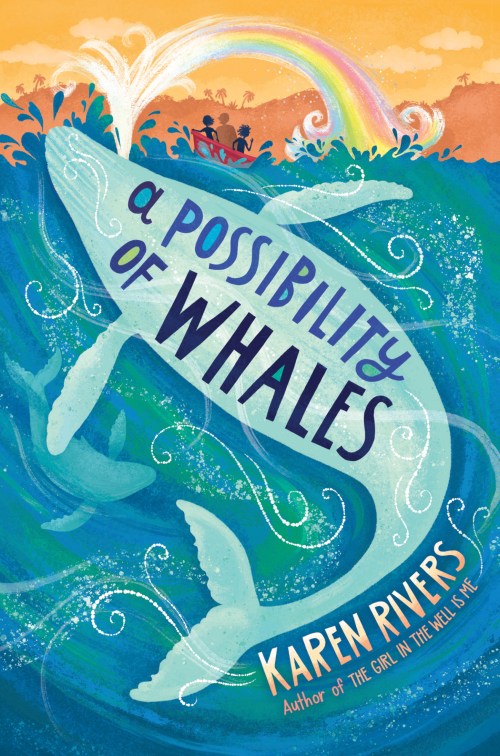
A Possibility of Whales with Author Karen Rivers

Are you up for a pre-book birthday celebration?

Great! Because I have the amazing Karen Rivers here to chat about her upcoming release A POSSIBILITY OF WHALES. Her book birthday is in six days.

Here’s a peek into Karen’s book.

The heartfelt story of a girl who–thanks to her friends, her famous single dad, and an unexpected encounter with a whale–learns the true meaning of family.

Twelve-year-old Natalia Rose Baleine Gallagher loves possibilities: the possibility that she’ll see whales on the beach near her new home, the possibility that the trans-gender boy she just met will become her new best friend, the possibility that the paparazzi hounding her celebrity father won’t force them to move again. Most of all, Nat dreams of the possibility that her faraway mother misses her, loves her, and is just waiting for Nat to find her.

But how can Nat find her mother if she doesn’t even know who she is? She abandoned Nat as a baby, and Nat’s dad refuses to talk about it. Nat knows she shouldn’t need a mom, but she still feels like something is missing, and her questions lead her on a journey of self-discovery that will change her life forever.

In her unique, poignant narrative voice, Karen Rivers tells a heartwarming story about family, friendship, and growing up, perfect for readers of Katherine Applegate and Rebecca Stead.

***

Hi Karen! It’s wonderful to have you visit us. Did you always want to be a children’s author and what’s been your biggest surprise from doing so?

No, absolutely not. I honestly don’t think I would have thought it was possible. I didn’t even entertain the idea, although I was always writing. (It’s a bit of a mystery to me now, why I thought of authors as some realm of human beings so far above me that I didn’t even consider it.) I wanted to be a vet.  At certain points, I thought about acting, about law, about medicine, but I didn’t really consider writing as a possibility until after I’d written a book and sold it (it was an adult book that I don’t think I started believing it would ever be anything) and only THEN did it occur to me that I could go back to my first love, which was the books that mattered the most to me in my life, which were the books that I read when I was in middle school and in high school.

The mere blurb of A Possibility of Whales made my heart flutter. What was it like writing this poignant story?

I loved writing every word of this book. I had wanted to write a book that was a nod to ARE YOU THERE GOD, IT’S ME, MARGARET, a book that was about puberty and that transitional feeling of being in-between childhood and adulthood, being uncertain and even afraid of what the physical changes mean. That was my starting point. But when I dug deeper, I thought about my own kids, and how hard it has been for my son to be the boy-child of a single mother as he navigates puberty, so I wanted to give my character a single dad. I love Nat’s dad, who was loosely inspired by The Rock (with a touch of Matthew McConaughey thrown in). I love their relationship, their tiny family, the way they are a unit, but also the way that he can’t be a mother to her, he can’t be everything she needs. I loved exploring the ways that she found what she needed with her friendship with Harry and with The Bird. I loved bringing Harry to life, giving him a voice to be himself and not just a token character. His story is also rich and full and he has so much to say. And of course, I love the whales, both literally and symbolically. It all came together in my head in this complete piece and every day I got to spend with these characters was a joy.

I love the family aspect of this story!

Nat is a hopeful soul, but she has a lot going on. How did you use her sense of hope, yet spotlight her internal conflicts without dousing her positive outlook? And what can your young readers learn from this?

At certain points, Nat has a choice where she could allow the rejection and loneliness to take over, and she always manages to reach the lifeboat before she sinks. I think that kids instinctively do this, certainly not consciously, especially if they do – like Nat – have an adult who is 100% on their side. I think it’s harder for kids who don’t have a parent like Nat’s dad, who are not getting that kind of love and support from at least one person. My son’s therapist is always reassuring me that it just takes one. Kids need ONE person who is an anchor in their life, who creates the scaffolding for them to safely be themselves. I hate to think of teaching young readers a lesson, it somehow becomes didactic if I’m conscious of it, but what I’m always trying to do in my books (all of them) is to take a character who may, on the surface, seem like they are not OK or they are not going to be OK, and at the end have them realize – not from something external, but from something internal – that they ARE OK. I feel like readers at this age are all struggling with that question, “Am I OK? Am I going to be OK?” And I want to speak directly to all of them and to say through my books, through my characters, “YES. You are OK. You will be OK. You’ve got this.”

What aspect of Nat’s story do you think children of this age will relate to most?

I think the idea of feeling like you want to pump the brakes as puberty starts to loom is pretty widespread. In ARE YOU THERE GOD, the kids all seemed to want to rush towards puberty, to be the first. But amongst my kids and their friends, I see something different. I think life moves so fast now that kids are in less of a hurry to get to adulthood. Maybe we aren’t selling it well. But I think the mixed feelings about physical changes are top of mind to a lot of kids. I also think that kids will love Nat’s dad. I wrote him as a kind of idealized dad, a dream dad. 

Any advice to parents who read this book with their children on how to start a heartfelt discussion about some of the issues Nat deals with?

My best and only advice to parents is always to just create space where you can truly listen to what your kids are trying to tell you. So many times, we go into these conversations armed with what we think are the right things to say because we want to get it right, and we forget to really listen, to truly hear what they are saying. Make space! Don’t assume anything.

So, what do you see and what can your fans expect next on your horizon?

I have so many books in various stages of production right now! My next middle grade with Algonquin is called NAKED MOLE RAT SAVES THE WORLD and it’s about a kid who has a really unusual “superpower” and has to use it to, well, save the world (in the small picture, that is). It’s another book with a single parent, a kid who feels ‘different’ and about the way we seek and find our people and our place in a world that doesn’t always seem to understand us; it’s about expectations and figuring out how to be who you are.

Thank you for sharing your thoughts with us, Karen! Wishing the all the best in the future.

***

Karen Rivers grew up in British Columbia, where she takes loads of photos, goes on lots of walks, and writes books. She believes that stories are all secret passages to alternate worlds where we can be safe to explore the unsafe, the unsettling or the unfair hands some people have been dealt.  She also believes in you. Find Karen on her Website and Twitter.

Want to own your very own copy of A Possibility of Whales? Enter our giveaway! (*Winner will be announced via Twitter on March 14th.)

a Rafflecopter giveaway

STEM Tuesday Wild and Wacky Science — Interview with Sarah Albee

Welcome to STEM Tuesday: Author Interview & Book Giveaway, a repeating feature for the fourth Tuesday of every month. Go Science-Tech-Engineering-Math!

Today we’re interviewing Sarah Albee who wrote this month’s featured wild and wacky science book, POISON: Deadly Deeds, Perilous Professions, and Murderous Medicines.

Sarah Albee is the New York Times bestselling author of more than 100 books for kids, ranging from preschool through middle grade. Recent nonfiction titles have been Bank Street College of Education Best Books selections, Notable Social Studies Trade Books, and winners of Eureka! Nonfiction Children’s Book Awards. She loves to meet her readers and visits K-8 schools all over the country.

Mary Kay Carson: Tell us about Poison and how you came to write it.

Sarah Albee: It’s the history of how humans have poisoned one another, from ancient times to the present. For kids who want to delve deeper into the chemistry of a particular poison, there are “tox boxes” throughout the book that describe how a particular poison can be delivered, where it comes from or how it is manufactured, and what the symptoms are when a person is poisoned. I’ve been obsessed with poison and how it works ever since I was a little kid and first read Snow White. I wanted to know what sort of poison was in that apple. How could it cause a reversible paralysis and a heartbeat that is so slow, you might not find a pulse and conclude that the victim is dead? And because I know you are wondering, too, I’ll tell you my theory: atropine. It’s a plant-based alkaloid found in belladonna and mandrake, and used to be known as sleeping nightshade. Back in 1597 a botanist wrote that a small amount of belladonna leads to madness, while a moderate amount causes “dead sleepe” and a lot of it can kill you.

MKC: You undertook a phenomenal amount of research to write this book. 

SA: I uncovered so many cool stories, I didn’t have room to include them all in the book. So I released a series of short videos called The Poison Files, mostly “whodunit” poison cases from history, and starring some great kid-actors. You can find them on YouTube and on my website.

MKC: This book, as well as others you’ve authored, are a mix of both history and science. Do you have a STEM background? 

SA: Many of my books are a mash-up of history and science. I am more of a historian than a scientist. In fact, to refresh my scientific knowledge, I took two online college courses as part of my research for this book (chemistry and forensics). But the division of human knowledge into separate disciplines is a relatively recent phenomenon, and in my mind, somewhat of an artificial construct. Enlightenment era thinkers considered all human knowledge seamless. What I find fascinating to explore and to write about are the in-between areas—the science behind historical events, the history of science, the real lives of painters and musicians and how their experiences informed their art, and the real-life events that might have inspired novels and poems.

MKC: For readers who loved POSION, what other middle-grade books would you suggest—nonfiction and/or fiction?

SA: I’m a big fan of How They Croaked/How They Choked by Georgia Bragg (and, fun fact, we share the same editor!). Also books by Carlyn Beccia (she has a new one coming out in April that I can’t wait to read, called They Lost Their Heads!). Another science writer with a great sense of humor is Jess Keating. Love her books!

MKC: What’s next for Sarah Albee?

SA: I am hard at work right now on a book that has yet to be announced, so I can’t talk too specifically about it. But it will be a combination of (true) stories that include a bit of history, science, biography, art, and sports, all rolled into one. As for how I’m tackling it…let’s just say one must tiptoe gently through my office to avoid setting off an avalanche and being crushed beneath a tumbling pile of books.

More about Sarah Albee and her book POISON:

  • Read reviews from KirkusSchool Library JournalBooklist, and Bulletin for the Center for Children’s Books here.
  • Buy the book!
  • See the book trailer!
  • Watch six videos from Sarah Albee’s “Poison Files.”

Win a FREE copy of POISON!

* Enter the giveaway by leaving a comment below.*  The randomly-chosen winner will be contacted via email and asked to provide a mailing address (within the U.S. only) to receive the book.

Good luck!

Your host this week is Mary Kay Carson, fellow space geek, science nerd, and author of Mission to Pluto and other nonfiction books for kids.