Welcome to STEM Tuesday: Author Interview, a repeating feature for the last Tuesday of every month. Go Science-Tech-Engineering-Math!
Today, we are thrilled to travel to the Czech Republic to interview Magda Garguláková, author of Bridges (April 2025, Post Wave). Explore the amazing world of bridges—from ancient stone arches to modern marvels—and discover how they connect us all! This illustrated 64-page hardcover book delves into the history, engineering, and construction of bridges. Intricate illustrations by Jakub Bachorík invite readers to follow roads and rivers and stumble upon tiny details: a cyclist, a stroller, a leashed dog, and more.

About the book:
Imagine a world without bridges, where every journey takes longer, rivers become obstacles, and valleys are nearly impossible to cross. Bridges don’t just make travel easier—they connect us to extraordinary places, too.
Take a journey through the fascinating world of bridges, exploring their awe-inspiring structures and the visionary architects who brought them to life. Uncover the secrets of bridge-building and marvel at some of the most famous designs from around the globe. Along the way, enjoy captivating comic strips, fun facts, and hands-on engineering activities.
Bridges
Linda: Tell us about your book, Bridges.
Magda: Bridges is a large-format, illustrated non-fiction book that invites readers into the world of bridges. It is richly illustrated with Jakub Bachorík’s distinctive, playful, and original—yet highly precise—artwork.
I like topics that can be explored from many different angles, and bridges are perfect in this respect. In the book, I don’t look at them strictly as architectural structures, engineering constructions, or from the perspective of how they are built. I also ask why people started building bridges in the first place, how they influenced history and technological progress, how they have evolved, how they have changed our everyday lives, why they are such powerful symbols, and what surprising kinds of “bridges” we can find outside architecture.

The book is intended primarily for children aged nine to eleven. It is fact-based but playful, and the amount of text is just right. I tried to draw readers into the topic and spark curiosity about bridges. Although it is designed for children, it also works very well as an all-age book. I’m really happy with readers’ responses, as it turns out that it resonates across generations and appeals to adults as well.
Linda: That’s wonderful. What inspired you to write about this topic?
Magda: It’s actually quite simple. I’ve been fascinated by bridges since childhood. I don’t even really know why, but they’ve always drawn me in and sparked my curiosity. I’m also an amateur admirer of architecture, especially modern architecture, and I love concrete as a building material as well as riveted steel structures.
What fascinates me about bridges is not only their technical side; I’m equally drawn to how multilayered a symbol they are—how they can bring hope and expectation, how important a role they play in our lives, and, at the same time, how ordinary and invisible they often feel in everyday life. I enjoy the overlaps they offer—into history, art, culture, and everyday experience.
And then there’s one more thing: I’m afraid of heights. So bridges are also a bit of a challenge for me. I actually prefer looking at them rather than from them—and quite often, that turns out to be a more interesting view anyway. 😊
All of this together makes them a perfect subject for a book. It also invites rich illustration, which can communicate with readers in its own way, which is why I like to give illustrations a very important role in my books.

Linda: The textured maze-like illustrations complement the text. How did you organize the material in this book, and why did you choose to present it this way?
Magda: Let me start a bit broadly. When I begin working on a book, the first thing I look for is its overall arc: where I start and where I want to arrive. The flow of the book—how individual pieces of information and thematic sections are arranged—is essential to me. I constantly think about what follows what, why it should be that way, and to what extent I need to follow the logic of the subject. These are questions I return to again and again. During the process, I create several versions of dummy layouts where I test and rearrange the order and structure of the content. It’s one of the most important parts of my creative process.
At the same time, I enjoy when the reader is occasionally surprised, and the expected flow is interrupted—when the rhythm of the book shifts or something unexpected appears.
Bridges reflects all of this. It follows a logical structure of the topic, but it also allows for occasional detours. I wanted the book to flow like a river—one idea leading to another, layering and complementing each other.
It was also important to me that the book works even when read non-linearly. In other words, you can open it almost anywhere and immediately find something that grabs your attention. In this respect, Jakub Bachorík’s illustrations are essential—I knew from the very beginning that they would not just accompany the text, but become an equal part of the storytelling. Thanks to them, the book gains its unique atmosphere and appeal.
Linda: In the book blurb, there is a statement that “bridges connect us to extraordinary places.” Can you tell us about some of these places?
Magda: When I say that bridges connect us to extraordinary places, I don’t mean only specific destinations on a map or in our surroundings, but also different kinds of experiences and meanings. Some bridges lead into dramatic natural landscapes, places that would otherwise be very difficult to reach. Other bridges become destinations in themselves—iconic landmarks and architectural highlights that people travel to see.

At the same time, we also use the word “bridge” in much broader contexts. Metaphorically, a bridge can take us anywhere we can imagine. We perceive it very positively as a symbol of change or transition, and it can even signify passage into another world. It is a very powerful symbol on many levels.
And then, there is also a more playful aspect where we encounter “bridges” in unexpected places—such as in dentistry or in a yoga class.
Linda: By looking at the word “bridge,” and its many meanings and its symbolism, you added depth to this work. What would you like readers to get out of this book?
Magda: I often think about this. If I keep it to the most basic wish, it is simply that I want my book to inspire enthusiasm for bridges, encouraging us to notice, explore, and appreciate them.
If a reader, thanks to my book, decides to stop on a bridge and enjoy the view, remembers the complexity involved in bridge construction, or, with joy and an awareness of their importance, appreciates a bridge expansion joint, that would already be enough.
The book is quite intense, so it is good to take breaks while reading it, come back to it, and discover things that may have escaped you the first time. I would therefore be very happy if the book worked this way and readers enjoyed returning to it—either on their own or when reading it together.
I have also personally found that it is a great travel companion; it presents a large number of bridges from all over the world, many of which you will simply want to see in real life (or at least some of them).
Linda: This book includes fun engineering activities. I’m intrigued. How can parents, teachers, and librarians use this material?

Magda: The book includes a challenge to build your own bridge out of dried spaghetti. It’s a playful activity, but it also works as a small test of engineering thinking and technical skills. The task is to build a bridge—of any size and design you dare to attempt—that can hold a load without collapsing.
This activity can be used at home, in schools, or in libraries as a simple project or even a small competition. It is a lot of fun, but also requires real thinking. I’ve tried building several of these bridges myself—and you can probably guess how that went…
Linda: Lol! Instead of building a bridge, it might be easier to boil the spaghetti and toss it with some pasta sauce. Magda, thank you so much for joining us!

Magda Garguláková studied Art History at the Faculty of Arts of Masaryk University in Brno, in the Czech Republic. She works as a curator and producer at the Brno-based art gallery OFF/FORMAT. After spending some time in marketing, she eventually found her way back to books, which she has loved since childhood. She collaborates with Albatros Media and its foreign rights editorial team, writing and editing mainly nonfiction illustrated books for children. She is the author of more than ten books, which have been translated into numerous languages around the world. Her The Hand Book was selected among the 100 most beautiful books at the 2022 Bologna Children’s Book Fair and was nominated for several prestigious awards in the Czech Republic and Italy. For older readers, she also wrote the acclaimed Bridges, whose illustrations by Jakub Bachorík received the Golden Ribbon Award and which was honored with the Open Book Award in Taiwan. She lives in Brno, Czech Republic, with her husband and their two daughters. Her books have been translated into English, French, German, Spanish, Korean, Japanese, and several other languages.

Linda Zajac is the author of Robo-Motion: Robots That Move Like Animals and eight Minecraft books for kids. She is an award-winning science writer who gained an appreciation for bridges after a stream crossing that involved straddling an iced log. Find her at www.lindarosezajac.com


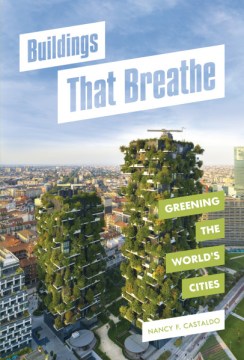
 AD: Boeri’s vision of a building that incorporates trees and essentially becomes one great tree that “incidentally houses humans” is a real shift from our traditional way of thinking of architecture as serving humans—these buildings serve the land. Why do you think that shift is happening now?