River systems are an essential part of Earth’s ecosystems. Rivers provide water and habitats for animals and plants. Their flowing waters are a source of transportation and power for the communities that live nearby. Rivers are even a place for celebrations, festivals, and recreational activity. Life would not be the same without rivers.
A River’s Impact
Rivers have shaped life all over the world. Students can explore the impact some famous rivers have had in these books:
Ten Rivers That Shaped the World by Marilee Peters, illustrated by Kim Rosen
 As the rivers of our world twist and turn, they also mold our history. Readers can take a metaphorical dive into 10 fascinating rivers that shaped our lives and learn fun facts along the way such as why people in India have gathered to bathe in the Ganges for thousands of years. The book shows readers that rivers can be extraordinarily powerful, not simply because of their fast-flowing currents, but because of their ability to make civilizations rise or crumble. Through a colorful and engaging layout, this book teaches both geography and world history.
Where is the Mississippi River? by Dina Anastasio, illustrated by Ted Hammond
 Part of the popular Where Is? series, this chapter book traces the history of the Mississippi River from its formation during the Ice Age into the present day. Over time, the “mighty Mississippi” has been a home for wetland wildlife, an important route for trade and military campaigns, and an inspiration for classic literature. Engineering connections are embedded into a section about flooding disasters and various efforts to design flood-prevention structures like levees and spillways.
Great Rivers of the World by Volker Mehnert, illustrated by Martin Haake
 This gorgeous atlas travels down 17 rivers in six continents, from the Rhine in Europe to the Murray in Australia. Each river is introduced with a full-page map, a short narrative, and fascinating facts about its history and ecology. With eye-popping icons of landmarks, animals, plants, and people, readers will always find more to discover and explore.
Activity #1
What rivers are closest to where you live? Identify and research a nearby river. What impact has the river had on the local community? What is the river’s history? How was it used in the past? How does that compare to how it is used today? What industries rely on the river? What problems are associated with the river? How can these problems be solved? Present what you have learned.
Activity #2
Rivers are full of plant and animal life. Plants provide food and shelter for many animals. Some animals and plants live under the water, while others live on the water’s surface. Other animals and plants live on riverbanks near the water. What animals and plants live in the river near you? Take a fieldtrip to the river and see how many different plants, animals, and insects you can find. How does each fit into the river’s ecosystem?
Healthy Rivers
A healthy river is essential for the communities and ecosystems that rely on it. Students can learn about efforts to conserve water and improve the health of our waterways in these books.
Going Blue: A Teen Guide to Saving Our Oceans, Lakes, Rivers & Wetlands by Cathryn Berger Kaye, M.A. and Philippe Cousteau with EarthEcho International
 Written in conjunction with ocean spokesperson Philippe Cousteau, grandson of the illustrious Captain Jacques Cousteau, this call-to-action book is both interesting and commendable for its well-researched content. The book educates readers about the earth’s water crisis and gives them tangible tools and inspiration to transform their ideas into action. This includes practical suggestions they can implement today in order to benefit our planet’s water system. The content is not only theoretical but also experience based, as it shows readers of the value of community service. The book also includes many stories, interviews, and resources on the topic
My River: Cleaning up the Lahave River by Stella Bowles and Anne Laurel Carter
 This engaging book tells the story of Stella Bowles, a sixth grade Nova Scotia student who became an environmental activist. She focused her science fair project on her campaign against sewage pipes draining straight into the LaHave River. She doggedly advocated for all three levels of government (municipal, provincial, and federal) to step up and do something about the issue, and after fighting for two and a half years, she succeeded in rallying supporters into funding a $15.7 million cleanup. This is an excellent book about not only environmental activism but also having the courage to stand up and speak out when you see something that isn’t right.
Activity #3
What steps can you take to improve the health of rivers in your community? Investigate existing river health efforts in your community and see how you can volunteer. Many communities have groups that work together to clean and restore river ecosystems. Joining one of these teams will give you a chance to see how one person can make a difference in local rivers. What other changes in daily life can you make to protect river health? Brainstorm ways to conserve water, reduce water pollution, and more.
*************************************
 Carla Mooney loves to explore the world around us and discover the details about how it works. An award-winning author of numerous nonfiction science books for kids and teens, she hopes to spark a healthy curiosity and love of science in today’s young people. She lives in Pennsylvania with her husband, three kids, and dog. When not writing, she can often be spotted at a hockey rink for one of her kids’ games. Find her at http://www.carlamooney.com, on Facebook @carlamooneyauthor, or on Twitter @carlawrites.


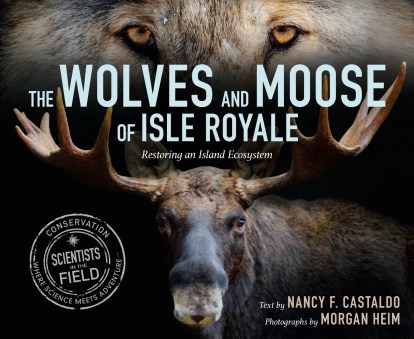 Nancy Castaldo: This is a book project that began decades ago in my college ecology class. That is where I first heard of the important predator/prey study on Isle Royale. I was intrigued by this long study and have followed it ever since. When I found out that wolves might be released on the island I started to formulate the book project.
MKC: Care to share a favorite research moment from your time on Isle Royale?
Nancy: Spending time on the island was wonderful. I truly can understand why so many people return to the park after visiting. Photographer Morgan Heim and I stayed on the island, got up super early every morning, and hiked well past 10 pm each night to complete this book. The remoteness of the island provided some travel challenges, but they were well worth it. It is an exceptional place that deserves protection. I only wish we had more time there. It was a great experience. My favorite moment? Perhaps when we were in the forest with Cara as she was investigating wolf pings and we came across a spot where a moose had bedded down. We could see where it had folded its legs to rest. And beside this spot we found one where a wolf had bedded down. They were side by side. Of course, it is highly unlikely they were there at the same time. I couldn’t resist curling my body up to fit in those spots where they had rested. And then, I coaxed Cara and Morgan to do the same. It filled me with lots of feelings of connection and also fun. Those moments were so unexpected.
MKC: To whom did you imagine yourself writing to while drafting the book?
Nancy Castaldo: This is a book project that began decades ago in my college ecology class. That is where I first heard of the important predator/prey study on Isle Royale. I was intrigued by this long study and have followed it ever since. When I found out that wolves might be released on the island I started to formulate the book project.
MKC: Care to share a favorite research moment from your time on Isle Royale?
Nancy: Spending time on the island was wonderful. I truly can understand why so many people return to the park after visiting. Photographer Morgan Heim and I stayed on the island, got up super early every morning, and hiked well past 10 pm each night to complete this book. The remoteness of the island provided some travel challenges, but they were well worth it. It is an exceptional place that deserves protection. I only wish we had more time there. It was a great experience. My favorite moment? Perhaps when we were in the forest with Cara as she was investigating wolf pings and we came across a spot where a moose had bedded down. We could see where it had folded its legs to rest. And beside this spot we found one where a wolf had bedded down. They were side by side. Of course, it is highly unlikely they were there at the same time. I couldn’t resist curling my body up to fit in those spots where they had rested. And then, I coaxed Cara and Morgan to do the same. It filled me with lots of feelings of connection and also fun. Those moments were so unexpected.
MKC: To whom did you imagine yourself writing to while drafting the book?