

Let’s get coding! Why? Because coding skills develop students’ logical thinkng and problem solving skills, teach structural thinking and how things work, and is fun and rewarding. We’ve assembled a varied list of books on coding designed to capture a middle-grade reader’s imagination.

Code This Game! Make Your Game Using Python, Then Break Your Game To Create a New One! by Meg Ray and Keith Zulawnik
This is a great book for instruction on how teens can create their own video game.

Code This! Puzzles, Games, Challenges and Computer Coding Concepts for the Problem Solver In You by Jennifer Szymanski
Join the Coder Crew’s mission and learn coding with puzzles, games, and fun characters.

Can You Crack the Code? A Fascinating History of Ciphers and Cryptography by Ella Schwartz; illustrated by Lily Williams
Delve into the history of codes in this fun book that introduces readers to wartime secrets and hidden messages.

Coding Creations by Janet Slingerland
Young readers will use SCRATCH, a computer language, to create their own music, stories, games, and animations.

Video Game Coding by Janet Slingerland
Slingerland takes readers on the path of discovery with this title about coding video games.

So, You Want to Be A Coder? The Ultimate Guide to a Career in Programming, Video Game Creation, Robotics, and More! by Jane Bedell
Readers who have begun having fun with coding will enjoy reading about STEM careers in coding, from cyber security to artificial intelligence to gaming.

Coding Games in Scratch: A Step-by-Step Visual Guide to Building Your Own Computer Games by Jon Woodcock
Learn to master SCRATCH in this step-by-step guide for young coders.

Code Your Own Games: 20 Games to Create with Scratch by Max Wainewright
More coding adventures await young readers in this additional Wainewright title.

Scratch Programming Playground: Learn to Program by Making Cool Games by Al Sweigart
Here’s another title that uses SCRATCH to engage young coders.

Code Like A Girl: Rad Tech Projects and Practical Tips by Miriam Peskowitz
Step-by-step projects will guide young readers through the creative process, self-expressions, and telling their own stories. Projects include smartphone gloves and a motion sensor to tell when someone enters your room.
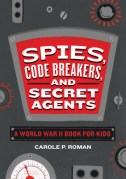
Spies, Code Breakers and Secret Agents: A World War II Book for Kids by Carole P. Roman
Take a look at another facet of coding with this historical STEM book that takes readers on a tour of the undercover operations that helped the Allies win WWII.

Girls Who Code: Learn to Code and Change The World by Reshma Saujani
Be inspired by the creator of the Girls Who Code organization to get hands-on with this book. Create apps, games, and robots to make the world a better place.

Secret Coders 6-book series by Gene Luen Yang and Mike Holmes
Although this series is fiction, former computer programming teacher Yang delivers an exciting mystery full of logic puzzles and basic coding instructions. Pair with any of the other coding books above.

Nancy Castaldo has written books about our planet for over 20 years including, THE STORY OF SEEDS, which earned the Green Earth Book Award, Junior Library Guild Selection, and other honors. Nancy’s research has taken her all over the world from the Galapagos to Russia. She strives to inform, inspire, and empower her readers. Nancy also served as Regional Advisor Emeritus of the Eastern NY SCBWI region. Her 2020 international title about farm and food is THE FARM THAT FEEDS US: A Year In The Life Of An Organic Farm. Visit her at www.nancycastaldo.com.

Patricia Newman writes middle-grade nonfiction that empowers young readers to act on behalf of the environment and their communities. The Sibert Honor author of Sea Otter Heroes, Newman has also received an NSTA Outstanding Science Trade Book Award for Eavesdropping on Elephants, a Green Earth Book Award for Plastic, Ahoy!, and a Eureka! Gold Medal from the California Reading Association for Zoo Scientists to the Rescue. Her books have received starred reviews, been honored as Junior Library Guild Selections, and included on Bank Street College’s Best Books lists. During author visits, she demonstrates how young readers can use writing to be the voice of change. Visit her at www.patriciamnewman.com. Stay tuned for her upcoming Planet Ocean – spring 2021.

 Hello, fans of Middle Grade! I hope the school year is running smoothly for your students, your readers, or your own kids, whether they are learning in-person, remotely, independently, or in a hybrid or homeschool environment. While online learning and the use of technology are certainly helpful in this time of Covid, I know my own kids sometimes grow weary of screens and keyboards in their current environments. So I wanted to share a fun and engaging reading activity that can work equally well in both the home and classroom: A Mini-Museum display based on a great Middle Grade read.
 If you’ve read or taught the excellent Stella by Starlight by Sharon M. Draper, you’ll recognize how these real objects make great representations of the novel’s important character and plot points:


