Posts Tagged resources

STEM Tuesday– Genetics– Writing Tips & Resources

CAT TAG

It’s February. The month of love. The perfect month to declare my love of genetics to the STEM Tuesday world in the passionate execution of my Week 3 Writing Craft & Resources post. I love genetics!

It is more than mere fate or blind luck that the STEM Tuesday schedule and my posting schedule aligned for February 2023. The STEM nonfiction universe knows.

Genetics + Me = #ForLife.

But what does all that have to do with a Writing Craft & Resources post? Bear with me, please, through my soliloquy on genetics.

Genetics had me at my first Punnett square. Just like Mendel and his pea plants or Barbara McClintock and her corn chromosomes, genetics had me hooked from the get-go. The idea that life has a blueprint and we have the ability to study and define it captured the teenage me as much as sports had. As a son of a civil engineer who designed and built bridges and highways, plus, as someone just getting into computer programming on my Texas Instruments TI-99, I was hooked on the coded blueprint of life for life.

Then deoxyribonucleic acid came along. The fundamental code of life. Adenine (A), cytosine (C), guanine (G), and thymine (T). Four chemical bases attach to a sugar-phosphate backbone to form a nucleotide. Four bases that pair with one another (A-T and C-G) in a particular order to form a double-helix strand of DNA and the chromosome. Just about everything we see in the living world is built from the order of those four bases. A, T, C, and G, coded in the chromosome blueprint. 

The genetic information coded in our DNA is transcribed into a specific protein in the central dogma of genetics, DNA→RNA→Protein. The triplet code is the key to the central dogma during the transcription of the DNA code. The cell’s machinery reads the code three nucleotide bases at a time and makes RNA copies of them which, in turn, code for one of 20 amino acids used to construct a protein. 

Humans have about 38 trillion cells in the body and each of those cells contains the code for ~20,000 genes within its chromosomes. The total length of the DNA in one cell is six feet. That’s a lot of DNA needing to be intricately folded to fit inside the cell’s nucleus! Each cell transcribes the proper genes at the proper time to make the proper proteins it needs to function. The cell must keep the genetic code organized while maintaining its integrity and repairing any damage to the code. Add to that, the need to faithfully replicates itself for future progeny cells so mistakes in the code, called mutations, don’t get passed to the next generation of cells. 

This molecular dance of life. with its high level of fidelity. never ceases to blow my mind.

I’ve made a career chasing DNA. I’ve cloned it and I’ve sequenced it. I’ve digested, purified, manipulated, mutated, labeled, edited, and analyzed it. Everything I’ve done in three decades of science revolves around A, T, C, and G. And even after all this time, there is still so much that I don’t know about genetics and DNA and the molecular dance of life, which brings me back to writing. 

Everybody knows writing is work. It’s hard work but, similar to genetics, it is also work that has me hooked. Also like genetics, there’s is still so much I need to learn about writing, even after decades of writing. Just as there are the tools of genetics, writers have tools. Letters, words, structure, and grammar are the nucleotide bases (A/T/C/G), genes, chromosomes, and triplet code of genetics. 

Word→Sentence→Paragraph is the writer’s central dogma. Finding the right words to describe our ideas and transcribing them in legible form is what we attempt to do as writers. 

When I teach what we do in our lab or speak to students about genetics and genetic mutations, I use a little paper demonstration called CAT TAG. It’s based on transcription using the triplet code defined above. I use it to describe how important it is to preserve the correct sequence and fidelity of the triplet code when we are cloning or mutating a gene for further analysis.

Here’s the imaginary DNA code sequence I use for the CAT TAG gene demonstration:

ATG CAT TAG CAT TAG CAT TAG CAT TAG

If we start transcribing at the “ATG” start codon signal, we get frolicking felines playing an adorable game of CAT TAG protein.

CAT TAG CAT TAG CAT TAG CAT TAG

What happens when we inadvertently insert a base in the gene?

ATG tCAT TAG CAT TAG CAT TAG CAT TAG

We get nonsense and no more frolicking feline protein. Where did my adorable cats go!!!

tCA TTA GCA TTA GCA TTA GCA TTA G

The same thing happens when we delete a base in the gene. Nonsense and no cats!

ATG AT TAG CAT TAG CAT TAG CAT TAG

ATT AGC ATT AGC ATT AGC ATT AG

Even more frightful, what if a whole CAT codon gets deleted?

ATG TAG CAT TAG CAT TAG CAT TAG

Argghh!!!!! Ouch!!! Now I’m tagging the cat and the cat does not appreciate it! Ouch!

TAG CAT TAG CAT TAG CAT TAG

Writing is like the CAT TAG gene game. Finding the right order and sequence of words to express ideas is the ultimate goal. The skill and magic of revision lie not only in the order and sequence but in finding the best words to express the idea. No more or no less. Make sure additions or subtractions fit properly.

The goal is to find the adorable cats playing tag version of your writing without creating confusion, nonsense, or attacking felines. 

Mike Hays has worked hard from a young age to be a well-rounded individual. A well-rounded, equal-opportunity sports enthusiast, that is. If they keep a score, he’ll either watch it, play it, or coach it. A molecular microbiologist by day, middle-grade author, sports coach, and general good citizen by night, he blogs about sports/training-related topics at  www.coachhays.com and writer stuff at  www.mikehaysbooks.com. Two of his science essays, The Science of Jurassic Park and Zombie Microbiology 101, are included in the Putting the Science in Fiction collection from Writer’s Digest Books. He can be found roaming around the Twitter-sphere under the guise of @coachhays64 and on Instagram at @mikehays64.


The O.O.L.F Files

This month’s version of the O.O.L.F.(Out of Left Field) Files explores revision tips, genetics history with two of the faces on the Mount Rushmore of genetics, a lesson in genetic expression, and CRISPR gene editing at home. 

Kirsten W. Larson’s Revision Tip: Unwriting Your Draft blog post

Barbara McClintock

Gregor Mendel

The fabulous Punnett square

University of Nebraska-Lincoln Plant & Soil Science Learning Module

CRISPR at Home


Sydney Taylor Book Award Blog Tour — Interview with Honor Book Award-winner Author Sofiya Pasternack


The Mixed Up Files Blog is proud to be a host for the Sydney Taylor Book Award.

The Sydney Taylor Book Award is presented annually to outstanding books for children and teens that authentically portray the Jewish experience. Presented by the Association of Jewish Libraries since 1968, the award encourages the publication and widespread use of quality Judaic literature. Gold medals are presented in three categories: Picture Books, Middle Grade, and Young Adult. Honor Books are awarded silver medals, and Notable Books are named in each category.  To learn more about this prestigious award and to see a list of all of the winners, please visit this website: https://jewishlibraries.org


Today we are thrilled to introduce Sofiya Pasternack, author of the Black Bird, Blue Road (published by Versify,
an imprint of HarperCollins Publishers

a  Sydney Taylor Honor Book in theMiddle Grade Category. CONGRATULATIONS Sofiya!


BlackBird Blue Road


In this historical fantasy novel, praised as a “rich, omen-filled journey that powerfully shows love and its limits*” and “propulsive, wise, and heartbreaking,”** Ziva will do anything to save her twin brother Pesah from his illness—even facing the Angel of Death himself. From Sydney Taylor Honor winner and National Jewish Book Award finalist Sofiya Pasternack.

Pesah has lived with leprosy for years, and the twins have spent most of that time working on a cure. Then Pesah has a vision: The Angel of Death will come for him on Rosh Hashanah, just one month away.

So Ziva takes her brother and runs away to find doctors who can cure him. But when they meet and accidentally free a half-demon boy, he suggests paying his debt by leading them to the fabled city of Luz, where no one ever dies—the one place Pesah will be safe.

They just need to run faster than The Angel of Death can fly…


Review

Pasternack shows how Ziva’s love of justice drives her, while depicting a world in which spirits are manifest, healers come in many forms, and a bold girl can literally bargain with the Angel of Death. Tenderly rendering Ziva’s feelings of responsibility—including around Pesah’s physical care and amputating his infected fingers and toes—Pasternack imagines a rich, omen-filled journey that powerfully shows love and its limits. — Publishers Weekly (starred review)

Pasternack’s story is rich in the rhythms, values, and deep magic of Jewish culture and life in the Turkic Jewish empire of Khazaria. It revels in an often overlooked mythology, deploying exciting fantasy elements with ease. More than simply an adventure, this is a story about grief and illness and arguing with the rules of the world, enduring and enjoying the living that happens between now and the end, threaded through with the profound, unshakeable love of two brave siblings. Propulsive, wise, and heartbreaking. — Kirkus Reviews (starred review)

Pasternak’s historical fantasy weaves Jewish mythology and traditions into this heroine’s journey that asks readers to contemplate issues of life and death. Readers will be intrigued by the ravens that follow Pesah everywhere, the details of the city of Luz (where no one dies), and Pesah’s vision that the Angel of Death will visit him on Rosh Hashanah. This works as an adventure, but it should also prompt discussions about the ethics of preserving life at all costs.  — Kay Weisman — Booklist (starred review)

Set in Khazaria, a medieval empire of the Eurasian steppes, this moving tale steeped in Jewish lore is a welcome addition to middle grade fantasy shelves. Ziva is a fierce, appealing heroine, driven by her deep love for her brother, a profound sense of justice, and an unwillingness to accept the status quo—qualities that serve her well but sometimes keep her from seeing those around her clearly. An omniscient narrator addresses the reader in interludes that lend the text a mythic feel, while the main narrative is a rousing adventure and coming of age story inflected by Ziva’s internal struggles. — Bulletin of the Center for Children’s Books (starred review)

Pasternack (Anya and the Dragon) writes with a storyteller’s cadence without sacrificing liveliness, keeping emotions front and center (“She’d jab the Angel of Death in every single one of its eyeballs if that meant keeping Pesah safe”).  – SHOSHANA FLAX www.hbook.com — Horn Book Magazine


Thanks so much for joining us today at the Mixed-Up Files, Sofiya!

Booklist said of your book, “Pasternack’s historical fantasy weaves Jewish mythology and traditions into this heroine’s journey that asks readers to contemplate issues of life and death.” You weave these topics so skillfully together. Can you tell us more about why you chose to write about these topics? 


Well, I write historical fantasy because it’s fun! History is full of amazing stories all over the place, and as a lifelong fantasy enthusiast, including some magic makes really fascinating history just a little more amazing. I write Jewish mythology because it’s not terribly common and I want to see more of it; sometimes, I’ll see a Jewish story that’s had all the Jewishness taken out of it (Corpse Bride is one that comes to mind!), and I aim to put the Jewishness back in. As for why I wanted to write about life and death, it was a way of processing not only the cycle of life and death that I saw at the hospital every day (as an ICU nurse), but also my own dad’s death. Death is a difficult topic, and I think the more stories we have about the topic, the better able we’ll be to face it when it shows up in our lives.


You often set your books in these wonderful, vivid and mythical settings. Why? 


I like settings that are mostly like the regular world, but if you pay attention, they’re not. I’ve been to incredible places that are totally real (I’m pretty sure, anyway), but are also so magical that if an elf or a sheyd or a wizard showed up, you wouldn’t really be that surprised. Recreating these in fiction is a great challenge: can I approximate the feeling of the fog racing me down the street on the Pacific Coast? Or watching the sun rise over the High Atlas Mountains? Or squeezing through the Roman aquifers under Naples? I sure hope so.


This book depicts a strong and supportive relationship between siblings. It seems as if family plays a big part in all of your books. Is there a significance to that? 


Generally, I write a family I wish I’d had. Ziva’s family is a little bit different, because a large part of her growth was that she needed to challenge her preconceived snap judgements about people—including her own family. She made some assumptions about her family members, and then was forced to reconsider them. She also needed to consider that people are rarely all bad or all good. I hope to explore all kinds of families in my stories, from Anya’s supportive and close-knit family, to Ziva’s family fractured by terminal illness, to someone’s future family that looks like something entirely different.


Your books all have a wonderful world-building aspect to them. What drew you to this world in particular? 


The Byzantine Empire was something I didn’t pay much attention to when I learned about it in middle school, but as I grew up and started to appreciate history a little bit more, that time period and place got more and more interesting. The Byzantines are well covered though, so I kind of directed my attention elsewhere for inspiration. The Empire of Khazaria is fascinating because it was and remains mysterious, and is fabled to have been an empire of (some? mostly? all?) Jewish converts. An ancient empire of once-nomads on the wide steppe around the Caspian Sea? The world erupts to life all around me!


Do you have any tips for aspiring writers (of all ages)? 


It seems cliché, and I’m sure you’ve all heard it before: keep writing. Keep creating. Keep imagining. Sometimes it feels like you’re screaming (writing?) into the void, but every line written makes the next one better, and if you want to read a certain story, it’s basically guaranteed that a whole ton of other people want to read it too. Don’t give up!


What are you working on next? 


I have a whole bunch of projects lined up! One is about Maria Hebraea, the first alchemist. Another is set during the year 536 CE, which was called “the worst year” by historians because a huge volcanic eruption blocked out the sun for a year and a half! There are a couple more, but for sure there will be more history, more fantasy, and more Jewish magic from me!


STEM Tuesday– Genetics– Book List


Genes play an important role in determining what makes us us. Dive right into these books, which are great resources on genes, DNA, and cutting-edge technology that holds a lot of promise for the future.

Genetics (A True Book: Greatest Discoveries and Discoverers) 

by Christine Taylor-Butler

Scientists now know that genes are the blueprint for life, but many years ago they didn’t. They discovered it when they attempted to change the traits of living things by altering their genes. Learn about the a-ha moments these scientists had; and more, with this engaging text


The DNA Book

by Alison Woollard

A colorful, interesting book with an in-depth look at DNA and its role in our lives: what DNA does, why we look like our parents, how DNA evidence helps catch criminals, genetic engineering, and more.


The Human Genome

The Human Genome: Mapping the Blueprint of Human Life

by Carla Mooney, illustrated by Tom Casteel

All about the human genome, and how understanding it has added to our knowledge in fields like medicine and human history. With hands-on STEM activities, and discussions on the social and ethical issues of genomic science, this book is a fascinating peek into the world of genetics.


The Code Breaker -- Young Readers Edition


The Code Breaker: Jennifer Doudna and the Race to Understand our Genetic Code

by Walter Isaacson, Adapted for young readers by Sarah Durand

An account of how Nobel Prize Winner Jennifer Doudna and her colleagues launched CRISPR, a tool that can edit DNA, and a discussion of its potential, and the associated moral implications.


CRISPR: A Powerful Way to Change DNA

by Yolanda Ridge, illustrated by Alex Boersma

An engaging book, with detailed illutsrations that explains CRISPR, and the potential it has in the fields of medicine, food and conservation.


Blood, Bullets and Bone: The Story of Forensic Science from Sherlock Holmes to DNA

by Bridget Heos

A history of modern forensic science right from the 1700s to modern times, with its advanced technology, including DNA testing, which has changed the world of forensic science.


Biodiversity: Explore the Diversity of Life on Earth with Environmental Science Activities for Kids (Build It Yourself)

by Laura Perdew (Author), Tom Casteel (Illustrator)

Calling all middle schoolers who are curious about life on earth and its biodiversity. This hands-on STEM-based book is filled with activities to engage critical thinking, as well as lead readers to explorations of the biodiversity around them. 


I Can Be a Science Detective: Fun STEM Activities for Kids 

by Claudia Martin

Simple hands-on experiments on how to catch a thief, extract DNA from strawberries, and much more!


Extract DNA with Rosalind Franklin: Women in Science Interactive Book With Illustrations

Rosalind Franklin is a known chemist and x-ray crystallographer who is passionate about DNA. She loves sharing her knowledge about this fantastic discovery:  she was the first person to discover the shape of DNA! With her expert guidance, readers will be able to experiment at home and make discoveries for themselves. 


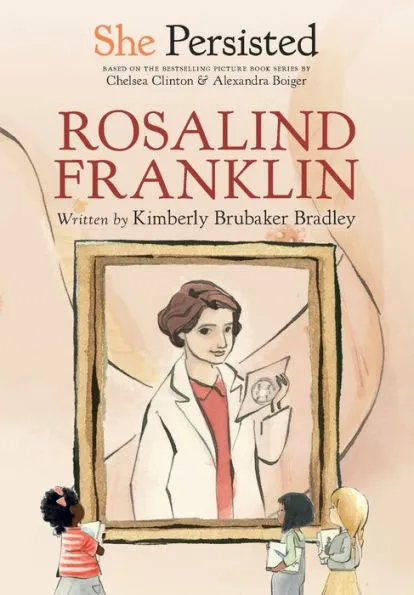
She Persisted: Rosalind Franklin


She Persisted: Rosalind Franklin

by Kimberly Brubaker Bradley, Chelsea Clinton, Alexandra Boiger (Illustrator), Gillian Flint (Illustrator)

A biography of the amazing woman who persisted in following her dreams to become a scientist and played an important role in the discovery of the shape of the DNA.


Saving the Tasmanian Devil: How Science is Helping the World’s Largest Marsupial Carnivore Survive

by Dorothy Hinshaw Patent

This book describes how scientists are working to prevent and eradicate genetic diseases, and helping to save Tasmanian Devils, which are dying in large numbers due a deadly disease.


De-Extinction: The Science of Bringing Lost Species Back to Life

by Rebecca E. Hirsch

This book explains how scientists are trying to reverse extinction and bring back species to life, using techniques like cloning. It also discusses the pros and cons of de-extinction.


Susan Summers is a wildlife enthusiast and an author. Contact her at: https://susan-inez-summers.weebly.com/


Shruthi Rao is an author. Her home on the web is https://shruthi-rao.com