

Going Deep
Today we are diving deep into two books that intrigue me. Books about a horrific medical epidemic. Books that both use narrative and expository plus characters to carry readers through the story. Books that plunge into history and science plus ethical and moral questions.
Fatal Fever: Tracking Down Typhoid Mary, by Gail Jarrow
Terrible Typhoid Mary: A True Story of the Deadliest Cook in America, by Susan Campbell Bartoletti
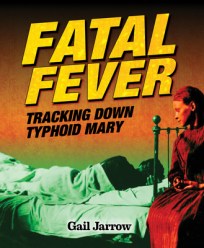
Here’s a quick recap. In the early 1900s Mary Mallon carried typhoid but didn’t display any of the symptoms. She worked as a cook, was definitively linked to the infections of 49 people plus three deaths, was quarantined for decades, and became the brunt of a tabloid scandal. Both books look at the entangled story of her life, medical professionals who tracked her down, legal charges against her, and implications for constitutional rights.

In two books on the same topic, published in the same year, written with similar audiences in mind, there is much to compare and contrast. What I find most intriguing is that both bring the science and history to light while posing enduring questions.
Dive In
Let’s look at how these books each handle one of those enduring questions. Get ready for some close reading!
After years of quarantine, Mary was finally released on parole. The terms of her release specified that she take precautions to not infect others, not work as a cook, and report regularly to the health department. But Mary broke those terms, resulting in another major outbreak and her own exile until death. The question these authors chase: Why did she risk it?
Turn to pages 133-135 of Terrible Typhoid Mary and Page 118-120 of Fatal Fever to read the texts. Here are some things to look for. I’ve included a few things I noticed and am eager to hear what you discover.
Whose story is told first?
- Fatal Fever:
- “Mary had no lawyer to help her.”
- Terrible Typhoid Mary
- “Mary never said why she broke the conditions . . .”
What words are chosen to set the tone?
- Fatal Fever:
- “A Witch!”
- Terrible Typhoid Mary
- “. . . she struggled . . .”
In what way are other characters’ reactions used? Do those reactions support or denigrate Mary’s choice?
- Fatal Fever:
- “The sympathy that people once felt toward Mallon evaporated.”
- Terrible Typhoid Mary
- “Her temerity galled Soper.”
What words or phrases convey doubt or leave interpretation open?
- Fatal Fever:
- “Maybe she didn’t see the harm in it, . . .”
- Terrible Typhoid Mary
- “Is it possible that Mary simply didn’t understand . . .”
Are you caught up in this conundrum? Of how Mary, who had been presented as a person who stepped in to care for children when needed, could do such a thing? I am.
Where do these passages leave you emotionally? Did the balance between narrative and expository impact your reaction? Does either passage affect you more? Why?

On Your Own
Now, pursue a similar close reading on your own. There are plenty of other parallel topics in these books. Try the discussion of gall bladder removal: Fatal Fever (page 93) and Terrible Typhoid Mary (pages 136-137).
How do these authors use sequencing, language, and other characters? How do their skillful use of nonfiction devices impact you as a reader?
—-
By Heather L. Montgomery
Heather L. Montgomery writes for kids who are WILD about animals. Her latest book, Bugs Don’t Hug: Six-Legged Parents and Their Kids, is a perfect picturebook for a close read.
The O.O.L.F. Files
Resources for Writers
This site might have been designed with rhyming in mind but it has many other uses. Need a thesaurus? Angling for alliterative words? Looking for lyrics? Rhymezone’s got you covered.
Needing to go deep on a topic? Set up a Google alert on your topic. Day after day it will deliver the freshest posts straight to your inbox.
http://www.bluebulbprojects.com/MeasureOfThings/default.php
When you need a measurement comparison, The Measure of Things is your best friend! How large is 110 cubic inches?
- 9/10th the size of a human stomach
- 1/3rd the size of a bowling ball
- 1 1/10th the size of an ostrich egg!




 Carolyn Cinami DeCristofano pairs writing nonfiction STEM books for kids with STEM educational consulting work.