

Let’s Get Organized!
When you are staring at a blank piece of paper, pulling your hair out because writing is so hard, I challenge you to do a double take. Is “writing” actually the hard part? For me, the hard part is:
- knowing what to write
or…
- knowing what not to write.
And if you’ve done your research and are boggle-eyed by a mountain of marvelous material, it can feel like you are facing Mount Everest. So what do you do?
You turn to your handy-dandy toolbox – the one labeled “Organization.”

When you are writing about STEM topics, you’ve got lots of organizational tools to choose from. It’s kind of like clothes in a closet; there are tons of ways to get organized.
Cubbies & Compartments
Some folks like those super-segmented organizers you can buy at the home improvement store. Those make sense because someone has already figured out what works for the standard items stored in a closet. There are shoe-sized cubbies, shelves for t-shirts, racks for slacks. And when you want to use the closet, you know where to turn for each type of item. Lots of expository nonfiction is organized like that. Pick up a field guide to birds and it’s super easy to find the range of a black vulture because you know where to look. With discrete chunks of information, those books make fun-fact lovers smile.
As for the writer, once you know what the sections are (and how much space you have in each one), pulling the right information from that mound of research becomes a whole lot easier! Organization is your friend. Of course there are still challenges. How do you handle pieces that don’t come in the “standard” size? What do you do when there’s a gap in the known information? Won’t that standardization be boring? A skilled writer knows how to handle that.
On Your Own
 Take a look at any STEM book which uses this organizational tool. Animal Zombies: And Other Bloodsucking Beasts, Creepy Creatures, and Real-Life Monsters by Chana Stiefel is a great example. Compare the content provided on three different animals. Make a list of the standard chunks of text. What are their labels? How long is each chunk? How do they vary in content?
Totally Traditional
For their clothes closet, other folks are choose a traditional clothes rack and hangers. A section for pants, one for shirts, shoes on the floor. Each section can be as large or small as needed, and there’s room within each section for items of varying sizes (i.e. a mini-skirt hangs just fine beside an evening gown). Need segments within the sections? No problem. Stick skinny jeans on one end of the rack and fancy pants on the other.
There’s a reason animal books have been relying on good old-fashioned, traditional chapters for years. They work. Readers know what to expect. Pick up a book about animals and most likely you’ll find chapters with headings and subheadings, grouped by animal type. This organization lets a reader get all the info about similar animals at one time, helping them mentally compare and contrast.
This strategy gives the writer lots of freedom. Material unearthed during research can be lumped together by similarities. Have a subject that needs additional explanation? There’s room for that. Want to be a get creative? You’re in charge of labeling the chapters!
On Your Own
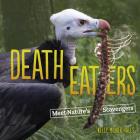
 Find a title with traditional organization. I got up close and personal with Death Eaters: Meet Nature’s Scavengers by Kelly Milner Halls. Looking at the table of contents, I saw that chapters 2 through 5 were organized by type of animal. One of the fun things about studying this book – besides all the ick appeal! – was that the author spiced up this traditional take on organization by using fun chapter titles. Boring old “Mammals” became “Furry Death Eaters.” Study the title you’ve chosen and ferret out the author’s unique twists on this traditional method.
Organized by Outfit
Snoop around in the closets of friends and you will find a few with unique organization. Some folks organize their closet by outfit. If you find that perfect combination – that sweater, scarf, and suede that set off your eyes just right – you might want to keep it together.
When a book works this way, the information in a chapter is integrated tightly to build to one point, cover one story, or address one discrete aspect of the topic. Each chapter is distinct, often focusing on an exclusive topic or category. Readers gain a more in-depth understanding of a single topic.
For the writer who is staring up at lots of single stories, anecdotes, or parts of a whole, this organizational took can be their ticket to free flowing words! Knowing that you can write just one piece at a time, crafting each chapter individually, can help you focus and get those words on the page.
On Your Own
 Pick up a book labeled “Field Guide” and you expect information in cubbies and compartments. But dive into Beavers (The Superpower Field Guide) by Rachel Poliquin and you’ll feel the power of this alternative organizational technique. Through a laser-tight focus on one body part – chainsaw teeth, paws of power, superstink – per chapter (plus a healthy dose of humor), Poliquin proves that adaptations are superpowers. Find another book that uses this organizational tool. Why was this strategy chosen? Was it based on the type of information available? The content itself? Or, perhaps, the author’s purpose?
Looking at how other writers use their organizational toolbox gives us a peek into their writing process. Understanding these structures better can help us see our options. Every piece adds to our own writing toolbox, so that next time when we sit down to write, our words will spill (in an organized manner) onto the page.
 Heather L. Montgomery writes books for kids who are wild about animals. The wilder, the wackier, the better. She’s tried on each of these organizing tools: Her Wild Discoveries: Wacky New Animals used chunked text that functions like cubbies and compartments; her Little Monsters of the Ocean used totally traditional chapters; her Something Rotten: A Fresh Look at Roadkill is organized by outfit. Learn more at www.heatherlmontgomery.com/books.html
————————–
O.O.L.F.
Random Fun Sites For STEM Writing Inspiration
Today I Learned: Today I learned that the bearded vulture’s diet is almost entirely made of bone! https://www.reddit.com/r/todayilearned/
The Fibonacci Sequence in Nature: Photos and patterns to blow your mind! https://insteading.com/blog/fibonacci-sequence-in-nature/
Science News for Students: Current research written with kid appeal, such as a robotic jellyfish that spies on the sea. https://www.sciencenewsforstudents.org/


 Jodi Wheeler-Toppen is a former science teacher and the author of the




 Nancy Castaldo
