
Posts Tagged middle-grade fiction

Author Spotlight: Lakita Wilson + a GIVEAWAY

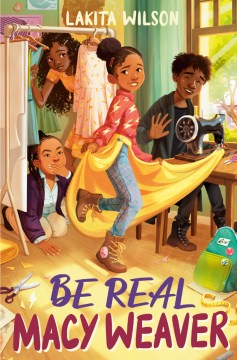
In today’s Author Spotlight, Lakita Wilson chats about her MG debut, Be Real, Macy Weaverout tomorrow, July 12, from Viking—as well as how she juggles her job as a college professor with her writing life. Plus, scroll down for a chance to win a copy of Be Real, Macy Weaver! 

Book Summary

Eleven-year-old Macy Weaver knows relationships are complicated. Fresh off her latest friendship breakup, she’s spent most of her summer break on her own. So, when Macy’s mother decides to go back to college three states away, Macy jumps on the chance to move—anything for a fresh start.

But Macy’s new home isn’t exactly what she expected. Her mother’s never around and her dad’s always working. Lonelier than ever, Macy sets her sights on finding a new best friend. When she meets Brynn, who’s smart and kind and already seems to have her whole life figured out—down to her future as a fashion model—Macy knows she’s it. The only problem is that Brynn already has a BFF and, as everyone knows, you can only have one.

Resorting to old habits, Macy turns one small lie into a whole new life—full of fantastic fashion and haute couture—but it isn’t long before everything really falls apart. Ultimately, Macy must determine how to make things right and be true to herself—rather than chasing after the person she thinks she’s supposed to be.

Interview with Lakita Wilson

MR: Welcome to the Mixed-Up Files, Lakita! Thanks for joining us today.

LW: Thank you, for having me!

MR: First, I have to tell you how much I enjoyed Be Real, Macy Weaver. It’s the kind of book I would have been drawn to as a tween, because—like Macy—I was desperate to have a best friend. I’m guessing the desire for a close friendship was something you craved, too?

LW: Of course. I think, for me, it took so long to find my community because I still struggled to find myself. It’s kind of hard finding people who get you, if you haven’t quite gotten yourself yet.

Would I Lie to You?

MR: Macy, the fashion-forward protagonist, weaves a web of lies to impress Brynn, the object of her BFF affection. At the same time, the lies cause Macy untold guilt, shame, and anxiety (i.e., she gets the “creepy-crawlies” whenever she tells a lie and/or feels anxious). What is it about lying that makes most of us get the “creepy-crawlies”? And what were you trying to say about lying in general?

LW: Macy told pretty big lies throughout the story. Other characters told smaller lies, or let lies linger to cover up things they didn’t want to reveal either. I truly believe that people want to be their most authentic selves, but there’s often an inner voice telling us that our truest self isn’t good enough. So, lying becomes a shield to protect us from the potential rejection of our peers. I think the conflict of needing to live in our truth, yet fearing such vulnerability creates anxiety. Describing the creepy crawly feeling Macy felt on her arms and legs, was my way of showing how this anxiety doesn’t just stay inside of us, but shows up in physical ways.

Significance of Symbolism

MR: Speaking of webs, Macy befriends a spider—Charlotte—with whom she shares her secrets, worries, and fears. I know this is an homage to Charlotte’s Web, but it’s also a symbolic choice. Other bits of symbolism include Macy’s first and last names (i.e., Macy’s = a department store/Macy is into fashion; Weaver = weaver of lies/weaving of fabric). Labels are symbolic, too (clothing labels/labeling oneself and others). I’m guessing these were purposeful choices. Why is symbolism important to you as a writer?

 LW: Okay, here’s the funny thing about Macy’s name. I chose Weaver on purpose. Here is a girl who constantly weaves a web of lies and she’s learning to sew in the book. So, it made sense. However, the first name wasn’t an intentional choice. I love Macy Gray, and I think the name Macy is pretty—so that’s how I chose her first name. The ridiculous thing is, I live in walking distance of a Macy’s department store. You would think I would’ve connected the two a LOT sooner than I did. I still shake my head over this all the time!

MR: In addition to friendship, abandonment is a predominant theme in your book. For instance, Macy’s mom uproots the family so she can attend college in another state—and then promptly checks out of Macy’s life. How does this feeling of abandonment affect Macy in terms of the choices she makes, and the lies she tells?

Attachment Theory

LW: As I was writing Macy’s story, I needed to figure out why she was so needy. Everyone wants a best friend, but there was a certain desperation that Macy had about needing a best friend, right from the beginning. And that level of neediness doesn’t come out of nowhere.

When it comes to parenting, there are four different attachment styles. I teach my college students that parents who are present and responsive to their child’s needs help create a secure-attachment. Children who develop a secure-attachment are more confident, trusting, and able to explore the world and interact with peers, knowing that they have this safe base to always go back to—even if situations get a little tough. But Macy didn’t have that with her Mom.

When a parent is sporadic with their time, attention and affection, this creates an anxious-insecure attachment. These children often know deep down they can’t rely on the parent, so they become clingy—with that parent, and other relationships. These children become needy, angry and distrustful. We see this play out in Macy’s behavior almost from the very beginning of the story. She’s very needy in her friendships, clinging to them like they are her only hope. She quickly becomes angry or anxious when her expectations are dashed. And she never gives anyone the true version of Macy, because she’s not only distrustful of others, she doesn’t trust herself to be loveable or worthy of friendship.

Switching it Up

MR: Turning back to writing, Be Real, Macy Weaver is your first MG novel, but you’ve written a YA novel, too (Last Chance Dance is coming out in spring 2023), as well as nonfiction (What Is Black Lives Matter?) and biographies of such luminaries as Thurgood Marshall, Rosa Parks, and Michelle Obama. Is it tricky to switch it up? Or just fun?

 LW: For me, it’s super fun. I’m interested in a lot of things, and super curious about the world around me. Being able to write in different genres and for different age groups gives me multiple lanes and strategies in which to talk to children about the world around us.

A Writer’s Juggling Act

MR: In addition to being a children’s book author, you are a college professor. How do you juggle your writing career with your day job? What does your writing routine look like? 

LW: I don’t know if I would be able to write as much if I had a typical nine-to-five job. Even though I am full-time faculty at my college, I don’t go into the office Monday-Friday from nine to five. Faculty are fortunate enough to stack our schedules with courses on certain days, freeing other days for things like writing. So, in order to keep up with my teaching responsibilities and write, I usually keep a pretty strict, consistent schedule. I also use a planner that I write down a schedule and a to-do list. I used to get up every day at 5 a.m and write for a few hours while the world slept. Then I would go to work, or run errands. But the pandemic has ruined me. I’m up all night, wandering my house like the resident ghost. So, I’ve switched my writing schedule according to when my kids are in school. When my daughter is home from college, I tend to write overnight because during the day we distract each other with invitations to watch the latest reality show. 🙂

Social Media Star

MR: Lakita, I noticed that you’re killing it on social media, with an impressive 23K followers on Instagram (LakitaReads). What is the secret to your success? Any tips for other writers trying to up their social-media game? Do you have a preferred platform? Also, how much time do you spend on social media?

LW: Yes. I am killing my social media accounts—and not in a good way. Ha! In 2017/2018, I was book blogging and sticking to strict schedules, and posting three times a day, every day. Instagram was my go-to platform. My followers consistently went up, and I formed many cool relationships from the experience. Now I post sporadically, and it’s killing my engagement, and my followers are dropping off by the dozens. Sometimes I feel guilty about wasting a great platform and I just want to donate it to an organization that’s willing to bring it back to life. But, there’s also the hope that one day I’ll revive that page and bring it back to its glory days. Poor @LakitaReads, lol.

Next Project

MR: What are you working on now, Lakita? Can you give us a hint?

LW: Right now, I am finishing up a draft of my second middle-grade novel. I will give you a one-word hint: bald. I’m also working on a non-fiction project centering hip hop and feminism.

Lightning Round!

MR: And finally, no MUF interview is complete without a lightning round, so…

Preferred writing snack? Chipotle. I know this isn’t technically a “snack”, but it’s what I prefer. I need to cut down though. I eat it way too much when the kids are at school.

Coffee or tea? Pepsi.

Cat or dog? Two dogs. One old. One young—to give you the perfect balance.

Favorite designer? Alexander McQueen

Favorite model? Naomi Campbell

Zombie apocalypse: Yea or nay? Nay. I scream when a leaf blows by my window. Do you honestly think I can handle zombies?!

Superpower? I just taught my puppy to push a button when he wants a treat. Is that a superpower, or do I now work on-call for my puppy? Hmm…

Favorite place on earth? My bed. Sleep is the best!

If you were stranded on a desert island with only three things, what would they be? A functional Chipotle restaurant (staffed), one of those inflatable floaties, and Megan Thee Stallion—we’re on a deserted island, so she’ll have plenty of time to teach me to dance! (You know, I almost gave a more acceptable answer here, but in honor of Macy I’m choosing to Be Real, ha!)

MR: Thank you for chatting with us, Lakita—and congratulations on the publication of Be Real, Macy Weaver. I thoroughly enjoyed it, and I know MUF readers will too!

LW: Thank you for having me!

And now…

A GIVEAWAY!

For a chance to win a copy of Be Real, Macy Weavercomment on the blog–and, if you’re on Twitter, on the Mixed-Up Files Twitter account for an extra chance to win! (Giveaway ends 7/13/22 EST.) U.S. only, please. 

About Lakita

Lakita Wilson is a Professor of Education, writer, and advocate for diverse and inclusive children’s literature. A 2017 recipient of SCBWI’s On-the-Verge Emerging Voices Award, Lakita also obtained her MFA in Writing for Children and Young Adults from Vermont College of Fine Arts. Lakita lives in Maryland with her two children and Shih-Tzu. Learn more about Lakita on her website and follow her on Twitter and Instagram: Lakitareads and Lakitawrites.

Interview with Molly and the Machine author Erik Jon Slangerup and Giveaway!

Welcome, Erik! 

Thanks for having me! Big fan of the Mixed-Up Files!…and all things mixed up.

SLANGERUP_EDITED_1500px-5047-2.png

I can say that I knew you when, as we hosted you at Claire’s Day way back in 2006! I am so excited for the release of your latest, Molly and the Machine  a heart-warming novel for middle-grade readers.

Ha, yes, it’s been a minute! But that festival is such a great memory for me. I recall a moment stepping out of a tent, and seeing some kids skipping along in these fantastic, colorful costumes, one holding balloons, and another blowing bubbles, and I thought: wow, this is really magical…books are magical.

MollyFinalCover.jpg


Tell us a little bit about your journey as a writer…

Oh man, as I look back to way back when, it really does feel like a journey now, ha! For 25 years, I was lucky enough to make my living as a creative writer in the ad business—as many do—while writing some picture books on the side. It was lots of fun, and helped hone my craft, but a few years ago, I felt like time was growing short, and decided to make the side gig the main one. Shortly after that, I had a serendipitous coffee with an amazing writer friend, Bryan Hurt, who put me in touch with Elizabeth Rudnick, another amazing person, who eventually became my agent. Prior to that, I’d already been shopping my manuscript for “Molly and the Machine,” but Liz helped me beat it up, expand it, and make it much better. Revising was a very long process, because I’m a slow writer. But after that, things moved fast, and we sold it in an exclusive first look over a weekend, which I can now appreciate is pretty crazy.

 When did you start writing Molly And The Machine?

The kernel for Molly and the Machine actually began as a sketch, a little more than ten years ago—told you I was slow! I like to draw as well as write, so that’s sometimes how I initially capture an idea. (I have that sketch framed in my office now.) I grew up watching old monster movies, like The 7th Voyage of Sinbad, and was always terrified of being eaten by some giant creature like the cyclops. So I channeled that fear into a story about a giant robot who swallows children.

The young protagonist is Molly McQuirter, an eleven-year-old girl who is navigating the grief from her parent’s broken marriage, her dad’s broken heart, all the while dealing with an annoying young brother. Molly is inventive, creating Rube Goldberg-like chain reaction machines, and she escapes her reality by taking off on her bicycle, Pink Lightning. How did the character of Molly come to you?

What a great description. Isn’t Molly great? Like all characters, I suppose she’s an amalgamation of many people I know—my Mom, my daughters, maybe even a little of myself. I’m the oldest of four, and I think there’s always this feeling of responsibility that comes with having younger sibs. But I was really attracted to the idea of taking some of the traditional gender norms in literature, like “knight rescues damsel,” and flipping them. So, among other things, this is a story about a girl who sets out on a quest to rescue her brother. Girl saves boy.

At the heart of the story is love. Which relationship in the novel was your favorite?

I’m so thrilled that comes through—even between all the explosions and mishaps. Most of all, I love the dynamic between Molly and her beloved “Gruncle” Clovis, because for me its representative of the kinds of bargains we all strike among those we love to meet people where they are in life, and accept the gifts they’re able to offer, even when it falls short of a “model relationship,” whatever that might be. That’s life—being stuck in a room filled with weird, wonderful, incredibly flawed people, and figuring out how to love them.

Grunkle is quite a character and brought to mind Hagrid from Harry Potter. Would you say the same?

That hadn’t occurred to me! Unlike some younger debut authors, I only experienced Harry Potter as a parent, so while I love that universe, it doesn’t occupy quite the same space in my heart and mind that it does for, say, my oldest son, Dalton, who remains a huge fan to this day. But now that you mention it, I can see the similarities! Both Hagrid and Gruncle are very well-intentioned, but sort of bumbling their way through everything, aren’t they? Oh, and of course, they both have these monster motorcycles with sidecars! (Gruncle’s “Blue Thunder” is a refurbished bike from World War II—with some James-Bond-like gadgets—like Molly’s “Pink Lightning.”) And although Gruncle is far from half-giant stature, he does have a very big personality!

The setting, the Hocking Hills area of Ohio is a character in itself. Why did you choose to use this location for the background?

Yeah, those hills to play a big role in the story. Ohio is filled with all kinds of little tucked-away treasures like this. Aside from it being one of my favorite getaways, I chose Hocking Hills because I love exotic locales. This might sound strange to someone born and bred in Ohio, but for a Californian transplant like myself, the landscape here is so lush and green, it feels like another world. And that’s just the feeling I wanted to convey. (The woods also made the perfect hiding spot for a ten-story-tall robot.)

The novel is set in the 1980s, a time before many of the conveniences and distractions young readers have today. Offer a bit about your experiences in growing up during this time frame and how that transferred into your novel.

My generation was much more feral. We were pre-cellphone, pre-internet, pre-GPS. Who knows, maybe less of us survived intact, but the ones who did have good stories to tell! The environment that young people grow up in today can present a different set of challenges. It’s what drew me to the idea of an enormous robot that swallows children. On one level, the robot can be seen as a metaphor for all the ways technology envelopes us—and has the power to make us feel more connected, or more isolated. And navigating that can be really complicated. So, I hope this story invites more conversation and reflection on that.

What do you hope young readers take away from Molly And The Machine?

I hope readers come away with the sense that are real adventures out there to be had—and sometimes the outcomes might depend on how they apply their own wits and grit.

 I understand you are already working on a sequel to Molly’s first story. Can you share a bit about this new adventure?

Absolutely! Right now, I’m deep into revisions on “Molly and the Mutants,” the next book in the series. I don’t want to give too much away, but I’ll share that the resolution at the end of book one inadvertently winds up causing the problem that arises in book two… and that problem takes the shape of some very large—and very hungry—amphibious creatures that require even more ingenuity on Molly’s part to save everyone in Far Flung Falls from becoming something’s lunch. (As you can see, I’m tapping into my fear of being eaten again.)

Thank you, Erik, for your time and for offering insights into your writing journey, and the creation of Molly and the Machine.

Oh, it’s my pleasure, Julie! Love chatting books!

The publisher, Simon & Schuster has graciously offered a complimentary copy for a giveaway, to one lucky winner. To enter, click here


The F.A.R.T. Diaries #1: Top Secret! No Kids Allowed!~ An Interview with Peter Bakalian

Welcome to my interview with author Peter Bakalian and his hilariously clever middle grade book The F.A.R.T. Diaries #1: Top Secret! No Kids Allowed! I’m sure the title has you as curious as it did me. So let’s jump right in and see what this diary is all about.

The Book

The F.A.R.T. DIARIES #1: Top Secret! No Kids Allowed! by Peter Bakalian

Publisher: Aladdin

Released: May 3, 2022

When a young teen discovers a top-secret parenting manual, it’s kids versus grown-ups in this kooky, illustrated middle grade thriller with nonstop, seat-of-your-pants action that will delight fans of Jarrett Lerner and Stuart Gibbs.

When a tween boy [Codename: Furious Popcorn] picks up what he thinks is a cookbook and finds a diabolical parenting manual, his world turns upside down. The Ultimate Guide to Hacking Your Kids was written by an organization called F.A.R.T. (Families Against Rotten Teens), a secret society of grizzled parents whose origins date back to antiquity.

FP is determined to get to the bottom of this, but when he begins investigating F.A.R.T., the manual goes missing, his parents deny knowing anything about any kind of book, and–maybe strangest of all–kids at school start listening to their parents and teachers. What kid would ever do that?

F.A.R.T. proves to be more than just some gassy acronym and parental rules and regulations when FP and the Only Onlys, his best friends since preschool, discover F.A.R.T.’s grand plan: a brain modem that can turn kids into well-behaved zombies!

This wacky crew has no choice but to find out who’s behind the nefarious organization and save young people the world over from total F.A.R.T. domination!

“A laugh out loud outrageous adventure with likeable characters and an engaging storyline. I loved the obstacles, the fast pace, and the unique skill set each character brought to the group.”   –  Meagan Marie, Goodreads 

Interview🎙️

Hi Peter! We are thrilled you’ve stopped by the Mixed-Up Files to share this fun middle grade book. Let’s start with the obvious – Humor. It’s a huge element throughout the story. And it’s not just humor, but some quirky and witty humor such as the characters having coded names. How did you come up with such an ingenious idea and title?

Thank you for the word “ingenious.” I’ve heard other adjectives!

Haha! I’m sure.

F.A.R.T. (Families Against Rotten Teens) is about a secret organization of frustrated parents whose mission is to keep kids confused and obedient. It’s been around since ancient times. All parents know about it. F.A.R.T. publishes a parenting manual that’s chock full of dirty tricks, advertisements for insane products and services. No kid is ever supposed to see it, until one does.

The idea came about when I was young parent and I heard a commercial for a manual that promised a perfectly obedient child within 30 minutes or less. I was ready to empty my savings account for it until I realized that it would become useless once my son caught on to the 30 minute secret. Anyway, I realized that this 30 minute manual was hype, but it got me thinking – what if a manual like that really existed and a kid found it?.

Surely this will get MGers to think about it’s possibility.

As for the book title, I tried a lot of acronyms but F.A.R.T. was the silliest so it won. The original title of the book was HOW TO RAISE YOUR ROTTEN KIDS UNTIL THEY’RE READY FOR JAIL.  A little harsh, yes? Anyway, the folks at Aladdin suggested putting F.A.R.T. on the cover and I’m glad they did.

I loved the silly! I’m sure young readers will, too.

If a secretly coded description of F.A.R.T. (Families Against Rotten Teens) was found on the back of a cereal box, what would a middle grade reader see? Same middle grader reader’s parents/guardians see?

Now, THAT’S ingenious.

😊 Aw . . . thank you.

Hmm, I think you could print anything you wanted under the words NUTRITIONAL INFORMATION. No kid would ever read it. Does anyone? If they did they’d probably never buy the cereal. I was going to suggest something diabolical with Alpha-Bits cereal, but they discontinued making it last year, which means that all our domestic cereals are illiterate.

Haha! Good point.

I’m afraid I’ll have to kick this problem over to the folks in F.A.R.T. RESEARCH. Incidentally, cereal plays a pivotal role in the second book of this trilogy.

Visuals👓

How did the illustrations influence the text? Did you change anything once the illustrations were added?

The illustrations and text were conceived simultaneously. Basically, I’d have an idea like a camera that prevented kids from pulling a photobomb – you know, making a weird face just as you took their picture. I wrote the copy quite seriously even though it was ridiculous (e.g.: The camera would shoot 40 gallons of compressed water at the kid if it sensed an incoming photobomb.).

See, that is genius and super funny!

At the same time, I’d Photoshop stock images to support this idea, as if it were an article from Consumer Reports.  I’ve spent a number of years producing and writing animation where text and images were conceived hand in hand, so I tend to think that way.

The book also contains interactive graphics on some pages. Were those after-thoughts or did you write scenes on purpose to include them?

At its heart, F.A.R.T. is a mystery story, so the graphics included clues and details that were essential. They were always meant to be there. Personally, I love when a book rewards me with seemingly hidden details. When I was a kid, Mad Magazine would include tiny sketches of guys having a fist fight or a duel in the page margins. I’d think I was the only one who saw it, but of course everyone did.

(PS: Readers – the graphics are very cool and interactive. I agree with Peter. They were essential.)

Excerpt📖

Let’s break in for a moment to share a teeny excerpt from F.A.R.T. (Families Against Rotten Teens).

Diary 1: Ride at Your Own Risk DIARY 1 RIDE AT YOUR OWN RISK
The guys who run amusement parks won’t tell you this, but all the really good rides have a secret exit just before you get on them. It’s true. They call it a “Chicken Hatch,” and it’s for people who lose their nerve at the last minute.

Me, I think it’s wrong to call people “chicken” because they don’t want to vompedo their lunch on some roller coaster. That’s why I’m offering you a chance to exit this diary right now.

I’m serious. I’ve kept this journal in case something should happen to me, but the detours and trapdoors that follow could easily scramble your eggs. But before you leave, consider this: F.A.R.T. wants you to take this exit.

Yes, you heard that right—F.A.R.T. They want you to laugh at their ridiculous name and go back to eating your cornflakes because you’re not supposed to know anything about them. Not you or your friends or any kids anywhere.

Now, if you’re still with me, ask yourself this question:
ARE YOUR PARENTS SUDDENLY SMARTER?
I mean a lot smarter. Do they always find your hiding places for junk food, like the Pringles can you disguised as a fire extinguisher or the cake frosting you use for toothpaste? Have they recently discovered that you’ve rigged the thermometer in the medicine chest to read 10,000 degrees when you want a sick day, or put Meow Mix on your veggies so your cat will eat them?

How about you? Has a change come over you at school? Do you high-five your teacher when she pulls a pop quiz, remind substitute teachers that homework is due, or tell fellow students, You only hurt yourself when you forge a bathroom pass? Sound familiar?

And riddle yourself this: When your parents go to a PTO meeting, where do they really go? IS there a PTO? Have you ever been to a meeting? Of course not.

Like you, I ignored these warning signs until I stumbled onto the truth. It was a bizarre truth that made sense of it all, but none of my so-called friends could believe it. If you must know, they laughed at me. The fools!

What I needed were people who could grasp the incredible. People I could trust. And I needed them now.

That was when I called THE ONLY ONLYS.

I loved the ONLY ONLYS!

Story Charm✨

All humor aside, this story challenges the relationship between parent and child. What collective message and/or lesson do you hope readers of all ages will take away after reading F.A.R.T.? (Is it too obvious that I like typing your title?)

I used to think: Raising a kid will be easy because I was a kid, once.  Then, this kid enters your life and you realize that all the stuff that worked on you as kid doesn’t work because YOUR KID ISN’T YOU.  Naturally, you look for answers from other parents and manuals and a boatload of experts – it’s a whole industry – and again you discover that nothing works quite the way you thought it would. The F.A.R.T. Manual is a parody of all it. The message, I guess, is that you’re raising an individual, not a Mini-Me.

BTW, I like typing F.A.R.T., too. I have it on speed type so it pops up whenever I type an “f” followed by a period. Unfortunately, I forget to turn this feature off and it has sneaked into some of my business correspondence with troubling consequences.

Too, funny! *Note: to clarify, while writing up the interview I shared with Peter how much I liked writing F.A.R.T.

Why will MG readers relate to the group of young characters you’ve created?

Well, I hope they do. Our four characters’ initial bond was that they are all only children – hence they call themselves the Only Onlys – but that becomes less important.  I think what makes them relatable is that they fuss and fight among themselves, but they like each other very much. That was important to me. We all have relationships like that. I’ve also noticed that comedy ensembles – even those that beat each other up for most of the story – are always loyal to each other in the end, and that seems essential to the genre.

Author Insights👀

What was the most challenging part of writing this story? Easiest?

I’m not confident enough to start writing and see where it takes me. I believe Stephen King does that but – surprise! – I’m not Stephen King. Or Burger King. I began as a television writer.  No producer wants to hear that you wrote yourself into a corner when the show starts shooting tomorrow, so I outline and outline. The easiest part – or the more enjoyable part – is the dialogue I get to write for my characters.

And IMHO – because I’ve read the book – the dialog is fantastic! I really enjoyed that part.

What do you see as the greatest challenge for middle grade literature today?

More people are fighting for the real estate between kids’ ears than ever before, so an author must be a willing marketer and understand new information channels.  The challenge is to do this responsibly.  I’m climbing that learning curve right now and it’s fascinating.

Writer’s Corner📑

Fun fact: What does your creative/writing space look like?

I love being surrounded by everything I could possibly need, like a surgeon. You can see it at Peterbakalian.com for free! My desk fits perfectly in an alcove because I purchased a beautiful dining room table at an estate sale and sawed off the ends to make it fit. Ah, the things we do for art.

From your vast experience, what are the three top traits an aspiring writer should focus on honing?

I’m a first time novelist, so “vast” may not apply. In any case, it reminds me of the joke: There are four ingredients to writing a successful novel, but nobody knows what they are.  But since you asked, people often say “Write what you know,” but I’d suggest writing what you like. You’ll research it for pleasure and your enthusiasm may rub off on the reader.  Second, protect your writing time from interruptions. You’ll win no popularity contests, but it’s essential. Lastly, there are A LOT of books on how to write by some very successful writers. I enjoyed them all, especially learning that they wrestle with the same doubts that we all do. They tend to say the same things about conflict, action, etc, but they may save you from rookie mistakes that will cost you time, which is the most precious thing you have.

What next creative adventure might be on the horizon for you?

There are two more books in the F.A.R.T. trilogy, so that’s my horizon for now. I am truly grateful for the opportunity.

That’s great! I’m sure readers will be anxiously waiting for those books.

About the Author

Peter Bakalian

After starting as an intern at Walt Disney Studios, Peter Bakalian joined the production team for Rankin/Bass’s ThunderCats and later earned Emmy recognition for his writing on Curious George. He was also nominated along with Suzanne Collins for Best Animated Screenplay by the Writers Guild of America for the Fox musical special Santa, Baby! which he also produced. His work has also appeared on the BBC series Big & Small and Scholastic’s Clifford’s Puppy Days. F.A.R.T. is his first novel. He lives in Bradley Beach, New Jersey. You can find Peter on his Website & on LinkedIn.


Thank you for sharing yourself and your work with our readers and writers. All the best to you!

Feel free to share your thoughts with Peter about his book. I’m sure he’d love to hear from you! And if you’d like to check out another illustrated middle grade book, hop over to this Link!