
Posts Tagged middle-grade fiction

Agent Spotlight: Jonathan Rosen at The Seymour Agency

Hi Jonathan, I’m so excited to interview you for our Agent Spotlight here on the Mixed Up Files, the blog you yourself started and have watched go from success to success over the last 10 or so years. You recently made the jump to agenting as well, joining The Seymour Agency, so now we get to tap your brain from the “other side!”

Jonathan Rosen, literary agent at The Seymour Agency

Can you tell us a little about your path to becoming a literary agent?

Jonathan:  Hi Meira,

Thanks for asking me!

Being an agent is something that I had thought about doing for a while. So, at the end of 2021, I spoke to my agent, Nicole Resciniti about it, and she thought it was a good idea. So, mid-year of 2022, I started learning the ropes and announced shortly afterwards.

People who follow you on social media will quickly see your sense of humor. Is that something you look for in authors to represent?

Jonathan: I’ll always have a soft spot for humor in anything, but it doesn’t necessarily need to be a humorous story in order for me to be interested in it.

People will also see how much a fan you are of retro popular culture. Do you bring that to the table as an agent?

Jonathan: I will say that I’m very interested in anything pop culture related. I handle a lot of nonfiction as well, and a lot of it is grounded in the pop culture realm.

What most struck you when you made the jump from author to author AND agent?

Jonathan: A few things. Not that I didn’t know it, but I got to see for myself just how busy agents are. It really is a lot of work. A lot of reading, research, and working on things for clients. It really keeps you busy. Another thing that struck me is just seeing things from the other side. Learned a lot of things.

Knowing what you know now as an agent, what do you wish you would have known when you yourself were querying, and then as a pre-published author on submission, and then as a published author?

Jonathan: Proper submission format or etiquette. You’d be surprised at how many generic queries you get. Even with addressing it as Dear Agent. Just making sure everything is done right. Your query, your submission should be in great shape as well. Have even received queries, that say, It really starts getting good on page 6. Then, why doesn’t it start there? Don’t sabotage yourself.

What MG books influenced as a child and what are you loving that’s out there now?

Jonathan: My favorite books as a child were the Choose Your Own Adventure books. I just devoured them. As far as what’s out there now, there are so many that I do love. Won’t name specifics, but there are many that I read and admire.

Photo via empireonline

As much as it’s important not to “write to trends” it’s interesting to see what trends or themes emerge in publishing. What trends are you seeing in children’s publishing: is anything over the hill now and what do you think might be on the horizon?

Jonathan: I don’t speak of trends. I am a firm believer that you should just write what you want and if it’s good, a home will be found for it.

Can you tell us a little about your own MG work?

Jonathan: I still am writing MG, and have several stories planned, but currently have been working on an adult book. Have other stories that I want to tell.

What’s the best way for people to find out more about you as an author and what you’re looking for as an agent?

Jonathan: As an agent, you can check my bio on SeymourAgency.com, my MSWL wishlist, or just query me. I really do have a variety of tastes. I’m interested in so many different types of things, so take a chance.

As far as my work as an author, besides my website, Houseofrosen.com, I guess we’ll find out more about my work when my own agent submits it to editors. Have a few things in the pipeline that I’m excited about. 😊

Jonathan, it was so great to speak with you and get your insights–thank you!

Jonathan can be found on Twitter at @houseofrosen


Beyond Personification – Using (and Teaching) More Complex Literary Devices in MG Writing

I hope everyone’s year is off to good start!  Depending on your climate and interests, hopefully you are getting just the right amount of snow, rain, sun, or beach days. No matter the conditions, winter is a good time for bringing newness—new year, new plans, new lessons, new pages. I’m happily revising a MG historical right now and looking for new ways to enliven the narrative while staying true to plot and character. At the same time, I’m analyzing some new-to-me MG books for my editing job, and I thought I’d share some (hopefully) useful insights on three literary devices you might not immediately associate with MG writing.

You probably know these devices well, but since they don’t necessarily go hand in hand with middle grade curricula, you might not think of them in connection with MG. Generally, middle grades get a fair amount of similes and metaphors, imagery, personification, foreshadowing, and maybe a little situational irony; beyond those, many other literary techniques may not be covered in depth until later junior high/high school, even though examples appear in MG literature all the time.

You probably are already including the following lit devices in your MG writing because they are naturally graspable concepts for most middle grade readers—even though readers may not know the names. Recognizing these literary devices and elevating them as a strategy for revision might bring some fine, original moments to your MG writing—along with a breath of that newness we tend to crave in a project we seek to improve.

Vignettes

A vignette can refer to a short, standalone piece of writing; it can also mean a standalone performance, like one of a series of monologues or scenes in a nonlinear play. But vignettes appear all the time in narrative storytelling as well; look for them as brief sketches or descriptions that don’t contribute to the plot directly but work to more fully convey characterization, setting, or mood.

Vignette derives from the French word vigne (vineyard), which probably brings images of connected, trailing, spreading vines. MG vignettes, like literary sketches, are all of those: connected to the story, but leading the reader’s imagination a few steps down a path for a quick glimpse from a new perspective, like in this moment from Lisa Yee’s Maizy Chen’s Last Chance:

The Ben Franklin Five and Dime smells like apples. The handcrafted jewelry and glass jars crammed with colorful candies make me feel like I’ve walked into a treasure chest. A dig bald man in a nubby orange sweater sits at the soda fountain counter. He looks up from his banana split, but when our eyes meet, he turns away, almost shyly. (Chapter 6)

The lens on the story or character (or both) is adjusted and refocused with this descriptive little sketch, but no passage of time or plot event occurs. Think of a vignette as a time-standing-still moment in which you get to take a good look around. Sometimes the author stops time to build suspense or prolong and heighten emotion, like in this moment early in Sharon M. Draper’s Stella by Starlight:

Besides the traitorous leaves, Stella could hear a pair of bullfrogs ba-rupping to each other, but nothing, not a single human voice from across the pond. She could, however, smell the charring pine, tinged with …what? She sniffed deeper. It was acid, harsh. Kerosene. A trail of gray smoke snaked up to the sky, merging with the clouds. (Chapter 1)

In the time it takes to sniff the air, the author fills the moment with tone, sensory imagery, foreshadowing, and the hint of danger. Vignettes are powerful, swift tools in MG.

Allusions

Allusions are brief references to something that exists outside the scene, typically calling to mind some recognizable name or element from mythology, history, religion, culture, or another story. They are layered with meaning and rely on the reader “getting” the content based on their general familiarity with the topic. They are a quick and punchy shot-in-the-arm of interest for the reader who recognizes them, too, making them perfect for MG—middle graders enjoy coming across an unexpected mention of some bit of knowledge they already know. And you can communicate a complex idea with just a mention of an allusion—sometimes more easily than in explanation.
Think younger with MG allusions; favorite childhood characters, fairy tales, ideas, and stories that have stood the test of time and appear across multiple works or iterations might work well. If you want to get across the idea of an overbearing, oppressive, authoritative character, don’t call them a Big Brother; maybe call them an Umbridge. Ask if your allusions represent only one time period, culture, religion, or group. Consider cultural figures whose renown has crossed cultural divides.

Of course, allusions also offer a great opportunity for an MG writer to sneak-teach readers a new bit of history or culture when the reference might be not-so-recognizable. In Jennifer L. Holm’s Full of Beans (which takes place in Key West in the 1930s), the allusion to the town’s “resident writer” offers the chance to investigate Ernest Hemingway; and in Brenda Woods’s When Winter Robeson Came (set in 1965), protagonist Eden’s piano teacher mentions Margaret Bonds and Julia Perry, Black female composers.

Juxtaposition

The tricky-sounding word belies its simplicity. Juxtaposition is simply the setting up of contrast between two elements (characters, settings, ideas, emotions, really anything) for the sake of highlighting one or both involved. Middle graders are keen on comparison (this is why we introduce and review metaphor and simile so frequently at early middle grades) and with juxtaposition, the meaningfulness is simple and elemental—thinking about what’s dissimilar between two sides speaks to just the right developmental skills of middle grade.

Many MG novels start off with a juxtaposition between the way the protagonist thinks the week (holiday, school day, morning, etc.) will go and the strange, unexpected, or shocking events that really occur. Juxtaposed characters can show a host of contrasts; opposing traits might appear in dramatic foils.

Juxtaposition of setting is key if a protagonist leaves their Ordinary World for another place. Think of how effectively Neil Gaiman sets up the difference between Coraline’s real home and the otherworldly home of her “other mother.”

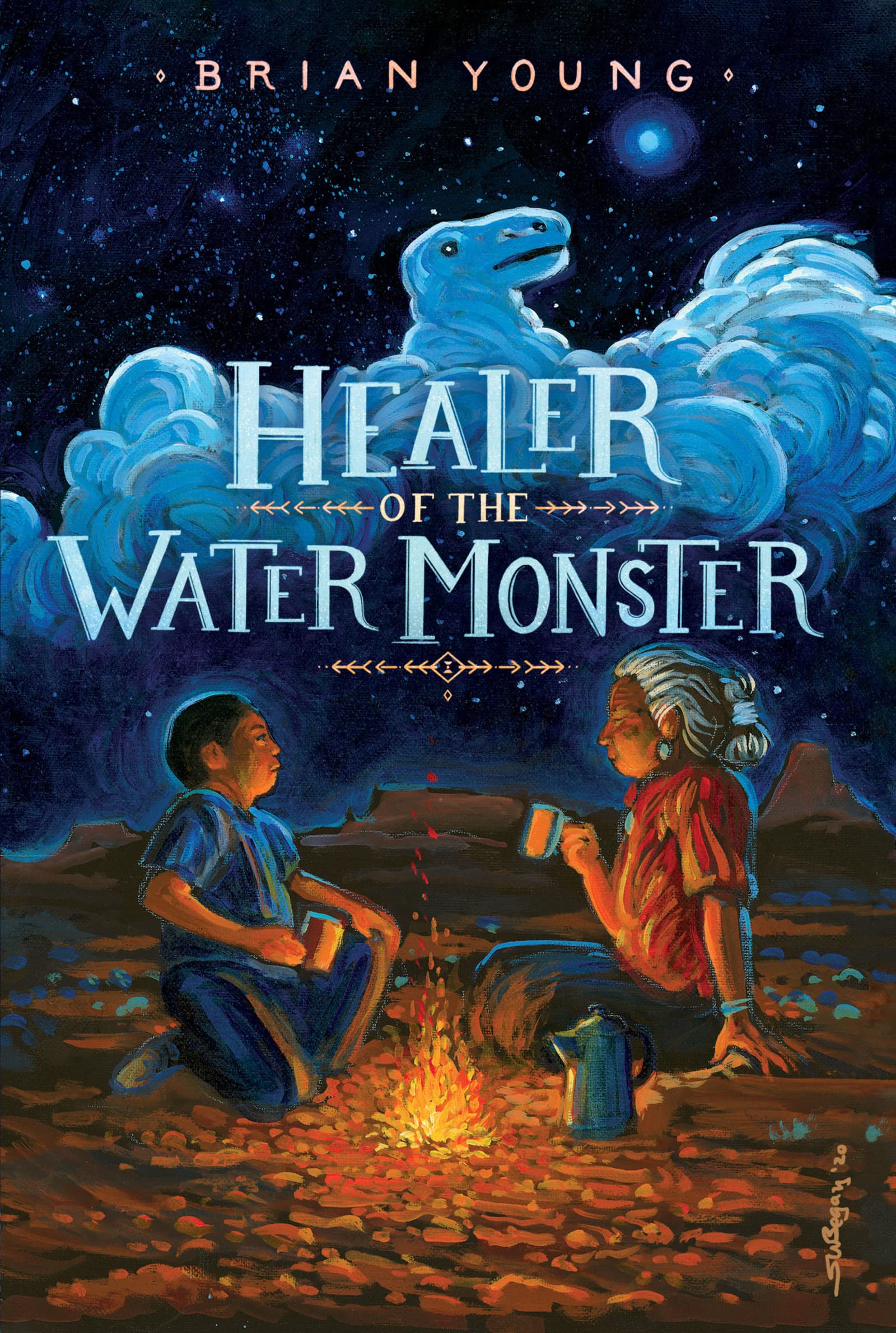
In a more recent example, Brian Young uses juxtaposition to set the stage in his Healer of the Water Monster, starting with the Navajo legend revealed in the Prologue (the gentle Water Monsters who keep the waters “tranquil” and “nourishing” become violent and destructive when Coyote kidnaps one of their infants) and continuing with protagonist Nathan’s big change in summer plans from bonding time with his father on a trip to Las Vegas to—instead—a long stay with his grandmother Nali in her mobile home in the desert. Even the chapter headings show juxtaposition of language with the number first in Navajo, then in English.

If you teach middle graders, they might be ready for some brief introduction to these and other lit devices that go beyond the usual study of personification and foreshadowing. They might look for examples of allusions in their class novels, and talk about why the author chose the reference they did. A handy chart or table in their reading journal can be used to compile examples of juxtaposition. And vignettes present an excellent opportunity for creative writing in the classroom; students might try their hand at short character sketches when a “walk-on” character in a class novel inspires description.

Happy writing in this year – I wish you all the best with everything new!


Interview with James Ponti – Author of CITY SPIES: CITY OF THE DEAD

I had the good fortune to interview James Ponti, author of the CITY SPIES series, this week. James’s fourth book in the series, CITY SPIES:  CITY OF THE DEAD comes out February 7.

I’m ashamed to admit that I am a little late to the CITY SPIES game, but I can’t wait to jump in and read them all.


Please tell us a little bit about your latest book, CITY SPIES: CITY OF THE DEAD.

It starts with a heist, which is so much fun to write. The City Spies have to break into the British Museum and steal something for the government. (Which means I had to figure out how to break into the British Museum.) In the process, they get swept up in a massive cyber-assault on venerated London institutions like Parliament and the Underground. To thwart the attack, they have to journey to Egypt and look for answers in the tombs among the Valley of the Kings. I wanted a story with elements that were up-to-the-minute modern alongside those that were ancient and mysterious. And mummies. I wanted mummies.

And, not for nothing, the fact that it involves breaking into a museum late at night can be traced directly back to the one book that found its way into my heart when I was a young reader. A certain book that shares its name with this website!


This series is incredibly popular. Colby Sharp of Nerdy Book Club said, “Books like this are why kids love to read,” which is high praise. What inspired you to write these stories and/or these characters?

First of all, I nearly fainted when I heard Colby say that on his video. My goal was to write a series that young me would’ve wanted to read. I was an extremely reluctant reader, so I keep that in mind when I work on the books. I tried to include the elements that grab me most as a reader – mystery, humor, adventure, and family. The actual idea was spurred by a trip my wife and I took to visit our son when he was studying in England for a year abroad. We went to London and Paris and had an amazing time. That trip and those elements came together to make City Spies.


Everyone says writing is a process. Could you share a little about your writing and/or research process?

I wish I had a process, but it seems to change all the time. Sometimes a story starts with characters and other times a plot. City Spies started with a setting. But for me, I really need those three ingredients before I can start cooking.

Right now, I’m finishing the first draft of City Spies 5, which comes out in 2024. Five books into this series, I still have to find all of those elements, but I also have to make sure they don’t seem too similar to what happened in the previous books. The main character changes from book to book, so with City Spies I start with who’s going to be the lead. Then I figure out what amazing location I want to write about. Then I try to work out a mystery/mission that feels organic to the combination of the two.

As for research, it’s extensive. For recent books, I’ve had long interviews with the former deputy director of the CIA, a leading Egyptologist, and a praying mantis expert who works for National Geographic in the Amazon. (My job is really fun that way.) I try to visit the locations when that is feasible. (I.e., when there isn’t a worldwide pandemic.) And the best part is when I get special tours. My wife, editor, and I got to look around the behind-the-scenes area of the New York Public Library to research a big action scene in book 5. It was FANTASTIC!


We know no writer is created in a vacuum. Could you tell our readers about teacher or a librarian who had an effect on your writing life?


I was blessed with great teachers from elementary school through college. My Mount Rushmore includes Herman Prothro (elementary), Dale Tyree (jr. high), Judith White (high school), and Abraham Polonsky (college). Judy White was my eleventh grade English teacher and she was amazing. She saw potential in me and pushed me as a writer. She encouraged me. She wrote notes to me in the margins of my work. She circled the opening paragraph of a paper I wrote about Robert Frost and next to it wrote “WOW!” That singular wow helped get me through self-doubt for years. She was also the hardest grader of any teach I’ve ever had and that was just what I needed.

I kept in touch with her after school and as I began my writing career. Unfortunately, she passed away before this success came along. She would’ve been over the moon about it. I love her so much, that I’ve used her name as the name of a teacher in virtually every book I’ve ever written. I just want her to be part of it.


What makes your books a good pick for use in a classroom? Is there any particular way you’d like to see teachers or parents use it with young readers/teens?


I come from a family of teachers and always write with them in mind. My wife teaches high school and told me that I had to do things for teachers that are free and require little set-up time. I try to live up to that challenge. My website is very educator-friendly and Simon & Schuster is setting up a Digital Classroom Dossier that has anything and everything teachers could use in a single location. I asked a bunch of educators what would be useful and we’ve got curriculum guides, videos, worksheets, downloads, links, interviews, graphics, you name it. They’re all just a single click away.

As for using City Spies in the classroom, in addition to the dossier, it’s important to know that virtually everything in the books is real. I research inside and out so that if you’re reading about an Egyptian tomb, the Great Wall of China, or Muir Woods in California, your students can go online and explore further. I put in tons of facts that I find interesting hoping it sparks interest for readers and educators. I also try to incorporate core subjects in each book. Math classes can look at codes and patterns. A science teacher can talk about the different technologies, old and new that the team uses. I always connect historic events and true to life people with the adventures they’re on. And, in addition to the reading in the books, I try to include literature. There’s an entire throughline about poetry and Robert Burns in two of the books.

All of us at Mixed-Up Files are huge fans of independent bookstores. I see that you are going on a 10-stop tour of independent bookstores across the country. Do you have a favorite Indie that you’d like to give a shout out to?

I could never pick a favorite Indie. I visit them all the time. My wife and I did a vacation to Boston last summer and managed to squeeze in fourteen indies while we were there. Overall, in the last few years, I think I’ve been to nearly one hundred of them. They are the lifeblood of our industry and I love how each one has its own distinct flavor with different quirks and qualities that make them what they are.


Can you give us a hint about what we can look forward to next from you?

I’m going to write City Spies at least to book 6 (and hopefully more), so that’s exciting. Book five has a jet-setting mission that takes the team to Venice, Washington, and New York. I’m also writing the first book in a new series.  It’s called the Sherlock Society and it’s a mystery series featuring multi-generational family in South Florida. The first one comes out next year and I am so excited about it! (I hope readers will be too.)


James Ponti is the New York Times bestselling author of three middle grade book series: City Spies, about an unlikely squad of five kids from around the world who form an elite MI6 Spy Team; the Edgar Award–winning Framed! series, about a pair of tweens who solve mysteries in Washington, DC; and the Dead City trilogy, about a secret society that polices the undead living beneath Manhattan. His books have appeared on more than fifteen different state award lists and he is the founder of a writers group known as the Renegades of Middle Grade. James is also an Emmy–nominated television writer and producer who has worked for many networks including Nickelodeon, Disney Channel, PBS, History, and Spike TV, as well as NBC Sports. He lives with his family in Orlando, Florida. Find out more at JamesPonti.com.


Thanks so much to James for taking the time to talk with us.

CITY SPIES: CITY OF THE DEAD releases February 7 and is available at bookstores everywhere.

You can see more purchase options at:  Simon & Schuster.


Are you a CITY SPIES fan? Are you about to be? Let us know in the comments below.