
 Welcome to STEM Tuesday: Author Interview & Book Giveaway, a repeating feature for the fourth Tuesday of every month. Go Science-Tech-Engineering-Math!
Today we’re interviewing Kathy Ceceri about her chemistry-infused book, EDIBLE INVENTIONS: Cooking Hacks and Yummy Recipes You Can Build, Mix, Bake, and Grow. PickaGoodBook.com says,”this book is such a great source to explore and learn through science and more.”
Mary Kay Carson: How did Edible Inventions come to be?
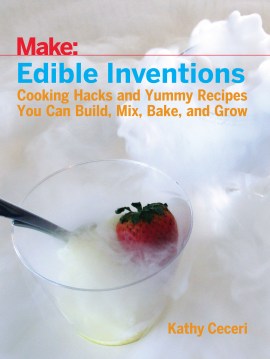 Kathy Ceceri: I have to credit my friend Miguel Valenzuela, inventor of the PancakeBot, a kind of 3D printer for making cool designs with pancake batter. I had written two books for Maker Media — Making Simple Robots and Paper Inventions — and gotten good feedback from educators and families looking for low-tech projects to help kids learn about STEAM (Science, Technology, Engineering, Art, and Math) concepts. I ran into Miguel at World Maker Faire New York — one of the worldwide celebrations of creativity in tech produced by Maker Media — where I was a speaker, but also casting about for inspiration for my next title. Miguel suggested I focus on food projects, and I roped him into a creating one of them — a hand-powered Lego version of the PancakeBot that lets kids “draw” with icing on cookies. The other projects touch on a wide variety of science and technology, with a heavy emphasis on chemistry, of course!
MKC: What was it like developing all these projects?
Kathy: Like most science experimentation, this one involved a lot of mishap! I spent several days trying to build an edible Rube Goldberg machine that included cucumber slice “dominoes” and a marble run using celery stalks and cherry tomatoes, but in the end it proved too difficult to coordinate all the moving parts. (You can see a test run video here.) More successful was the cardboard box solar oven. After going through several iterations, I finally developed a design that got hot enough to bake a chocolate cake! One of the things I loved about this book (and all my books, really) was learning a bunch of new stuff. For instance, thanks to a tip from another friend, flour expert Amy Halloran, I discovered that housewives used to make their own baking powder from chemicals they got at the local pharmacy. But probably the best part of creating Edible Inventions was getting to eat the results!
MKC: Why do you choose to write STEM books?
Kathy: My background is as a journalist. Over the years, I’ve written for local newspapers, magazines such as Sesame Street Parent, and websites such as Wired.com (where I helped create the GeekMom blog) and About.com (now Thoughtco, where I was the Homeschooling Expert). I’ve covered education, child development, history, art, and science — but I’m not an expert in any of those areas. You could say my expertise is in digging up background information research, finding the right people to talk to, and asking the right questions. My real talent is knowing how to distill what I learn into a form that’s easy for anyone to understand.

Kathy Ceceri is the author of over a dozen books of nonfiction for middle grade readers that teach STEAM along with history, geography, literature, and culture. Her hands-on projects have been used in classrooms and enrichment programs across the country and around the globe. Visit Kathy at Crafts for Learning, and follow her on Twitter @kathyceceri for sneak peeks of works in progress and links to her free online tutorials (including how to make Juicy Edible Gel Dots from Edible Inventions)!
I began focusing on STEAM (the “Art” is an important aspect to me!) after educational publisher Nomad Press asked me to do a book on robotics. Because my then-teenage oldest son was exploring robotics at the time as part of his homeschooling studies, I had spent a couple of years jumping on any opportunity to interview robotics engineers and designers. So I already had a good grasp of the basics, and a contact list of experts who were kind enough to let me pick their brains for topics and project ideas. I discovered I really enjoyed the process and I’m good at it, so I’ve continued writing about STEAM topics even after my kids grew up and moved onto other interests!
Today I teach crafts-based electronics and enrichment programs for kids and teens, and present hands-on professional development workshops for teachers and librarians. I’ve also worked with the Girl Scouts of the USA on their recent line of Robotics badges and their first-ever Cyber Challenge, coming this fall. All of these experiences help me keep in touch with what students and educators want to know about STEAM topics and ensure my writing is fresh and relevant.
MKC: To whom did you imagine yourself writing to while drafting the book?
Kathy: All my books are written for readers with little to no knowledge about the topic. That’s where I am at the start, too. So I can recognize the places where beginners are going to need some hand-holding and encouragement. I always try to relate concepts and techniques to things the reader is already familiar with. With robots, I use familiar materials like cardboard and duct tape. With Edible Inventions, I included a chapter featuring recipes that used standard ingredients and techniques to create unexpected textures and flavors (sort of like Molecular Cuisine, but using things you could find in any supermarket or natural food store). What makes my book different from an ordinary cookbook is that I emphasize the science. How does whipping an egg white turn a gooey liquid into a stiff meringue? Why do juice-flavored gelatin dots change color when you plop them into lemon-lime soda? And what’s the chemical reaction that causes watermelon lemonade to foam up and bubble over when you add a touch of baking soda? Readers get to learn about chemistry while making tasty snacks — what could be better?
 MKC: What’s your current project and how are you tackling it?
Kathy: My next book, Bots! from Nomad Press, is an update on my original 2012 book Robotics. It contains several new projects and topics, as well as old favorites. As with every book I write, I try to approach the topic from as many different angles as possible. I firmly believe that showing how science relates to other kinds of creative activities helps bring in people who might not otherwise give it a try. So along with engineering, electronics and programming, there’s a “kitchen chemistry” robotics project that shows you how to make edible, stretchable robot skin! And like most of my projects, it ties into actual research — in this case, researchers who are trying to make inflatable robots that can crawl or slither into hard-to-reach areas. They hope their edible robots could help rescue lost explorers trapped in a cave, for example, and provide nourishment after sending back data about their location. You can see video of my homemade edible inflatable robot here. Bots! comes out in October 2019.
Win a FREE copy of EDIBLE INVENTIONS!
Enter the giveaway by leaving a comment below. The randomly-chosen winner will be contacted via email and asked to provide a mailing address (within the U.S. only) to receive the book.
Good luck!
 Your host is Mary Kay Carson, author of The Tornado Scientist, Alexander Graham Bell for Kids, Mission to Pluto, Weird Animals, and other nonfiction books for kids. @marykaycarson


 THE SEVENTH ANNUAL CHAPPAQUA CHILDREN’S BOOK FESTIVAL brings together exciting authors, favorite characters, and heartfelt stories for children and teens. This small, welcoming town is the place to make a lasting connection between young readers and books. How did this wonderful event come to be? I asked founder, Dawn Greenburg that question–and lots of others.


