

Tough Texts
As I discussed in last week’s In the Classroom blog, science text is tough because it is often dense–there are lots of ideas crammed into just a few sentences. Students often think of reading as an all-or-nothing proposition: either they read through and get it (success!) or they read through and didn’t (failure!). Academic text is more complicated than that. Just as they couldn’t unzip a duffle bag and instantly perceive everything inside, they won’t be able to understand most academic texts on the first read-through. They have to be like the guards at the stadium and unpack (or at least riffle through) the things inside the duffel bag.
In this month’s blog, I am going to walk through a set of unpacking tools that readers might use to work through a passage from Inside Biosphere 2: Earth Science Under Glass by Mary Kay Carson.
Before using this passage with your class, you should do a quick book-talk, explaining that the Biosphere 2 is a gigantic (multi-acre!) laboratory that reproduces several earth biomes in ways that allow scientists to control environmental variables such as the temperature, rainfall, wind, and the organisms present. One of the biomes is a tropical rainforest. Joost van Haren studies this biome.
Then present them with this passage from pages 24-25.
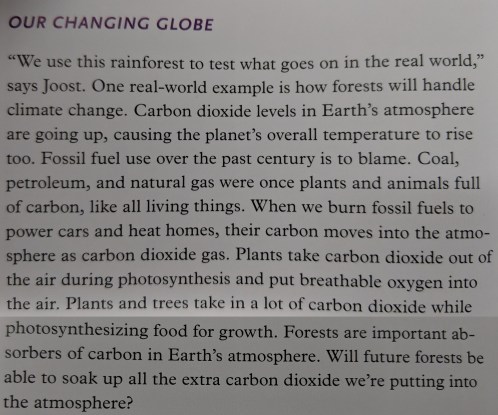
Highlight these strategies as you work through the passage with your students:
Chunking
Focus in on this sentence:
Coal, petroleum, and natural gas were once plants and animals full of carbon, like all living things.
There are actually three ideas in this sentence, that I have marked with slash marks (/) below.
Coal, petroleum, and natural gas were once plants and animals / full of carbon, / like all living things.
If your students are familiar with all three ideas, the sentence will be easy to read. But if some of these ideas are new, they may need to linger on them a moment, and think through what is being said and how it relates to their prior knowledge about fossil fuels.
This strategy is called chunking. Students tend to pause and think at points predetermined by the author: at commas, periods, or the ends of paragraphs. Sometimes, a reader needs to slow down and process smaller chunks of text. As Ruth Schoenbach explains in Reading for Understanding, nobody eats a pizza in one bite. Everyone has to break the pizza down, bit by bit, but different people take different sized bites.
Sketching/ Diagramming
This passage offers a whole series of causes and effects, a cascade of consequences. A quick sketch of the relationships between ideas could help keep them straight. This was my sketch through the text:

Look for surrounding supports
Many science ideas are easier to understand in diagram form, so when you encounter tough text, check surrounding pages for a diagram or illustration. In this case, some of the information in this paragraph is summarized in a diagram of a tree interacting with the environment on page 24.
Build your background
Sometimes, tough text is tough because the writer of the text assumes you already know something that you don’t already know. If you’ve tried to unpack the text, and its still tough, you may need to step back a level–not a “reading level” so much as a “knowledge level.” Read someone else’s account of the ideas, especially one aimed at a less knowledgeable audience, and see if that gives you the background for the more sophisticated text. Another book off this week’s list addressed some of these ideas in simpler form. Show students this passage from page 5 in Out of the Ice by Claire Eamer.

What information does this paragraph contribute to their understanding?
Skip it
Let students know that sometimes, its ok to just skip past a section of tough text! This can feel very freeing for struggling readers. It depends on your purpose for reading–I chose this passage because it gets at an important idea for Earth Science. But what if you are reading this because you want an overview of Biosphere 2? Or you are planning to visit, and want to know what to expect? Or you’re looking for an idea for a science project? You might not need to understand this particular section of text. In this particular book, there is a wealth of interesting information. You could skip this paragraph and still glean all kinds of great ideas from the book. Indeed, it may be that reading further clarifies this set of ideas for you.
(And as a side note make sure your students know that it can be ok to blame the author. Sometimes, text is tough because it is not well-written (not the case here, but sometimes)! Struggling readers tend to assume that reading struggles are all their fault. But many times, the fault lies with writer for not expressing ideas clearly.)
 Jodi Wheeler-Toppen is a former science teacher and the author of the Once Upon A Science Book series (NSTA Press) on integrating science and reading instruction. She also writes for children, with her most recent book being Dog Science Unleashed: Fun Activities to do with Your Canine Companion. Visit https://OnceUponAScienceBook.com for more information on her books and staff development offerings.

 Turtle in Paradise by Jennifer L. Holm – Turtle is a strong-minded girl who bravely faces reality: in the Depression-era South, her mama must take a live-in housekeeper job with a no-children-allowed rule. Turtle tries to be positive about being sent to live with an aunt and cousins in Key West, Florida; however, she is out of her element there (scorpions like to hide in shoes, so be careful; also, alligator pear is what’s for breakfast—rather, avocado on toast.) Turtle tries to find ways to get along with the relatives who were not expecting her arrival, and to open her heart to a deeper meaning of family.
 in 1768, relates a historical sailing story through the perspective of a bold narrator. The opening of Stowaway pulls the reader in to join Nick in his tiny, cramped hiding place on the Endeavour, waiting through long days and nights, until the ship sails far enough away from England for him to be revealed to the Captain and crew. Nick’s story brings the reader along for adventure and excitement in long-ago days of exploration and discovery as Captain Cook pursues a secret mission to relatively unknown waters.
 A Bandit’s Tale: The Muddled Misadventures of a Pickpocket by Deborah Hopkinson — In the mood for a picaresque tale? Think “I-voice” narrative by a roguish young person setting out on independent adventures in the face of daunting surroundings or social circumstances; examples include Moll Flanders, The Adventures of Huckleberry Finn, and Oliver Twist, to name a few. In A Bandit’s Tale, main character Rocco’s story begins with an actual journey from late 1800s Italy to America following a misunderstood misdeed in his hometown. In New York, the guardian supposedly responsible for him requires that he and other boys play street instruments for money. Rocco’s “journey” continues as he learns to navigate difficult living conditions, the challenges of early immigrants, and historic reform movements to improve the treatment of children and animals.
 Sophie to wear trousers and practice handstands. But once Sophie turns twelve, their enigmatic way of life catches the attention of the authorities, and Sophie is set to be sent to an orphanage for young ladies. Using only a few cryptic clues, the two set out on a journey to Paris to attempt to find Sophie’s mother–who may or may not still be alive.
 Welcome to STEM Tuesday: Author Interview & Book Giveaway, a repeating feature for the fourth Tuesday of every month. Go Science-Tech-Engineering-Math!

 Your host this week is fellow elephant fan