Posts Tagged kidlit

STEM Tuesday– Taking a Look at Climate Change/Earth Science– In the Classroom

Tough Texts

As I discussed in last week’s In the Classroom blog, science text is tough because it is often dense–there are lots of ideas crammed into just a few sentences. Students often think of reading as an all-or-nothing proposition: either they read through and get it (success!) or they read through and didn’t (failure!). Academic text is more complicated than that. Just as they couldn’t unzip a duffle bag and instantly perceive everything inside, they won’t be able to understand most academic texts on the first read-through. They have to be like the guards at the stadium and unpack (or at least riffle through) the things inside the duffel bag.

In this month’s blog, I am going to walk through a set of unpacking tools that readers might use to work through a passage from Inside Biosphere 2: Earth Science Under Glass by Mary Kay Carson.

Before using this passage with your class, you should do a quick book-talk, explaining that the Biosphere 2 is a gigantic (multi-acre!) laboratory that reproduces several earth biomes in ways that allow scientists to control environmental variables such as the temperature, rainfall, wind, and the organisms present. One of the biomes is a tropical rainforest. Joost van Haren studies this biome.

Then present them with this passage from pages 24-25.
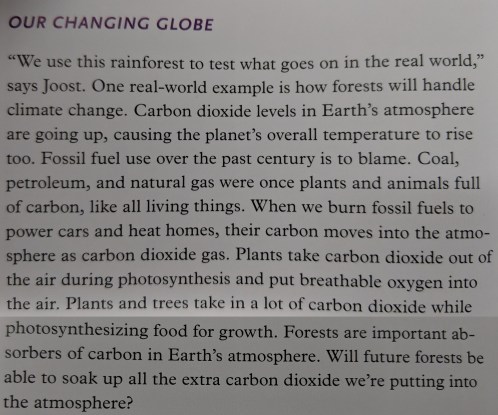
Highlight these strategies as you work through the passage with your students:

Chunking

Focus in on this sentence:

Coal, petroleum, and natural gas were once plants and animals full of carbon, like all living things.

There are actually three ideas in this sentence, that I have marked with slash marks (/) below.

Coal, petroleum, and natural gas were once plants and animals / full of carbon, / like all living things.

If your students are familiar with all three ideas, the sentence will be easy to read. But if some of these ideas are new, they may need to linger on them a moment, and think through what is being said and how it relates to their prior knowledge about fossil fuels.

This strategy is called chunking. Students tend to pause and think at points predetermined by the author: at commas, periods, or the ends of paragraphs. Sometimes, a reader needs to slow down and process smaller chunks of text. As Ruth Schoenbach explains in Reading for Understanding, nobody eats a pizza in one bite. Everyone has to break the pizza down, bit by bit, but different people take different sized bites.

Sketching/ Diagramming

This passage offers a whole series of causes and effects, a cascade of consequences. A quick sketch of the relationships between ideas could help keep them straight. This was my sketch through the text:

Look for surrounding supports

Many science ideas are easier to understand in diagram form, so when you encounter tough text, check surrounding pages for a diagram or illustration. In this case, some of the information in this paragraph is summarized in a diagram of a tree interacting with the environment on page 24.

Build your background

Sometimes, tough text is tough because the writer of the text assumes you already know something that you don’t already know. If you’ve tried to unpack the text, and its still tough, you may need to step back a level–not a “reading level” so much as a “knowledge level.” Read someone else’s account of the ideas, especially one aimed at a less knowledgeable audience, and see if that gives you the background for the more sophisticated text. Another book off this week’s list addressed some of these ideas in simpler form. Show students this passage from page 5 in Out of the Ice by Claire Eamer.

What information does this paragraph contribute to their understanding?

Skip it

Let students know that sometimes, its ok to just skip past a section of tough text! This can feel very freeing for struggling readers. It depends on your purpose for reading–I chose this passage because it gets at an important idea for Earth Science. But what if you are reading this because you want an overview of Biosphere 2? Or you are planning to visit, and want to know what to expect? Or you’re looking for an idea for a science project? You might not need to understand this particular section of text. In this particular book, there is a wealth of interesting information. You could skip this paragraph and still glean all kinds of great ideas from the book. Indeed, it may be that reading further clarifies this set of ideas for you.

(And as a side note make sure your students know that it can be ok to blame the author. Sometimes, text is tough because it is not well-written (not the case here, but sometimes)! Struggling readers tend to assume that reading struggles are all their fault. But many times, the fault lies with writer for not expressing ideas clearly.)


Jodi Wheeler-Toppen is a former science teacher and the author of the Once Upon A Science Book series (NSTA Press) on integrating science and reading instruction.  She also writes for children, with her most recent book being Dog Science Unleashed: Fun Activities to do with Your Canine Companion. Visit https://OnceUponAScienceBook.com for more information on her books and staff development offerings.

STEM Tuesday– Awesome Animal Antics– Interview with Author Patricia Newman

Welcome to STEM Tuesday: Author Interview & Book Giveaway, a repeating feature for the fourth Tuesday of every month. Go Science-Tech-Engineering-Math!

Today we’re interviewing Patricia Newman, author of Eavesdropping on Elephants: How Listening Helps Conservation. This fascinating book is a 2019 Outstanding Science Trade Book for Students: K-12 (National Science Teachers Association and the Children’s Book Council) and won a Eureka! Gold Award from the California Reading Association.

Mary Kay Carson: Why did you write Eavesdropping on Elephants?

Patricia Newman: Back in the 1980s I visited Kenya and saw elephants in the wild for the first time. I watched the way they moved, observed their family groups, and experienced how fiercely the matriarch protects her herd when she charged our safari van. One day we took a hike outside the national park and came across a massive elephant skull. Any child who has seen The Lion King understands the circle of life, but it wasn’t at all clear to us how this elephant had died. Natural causes or poaching? The tusks were gone. Did a park official or a poacher take them? The idea that a poacher carried away the tusks under cover of darkness gave me shivers.

I must have passed my interest in elephants on to my daughter Elise, because she worked for Cornell’s Elephant Listening Project as an undergrad. She had daily contact with Katy Payne, Peter Wrege, and Liz Rowland. She explained their research to me and described how she sat in front of the computer cataloguing forest sounds. And she told stories of snatching the headphones off her ears when an elephant trumpeted a very loud alarm call. I knew then I wanted to write about them. Elise handled the introductions, and the rest…well, you know.

School Library Journal says about Eavesdropping on Elephants, “…this book does an excellent job of transporting readers and providing a clear, multifaceted picture of African forest elephants…The more you listen to wildlife, the more your mind opens up to new ideas about why the world is a place worth saving.”

MKC: How did you research this book? Did it involve travel? 

Patricia: I did not spend time with forest elephants. The scientists were not at their research station in the Central African Republic when I wrote this book, but I did sit in the Elephant Listening Project’s lab and listen to forest sounds. I had headphones on my ears and for hours I watched video and listened to sound files.

You might think listening to sounds is a poor substitute for actually being in the field, but it wasn’t. The sounds were transformative and immersive! I felt elephant rumbles and roars deep in my chest. I heard water sloshing as elephants walked through it. I literally swatted away a mosquito buzzing in my ear. I could imagine the forest mud sucking at my feet. And I learned how to identify the sounds of frogs, buffalo, parrots, gorillas, and chimps.

By allowing my ears to take over, I learned to appreciate the forest in a whole new way. And I wanted my readers to have the same experience. Eavesdropping on Elephants tells the story of field scientists helping an endangered species, but it’s so much more. Through the power of video and audio QR codes, the book allows readers to walk in the scientists’ shoes inside the forest. I always ask kids to tell me what they see in the videos or hear in the audio. Their responses would make Katy and Peter proud.

Patricia Newman’s books show kids how their actions can ripple around the world. Newman hopes to empower kids to think about the adults they’d like to become. Find out more about the author and her award-winning books at www.patriciamnewman.com.

MKC: To whom did you imagine yourself writing to while writing the book?

Patricia: Throughout, I imagined my daughter at age ten. What would she want to know? Elephant facts, for sure. But she was also interested in the “how” and “why” of the world. This book was a challenge because the narrative unfolded over the course of many years. How would I squeeze in Katy Payne’s early work with infrasound, sprinkle in some Elephant Listening Project history, and still keep the ten-year-old Elise engaged? I decided to use the passage of time to my advantage.

Science is not performed in a vacuum, nor is a long-term investigation quick. I thought the story of how Katy’s work on infrasound at the Oregon zoo morphed into ELP was a great example of real science in action. Questions and observations often lead scientists down unexpected paths and to unexpected conclusions.

Also, scientists sometimes age out of their work. When Katy retired from ELP, Peter carried on her vision but added his own flair. I thought the staff change was a great example of the inclusiveness of science—how different individuals can contribute to and build on the same project.

MKC: For readers who loved Eavesdropping on Elephants, what other middle-grade books would you suggest?

Patricia: A tough question because I don’t know of any other books about forest elephants for children (or for adults for that matter). They are just coming into their own as a species and few people know about them. Young readers interested in elephant research might consider The Elephant Scientist by Caitlin O’Connell and Donna M. Jackson, which features Caitlin’s work with savanna elephants. Also, consider Bravelands #3: Blood and Bone by Erin Hunter, the author of the Warriors series. The third installment of Bravelands is told by the African elephant—but it’s a savanna elephant, not a forest elephant.

Win a FREE copy of Eavesdropping on Elephants!

Enter the giveaway by leaving a comment below. The randomly-chosen winner will be contacted via email and asked to provide a mailing address (within the U.S. only) to receive the book.

Good luck!

Your host this week is fellow elephant fan Mary Kay Carson, author of Mission to Pluto and other nonfiction books for kids. @marykaycarson

STEM Tuesday– Awesome Animal Antics– In the Classroom

Help! Help! We need your help! We want to know what would help you most in our second-Tuesday-of-the-month posts.

In case you haven’t noticed, there is a regular structure to our STEM Tuesday posts.

  • The first Tuesday of the month is the book list.
  • The second (this one!) is classroom information.
  • Week three covers writing craft, for writers and teachers of writing.
  • Week four is an author interview and book giveaway.

A different team of writers works on each week. Our second-Tuesday team is trying to figure out what type of classroom support would be most helpful to you, our readers. Would you please take just a moment to answer 4 quick questions  for us? Your survey responses will help us write super-useful classroom guides for you!

****Take Survey Here. Thank You!****

And now, I interrupt this blog post to give you…

The Interruption Construction!*

Sometimes, readers don’t enjoy STEM writing because they find it difficult. STEM writing can be dense, with lots of ideas packed into a single sentence. Fortunately, some of those sentences follow patterns that can help readers sort out the information. One very common structure in science writing is called the interruption construction. This month’s books contain some great examples of the construction using high-interest topics (and high-interest topics are always the best way to teach useful reading skills!)

Consider this sentence, from page 41 of Animal Zombies, which describes the Frilled Shark:

Its 300 teeth, with multiple spikes arranged in 25 rows, are pointed like arrows toward the creature’s throat.

Show that sentence to students, and then block out the “interruption” found between the commas:

Its 300 teeth, with multiple spikes arranged in 25 rows, are pointed like arrows toward the creature’s throat. 

Point out that the information surrounding the commas make a complete thought. The “interruption” consists of extras that the author is throwing in as a freebie, like when you buy a big lotion pump and get an extra little bottle for free. If a sentence with an interruption construction is  overwhelming them with new information, they can read around the comma and then look back to find out what extras the author wanted to add.

Death Eaters has a wealth of these sentences. At the bottom of page 18, there’s an intriguing passage that describes hyenas and wolves. It would be a great text for a class talking about scavengers, and you could throw in a quick introduction to the interruption construction. The first paragraph reads:

Wolves, found in Africa, northern Asia, Europe, and North America, prefer colder climates. Hyenas, which are native to Africa and southern Asia, thrive in warmer areas. These two death eaters are very similar.

Two interruptions in a row! And if students keep reading that short section, they’ll come across two more. You can discuss the first one as an example, have students talk about the next one, and then have them watch for the others as they read.

Finally, Little Monsters of the Sea illustrates a second form of the interruption construction–one that uses dashes instead of commas. Often–but not always–dashes are used to show that the interruption is restating or clarifying the information that came just before. Consider these sentences:

If you require a very specific habitat—if you can’t call just anywhere home—it’s nice to have young’uns who can get up and go find a fresh spot. (page 26)

Animals inherit their DNA—and therefore their characteristics—from their parents. (page 44)

Once again, if a sentence with extras offset by a dash gets too long or too dense, readers can skip the middle part, and go back to it after they have digested the main part of the sentence.

The interruption constructions in these books are fairly short. But in academic text, that “extra” information can get quite long. If students get used to observing the structure in easier, interesting text, they will have the confidence to tackle it when it shows up in more difficult text.

*I believe the phrase “interruption construction” was coined by Zhihui Fang in: The Language Demands of Science Reading in Middle School, International Journal of Science Education, 28:5, 491-520, 2006. (DOI: 10.1080/09500690500339092). If you ever come across Zhihui, please let him know I appreciate his contribution. It’s a great descriptor and helps students grasp the idea quickly!


For more great ways to use these books in the classroom, see the links below for online educator guides and supplementary material.

Eavesdropping on Elephants

Support Independent Bookstores - Visit IndieBound.org


Teachers guide with supplementary videos and activities http://www.birdsleuth.org/eavesdroppingonelephants/
The SuperPower Field Guide: Beavers

Support Independent Bookstores - Visit IndieBound.org

A free unit on beavers for grades K-3 that incorporates the book http://www.discoverunitstudies.com/blog/freebie-beaver-unit-study-for-k-3rd-grade
Backyard Bears

Support Independent Bookstores - Visit IndieBound.org

Teachers guide with prereading, discussion, and extension activities http://www.sciencemeetsadventure.com/wp-content/uploads/2018/10/SITF-Cherrix_BackyardBears.pdf
Penguins vs. Puffins

Support Independent Bookstores - Visit IndieBound.org

Videos and more to go with the book https://kids.nationalgeographic.com/explore/books/penguins-vs-puffins/
Smart About SharksSupport Independent Bookstores - Visit IndieBound.org Video describing the creation of the book cover https://vimeo.com/192643792
Animal Zombies

Support Independent Bookstores - Visit IndieBound.org

Teachers guide with some unique activities that only require students to read parts of the book https://fromthemixedupfiles.com/wp-content/uploads/2019/01/Lesson-plans-for-ANIMAL-ZOMBIES-1.docx
Little Monsters of the OceanSupport Independent Bookstores - Visit IndieBound.org A description of the origin of the book and some quick teaching ideas https://fromthemixedupfiles.com/wp-content/uploads/2019/01/Teaching-Ideas-for-Little-Monsters-of-the-Ocean.docx

Jodi Wheeler-Toppen is a former science teacher and the author of the Once Upon A Science Book series (NSTA Press) on integrating science and reading instruction.  She also writes for children, with her most recent book being Dog Science Unleashed: Fun Activities to do with Your Canine Companion. Visit https://OnceUponAScienceBook.com for more information on her books and staff development offerings.