
Posts Tagged kidlit

Ho! Ho! Ho! December New Releases

Just in time for the holidays, check out these new releases! Make sure to put them on your Wish List…or pick up a copy or two for your favorite middle-grade readers.

The Last Rose

Written by Leah Cypess, Delacorte Press, December 5 release

The fourth book in the Sisters Ever After series of fairy tale retellings, this is the wild story of Mera, the only one who can save her beautiful older sister when she is kidnapped by the Beast who viciously rules over their small village.
For as long as Mera can remember, she and her sister Darina have feared the Beast who lurks in the castle above their village. On countless nights they have locked themselves into their home while the Beast led his hounds on the Wild Hunt, preying on anything in his path.
Now Darina has been kidnapped by the Beast, and only Mera can save her. But she soon finds that in the Beast’s eerie, magic-haunted castle, nothing is quite what it seems–including her own sister. Here, Mera will discover the dark secrets that have bound her village to the Beast for so long.
But in order to set them all free, she will have to face the most dangerous secret of all: the truth about herself.

Mercy Watson is Missing! Tales from Deckawoo Drive

Written by Kate DiCamillo, Illustrated by Chris Van Dusen, Candlewick Press, December 5 release

Every favorite character from Kate DiCamillo’s New York Times best-selling Mercy Watson books makes an appearance in this extended, riotously funny series crescendo.
When Mercy Watson the pig goes missing, all of Deckawoo Drive is in an uproar. The Watsons are inconsolable, and the local police, fire, and animal control departments are no help whatsoever. Bossy neighbor Eugenia Lincoln is not quite as sad as she might be, but thankfully her sister, Baby Lincoln, has the idea to hire a private investigator. Granted, Percival Smidgely, PI, may be more bumbler than gumshoe, but his pigeon, Polly, is there to point the way. Meanwhile, Frank and Stella Endicott and Stella’s friend Horace Broom are ready to do some investigating of their own. Will the clever neighborhood sleuths manage to follow the trail of hoofprints–and a certain overwhelmingly enticing scent–and recover their porcine wonder? With deftly paced narrative comedy, visual slapstick, abundant artwork in both black and white and full color, and warm affection for their cast of characters, Kate DiCamillo and Chris Van Dusen bring us a highly satisfying, extra-special series finale that rewards loyal fans–and invites new readers to explore the stories that came before.
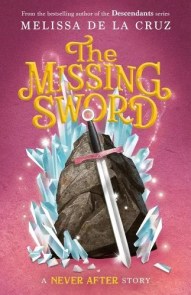
Written by Melissa De La Cruz, Roaring Brook Press, December 5 release

Return to the land of Never After, where real life and fairy tales collide, in book four of New York Times-bestselling author Melissa de la Cruz’s hit middle grade series.

To save her mother from Olga’s evil clutches, Filomena and her friends will set off for new lands and new adventures. Without a moment to lose, Filomena must travel to the legendary land of Camelot to find the sword of Excalibur – the only thing that can save Fil’s mother from Olga’s mysterious illness that has poisoned her body.
But Camelot is not all that it seems. Fil and the crew quickly realize that there is another fairy tale that has taken hold in the land of Arthurian Legend. . . that of the Wizard of Oz! With the help (and hindrance) of the Wicked Witches of the East and West, lions and tigers and bears will surely be the least of Fil and the gang’s troubles.
As the League of Seven follows the yellow brick road to retrieve the sword and complete their most important quest yet, they find nothing will thwart the ogres and their mission to destroy Never After. In a land where nothing is truly as it seems, will Fil and the League of the Seven survive the witch’s tests? Or will Olga’s perilous plans rip Fil’s mother away from her forever?

Eyewitness Fossil

DK Publishing December 5 release

Packed with striking photography, Eyewitness Fossil explores the creatures and plants that lived long ago.

Become an eyewitness to the natural treasures found in rocks in this picture-led reference guide that will take you on a visual tour of all things fossils. Children will be mesmerized by the bones, teeth, and plants from long ago that have all been turned to rock.

This beautifully illustrated guide for kids aged 9+ gives an insight into how paleontologists learn about ancient life forms. Striking photographs, detailed diagrams, and lots of examples of fossils help you to learn what can be discovered around the world and why some fossils lead to new discoveries about the past.

Shelter for Lost Dreams

Written by Alfonso Font, Dark Horse Books, December 19 release

In a house of wonder, two children will learn life lessons through stories spanning across time.

During his first stay with his uncle, a boy discovers the magical world that is his uncle’s house. Surrounded by eclectic antiques, a vast library of books, strange objects, and whimsical animals, he is overcome with curiosity. Here, he meets a girl who shares his sense of wonder. With his uncle’s wisdom and an enchanted gift, the children will learn important life lessons through the diverse experiences of people throughout time—from common hikers encountering an unusual creature, to a general making the final decision to end a war, and many more!

Robert Winston: The Story of Science

Written by Robert Winston, DK Publishing, December 12 release

Let Professor Robert Winston take you on a scientific journey through human history in this fact-packed science book.

Delve into the stories of history’s most influential scientific experiments, inventions and life-changing discoveries that have impacted our understanding and changed the world in this science book for kids aged 7-9.Robert Winston’s The Story of Science will teach children about the incredible world of science through fascinating facts, innovative inventions, and daring discoveries. Learn how random accidents have led to some of the greatest findings our world has ever seen, and how anybody who dares to dream can be successful.

STEM Tuesday: Snow and Ice– Interview with Author Cindy Blobaum

    We are delighted to interview author Cindy Blobaum for our Ice and Snow theme this month!

Cindy is the author of:


Ice Age by Cindy Blobaum

Explore the Ice Age! With 25 Great Projects

Illustrated by Bryan Stone
Brrr–does it feel cold? Get out your gloves and get ready to experience the Ice Age! In Explore the Ice Age! With 25 Great Projects, readers ages 7 to 10 discover what an ice age consists of, why we have them, and what effect an ice age has on living organisms and ecosystems. The book pays particular attention to the most recent Ice Age, which is the only one humans were around to witness.

Cindy digging up mammoth

Cindy holding a mammoth bone


Cindy digging up a mammoth bone, and then holding one! 


Cindy, thanks for being on our blog. How fun was it to write a book about the Ice Age? 

I’m one of the few people I know who absolutely LOVES winter.  In fact, I drive almost everyone crazy because I sing every time it starts to snow J . The cold weather gives me the opportunity to create snow “somethings” (not usually a snowman), make snow ice cream and go ice skating (outdoors), snow shoeing and skiing.  So writing a book that revolves pretty much around winter-style activities was a blast for me.


Your book is packed full of awesome projects– did you come up with them yourself?

Many of the projects tapped into my experiences as a naturalist (field trip lady). I had the good fortune to take part in a mammoth dig (excavating several mammoth skeletons), I constantly use ice cube glacier models in my geology programs to explain local topology, and teaching people how to throw spears using atl atl’s was a constant part of fall programs for many years. Other projects that explained important concepts are ones that I adapted from other programs. When I started working on Explore the Ice Age, I had a notebook full of ideas and connections, which expanded as I got going.


Did you research them? If so, where can people find cool activities for kids?

Each activity I include is thoroughly researched and tested – with my children and neighbor kids often helping out. Research is one of my favorite parts of writing! The research can include checking books, online resources, primary source materials and of course, asking real experts.  I learn so much that it can be difficult to select what to include and what I have to leave out. For example, I lived in Iowa when I was writing Explore the Ice Age.  When I was working on the mammoth dig, I met an expert on giant sloths. He had created a website with a wealth of information that could be enough for its own book! https://slothcentral.com/

As for finding cool activities for kids, there are multiple ways to approach the search. Activity books are an obvious choice, and don’t pass up the old ones!  I have “discovered” many awesome projects that are so old that many people have never seen them, but they are still cool, fun and relevant! Online searches are great, especially if you have the time to actually use “the web” – as in follow many of the multiple possibilities that pop up, especially if you scroll past the first page of results. I also let my mind wander, choosing a word, like “lever” or “insulation” and seeing what I can find that way. And don’t be afraid to adapt activities – try doing them using different materials or in new ways.


Can you give us a sneak peek of one or two of the activities? 


An easy and very effective activity to start RIGHT NOW is Sun Stretch! The purpose of the activity is to measure how much the tilt of the sun changes from season to season.  If you are living in the Northern Hemisphere, use a south facing window. (Use a north facing window if you live in the Southern Hemisphere.)

Write today’s date on a piece of masking tape or similar substance. Right around noon, place the piece of tape on the floor or wall where you see the sunlight end.  At least once a month, do the same thing – putting a new dated piece of tape where you see the sunlight end. The farther you live from the equator, the more change you will see!

Bundled Bottles is an activity that clearly demonstrates the effectiveness of the insulation found on some animal’s bodies. The equipment is zippered baggies, shortening, socks (the thicker, the better), plastic water bottles and a freezer.  After creating a coat that mimics a warm-blooded animal’s body, you measure how long it can keep hot water from freezing.


Can you give any tips to writers who want to break into nonfiction children’s books? Should they start with educational publishers like you have done? 

At a writing conference, I remember a publisher commenting that although children’s fiction titles usually steal the spotlight, young readers eagerly seek out nonfiction to feed their desire to know more and understand how things work. That is who I write for and why I write. The fact that many formal and informal educators (staff/volunteers at museums, nature centers, summer camps, home schoolers) use my books gives me a definite thrill.

Just like you have to do your research for your subject matter, it is also imperative to research potential publishers. Due to my writing style and content, it makes the most sense to work with publishers who know/understand/work with that format, which is mostly educational publishers. If your writing is more narrative, look for publishers who feature that style of titles. Two other nonfiction styles (this list is not exhaustive) are short facts/records/lists and curriculum/activity sheets. Each one has a separate but sometimes overlapping audience and publisher. .


What are you working on now? 

I recently updated Explore Gravity (Nomad Press), expanding it for older readers (ages 9 – 12). I am also working on updating Geology Rocks to get it back in print with Chicago Review Press. With my new full time position, quite honestly, it would be very difficult to start a project right now – although as always, I have a notebook and file folder full of ideas!


Thanks for being on our blog, Cindy, and sharing all of this great info on your book and STEM!

You can discover more about Cindy HERE 


******************************

Jennifer Swanson authorJennifer Swanson is the award-winning  author of 45+ books for kids, mostly about STEM, and also the creator and cohost of the Solve It for Kids podcast.  You can hear her recommendations for the best STEM books for kids in 2023 on NPR’s Science Friday, here!


STEM Tuesday: Snow and Ice– Writing Tips & Resources


Accordions and Information

The five-paragraph essay. Love it or hate it, it’s a thing. One of the reasons it is so hard to teach? Young writers rarely see pure examples in their pleasure reading. Still, this formulaic approach can help young writers learn to organize their thinking and writing.

So, how do we teach them to use this tool?

Step By Step

My favorite is the accordion method. Start by printing each of the sentences below on a separate sheet of colored paper.

Green paper:

  • Bugs have wicked cool mouthparts.
  • These mouthparts allow insects to chow down on their favorite food.

Yellow paper:

  • Some bugs have hypodermic needles for mouths.
  • A few insects use sponges for mouths.
  • And, others have strong grinding jaws.

Post those in random order on the board or wall. Challenge students to physically re-arrange them into a logical paragraph. This can be done together on the board or students can copy onto sticky notes and work individually on their desks.

Now, on the board, lay the sentences out with the yellow ones indented to look like an outline. Introduce the color scheme and provide examples from texts they are familiar with (textbooks, student writing, etc.):

Green = General topic

Yellow = Reason, detail or fact

Red = Example or explanation

Accordion it!

Next, demonstrate how a paragraph, like an accordion, can be lengthened if we add additional information. Show the new sentences below and have students move these examples into place on the outline.

Red paper:

  • The assassin bug stabs its sharp proboscis through the exoskeleton of other insects.
  • The house fly uses its labella to sop up spit-soaked food.
  • The mandibles of a cockroach crush with a force five times stronger than human jaws.

Rewrite on the board in standard paragraph form.

Once students are comfortable with the color scheme, challenge them to use highlighter markers to color-code pre-written paragraphs. You can write your own or use examples from textbooks or STEM Tuesday’s reading list. For example, Page 30 of What was the Ice Age:

“To have enough energy, Megatherium needed to eat a lot! It ate grasses, buts, and fruits. It dug roots out of the ground with its sharp claws. It stood on its hind legs to pull leaves from the highest branches. Some scientists think Megatherium might have even eaten meat.”

Once they are ready, have students use this color-coded sticky notes to create a paragraph about their favorite animal.  For some fun, let students swap yellow and red notes to create silly paragraphs.

Extension

To extend the lesson, demonstrate how a single paragraph can be lengthened like an accordion into a 5 paragraph essay, a section of a longer work, or an entire book. For example, in Ice: Chilling Stories from a Disappearing World students can study the introduction as one accordion and the entire book as another.

Finally, have students examine nonfiction trade books, magazines, and a variety of informational texts. Are super-structured paragraphs common? Discuss why and why not. Are they more common in one type of informational text? Is the formula more common in the over all text than as paragraphs? Do students prefer them or not?

________________________________________________

Prepared by:

Heather L. Montgomery writes books for kids who are wild about animals. She is author of 17 nonfiction books for kids, including What’s In Your Pocket? Collecting Nature’s Treasures and the upcoming Sick! The Twists and Turns Behind Animal Germs.

www.HeatherLMontgomery.com