Posts Tagged illustration process

Interview with Author/Illustrator J.C. Phillipps

Today, please join me in giving a hearty Mixed-Up welcome to author and illustrator J.C. Phillipps. Originally from Toledo, Ohio, J.C. took art lessons at the Toledo Museum of Art and went on to get degrees in art and theater from Hope College in Holland, Michigan, and Emerson College in Boston.
More recently, J. C. has been working as an artist, author, and illustrator in West Hartford, Connecticut. She has written and illustrated four published picture books as well as the graphic novel series Pacey Packer Unicorn Tracker. Her latest graphic MG novel, The Ghost in Cabin 13, has been praised by Kirkus as “A coming-of-age journey worth sharing around a campfire” and is out now from Penguin Workshop.

The Ghost in Cabin 13: A Summary

Twelve-year-old Leah is nervous to attend Camp Cottontail for the first time. She’s worried about meeting new friends, sleeping out in the woods, and being away from her family. But Leah didn’t expect to be freaked out about the ghost in Cabin 13. It’s a good thing she brought her beloved doll, Beverly, for comfort. But after getting picked on by the older girls in her cabin, participating in a séance gone wrong, and befriending—and then ditching—a possessed doll, Leah’s experience at camp goes from anxiety-ridden to straight-up spooky. Will she survive or hightail it home?

Interview with J.C. Phillips

MR: Welcome to the Mixed-Up Files, J.C! (May I call you Julie?)

JCP: Absolutely! Thank you so much for having me.

It Started with Inktober

MR: I read that the inspiration for this book came from your participation in a month-long drawing challenge called Inktober. Can you tell MUF readers more about this?

JCP: Sure. Inktober is a 31-day drawing challenge that takes place in the month of October. Each day there is a one-word prompt, like Salty or Bluff, and artists all over the world draw their interpretations and post them on their Instagram pages with the hashtag #inktober and details like the year and prompt. In 2022, one of the prompts was Uh-oh. I thought back to my childhood when my friends and I would play spooky games at slumber parties, and I drew a séance gone wrong. Four poor girls are startled by a Victorian ghost that they have accidentally summoned. I loved the memory of having fun being scared and developed that feeling into the story of The Ghost in Cabin 13.

What a Doll!

MR: Leah, the doll-toting, 12-year-old protagonist, is an extremely sympathetic character. Did you share traits with Leah at that age? Also, did you go to sleepaway camp? If so, what was your experience like? Did you encounter any ghosts? 🙂 

JCP: I absolutely shared (and still share) character traits with Leah. Leah is nervous with new people. My nightmare is a party where I only know one person. Leah wants to be part of the group but she’s afraid of being teased and rejected. I think most of us feel that way. At the end of the day, I think we all want to be around people who like us for who we are. But sometimes it’s hard to find those people, so we pretend we don’t really need them. I’m no different.

As for personal camp experience, I had a one-night sleepover camp during my Girl Scout years and I used to be a counselor for a day camp called Camp Seafaring in the Boston area. (That camp was a major influence on Book 2 in the Cabin 13 series.) I’ve never encountered a ghost, and I’m okay with that. I prefer them in fiction. 🙂

Portrait of an Artist

MR: In addition to writing the novel, you created the illustrations. What was the process like for you? Did you do both at the same time or add the illustrations later? Also, how does being an artist influence your writing and vice-versa?

JCP: I write the story first. Sometime in the first draft I might start to draw the main characters. Knowing what they look like helps me capture their voice. I probably go through two or three drafts of writing before I get serious about illustrating. And I will intentionally over-write scenes knowing that I will cut them down when I start sketching out the pages.

It’s easy to write a long conversation, but once you start to draw it, it becomes visually boring if the characters stay in the same place for too long. It’s great to be both the writer and illustrator because I can choose what I want to say visually. Maybe I want a character to respond with a scowl. Or maybe I want a panel where someone’s jaw drops open in disbelief. I can visualize those moments as I’m writing and just make myself a little illustration note in the text. I call them Notes to Future Julie because I might not draw that scene for months.

Pacey Packer, Unicorn Tracker 

MR: In addition to The Ghost in Cabin 13, you have written and illustrated the popular Pacey Packer, Unicorn Tracker series. How did your experience crafting The Ghost in Cabin 13 differ from your creation of Pacey Packer? What was similar?

JCP: The writing of both projects was similar, although I remember having more difficulty in finding the right tone for Pacey Packer Unicorn Tracker. It took me a long time to figure out how evil or silly the unicorns were going to be. But for The Ghost in Cabin 13 I knew what vibe I was going for, so I had an easier time developing that plot.

I did have a hurdle at the beginning, because in the first draft there was no summer camp. Leah and her parents went to an AirBnB with their extended family. Instead of a cabin of teen girls, Leah was being teased by her teenage cousins who made TikTok videos. But the story focused too much on the relationship between Leah and her mom and it wasn’t as very fun. I had to figure out how to get rid of Mom. Once I landed on sending Leah to summer camp, things really came together.

The biggest difference between the creation of both books was in the illustrating. Pacey Packer Unicorn Tracker has only one color, purple. The Ghost in Cabin 13 is in full-color. I’m so glad Pacey was only in purple. It was the first time I’d worked digitally and it was a lot for me to learn Photoshop, Procreate, and the fundamentals of paneled storytelling without having to deal with color theory. Now that I know how to use the digital tools, I can spend more time working on the color palette and how to use color to help with the mood and tone of the story, especially the spooky parts!

Picture Books vs. MG

MR: Besides being a middle-grade author and illustrator, you have written and illustrated several picture books. What was it like for you to take the leap to middle grade? Were there any specific challenges creating stories and illustrations for an older audience?

JCP: If anything, the jump from picture books to graphic novels was a little easier. Writing for a middle-grade audience suits my sense of humor a bit more. I can be a little more snarky. A little more myself. Picture books are shorter, but that doesn’t mean they are easier. The ideas and the execution of those ideas have to be clear and concise in picture books. In graphic novels, I have more time to explore character arcs, include a small side plot, or even develop some of the supporting characters.

In Pacey Packer Unicorn Tracker I was able to develop a comic relationship between two unicorn guards. In The Ghost in Cabin 13, I had space to give more details to the counselors and Camp Leader. I think those small details are so much fun! In picture books, I might have been able to sneak some extra details into the art, but there was never space in the text. The biggest challenges for me in creating a middle-grade horror story was staying within the boundaries of what is acceptable spooky fun for the age group without overdoing it. I want the readers to have the thrill of being scared without any nightmares.

Path to Publication

MR: Can you tell us a bit about your path to publication? Was it smooth sailing or bumpy seas?

JCP: Arg! I think, relatively speaking, it was smooth sailing, but it was a roundabout path to get there. I never planned on being an author/illustrator. I got a Bachelors Degree in Art and Theater and a Masters Degree in Theater Education. I wanted to teach college-level theater. After I had graduated from Emerson College, I got a job teaching for a K-1 classroom at an afterschool program, and every day I would read picture books to the class. This was the first time I was looking at picture books as an adult. I looked at the art and knew I could create illustrations. And I looked at the stories, similar to plays, and I knew I could write them. So I shifted my focus to creating literature for children.

I read some books on the craft and joined the Society of Children’s Book Writers and Illustrators. One day, they had an Illustrators Day in New York City. I attended workshops while agents and editors looked at my portfolio. On the Greyhound bus back to Boston, I looked at my responses (the agents and editors left cards in my portfolio) and saw that an agent was interested in me. About a year later, I had a contract for my first picture book, Wink the Ninja Who Wanted to Be Noticed.

Julie’s Writing Routine

MR: What is your writing and illustrating process like? Do you have a specific routine or word-count goals? Also, are you a plotter or a pantser?

JCP: I wish I was a plotter! I’m such a type-A person that it would make sense if I was a plotter, but no, I love to sit down with an idea and just type away and see what happens. I’m a pantser through and through.

I always compare writing with pottery. The first draft is making clay. At the end of that draft you just have a big pile of clay in front of you. Then, in revisions, you shape it, remove excess, and it starts becoming a clear story with characters, plot, theme. I usually write in the mornings when my head is clear. I don’t have word-count goals when it comes to writing. For me, the writing process is most successful when I allow myself to be organic and free-flowing.

However, illustration is completely different. I absolutely set goals for myself. Usually it’s one spread (two pages) per day. That can take 4-6 hours depending on how detailed the drawing is. I ink (in Procreate) the entire book then submit it to the editors for notes. Once the ink drawings are approved, I move onto the coloring process. Again, I have a goal of one spread per day, but sometimes I can go faster and get 3-4 pages done per day. Making a graphic novel is a marathon-type project. I have to set a pace for myself that I can maintain for a year. Sometimes it can feel long, but, all in all, I like the routine of it.

Successful Author Visits

MR: Rumor has it you enjoy doing author visits at schools. What is your secret sauce for a successful visit?

JCP: This is where my theater degree gets put to use. I trained as an actor in my undergraduate program. I do not fear a stage. I can project my voice. And I enjoy interacting with young people. When I’m creating a school visit presentation, I build in games, quizzes, and different ways I can interact with the audience. I think of it as an audience-participation show. My goal is to give a 50-minute presentation that informs and entertains, that the students can be a part of.

The Ghost in Cabin 13: What’s Next

MR: The Ghost in Cabin 13 is the first in a series. Would you mind sharing a bit about what readers can expect in the books that follow?

JCP:  Cabin 13 is an anthology series, so every book is its own individual story. Different characters. Different camp. Different ghosts/monsters. But they are all spooky and there’s always a Cabin 13. I’m not sure how much I’m allowed to say about Book 2, but here’s a clue: Arrr, mateys!

When my editor and I were discussing book 2 of the series, we debated continuing Leah’s story or expanding the world of the books beyond Camp Cottontail. I figured I could extend Leah and Beverly’s story for one more book, but it would be challenging after that. Then I started brainstorming all the fun ideas for new monsters in new camps, and that seemed a lot more exciting. Plus, after the series is built up a bit, readers can choose any book in any order, which also appealed to me. I also like the idea of having many main characters so readers can hopefully find themselves reflected in one of the books.

Merch!

MR: Last question. You have the most incredible selection of artistic merch on Redbubble, including T-shirts, mugs, notebooks, phone cases, and more. What inspired you to branch out in this way? Also, will you have merch available for The Ghost in Cabin 13?

JCP: Okay, business talk. As an artist, it’s good to have multiple revenue streams. I love making books, but sometimes I don’t have a book under contract. So, I also have art in several local galleries and gift shops. I do art fairs. I teach paint-n-sip watercolor classes for adults. I do author visits. And I upload my art to print-on-demand sites like TeePublic and Redbubble.

I started uploading work to Redbubble about ten years ago. I liked being able to print my work on bags, T-shirts, and stickers so I could sell them at my art shows. But it’s also a good way for people to find my art online. If, say, someone in Chicago who follows me on Instagram likes a painting, they could buy a print on Redbubble. Or, sometimes people tell me they like one of my Inktober drawings and ask if I’ll post it on Redbubble so they can buy a print. I’m happy to do that. Right now there are two Cabin 13 designs in my Redbubble shop, so if you wanted to check them out, you’d go to Redbubble.com and search JCPhillipps Cabin13.

Lightning Round!

MR: No MUF interview is complete without a lightning round, so…

Preferred writing snack? Pretzels.

Coffee or tea? Iced coffee.

Zombie apocalypse: Yea or nay? In fiction, Yea – all the way. I love zombies. In reality, I think the zombies would eat my brains pretty quickly. Surviving a zombie apocalypse isn’t in my skill set.

Favorite camp activity? I’d be a theater girlie: painting sets, sewing costumes, making puppets. The show must go on!

Favorite ghost story? This is a tough one. The first thing that comes to mind isn’t a ghost story, but rather a scary, creepy story and it’s Edgar Allan Poe’s The Cask of Amontillado. It’s a story about cold, calculated revenge. My favorite ghost movie is The Sixth Sense, where a little boy can see ghosts, many of whom don’t know they are ghosts. He’s scared at first, but then he learns that he can help them. Neither of these stories are for kids, although I think I read The Cask of Amontillado in high school. I love Edgar Allan Poe.

Superpower? Teleportation. I love being places, but I hate getting there. I’d love to blink my way to Paris!

Favorite place on earth? Buck Island. It’s a small uninhabited island off the coast of St. Croix. If you go on a snorkeling trip, a boating company will take you out there, you can snorkel for an hour then spend about 20 minutes on the most beautiful beach I’ve ever seen. The sand is soft and white. The water is warm. It’s so peaceful and lovely. If I need to calm down, I just take a deep breath.

MR: Thank you for chatting with me, Julie, and congratulations on the publication of The Ghost in Cabin 13! I thought it was a lot of fun, and I know readers will think so, too!

JCP: Thank you so much. What great questions! I really hope your readers enjoy The Ghost in Cabin 13.

Bio

Originally from Toledo, Ohio, J. C. Phillipps took art lessons at the Toledo Museum of Art. She went on to get degrees in art and theater from Hope College in Holland, Michigan, and Emerson College in Boston. More recently, J. C. has been working as an artist, author, and illustrator in West Hartford, Connecticut. She has written and illustrated four published picture books as well as the graphic novel series Pacey Packer Unicorn Tracker. Learn more about J.C. Phillipps on her website and follow her Instagram.


Melissa Roske is a writer of middle-grade fiction. Before spending her days with imaginary people, she interviewed real ones as a journalist in Europe. Upon returning to her native New York, Melissa contributed to several books and magazines, selected jokes for Reader’s Digest, and received certification as a life coach from NYU. In addition to her debut novel Kat Greene Comes Clean (Charlesbridge), Melissa’s short story “Grandma Merle’s Last Wish” appears in the Jewish middle-grade anthology, Coming of Age: 13 B’Nai Mitzvah Stories (Albert Whitman). Learn more about Melissa on her Website and follow her on Facebook and Instagram.

GHOSTED ~ An Interview with Cartoonist and Author Michael Fry

Welcome to my interview with cartoonist and author Michael Fry! He’s the successful cartoonist of the internationally syndicated comic strip OVER THE HEDGE. His website is full colorful imagery and loads of humor – two of the wonderful elements you’ll find in GHOSTED, his new heavily illustrated middle grade novel. The book beams with Michael’s amazing artwork. It’s absolutely delightful! In the words of Publishers Weekly, GHOSTED “balances a serious premise with a gleefully manic energy” and how “Fry’s black-and-white linework—vibrant and just a little over-the-top—adds hilarity.”

I’ve seen the book, and couldn’t agree more!

GHOSTED: The Book

From the best-selling author of the How to Be a Supervillain series comes this laugh-out-loud, heavily illustrated story of a shy boy, his best-friend-turned-ghost, and their bucket list of adventures and dares. Perfect for fans of the Timmy Failure and Diary of a Wimpy Kid series.

Larry’s got a few problems. In school, he’s one of those kids who easily gets lost in the crowd. And Grimm, Larry’s best friend in the whole world, has ghosted him. Literally. One minute Grimm was saving a cat in a tree during a lightning storm, and the next, he’s pulling pranks on Larry in his new ghostly form.

When the two best friends realize that there’s something keeping Grimm tethered to their world, they decide that finishing their Totally To-Do bucket list is the perfect way to help Grimm with his unfinished business. Pulling hilarious pranks and shenanigans may be easier with a ghostly best friend, but as Larry and Grimm brave the scares of seventh grade, they realize that saying goodbye might just be the scariest part of middle school.

For more: HMH Books

The Interview

We are very excited for your visit and super excited to hear more about GHOSTED. Please share with our readers what sparked the idea to write this story?

Ghosted is a work-for-hire. HMH came to me with the basic idea: Larry, his dead/ghost friend Grimm and the Totally To-Do List and I filled in the rest.

What about your two main characters, Larry and Grimm? Tell us about them.

Larry and Grimm are opposites. Larry is shy and introverted. Grimm is loud and outgoing. Grimm pushes Larry to be more than he is. Larry pushes Grimm, eventually, to realize WHO he is. Also, Larry is alive and Grimm is dead.  So, there’s that.

Grimm’s realization gives me shivers. I love how these two play against each other, yet for each other. 💖

The subject of death is always in the background throughout the story. Share how you showed the internal growth of this unique friendship and how the character’s faced the inevitable.

I tried to write Ghosted as realistically as possible. I tried to imagine what it would be like, in the real world, to have a best friend come back as a ghost. On the one hand, it’s very cool. On the other, it’s very sad. Grimm exists, but he can’t touch anything. Nothing can touch him. He’s present, but he’s not really there. It’s an exaggerated version of losing any loved one. You feel their presence, yet they’re gone. At points in the story Larry wonders if what he’s experiencing is real. He wants Grimm to be there, but I don’t think he’s ever really sure if he is.

The way you worded this is so touching. I’m sure many young readers, as well as their parents, will ponder the truths of this tale. What was your favorite part of writing GHOSTED and why?

I liked writing the therapy stuff. I’ve had a lot of therapy and it gave me a chance write from experience. The bit where Larry cries when Dr Hank (as an adult) expresses sympathy is very personal. As a kid, you don’t always expect adults to be so sensitive. When they are, it can be overwhelming.

Is there anything about the story that surprised you while working on this book?

I was worried about mixing comedy and pathos. It’s hard to do well. Too much of one and not enough of the other is a danger. But I think it worked out. It’s silly and sad.

For our readers who might be interested in adding illustrations to their writing or those simply just curious, what differences do you find in being a cartoonist from telling a story as an author/illustrator?

Room to write!  I’ve been a syndicated cartoonist for over 35 years and comic strips have gotten smaller and smaller. I’m of the age now where I can barely read my own strip in the papers.  I really love stretching out with a novel. There’s plenty of room to wander around.

What are your processes for both?

I write the story in Word and leave blue boxes with notes for the art. Later I rough out the art as I rewrite. Writing is rewriting. My books go through dozens of drafts.

Insight🔮

Give us one aspect of publishing that most readers aren’t aware an author/a book goes through before release.

Not so much on Ghosted, but there can be a lot of back and forth worrying about taking offense. On a previous book of mine I had a kid super-hero character whose superpower was reading minds. The problem was he’s dyslexic. I thought it was a really clever joke. My editor worried that kids (mostly parents) would think I was making fun of kids with dyslexia. I argued that was certainly not my intention and I think my intention matters. I eventually won out. But, the truth is, whenever I would read that passage to kids on author visits it only got a laugh from the adults in the room (teachers, librarians). Not the kids. It’s really an adult joke. So, maybe my editor was right.

What written middle grade novel (or any novel, really) would you like to see told in illustrations or graphic novel format?

Huckleberry Finn. It’s my favorite work of American literature. I bet it would make a terrific graphic novel.

Fantastic choice! It would be wonderful to read Finn’s tale in the setting of a graphic novel. Hint, hint . . . Thank you for taking the time to stop by and for sharing GHOSTED with us! It’s been a pleasure.

Mixed-Up Readers – have a young reader who loves illustrated books or graphic novels? Check out this STEM illustrated book featured HERE.

🗒️The Cartoonist & Author✏️

Michael Fry is the best selling author of the Jimmy Patterson Presents How to Be a Supervillain series. A cartoonist for over thirty years, Michael is the co creator and writer of the Over the Hedge comic strip which was turned into a DreamWorks film starring Bruce Willis and William Shatner. He lives near Austin, TX.

WEBSITE | TWITTER

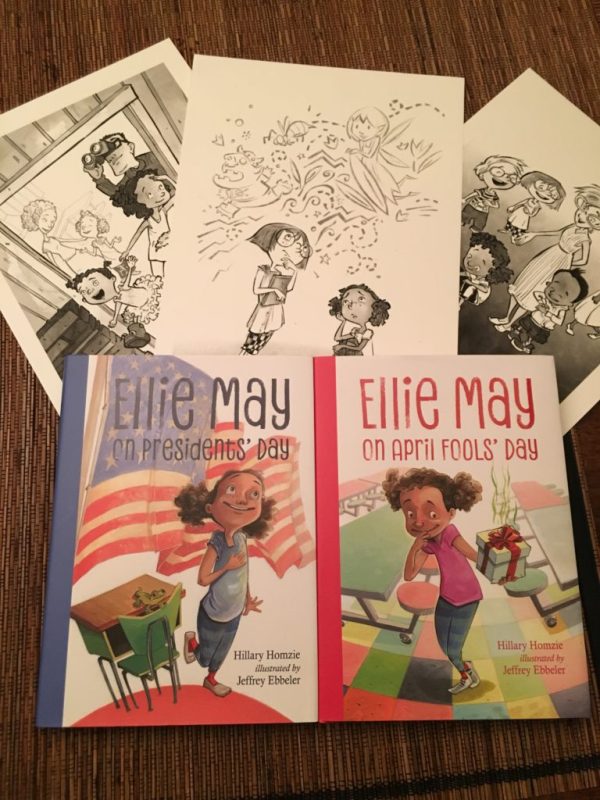
Interview with Illustrator Jeffrey Ebbeler & Giveaway: Ellie May on Presidents’ Day and Ellie May on April Fools’ Day

When my editor sent me cover sketches of Ellie May on Presidents’ Day (Charlesbridge, December 2018) and Ellie May on April Fools’ Day (Charlesbridge, December 2018), I was bursting with happiness. Illustrator Jeffrey Ebbeler truly understands the essence of this enthusiastic kid who has been in my head for such a long time.

And yet for months, I couldn’t really share the covers of my chapter books with anyone, but then the covers were shown at ALA, as well as a School Library Journal webcast Behind the Scenes: SLJ in Conversation with Children’s Books Editors. Additionally, the covers were sent to Indiebound.org, Barnes & Noble, Amazon and other bookselling sites. So yes, by then the cat was out of the bag. And so today is a big deal because it’s the first time I’m officially showing them off and talking about them.

Even though Ellie May on Presidents’ Day and Ellie May on April Fools’ Day are my tenth and eleventh books, this whole publishing process still amazes and, at times, overwhelms me because there are so many things that need to happen, much of which I have little to do with. And with chapter books–that would be all of those interior illustrations–and plus, the covers.

So now I get to interview illustrator Jeffrey Ebbeler about how all of this came together. And you all get to enter for some awesome prizes. More on that later.

Oh, but first you probably will want to know a little bit about the series. It stars the irrepressible Ellie May. When it’s time to celebrate holidays in the classroom, second-grader Ellie May can get a little overzealous, often learning about honesty and patience through trial and error. In Ellie May on Presidents’ Day, the second grader struggles with how to be honest and be a leader (wow, I no idea how timely this topic would be when I first wrote this one). Ellie May on April Fools’ Day ultimately debates how to be funny and not hurt people’s feelings.

Now, without further ado, here’s Jeffrey to tell us about the process of creating the covers, which I think are adorable (but I’m very biased!).

Where did the inspiration for the covers come from?

I have the same experience that I think most readers have. When I read a new story, a little movie plays in my head. When I read the descriptions and dialogue, I imagine how all of the characters might look. I try to imagine every small detail, from the kind of house they live in, to the clothes that they wear.
Ellie is such an exuberant character. She bursts with excitement and enthusiasm. I felt really fortunate that I was asked to illustrate Hillary’s two books, and it came at it came at a serendipitous time for me. I have twin daughters that were in third grade last year (the same age as Ellie May) when I was working on this book. Ellie May’s personality reminds me so much of my daughter Olivia, and her friend Lizzy is like my daughter Isabel.
I used a lot of family photos as inspiration for the poses and facial expressions of those two characters.
I wanted both covers to focus on Ellie May and convey her wide-eyed excitement.

Take us through the process of how you created the covers?

When I am illustrating a book, I try to do the cover last. I always start by reading the story several times. I write lots of notes and do a bunch of doodles. Then I do a character sheet, where I draw every character. It’s really important that the characters look the same through out the whole book. Sketching a book takes a couple of weeks, and I always find that I am refining and adding new details to the characters as I go. That’s why I like to save the cover for last, because by then I have really worked out all of the characters individual mannerisms.

Did you start with pencil sketches or work on the computer?

I do most of my work the old fashion way, with pencils and paint. I sketch everything on paper, and the final art for the covers are painted. I do some additional work to the art in the computer, though. After I scan in the finished paintings, I do some retouching in Photoshop. I lightened up the background behind Ellie May on both covers in the computer, so she would be the focus of the cover.

Did you have hurdles or challenges?

I knew right away that the cover President’s Day should be Ellie May saying the Pledge of Allegiance. The biggest challenge was her pose. I did four or five different poses that ranged from her standing very seriously at attention, to some goofy poses. I think the end result is a good mix of respect for the flag and the excitement in Ellie May.
I worried more about the April Fool’s Day cover because pranks can be a dicey subject. I think Hillary did a great job in the story of having Ellie May think through some jokes and why some might not be a good idea to actually do to someone. The cover hints at one of Ellie May’s joke ideas without revealing too much. She does give someone a stinky gift, but it has a surprising result.

Any aha moments?

I had tons of moments working on these two books. I love reading a funny passage in a book and trying to think of a way that I can add to that joke with a funny image. Some of my favorite illustrations in the books are when Ellie May is researching little known facts about presidents or birds. I got to draw Abraham Lincoln covered in cats, and a cardinal taking a bath in a tub full of ants.

What medium did you use?

The cover art is done in acrylic paint on paper. The black and white art inside the book is also painted with a brush. I love painting fine lines with a liner brush. I like the look if it better than using pens or markers. All of the art has had some touchups that I do in the computer.

What do you hope the covers communicates?

I hope Ellie May’s pose and facial expression communicate that she is enthusiastic, fun, a little mischievous, but also well meaning.

How many drafts did you do before you settled on what you wanted?

For book covers, I always try to present a bunch of different options. I showed about five or six different ideas for each book. I doodled about 20 ideas that I didn’t show because they weren’t quite right.

For the Presidents’ Day book, I did a sketch that ended up being the title page for the book. It was Ellie May dressed in Revolutionary War era clothing, holding the flag. I also sketched a cover that was a grid of presidential portraits with Ellie’s portrait in the middle.

For April Fools’ Day I sketched out several different April Fool’s jokes from the book. I also thought that it might be a fun and goofy image to have Ellie hanging upside down from the monkey bars, because she does that in both books.

In what ways is the final version different from your original concept for the cover?

The final versions were much more focused directly on Ellie May. Her face is the most important thing, and I hope that it will convey somethings about her personality, and get people curious to see what she’s all about.

How important is a cover to a book’s success?

It can definitely be important. I know I’ve picked up lots of books because they had intriguing covers. In the end, there needs to be a great story inside, and there is. It would be wonderful if my cover could help draw young readers in, to check out Ellie May’s adventures.

Anything new you learned from working on the Ellie May series?

I did learn a bunch of interesting facts about the presidents as well as the history April Fool’s Day. Two of my favorite facts were that in France, “jokers tape a fish to unsuspecting peoples backs on April Fool’s Day” and that George Washington’s false teeth were made from “gold, lead, hippo, cow and donkey teeth.”

Anything else you would like to share?
I want to thank Hillary for writing these excellent stories, and also for interviewing me about illustrating her books. I hope you will have as much fun reading them as I did illustrating them.

Oh, and here’s the giveaway part! It’s–drumroll. One high-quality print of an Ellie May illustration signed by Jeffrey Ebbeler AND signed paperback copies of Ellie May on Presidents’ Day and Ellie May on April Fools’ Day (these will be mailed in December) AND PDFs of both books.

How to register to win? Lots of ways. 1) Make a comment here. 2) Follow me on Twitter @hillaryhomzie. 3) Tweet about this and tag me on Twitter @hillaryhomzie 4) retweet my Twitter post about this post. If you do all four things, you will increase your odds of winning but you only need to do one thing in order to get registered. Good luck everyone!

Jeffrey Ebbeler has been creating award-winning art for children for over 15 years. He has illustrated more than forty picture books, including Melvin the Mouth, Captain’s Log: Snowbound and he is both the author and illustrator of George the Hero Hound. Jeffrey has worked as an art director and has done paper engineering for pop-up books. He and his wife, Eileen, both attended the Art Academy of Cincinnati. They have twin daughters, Olivia and Isabel.
www.jeffillustration.com

Hillary Homzie is the author of the forthcoming Ellie May chapter book series (Charlesbridge, Dec 18, 2018), as well as the forthcoming Apple Pie Promises (Sky Pony/Swirl, October 2018), Pumpkin Spice Secrets (Sky Pony/Swirl, October 2017), Queen of Likes (Simon & Schuster MIX 2016), The Hot List (Simon & Schuster MIX 2011) and Things Are Gonna Be Ugly (Simon & Schuster, 2009) as well as the Alien Clones From Outer Space (Simon & Schuster Aladdin 2002) chapter book series. She can be found at hillaryhomzie.com and on her Facebook page as well as on Twitter.