
Posts Tagged homeschooling

STEM Tuesday — Natural Disasters– Writing Tips & Resources

STEM Tuesday

Disasters

Hmm…

How is one supposed to write a Writing Tips & Resources post tied into natural disasters? Besides being an apt descriptor of 99.9999% of my writing drafts, the tragedy of a natural disaster has very little to do with writing, right?

Well, my work here is done. Stay safe everyone, take care, and I’ll see you for my next STEM Tuesday post in three months!

(STEM Tuesday Voice-Over Narrator: Hays went back to watching college basketball. Again, he’s taken the easy way out and shirked his duties as a STEM Tuesday “expert”. All in favor of banishing him from ever taking another step onto the STEM Tuesday stage, say—)

Wait! Don’t banish me yet. I’ve just had a revelation, albeit a revelation triggered by my favorite team’s upset loss in the tournament and a completely busted bracket. Nevertheless, it’s still officially classified as a revelation.

Natural disasters actually can tie into a Writing Tips & Resources post. How? Let’s pull back and have a look at the big picture.

This image is created from eight images shot in two sequences as a tornado formed north of Minneola, Kansas on May 24, 2016. Photo by Jason Weingart Creative Commons Attribution-Share Alike 4.0 International

Natural disasters affect everyone. They can come without warning or they can come as forecast. They come by land, sea, and air. They come in all shapes and sizes, just like writers. There is one thing, however, common to natural disasters. They wreak havoc. Take another look at the excellent book list for Natural Disaster Month. Havoc. Havoc. And more havoc.

Three things a writer of any age can learn from natural disasters.

Modeling & Predicting

There was a news blip from the time period after the worst of Hurricane Katrina had passed and before the 2008 financial crisis. It was the usual politics vs science funding BS that is so frustrating for a basic research scientist. A politician went on a rant about the “wasteful” funding in an appropriations bill about a grant awarded to a scientist at a major Texas university to study using GPS to determine and map exact heights on the earth’s surface. As you can probably imagine, the politician ranted on and on about the sheer stupidity of such an endeavor. If the scientist wanted to know how far something was off the ground, why don’t they just go outside and look at it instead of bloating their budgets with tax dollars? 

When the reporter tracked down the research scientist, he explained his research was focused on developing this aspect of GPS technology to better map elevation data. The ultimate goal was to be able to model geographical regions most susceptible to dangerous flooding with specific rainfall patterns. (I wish I could find the source reference but I can’t. I will continue to search for it, though, and post it here if I find it.)

Establishing models by establishing the science. That’s the goal. Better models help explain the world around us. Better models help us to predict the natural world, including natural disasters. The ability to model and predict allows us to stay safer and survive when Mother Nature strikes.

A writer does something similar. They experiment to find out what processes work for them and what doesn’t work. Their individual writing process becomes the model and the model allows them to tell whatever story they want to tell. That’s kind of like a prediction for creating stories that accomplish what the writer wants to accomplish. Janet Slingerland did an exceptional STEM Tuesday In the Classroom post last week that highlights mapping, which is a form of modeling, as a tool.

Planning & Preparation

Being a lifelong resident of tornado alley, we are brought up to plan and prepare for the tornado season. Tornado drills, safe havens indoors and out, supply boxes, and many other preparations are part of everyday life from March to November. We learn to pay attention to the weather report. We learn to know what to do in case of a tornado watch and a tornado warning so when these situations arise, we can be ready.

Planning helps a writer by providing a course of action and a direction. Preparation through practice and learning gives the writer the tools needed to successfully reach that destination. Through planning and preparation, a writer knows what to do when situations arise and is ready to tackle those hurdles.

React & Recover

The cost to humanity from natural disasters is beyond measure. There is no price tag to the emotional, physical, and mental toll a disaster leaves in its wake. However, there is often a sliver of hope that arises from the destruction and chaos. People help each other. Families, households, neighborhoods, communities, nations come together to help each other recover. Out of the rubble springs a new future. Rebuilt and, hopefully, rebuilt better.

Writing is similar. The first draft, and in some of our cases, the second, third, and fourth drafts are often chaos. Havoc on the page. We recover through revision. We revise through community. Writing groups, critique partners, beta readers, etc. all help our writing spring anew from the rubble of an early draft. Just as one would rely on the kindness of a community to recover from a natural disaster, rely on the kindness of the writing community to lift your words.

Tree ridge in flames during the 2018 Woolsey Fire, California, US. Photo courtesy of Peter Buschmann, United States Forest Service. https://www.flickr.com/photos/usforestservice/45923164272 We’re All In This Together

There you have it. A few ways to learn from natural disasters ways to improve your writing. Never forget, however, no matter how much havoc and chaos exist internally and externally, there’s a great community of writers there for support and encouragement.  

Just write. 

Start with one word and then follow with the next word. Repeat.

Just write. 

This is perhaps the best of the whole list of STEM Tuesday Writing Tips & Resources.

Just write.

The world needs your story.

Typhoon Molave on October 27, 2020. Creative Commons Attribution-Share Alike 4.0 International

Mike Hays has worked hard from a young age to be a well-rounded individual. A well-rounded, equal opportunity sports enthusiasts, that is. If they keep a score, he’ll either watch it, play it, or coach it. A molecular microbiologist by day, middle-grade author, sports coach, and general good citizen by night, he blogs about sports/training-related topics at  www.coachhays.com and writer stuff at www.mikehaysbooks.comTwo of his science essays, The Science of Jurassic Park and Zombie Microbiology 101,  are included in the Putting the Science in Fiction collection from Writer’s Digest Books. He can be found roaming around the Twitter-sphere under the guise of @coachhays64.


The O.O.L.F Files

Natural disasters are serious business to which a serious amount of STEM both contributes and is advanced. The drive to learn more about natural disasters continues with the ultimate goal of protecting life and limb. This month’s O.O.L.F. Files explores some of these entities and how they work to advance the knowledge base to keep us all as safe as possible.

National Oceanic and Atmospheric Administration (NOAA)

  • From the NOAA About web page:
    • NOAA is an agency that enriches life through science. Our reach goes from the surface of the sun to the depths of the ocean floor as we work to keep the public informed of the changing environment around them.
    • From daily weather forecasts, severe storm warnings, and climate monitoring to fisheries management, coastal restoration and supporting marine commerce, NOAA’s products and services support economic vitality and affect more than one-third of America’s gross domestic product. NOAA’s dedicated scientists use cutting-edge research and high-tech instrumentation to provide citizens, planners, emergency managers and other decision makers with reliable information they need when they need it.
  • That first line just about says it all! Enriching life through science!

Federal Emergency Management Agency (FEMA)

  • Due to the increase in the sheer number and severity of disasters and emergencies, FEMA has catapulted to one of the most important federal agencies in coordinating disaster response.

National Weather Service Storm Chaser Info Page

  • Uh…where has this site been all my life? I need to jump down this rabbit hole and find out what’s down there. 

Managing Fire by the U.S. Forest Service (USDA)

Japan Tsunami 2011

  • This month brings the ten-year anniversary of the Japanese earthquake and tsunami. The tragedy is an example of the multi-layered effects of a natural disaster at its worst.

Chaos Theory

  • Chaos by James Gleick
    • I recently checked this book out and started reading it. Chaos Theory has been a mind worm since the time I first read Jurassic Park. So far, so good!

Chaos: Making a New Science Cover

Mathematician Edward Lorenz

“When a butterfly flutters its wings in one part of the world, it can eventually cause a hurricane in another.” – Edward Norton Lorenz

  • One of the key figures in the development of chaos theory and its application in meteorology.

Popular Science: How Science Has Battled Natural Disasters

  • This is a pretty cool article about several historical methods scientists used to fight natural disasters.

Theatre in Our Schools, Middle Grade-style

March is Theatre in Our Schools Month, a designation celebrated and promoted jointly by the Educational Theatre Association, the American Alliance for Theatre & Education, and the International Thespian Society. Here are some ways we can help fulfill our middle graders’ theater needs this year!

In our Pennsylvania county, “spring musical season” was suddenly curtailed last year as many middle schools and high schools first postponed their shows, then canceled them out of Covid necessity (for many, after months of rehearsals). Throughout this year, while a few schools in our area planned socially-distanced plays and musicals with precautions like face shields, many other districts have not slated any productions.

The beauty of theatre, though, has always been its flexibility, its resourcefulness, and its creativity. As teachers, librarians, and parents, we can offer theatre opportunities in plenty of ways other than traditionally staged and performed productions. Let’s talk about a few ways we can allow the show to (safely) go on.

Many drama activities are perfect for flexible classroom situations, social distancing, or remote learning, with or without an in-person or remote audience:

  • Students can fill the role of director by choosing a scene, screen-sharing a script, casting roles, and leading fellow student-actors in a remote read-aloud.
  • Learners can study script format, then become playwrights of short scenes. Follow up with socially-distanced readers’ theatre performances of students’ original work.
  • Perform a favorite novel scene adapted as a radio show; this format is great for working vocal skills and facial expression, and those who would prefer a technical role can prepare and perform the recorded or live sound effects.
  • Explore the history of theatre from the Greeks to modern times in a mini-unit, or how theatre, historically, differs from culture to culture.
  • Have students complete and share mini-research projects on the technical side of theatre: stage composition, blocking, scene design, set construction, lighting, sound, effects.
  • Monologues! Actors can write their own or adapt a character speech from a favorite MG book for class performance.
  • Ever consider a class study of a dramatized version of a middle grade story? Dramatic Publishing Company, Dramatists Play Service, Theatrefolk, and others carry scripted, stageable adaptations of some middle grade modern favorites like Bud, Not Buddy, Walk Two Moons, and The Miraculous Journey of Edward Tulane, as well as classics like The Jungle Book and Anne of Green Gables.
  • And if your own kids or students are missing the school production they usually look forward to, consider staging a socially-distanced scene, one-act, or play in your classroom, library, or home school environment, or via remote means. You can keep it super simple with easy props and representative, homemade costume pieces. (Remember, Shakespeare did some pretty successful shows without any of that fancy stuff like lighting instruments, elaborate scenery, or microphones; you don’t need them either!)
  • Some drama licensing vendors have a convenient e-script format: just pay and print (sample pages are usually available online for free). Theatrefolk offers a list of short plays with flexible casting intended for classroom production, with livestream and Zoom options for performance; if a live audience is not your goal, classroom study of a play is only a few dollars per student for a downloadable, printable PDF. Some even have free study guides!
  • Finally, offer your thespians a middle grade read or two that might be new to them. Here are a few middle grade favorites featuring characters with a flair for drama:

The Marvels by Brian Selznick – Lose yourself in hundreds of amazing sketches that tell the story of the Marvel family, generations of brilliant actors whose drama-filled lives—on and off the stage—keep audiences spellbound for centuries. Theatre-lovers will especially enjoy the drawings of backstage, ropes, pulleys, drapes, flats, scenery, footlights, costumes, and a gorgeous proscenium arch.

Replay by Sharon Creech – Leo’s big, drama-filled family almost upstages his experience playing a great role in a class play. What Leo lacks in stage experience, he more than makes up for in passion, heart, empathy, and expression. And—bonus!—the play that Leo’s class performs is scripted at the end of the novel, in short, very stageable scenes for small groups or classes.

Better Nate Than Ever by Tim Federle – Eighth grader Nate knows he is Broadway-bound, even if he has to run away from western Pennsylvania the whole way to NYC to make it happen.

How to Stage a Catastrophe by Rebecca Donnelly – Sidney and best friend Folly try to save their beloved community theater, getting caught up in some bad drama along the way.

Thanks for reading and considering how to make theatre in our schools a reality, no matter the challenges!


STEM Tuesday– Celebrating Diversity in STEM– Interview with author Tonya Bolden

Welcome to STEM Tuesday: Author Interview & Book Giveaway, a repeating feature for the last Tuesday of every month. Go Science-Tech-Engineering-Math!

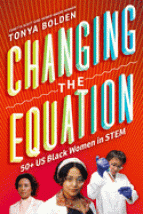
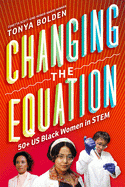
Today we’re interviewing Tonya Bolden , author of Changing the Equation: 50+ Black Women in STEM. This game changing compilation profiles more than fifty women whose significant contributions to science often go unsung. School and Library Journal writes, “Bolden, a master of the collective biography, presents an impeccably-researched call to action, imploring black girls to fight the racial and gender imbalance that plagues the STEM field.”

One of the things that impressed me about our guest author is her passion for children and willingness to light the way for future generations. Her work breathes life into nonfiction subjects, providing young people (and the adults in their lives) with vivid examples to follow. In 2016, Tonya received the Nonfiction Award for Body of Work from the Children’s Book Guild of Washington, DC. for significantly contributing to the quality of nonfiction for children. I am frequently quoted for advocating we provide positive, uplifting books for young people of color. Tonya Bolden is an outstanding example of that in practice. Many of today’s diverse writers, including myself, walk along the path she blazed.

* * *

Christine Taylor-Butler: Tonya, with more than 40 publishing credits to your name you’ve had an amazing career in children’s literature. You once said you were surrounded by books as a child.

Tonya: I did. My parents didn’t complete their education but they had ambitions for me and my sister. They raised us to reach high. To dream big. We didn’t have a lot of money but they knew the value education would play in our lives and made sure we were surrounded by books.

CTB: Was there a particular book that stood out to you as a child?

Tonya Bolden: Yes. The Borrowers, by Mary Norton is one that comes to mind. It’s about little people who secretly live in a house and borrowed things they needed from the owners. There was just something magical about the story and it resonated.

CTB: You were originally uninterested in writing history or nonfiction, or even writing books for children. And yet you are known for writing insightful works in this genre. What changed your mind?

Tonya: While reviewing books for Black Enterprise, I realized that history could be told with passion and heart. If you added soul, nuance, texture and complexity those books could be as fascinating as fiction. I realized there was nothing wrong with history. What had been wrong was how it had been taught when I was a kid.

“I find that historical figures are more fascinating than things people conjure up.”Tonya Bolden, Indian Express

CTB: In various interviews you  talk about writing for children who don’t otherwise see themselves in literature. Who aren’t shown as belonging in the world. 
Tonya: Yes. I wondered, where are the books for children who are aspirational? The kids who want to travel? I wanted to say – especially to girls – so much is possible! A lot of children don’t dream big. After I wrote And Not Afraid to Dare: The Stories of Ten African American Women, that’s when I found my passion for writing for children.

CTB: You hold a Bachelors degree from Princeton and a Master’s degree from Columbia. It might surprise people to know that both degrees are not in history or literature, but in Slavic Languages and Literatures with an emphasis on Russian.  I’ve been advocating for children to learn more than one language. My daughters, for instance, studied Latin, Italian and Japanese. But there is often push back, especially in urban communities. Where did your interest come from?

Tonya: I was 17 when I made that decision. In high school, I fell in love with works by Anton Chekov. It might have had something to do with the fact that I grew up during the Cold War. I’ve always loved languages. I was the first in my family to go to college. Back then, there wasn’t as much pressure on young people because of college costs. You could dabble and follow your bliss. My parents didn’t pressure me to follow a certain career. Their philosophy was “Do whatever you want, but find a way to make a living at it.”

It’s so much harder today for young people to explore their interests in the same way. The stakes are higher because of the high cost of education. But it’s still important for young people to learn languages outside of their own culture and learn about the broader world around them.

Changing The EquationCTB: Your book, Changing the Equation: 50+ US Black Women in STEM is such an important addition to children’s literature. You cover an enormous amount of information. What did the research process look like? Were you able to speak with any of the women you included?

Tonya: It started when I wrote Pathfinders: The Journeys of 16 Extraordinary Black Souls. My research included a profile of Katherine Johnson. Most people know her as one of the original “Hidden Figures.”  After I wrote that profile I was curious to know more about black women in STEM so my research grew out of that curiosity.

PathfindersThere’s a saying, “When a student is ready the ‘teacher appears’.” I read newspapers, books, oral histories and conducted web research to identify people to profile. I was surprised by how much I was able to find when I searched for specific professions. I discovered so many women, I didn’t have room to profile them all.  There were a lot of outtakes. If I had the opportunity, this book would have featured more than one hundred woman but it would have been too big a volume for the industry.

“We still have this stereotype that STEM is for boys and men and that’s not true,” – Tonya Bolden, Amsterdam News

Rebecca Crumpler

Rebecca Crumpler

One thought behind the book – I wanted girls to see how wide the world is. Even in science. Not everyone is in a lab coat. I liked the idea of presenting a Black woman who is an astrophysicist. Or a robotics engineer. I wanted girls to know that if they were going towards something that is tough, that there were people who have done it before them. For example, the first woman in the book, Rebecca Crumpler, was a physician. If this woman could go to Medical school before slavery was abolished then anything is possible.

I was lucky to be able to communicate with a number of the women. They were all very generous with their time. Those women included Mamie Parker (Biologist), Aprille Joy Ericsson (NASA Aerospace Engineer), Pamela McCauley (Industrial Engineer), Ayanna Howard (Roboticist), Treena Livingston Arinzeh (Biomedical Engineer), Paula T. Hammond (Chemical Engineer), Lisa D. White (Geologist), Emma Garrison-Alexander (Cybersecurity), Aomawa Shields (Astronomer and Astrobiologist), and Donna Auguste (Computer Scientist–and more!).

CTB: What advice do you have for young people who might want to follow in your path one day.

Tonya: Read. Read. Read. Master the language in which you want to write. Knowing other languages also helps a writer. Know your own culture and other cultures. If you want to write professionally, be prepared for lean days. It’s hard to get into publishing. I started writing under “write for hire” contracts. That means I wrote books other people wanted done and I took the work I was offered. It was helpful because it kept me flexible and nimble. In the industry it became clear I was open to other people’s ideas and I was offered additional work. It’s harder to get published now. Back in the day, publishers nurtured “house authors”. You would write several books and be given time to find an audience. Now books have a shorter shelf life. If you don’t hit it out the park with that first or second book it may be Game Over! There was a time when publishers focused on helping to build a long-term careers. Having said that, perseverance is key. Follow your passion and don’t give up. A young woman once wrote me to say, “You may not know me, but you have paved a path for me in this industry, and I wanted to personally thank you.”

CTB: So in a way, you’re passing on the dream through your writing.

Tonya: Yes. Doors started to open for many of us in the 1960’s. We grew up hearing about giving back. The work that I do is my way of saying “Thank you” to those people who opened the doors for us. People like Fannie Lou Hamer, Charlayne Hunter-Gault, Katherine Johnson, for example.

I always wanted to be useful. In elementary school, I thought I wanted to be a classroom teacher. But in a way that’s what I’m doing now. Teaching young people through the books I’m writing.

Dovey Johnson Roundtree

Dovey Johnson Roundtree

CTB: So what’s next for Tonya Bolden. Are there any books we should be looking for in the future?

Tonya: I have a new book coming out in June 2021: Dovey Undaunted. It’s the biography of Dovey Johnson Roundtree, civil rights attorney. She lived a life of service and was one of the first Black women to enter the Women’s Army Auxiliary Corps (WAAC). Dovey was born in Charlotte, North Caroline which is where my father was born. When I was a kid, our family would go down south to visit. I have so many vivid memories of Charlotte. This book seemed like a natural fit for me to write.

How to Build a MuseumAuthor’s note. Tonya Bolden is featured twice on our list this month. Her other book, How to Build A Museum: Smithsonian’s National Museum of African American History and Culture is a must read, featuring little known details about African American history. For those unable to make a visit to Washington, DC, this book is an important addition to your collection.
Changing The Equation

Win a FREE copy of Changing the Equation: 50+ US Black Women in STEM.

Enter the giveaway by leaving a comment below. The randomly-chosen winner will be contacted via email and asked to provide a mailing address (within the U.S. only) to receive the book.

Good luck!

Tonya Bolden

photo by Hayden Celestin

Tonya Bolden has authored and collaborated on more than forty books. Holding degrees from Princeton and Columbia Universities, she originally intended to complete a PhD and teach Russian literature. But her path lead elsewhere. Her first book for young people, an adaptation of the musical, Mama I want to Sing, lead to more contracts to write books for children. The rest is history. Her book, 33 things Every Girl Should Know was praised by Hillary Rodham Clinton in a speech on the 150th anniversary of the first Women’s Rights Convention. Her awards and recognition are too numerous to list in their entirety but include, the Childrens Book Guild Nonfiction award for her body of work, the James Madison Book Award, ALA’s Coretta Scott King Honor Award, NCTE’s Orbis Pictus Award, ALSC Notable Book and multiple nominations for the NAACP Image Award. To learn more about Tonya, please visit www.tonyaboldenbooks.com

Christine Taylor-Butler headshot

photo by Kecia Stovall

Your host is Christine Taylor-Butler, MIT educated STEAM nerd and author of Bathroom Science, Sacred Mountain: Everest, Genetics, and many other nonfiction books for kids. She is also the author of the middle grade sci-fi series The Lost Tribes. Follow @ChristineTB on Twitter and/or @ChristineTaylorButler on Instagram