Welcome to STEM Tuesday: Author Interview & Book Giveaway, a repeating feature for the last Tuesday of every month. Go Science-Tech-Engineering-Math!
Today we’re interviewing Tonya Bolden , author of Changing the Equation: 50+ Black Women in STEM. This game changing compilation profiles more than fifty women whose significant contributions to science often go unsung. School and Library Journal writes, “Bolden, a master of the collective biography, presents an impeccably-researched call to action, imploring black girls to fight the racial and gender imbalance that plagues the STEM field.”
One of the things that impressed me about our guest author is her passion for children and willingness to light the way for future generations. Her work breathes life into nonfiction subjects, providing young people (and the adults in their lives) with vivid examples to follow. In 2016, Tonya received the Nonfiction Award for Body of Work from the Children’s Book Guild of Washington, DC. for significantly contributing to the quality of nonfiction for children. I am frequently quoted for advocating we provide positive, uplifting books for young people of color. Tonya Bolden is an outstanding example of that in practice. Many of today’s diverse writers, including myself, walk along the path she blazed.
* * *
Christine Taylor-Butler: Tonya, with more than 40 publishing credits to your name you’ve had an amazing career in children’s literature. You once said you were surrounded by books as a child.
Tonya: I did. My parents didn’t complete their education but they had ambitions for me and my sister. They raised us to reach high. To dream big. We didn’t have a lot of money but they knew the value education would play in our lives and made sure we were surrounded by books.
CTB: Was there a particular book that stood out to you as a child?
Tonya Bolden: Yes. The Borrowers, by Mary Norton is one that comes to mind. It’s about little people who secretly live in a house and borrowed things they needed from the owners. There was just something magical about the story and it resonated.
CTB: You were originally uninterested in writing history or nonfiction, or even writing books for children. And yet you are known for writing insightful works in this genre. What changed your mind?
Tonya: While reviewing books for Black Enterprise, I realized that history could be told with passion and heart. If you added soul, nuance, texture and complexity those books could be as fascinating as fiction. I realized there was nothing wrong with history. What had been wrong was how it had been taught when I was a kid.
“I find that historical figures are more fascinating than things people conjure up.” – Tonya Bolden, Indian Express
 CTB: In various interviews you talk about writing for children who don’t otherwise see themselves in literature. Who aren’t shown as belonging in the world.
Tonya: Yes. I wondered, where are the books for children who are aspirational? The kids who want to travel? I wanted to say – especially to girls – so much is possible! A lot of children don’t dream big. After I wrote And Not Afraid to Dare: The Stories of Ten African American Women, that’s when I found my passion for writing for children.
CTB: You hold a Bachelors degree from Princeton and a Master’s degree from Columbia. It might surprise people to know that both degrees are not in history or literature, but in Slavic Languages and Literatures with an emphasis on Russian. I’ve been advocating for children to learn more than one language. My daughters, for instance, studied Latin, Italian and Japanese. But there is often push back, especially in urban communities. Where did your interest come from?
Tonya: I was 17 when I made that decision. In high school, I fell in love with works by Anton Chekov. It might have had something to do with the fact that I grew up during the Cold War. I’ve always loved languages. I was the first in my family to go to college. Back then, there wasn’t as much pressure on young people because of college costs. You could dabble and follow your bliss. My parents didn’t pressure me to follow a certain career. Their philosophy was “Do whatever you want, but find a way to make a living at it.”
It’s so much harder today for young people to explore their interests in the same way. The stakes are higher because of the high cost of education. But it’s still important for young people to learn languages outside of their own culture and learn about the broader world around them.
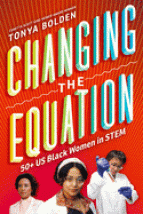 CTB: Your book, Changing the Equation: 50+ US Black Women in STEM is such an important addition to children’s literature. You cover an enormous amount of information. What did the research process look like? Were you able to speak with any of the women you included?
Tonya: It started when I wrote Pathfinders: The Journeys of 16 Extraordinary Black Souls. My research included a profile of Katherine Johnson. Most people know her as one of the original “Hidden Figures.” After I wrote that profile I was curious to know more about black women in STEM so my research grew out of that curiosity.
 There’s a saying, “When a student is ready the ‘teacher appears’.” I read newspapers, books, oral histories and conducted web research to identify people to profile. I was surprised by how much I was able to find when I searched for specific professions. I discovered so many women, I didn’t have room to profile them all. There were a lot of outtakes. If I had the opportunity, this book would have featured more than one hundred woman but it would have been too big a volume for the industry.
“We still have this stereotype that STEM is for boys and men and that’s not true,” – Tonya Bolden, Amsterdam News

Rebecca Crumpler
One thought behind the book – I wanted girls to see how wide the world is. Even in science. Not everyone is in a lab coat. I liked the idea of presenting a Black woman who is an astrophysicist. Or a robotics engineer. I wanted girls to know that if they were going towards something that is tough, that there were people who have done it before them. For example, the first woman in the book, Rebecca Crumpler, was a physician. If this woman could go to Medical school before slavery was abolished then anything is possible.
I was lucky to be able to communicate with a number of the women. They were all very generous with their time. Those women included Mamie Parker (Biologist), Aprille Joy Ericsson (NASA Aerospace Engineer), Pamela McCauley (Industrial Engineer), Ayanna Howard (Roboticist), Treena Livingston Arinzeh (Biomedical Engineer), Paula T. Hammond (Chemical Engineer), Lisa D. White (Geologist), Emma Garrison-Alexander (Cybersecurity), Aomawa Shields (Astronomer and Astrobiologist), and Donna Auguste (Computer Scientist–and more!).
CTB: What advice do you have for young people who might want to follow in your path one day.
Tonya: Read. Read. Read. Master the language in which you want to write. Knowing other languages also helps a writer. Know your own culture and other cultures. If you want to write professionally, be prepared for lean days. It’s hard to get into publishing. I started writing under “write for hire” contracts. That means I wrote books other people wanted done and I took the work I was offered. It was helpful because it kept me flexible and nimble. In the industry it became clear I was open to other people’s ideas and I was offered additional work. It’s harder to get published now. Back in the day, publishers nurtured “house authors”. You would write several books and be given time to find an audience. Now books have a shorter shelf life. If you don’t hit it out the park with that first or second book it may be Game Over! There was a time when publishers focused on helping to build a long-term careers. Having said that, perseverance is key. Follow your passion and don’t give up. A young woman once wrote me to say, “You may not know me, but you have paved a path for me in this industry, and I wanted to personally thank you.”
CTB: So in a way, you’re passing on the dream through your writing.
Tonya: Yes. Doors started to open for many of us in the 1960’s. We grew up hearing about giving back. The work that I do is my way of saying “Thank you” to those people who opened the doors for us. People like Fannie Lou Hamer, Charlayne Hunter-Gault, Katherine Johnson, for example.
I always wanted to be useful. In elementary school, I thought I wanted to be a classroom teacher. But in a way that’s what I’m doing now. Teaching young people through the books I’m writing.

Dovey Johnson Roundtree
CTB: So what’s next for Tonya Bolden. Are there any books we should be looking for in the future?
Tonya: I have a new book coming out in June 2021: Dovey Undaunted. It’s the biography of Dovey Johnson Roundtree, civil rights attorney. She lived a life of service and was one of the first Black women to enter the Women’s Army Auxiliary Corps (WAAC). Dovey was born in Charlotte, North Caroline which is where my father was born. When I was a kid, our family would go down south to visit. I have so many vivid memories of Charlotte. This book seemed like a natural fit for me to write.
 Author’s note. Tonya Bolden is featured twice on our list this month. Her other book, How to Build A Museum: Smithsonian’s National Museum of African American History and Culture is a must read, featuring little known details about African American history. For those unable to make a visit to Washington, DC, this book is an important addition to your collection.
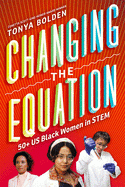
Win a FREE copy of Changing the Equation: 50+ US Black Women in STEM.
Enter the giveaway by leaving a comment below. The randomly-chosen winner will be contacted via email and asked to provide a mailing address (within the U.S. only) to receive the book.
Good luck!

photo by Hayden Celestin
Tonya Bolden has authored and collaborated on more than forty books. Holding degrees from Princeton and Columbia Universities, she originally intended to complete a PhD and teach Russian literature. But her path lead elsewhere. Her first book for young people, an adaptation of the musical, Mama I want to Sing, lead to more contracts to write books for children. The rest is history. Her book, 33 things Every Girl Should Know was praised by Hillary Rodham Clinton in a speech on the 150th anniversary of the first Women’s Rights Convention. Her awards and recognition are too numerous to list in their entirety but include, the Childrens Book Guild Nonfiction award for her body of work, the James Madison Book Award, ALA’s Coretta Scott King Honor Award, NCTE’s Orbis Pictus Award, ALSC Notable Book and multiple nominations for the NAACP Image Award. To learn more about Tonya, please visit www.tonyaboldenbooks.com

photo by Kecia Stovall
Your host is Christine Taylor-Butler, MIT educated STEAM nerd and author of Bathroom Science, Sacred Mountain: Everest, Genetics, and many other nonfiction books for kids. She is also the author of the middle grade sci-fi series The Lost Tribes. Follow @ChristineTB on Twitter and/or @ChristineTaylorButler on Instagram


 Kirsten W. Larson used to work with rocket scientists at NASA. Now she writes books for curious kids. She’s the author of