
Posts Tagged homeschool

STEM Tuesday — Bioluminesence– Writing Tips & Resources


What do bobtail squids, comb jellies, and lanternsharks have in common? Along with many other living things, these marine creatures glow in the dark. But why? In terms of economies, what does bioluminescence do for an animal? For some, it helps them attract matesor meals. For vampire squids, it’s actually a defense mechanism; instead of squirting ink like other cephalopods, they squirt glowing mucus to distract predators. In terms of how creatures glow in the dark, there are multiple answers. But we’ll get to that in a minute. For now, why is an important question, one that leads to our first exercise.

Writing Prompt 1 | Facts as Fantasy Seeds

I’ve personally found that some of my best fiction writing germinates from simple facts. For example:

“Soldiers in the trenches sometimes used glowworms to read maps without drawing dangerous attention to themselves” (35)

GLOW: The WILD WONDERS OF BIOLUMINESCENCE BY JENNIFER N. R. SMITH

What ingenuity! This cool fact is a perfect seed for a fictional premise.

Come up with a glowing fantasy creature. Why does it glow? Choose one of the reasons listed above, or invent your own. How has this creature influenced the world in which it lives? What inventions has this living-glow technology inspired? How might your glowing creature factor into the plot of your book? What problems might bioluminescent life forces be able to solve – in what low-light situations might they ethically (or unethically, if you’re writing a dystopian novel) be put to use? Brainstorm for at least 15 minutes, taking down every writerly thought you have. For extra credit, sketch your creature.

Adapt the Exercise for Classroom Use
What are your students’ favorite animals and why? Use the bioluminescence prompt above with students as-is, or let them choose their own found fact to work with.

Writing Prompt 2 | What’s the Difference?

Again from Smith’s book GLOW, when reading about bioluminescence, I noticed two related words: biofluorescence and biophosphorescence. They all have to do with glowing in the dark, but the differences are scientifically significant. Let’s take a look:

  1. Fireflies and glow sticks are both examples of luminescence; they work due to chemical reactions. The other two don’t create light through chemical reactions, but capture light from other sources.)
  2. Fluorescent materials absorb non-visible light and convert it into visible light, emitting no afterglow. Sapphires, amber, pearls, and other gemstones are prime examples of fluorescent materials because they glow under UV light, but stop glowing immediately when the light is turned off. Biofluorescent organisms include polka-dot tree frogs, hawksbill sea turtles, and scorpions.
  3. Phosphorescent materials store the light they absorb, emitting it more slowly. Because their glow lasts for a while after their initial exposure to a light source, glow-in-the-dark stars are an example of phosphorescence. The study of biophosphorescence—phosphorescence in living organisms—is relatively new, with reports of such in rice, starch, and millipedes.

All this to say, paying attention to words’ definitions can make a huge difference. Before beginning, select three to five sentences from a work-in-progress. They could be from an article, a novel, an essay. Whatever you (or your students, if you’re using this as a classroom activity) are working on.

This second writing exercise is inspired by Several Short Sentences about Writing by Verlyn Klinkenborg. He wrote that to be a writer,

“You need an ever-growing vocabulary—

and with it the awareness

that most words carry several meanings.

You need to look up even familiar words

every time you have a doubt

and especially

when you don’t have a doubt.

That is, very often.

That is, every time you write” (58).

With this in mind, look up the definitions of every noun, verb, and adjective in your sentences and revise each sentence in at least two different ways. Here are some tips:

  • Wherever there’s an -ly adverb, consider upgrading your verb.
  • Consider what each sentence denotes (literally means) vs. what it connotes (implies). Is it doing the work you intend? Browse a thesaurus to find other words that may capture your intended meaning(s) more accurately.
  • Moving from known information to new information is one way to ensure that you don’t lose readers. Could rearranging your sentences’ phrases clarify your meaning(s)?
  • Consider how the revised sentences compare with the originals. Did you learn anything new during this process?

If you try these exercises, comment below about how they worked for you, or hop over to my website and contact me.

Best,

Stephanie Jackson

A nature-loving creative, Stephanie Jackson writes poemsarticles, picture books, middle-grade novels, and more. Her nonfiction has been published in Cricket magazine and her poems have been published in The Dirigible Balloon and various literary journals including Touchstones, where she’s been a contributing poetry editor. Professional affiliations include the Society of Children’s Book Writers and Illustrators (SCBWI) and The Authors Guild. In 2025, she’s graduating from Utah Valley University with her English degree, emphasis in creative writing. She interacts with the kidlit community on Twitter as @canoesandcosmos, and you can read more at StephanieWritesforKids.com.

STEM Tuesday — Bioluminesence– In the Classroom


This month I learned from the following books that there are a LOT of animals that glow:

Mysterious Glowing Mammals: An Unexpected Discovery Sparks a Scientific Investigation

by Maria Parrott-Ryan

This book tells the story of scientific discovery. I love how it shows the twists and turns that scientists follow when they’re exploring a topic.


Animals That Glow: Fireflies and Glowworms

by Joyce Markovics

This book highlights a few animals that glow on land, specifically fireflies and glowworms.

Animals That Glow: Octopuses and Squid

by Joyce Markovics

This book explores the octopuses and squid that glow in the ocean. Some create their own light, while other harness the light made by other creatures.


Bonus: Luminous: Living Things that Light Up the Night

by Julia Kuo

This picture book is a great introduction to bioluminescence. Simple text is augmented with informative sidebars. The animals highlighted come from all around the world, on land and at sea. This could be a great read-aloud to kick off the exploration of glowing animals.


Animal Research Project

As I mentioned before, there are a LOT of animals that glow. I thought this would make a great research project. Have each student pick an animal that glows and research it – there are enough glowing animals that every student can explore something different.

Have each student create a poster highlighting their glowing animal. Set up an exhibition, showing off all the amazing animals. Each poster should include:

  • Animal name
  • Where found – both habitat and geographic location. (Include a range map.)
  • Image of animal
    • For more fun, use glow-in-the-dark paints to illustrate where and what color the animal glows. Use a blacklight to show off the glow.
  • How it glows
    • What makes it glow? Bioluminescence, fluorescence, symbiosis?
  • When is animal active?
  • Why it glows?
  • Other fun facts

Alternatively, turn the research into one or more social media posts. Social media is a great way to impart information to lots of people. The National Park Service and US Fish and Wildlife Service do an exceptional job using social media. As I was preparing for this month’s post, I saw this social media post about glow-in-the-dark scorpions: https://www.facebook.com/photo/?fbid=916191667218097

Explore Your Backyard

Fireflies are perhaps the best-known glowing animal. Do a little exploration. Are there fireflies in your area? If not, should there be?

There is a firefly atlas you can explore to help with this: https://www.fireflyatlas.org/map. If you have fireflies in your area, look into how you can contribute to the map. Learn about how you can tell different fireflies apart by their blinking pattern.

If there should be fireflies in your area, but you don’t see any, examine why. What kind of habitat do fireflies need? What can you do to help provide that habitat?

If you don’t (and shouldn’t) have fireflies in your area, are there other local glowing animals and/or plants?

More Resources

You could use this month’s theme to jump into exploring light and/or color. There are also quite a few resources and activities out there that focus on bioluminescence. Here are a few.

NOAA Bioluminescence Education Theme: https://oceanexplorer.noaa.gov/edu/themes/bioluminescence

Smithsonian Ocean: Bioluminescence: https://ocean.si.edu/ocean-life/fish/bioluminescence

WHOI: How does bioluminescence work? https://www.whoi.edu/know-your-ocean/did-you-know/how-does-bioluminescence-work

TeachEngineering: Exploring Bioluminescence in Aquatic Animals: https://www.teachengineering.org/activities/view/rice-2638-light-dyes-exploring-bioluminescence-activity

Science Buddies: Explore Glow-in-the-Dark Water! https://www.sciencebuddies.org/stem-activities/tonic-water-glows

Ocean Conservancy: Why Do Animals Glow? https://oceanconservancy.org/blog/2019/08/06/animals-glow-bioluminescence


Janet Slingerland has written over 2 dozen books for young readers. One of her latest projects is creating firefly habitat in her backyard. To find out more about Janet and her books, check out her website: http://janetsbooks.com

STEM Tuesday — Inventions that Changed the World — Author Interview with Sarah Aronson

Welcome to STEM Tuesday: Author Interview, a repeating feature for the last Tuesday of every month. Go Science-Tech-Engineering-Math!

Today we’re interviewing Sarah Aronson, author of the award winning book: Just Like Rube Goldberg The book is a fascinating look at the journey of a trained engineer who decides to take a job at a newspaper instead. His drawings of ridiculous inventions doing simple tasks became so popular, people use them as a starting point for creating their own “Goldberg” inventions.

Rube Goldberg Cover

Aronson notes that Goldberg ‘drew comics to make us look closer’; fittingly, this thoughtful, playful picture-book biography does just that, with whimsical pencil, ink, and digital illustrations capturing the machines’ intricacies.” – The Horn Book


Christine Taylor-Butler: Sarah, you are a prolific writer for both children’s fiction and nonfiction. But you didn’t start out as a writer?

Sarah Aronson: I didn’t. I taught fitness then trained to become a physical therapist.  When you are working with someone that has had a traumatic brain injury there is no book that explains how that individual person moves. You have to figure out the solution to helping that specific person being more functional. Now I think of writing and revision as rehab. When you take that sense of imagination and foresight and put it into whatever you are doing, you are doing STEM.

CTB: How did you get the idea for this book?

Sarah: When I was 7 years old, I was watching the movie, Chitty, Chitty Bang Bang. The breakfast machine is a Rube Goldberg contraption. I couldn’t believe how cool that was. I was a child with a lot of energy so I tried to make a breakfast machine with my mom’s best dishes. Here’s a tip – use plastic.

CTB: What happened to the dishes?

Sarah: I broke them all. Luckily mom wasn’t so found of that pattern. After seeing that, my dad began sharing Rube Goldberg cartoons with me. Later, while working for Jack La Lanne Health Clubs, I thought about those chain reactions when I was making my aerobics routines. How do we make a chain reaction with our bodies? How do we make ourselves stronger? I went back to college and got my Masters in Physical Therapy. I became a therapist and thought about physics while working. Once I became a writer I thought, who would I write about if I were going to write a biography? Ding! Why not Rube Goldberg?

CTB: He didn’t want to do an ordinary job.

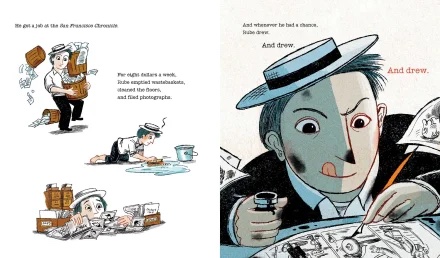
Rube GoldbergSarah: He loved drawing. But is father didn’t want him to be a starving artist. And I remembered thinking, I’m a lot like Rube. My Dad is an economist and when I switched to writing he said, “you’re supposed to take a job that makes more money.” He was speaking out of fear. But he ultimately understood what I was trying to do and that I had something to say. I didn’t study engineering but Rube did. When he looked around he was latching on to creativity. He was worried that giving people all these machines was going to give people less opportunities for ingenuity. For thinking out of the box. He lived in the industrial age and he worried what was happening to curiosity.
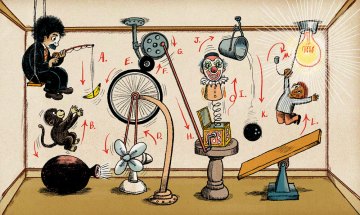
We see this with our laptops and AI. Rube would go bananas. He would say “why are you giving away your brain to a machine that will never be as creative as you are.

Rube errand boy


CTB: I once read that DaVinci suggested that everyone should create art because it was a way of developing the manual dexterity needed to do their jobs. We don’t get that when we allow machines to do it for us.

Sarah: Yes – when you look at Rube Goldberg’s cartoons, you see humor. You see his desire to have fun with this idea of making machines that make simple things complicated. He’s trying to say “Use your brain!”

He wanted to be an artist. But like many parents his father wanted him to have a steady job. So he went to college and studied engineering. But he didn’t want to do that kind of job. So he took a job at a newspaper and worked his way up creating cartoons of complicated machines.

rube newsroom


CTB: So that’s his superpower and his appeal. These unusual drawings of inventions that do more than needed to do a simple job.

Sarah: The power of Rube Goldberg inventions is that it’s not like the machines in engineering school. These complicated contraptions weren’t practical in the real world. They weren’t there to solve real world problems. They were to tickle the imagination. Rube drew comics to make us look closer. More important than any pile of nuts and bolts, it challenged people to use their brains. He was awarded a Pulitzer Prize and he’s included in the dictionary.

Rube_32-33SS

CTB: So his goal is to give people more freedom.

Sarah: Yes. This is what we need in education – a freedom to explore, discover, be curious and creative. And to try things where we don’t know what is going to happen in the end.

When we let go of the product and engage truly in the process, that’s why Rube’s concept of making something silly endures. It taps into what we are missing in education – to give kids a voice.

CTB: We want people to see, “Look at the joy, this person got from this process!” And also the author’s joy in writing this.

Sarah: I talk about that a lot. When we address writing with joy and openness and not being wedded to the ending. We then discover something. And we can apply it. All of the scientific models apply to everything in life. You’re thinking and connecting dots. That’s STEM. You’re dreaming about something that doesn’t feel obtainable. That’s STEM. I ask teachers to give their students 5 minutes a day to write in a curiosity journal. And I ask teachers not to look at it. To let students explore on their own. For example, if they are studying Abe Lincoln, they can ask questions, or just wonder what is inside that big hat.

Sarah at school session

CTB: That’s it. Just 5 minutes each day without rules.

Sarah: Yes. Give students a way to find their path to learning. That’s something 5 minutes a day can do. That’s how I start my own day. Writing in my curiosity journal. Lately, I’ve been drawing the view from my window. They’re not good. But they’re not for anyone but me and it gets my brain swirling. That sets me up for the day. That’s STEM. So that is what I try to help my writers get to. Don’t be so serious. Enjoy every step.

Celebrate when something works.

Celebrate when it doesn’t work.

CTB: One quick shout-out to your award winning illustrator, Robert Neubecker.

Sarah: Yes. His artwork is amazing. I tell authors not to get involved in the illustrations. You often get things back you can’t have imagined. Robert’s work is beautiful.

Rube_12-13SS

CTB: So what are you working on now? Anything we should be looking forward to?

Sarah: Right now I’m working on a picture book about Christopher Reeves. He was a superhero so I’m writing it about his super powers. But in the middle I am talking about spine injury and why he couldn’t recover and walk again. Thinking about the body I’m wearing my old physical therapy hat again.

There’s a movie coming out. It’s been 20 years since he died. He died young so he’s frozen in time. He would be in his 70’s now.

CTB: Christopher Reeve’s public outlook was so positive.

Sarah: I think how I go about writing a biography . It is because I loved how a person is. Reeves is so embedded in the miraculous. He’s almost unreal. When I wrote the book Head Case it was because my patients who had head injuries couldn’t get complete coverage. Christopher Reeves was able to get everything he needed. He was inspiring.

CTB: And you have a finished picture book coming out.

AbzugSarah: I also have a book about Bella Abzug. It is gorgeous. It will be out in a few weeks. She was one of my childhood heroes. I was fascinated by this woman who was loud, and Jewish, and said what she wanted. That just blew my heart open. My first title was originally, “Bela knows everything.” She was an activist and lawyer before she ran for Congress at the age of 50. She was the first to run on a woman’s platform and she was a co-conspirator with Shirley Chisholm. They didn’t agree on everything but they worked together and that really inspired me. She was raised by parents who thought charity was good, but teaching people to help themselves is better.

A woman’s place is in the house – the House of Representatives.” – Bela Abzug

Advice from Sarah:

The most important thing I want people to get is that STEM is learning, STEM is fun, STEM is discovery and it’s integral to everything we do. I was a kid who didn’t think I could ever do STEM. I thought it was about being a doctor, or being really smart. Even when I took physics for Physical Therapy. I didn’t get it until I dissected a human. Messing up with your hands is how we learn. Crumbling a piece of paper and throwing it in the garbage is how I grow. It means I had and idea, but now I have a better one.

“Strive for something that seems impossible. Like a yoga pose. When you are striving and reaching and losing your balance, you’re gaining strength.”


Aronson

Sarah Aronson is the award-winning author of books for young people. She has earned an MFA in Writing for Children and Young Adults from Vermont College of Fine Arts. Her work includes novels and picture books, fiction and nonfiction. She also teaches writing for Highlights Foundation.

She loves working with young writers in schools, and grown-up writers at the Highlights Foundation, and Writers on the Net (www.writers.com). Sarah has served as an SCBWI mentor in both Illinois and Michigan, and is now the PAL coordinator for Illinois. She loves sports, overuses exclamation points and when she’s excited, she talks with her hands.

author christine Taylor-butler

Photo by Kecia Stovall

Your host is Christine Taylor-Butler, a graduate of MIT and author of The Oasis, Save the… Tigers, Save the . . . Blue Whales, and many other nonfiction books for kids. She is also the author of the STEM based middle grade sci-fi series The Lost Tribes. Follow @ChristineTB on Twitter/X and or @ChristineTaylorButler on Instagram. She lives in Missouri with a tank of fish and cats that think they are dogs.