Posts Tagged graphic novels for kids

Interview with Author/Illustrator J.C. Phillipps

Today, please join me in giving a hearty Mixed-Up welcome to author and illustrator J.C. Phillipps. Originally from Toledo, Ohio, J.C. took art lessons at the Toledo Museum of Art and went on to get degrees in art and theater from Hope College in Holland, Michigan, and Emerson College in Boston.
More recently, J. C. has been working as an artist, author, and illustrator in West Hartford, Connecticut. She has written and illustrated four published picture books as well as the graphic novel series Pacey Packer Unicorn Tracker. Her latest graphic MG novel, The Ghost in Cabin 13, has been praised by Kirkus as “A coming-of-age journey worth sharing around a campfire” and is out now from Penguin Workshop.

The Ghost in Cabin 13: A Summary

Twelve-year-old Leah is nervous to attend Camp Cottontail for the first time. She’s worried about meeting new friends, sleeping out in the woods, and being away from her family. But Leah didn’t expect to be freaked out about the ghost in Cabin 13. It’s a good thing she brought her beloved doll, Beverly, for comfort. But after getting picked on by the older girls in her cabin, participating in a séance gone wrong, and befriending—and then ditching—a possessed doll, Leah’s experience at camp goes from anxiety-ridden to straight-up spooky. Will she survive or hightail it home?

Interview with J.C. Phillips

MR: Welcome to the Mixed-Up Files, J.C! (May I call you Julie?)

JCP: Absolutely! Thank you so much for having me.

It Started with Inktober

MR: I read that the inspiration for this book came from your participation in a month-long drawing challenge called Inktober. Can you tell MUF readers more about this?

JCP: Sure. Inktober is a 31-day drawing challenge that takes place in the month of October. Each day there is a one-word prompt, like Salty or Bluff, and artists all over the world draw their interpretations and post them on their Instagram pages with the hashtag #inktober and details like the year and prompt. In 2022, one of the prompts was Uh-oh. I thought back to my childhood when my friends and I would play spooky games at slumber parties, and I drew a séance gone wrong. Four poor girls are startled by a Victorian ghost that they have accidentally summoned. I loved the memory of having fun being scared and developed that feeling into the story of The Ghost in Cabin 13.

What a Doll!

MR: Leah, the doll-toting, 12-year-old protagonist, is an extremely sympathetic character. Did you share traits with Leah at that age? Also, did you go to sleepaway camp? If so, what was your experience like? Did you encounter any ghosts? 🙂 

JCP: I absolutely shared (and still share) character traits with Leah. Leah is nervous with new people. My nightmare is a party where I only know one person. Leah wants to be part of the group but she’s afraid of being teased and rejected. I think most of us feel that way. At the end of the day, I think we all want to be around people who like us for who we are. But sometimes it’s hard to find those people, so we pretend we don’t really need them. I’m no different.

As for personal camp experience, I had a one-night sleepover camp during my Girl Scout years and I used to be a counselor for a day camp called Camp Seafaring in the Boston area. (That camp was a major influence on Book 2 in the Cabin 13 series.) I’ve never encountered a ghost, and I’m okay with that. I prefer them in fiction. 🙂

Portrait of an Artist

MR: In addition to writing the novel, you created the illustrations. What was the process like for you? Did you do both at the same time or add the illustrations later? Also, how does being an artist influence your writing and vice-versa?

JCP: I write the story first. Sometime in the first draft I might start to draw the main characters. Knowing what they look like helps me capture their voice. I probably go through two or three drafts of writing before I get serious about illustrating. And I will intentionally over-write scenes knowing that I will cut them down when I start sketching out the pages.

It’s easy to write a long conversation, but once you start to draw it, it becomes visually boring if the characters stay in the same place for too long. It’s great to be both the writer and illustrator because I can choose what I want to say visually. Maybe I want a character to respond with a scowl. Or maybe I want a panel where someone’s jaw drops open in disbelief. I can visualize those moments as I’m writing and just make myself a little illustration note in the text. I call them Notes to Future Julie because I might not draw that scene for months.

Pacey Packer, Unicorn Tracker 

MR: In addition to The Ghost in Cabin 13, you have written and illustrated the popular Pacey Packer, Unicorn Tracker series. How did your experience crafting The Ghost in Cabin 13 differ from your creation of Pacey Packer? What was similar?

JCP: The writing of both projects was similar, although I remember having more difficulty in finding the right tone for Pacey Packer Unicorn Tracker. It took me a long time to figure out how evil or silly the unicorns were going to be. But for The Ghost in Cabin 13 I knew what vibe I was going for, so I had an easier time developing that plot.

I did have a hurdle at the beginning, because in the first draft there was no summer camp. Leah and her parents went to an AirBnB with their extended family. Instead of a cabin of teen girls, Leah was being teased by her teenage cousins who made TikTok videos. But the story focused too much on the relationship between Leah and her mom and it wasn’t as very fun. I had to figure out how to get rid of Mom. Once I landed on sending Leah to summer camp, things really came together.

The biggest difference between the creation of both books was in the illustrating. Pacey Packer Unicorn Tracker has only one color, purple. The Ghost in Cabin 13 is in full-color. I’m so glad Pacey was only in purple. It was the first time I’d worked digitally and it was a lot for me to learn Photoshop, Procreate, and the fundamentals of paneled storytelling without having to deal with color theory. Now that I know how to use the digital tools, I can spend more time working on the color palette and how to use color to help with the mood and tone of the story, especially the spooky parts!

Picture Books vs. MG

MR: Besides being a middle-grade author and illustrator, you have written and illustrated several picture books. What was it like for you to take the leap to middle grade? Were there any specific challenges creating stories and illustrations for an older audience?

JCP: If anything, the jump from picture books to graphic novels was a little easier. Writing for a middle-grade audience suits my sense of humor a bit more. I can be a little more snarky. A little more myself. Picture books are shorter, but that doesn’t mean they are easier. The ideas and the execution of those ideas have to be clear and concise in picture books. In graphic novels, I have more time to explore character arcs, include a small side plot, or even develop some of the supporting characters.

In Pacey Packer Unicorn Tracker I was able to develop a comic relationship between two unicorn guards. In The Ghost in Cabin 13, I had space to give more details to the counselors and Camp Leader. I think those small details are so much fun! In picture books, I might have been able to sneak some extra details into the art, but there was never space in the text. The biggest challenges for me in creating a middle-grade horror story was staying within the boundaries of what is acceptable spooky fun for the age group without overdoing it. I want the readers to have the thrill of being scared without any nightmares.

Path to Publication

MR: Can you tell us a bit about your path to publication? Was it smooth sailing or bumpy seas?

JCP: Arg! I think, relatively speaking, it was smooth sailing, but it was a roundabout path to get there. I never planned on being an author/illustrator. I got a Bachelors Degree in Art and Theater and a Masters Degree in Theater Education. I wanted to teach college-level theater. After I had graduated from Emerson College, I got a job teaching for a K-1 classroom at an afterschool program, and every day I would read picture books to the class. This was the first time I was looking at picture books as an adult. I looked at the art and knew I could create illustrations. And I looked at the stories, similar to plays, and I knew I could write them. So I shifted my focus to creating literature for children.

I read some books on the craft and joined the Society of Children’s Book Writers and Illustrators. One day, they had an Illustrators Day in New York City. I attended workshops while agents and editors looked at my portfolio. On the Greyhound bus back to Boston, I looked at my responses (the agents and editors left cards in my portfolio) and saw that an agent was interested in me. About a year later, I had a contract for my first picture book, Wink the Ninja Who Wanted to Be Noticed.

Julie’s Writing Routine

MR: What is your writing and illustrating process like? Do you have a specific routine or word-count goals? Also, are you a plotter or a pantser?

JCP: I wish I was a plotter! I’m such a type-A person that it would make sense if I was a plotter, but no, I love to sit down with an idea and just type away and see what happens. I’m a pantser through and through.

I always compare writing with pottery. The first draft is making clay. At the end of that draft you just have a big pile of clay in front of you. Then, in revisions, you shape it, remove excess, and it starts becoming a clear story with characters, plot, theme. I usually write in the mornings when my head is clear. I don’t have word-count goals when it comes to writing. For me, the writing process is most successful when I allow myself to be organic and free-flowing.

However, illustration is completely different. I absolutely set goals for myself. Usually it’s one spread (two pages) per day. That can take 4-6 hours depending on how detailed the drawing is. I ink (in Procreate) the entire book then submit it to the editors for notes. Once the ink drawings are approved, I move onto the coloring process. Again, I have a goal of one spread per day, but sometimes I can go faster and get 3-4 pages done per day. Making a graphic novel is a marathon-type project. I have to set a pace for myself that I can maintain for a year. Sometimes it can feel long, but, all in all, I like the routine of it.

Successful Author Visits

MR: Rumor has it you enjoy doing author visits at schools. What is your secret sauce for a successful visit?

JCP: This is where my theater degree gets put to use. I trained as an actor in my undergraduate program. I do not fear a stage. I can project my voice. And I enjoy interacting with young people. When I’m creating a school visit presentation, I build in games, quizzes, and different ways I can interact with the audience. I think of it as an audience-participation show. My goal is to give a 50-minute presentation that informs and entertains, that the students can be a part of.

The Ghost in Cabin 13: What’s Next

MR: The Ghost in Cabin 13 is the first in a series. Would you mind sharing a bit about what readers can expect in the books that follow?

JCP:  Cabin 13 is an anthology series, so every book is its own individual story. Different characters. Different camp. Different ghosts/monsters. But they are all spooky and there’s always a Cabin 13. I’m not sure how much I’m allowed to say about Book 2, but here’s a clue: Arrr, mateys!

When my editor and I were discussing book 2 of the series, we debated continuing Leah’s story or expanding the world of the books beyond Camp Cottontail. I figured I could extend Leah and Beverly’s story for one more book, but it would be challenging after that. Then I started brainstorming all the fun ideas for new monsters in new camps, and that seemed a lot more exciting. Plus, after the series is built up a bit, readers can choose any book in any order, which also appealed to me. I also like the idea of having many main characters so readers can hopefully find themselves reflected in one of the books.

Merch!

MR: Last question. You have the most incredible selection of artistic merch on Redbubble, including T-shirts, mugs, notebooks, phone cases, and more. What inspired you to branch out in this way? Also, will you have merch available for The Ghost in Cabin 13?

JCP: Okay, business talk. As an artist, it’s good to have multiple revenue streams. I love making books, but sometimes I don’t have a book under contract. So, I also have art in several local galleries and gift shops. I do art fairs. I teach paint-n-sip watercolor classes for adults. I do author visits. And I upload my art to print-on-demand sites like TeePublic and Redbubble.

I started uploading work to Redbubble about ten years ago. I liked being able to print my work on bags, T-shirts, and stickers so I could sell them at my art shows. But it’s also a good way for people to find my art online. If, say, someone in Chicago who follows me on Instagram likes a painting, they could buy a print on Redbubble. Or, sometimes people tell me they like one of my Inktober drawings and ask if I’ll post it on Redbubble so they can buy a print. I’m happy to do that. Right now there are two Cabin 13 designs in my Redbubble shop, so if you wanted to check them out, you’d go to Redbubble.com and search JCPhillipps Cabin13.

Lightning Round!

MR: No MUF interview is complete without a lightning round, so…

Preferred writing snack? Pretzels.

Coffee or tea? Iced coffee.

Zombie apocalypse: Yea or nay? In fiction, Yea – all the way. I love zombies. In reality, I think the zombies would eat my brains pretty quickly. Surviving a zombie apocalypse isn’t in my skill set.

Favorite camp activity? I’d be a theater girlie: painting sets, sewing costumes, making puppets. The show must go on!

Favorite ghost story? This is a tough one. The first thing that comes to mind isn’t a ghost story, but rather a scary, creepy story and it’s Edgar Allan Poe’s The Cask of Amontillado. It’s a story about cold, calculated revenge. My favorite ghost movie is The Sixth Sense, where a little boy can see ghosts, many of whom don’t know they are ghosts. He’s scared at first, but then he learns that he can help them. Neither of these stories are for kids, although I think I read The Cask of Amontillado in high school. I love Edgar Allan Poe.

Superpower? Teleportation. I love being places, but I hate getting there. I’d love to blink my way to Paris!

Favorite place on earth? Buck Island. It’s a small uninhabited island off the coast of St. Croix. If you go on a snorkeling trip, a boating company will take you out there, you can snorkel for an hour then spend about 20 minutes on the most beautiful beach I’ve ever seen. The sand is soft and white. The water is warm. It’s so peaceful and lovely. If I need to calm down, I just take a deep breath.

MR: Thank you for chatting with me, Julie, and congratulations on the publication of The Ghost in Cabin 13! I thought it was a lot of fun, and I know readers will think so, too!

JCP: Thank you so much. What great questions! I really hope your readers enjoy The Ghost in Cabin 13.

Bio

Originally from Toledo, Ohio, J. C. Phillipps took art lessons at the Toledo Museum of Art. She went on to get degrees in art and theater from Hope College in Holland, Michigan, and Emerson College in Boston. More recently, J. C. has been working as an artist, author, and illustrator in West Hartford, Connecticut. She has written and illustrated four published picture books as well as the graphic novel series Pacey Packer Unicorn Tracker. Learn more about J.C. Phillipps on her website and follow her Instagram.


Melissa Roske is a writer of middle-grade fiction. Before spending her days with imaginary people, she interviewed real ones as a journalist in Europe. Upon returning to her native New York, Melissa contributed to several books and magazines, selected jokes for Reader’s Digest, and received certification as a life coach from NYU. In addition to her debut novel Kat Greene Comes Clean (Charlesbridge), Melissa’s short story “Grandma Merle’s Last Wish” appears in the Jewish middle-grade anthology, Coming of Age: 13 B’Nai Mitzvah Stories (Albert Whitman). Learn more about Melissa on her Website and follow her on Facebook and Instagram.

Author Spotlight: Stan Yan

In today’s Author Spotlight, Sydney Dunlap chats with author Stan Yan about his middle-grade graphic novel, THE MANY MISFORTUNES OF EUGENIA WANG.

Stan is an award-winning, first generation American-born-Chinese, Denver-based writer, illustrator, caricature artist and instructor. He helped to co-found the Squid Works comic creator cooperative and was a board member of the Colorado Alliance of Illustrators. Stan is a recent co-Regional Advisor for the Rocky Mountain Chapter of the Society of Children’s Book Writers and Illustrators (RMC-SCBWI) and a co-founding professor of the online kidlit art school, the CuddlefishAcademy.com. You can find him online at stanyan.me.


All About the Book

In this hilarious and heartfelt debut graphic novel, a girl born on a day considered unlucky in Chinese superstition starts to wonder if she really is cursed when she’s troubled by visions of doom set to occur on her thirteenth birthday.

Twelve-year-old Eugenia Wang has never celebrated her birthday on her actual birthday, April 4th, because of her mom’s belief in the Chinese superstition that four is an unlucky number. And that’s not the only thing Mom’s strict about; she won’t let Eugenia go to a summer comic art camp because she thinks art is a waste of time. This year, Eugenia is determined to defy her mom by applying for the camp, having her party on her actual birthday, and inviting her super cute crush while she’s at it, too!

But when Eugenia gets hit in the head with a sneaker during PE, she starts getting unnerving visions of impending doom about her upcoming birthday. It might be the aftereffects of her head injury, or maybe she’s just anxious about turning thirteen. As the visions get worse, even affecting her artwork, Eugenia suspects an unseen force may be sending her messages. If she’s haunted after all, Eugenia will have to figure out why before it’s too late. Even more horrifying, she may have to do the unthinkable: admit her mom was right.


Interview with Stan

Sydney: Congratulations on your new book release! THE MANY MISFORTUNES OF EUGENIA WANG is such a cool mix of spookiness, humor, and oh-so-relatable tween angst. You do such a great job of balancing these elements. Was it difficult to craft this? What were your biggest challenges?

Stan: I’d be lying if I were to say it was easy. I think my biggest challenge was making it paranormal, because I discovered you’ve gotta create a paranormal ruleset and be consistent, which made plotting this story extra difficult, then after getting editorial notes, even harder. Any change I’d make would create a cascade of dominoes through the rest of the story.

Praise for This Book

Sydney: Your graphic novel has been praised by Kirkus with this glowing review: “The panels, which vary in perspective, adding visual interest, support the tone of this dramatic, funny, and touching graphic novel. . . Readers will relate to Eugenia’s struggles over meeting family expectations, following her passions, navigating relationships, and negotiating daily life as a tween. Slightly spooky and filled with humor and heart.” What inspired this story?

Stan: This story was inspired initially by a “bucket list” challenge to myself to write and illustrate a comic that actually scared me. I’m a huge fan of horror, but horror comics didn’t really seem to spook me at all, but I thought there had to be a way. In film and novels, I found that most of the things that tended to scare me related to a child character, so I thought I’d make my protagonist a child. So, by accident my story became a children’s book.

I tried to think of what I was scared of as a child, and I remember (ironically) having existential fears of death, so I inserted that into the story. As I wrote an early draft, it quickly became evident that my story didn’t scare me, but I liked it. Later, after getting a manuscript critique from an editor, who convinced me to simplify my story and make it contemporary, I completely rewrote it, reconceiving the main characters, and reimagining how the protagonist would fall into visions of her death on her 13th birthday, and in the process, I felt like it became scary again!


Characters

Sydney: Eugenia is a great main character. Your other characters are compelling and interesting as well. Do you have a favorite secondary character? Who and why?

Stan: While I find most readers’ favorite secondary character is Peanut, I feel like he’s mostly an emotional proxy for Eugenia, which I admit is adorable. But I think her best friend, Keisha, is my favorite character. I think Keisha is the hilarious free spirit that Eugenia wishes she could be, and I love her humorous interactions with her dads. Keisha is a loyal friend that really believes in Eugenia, and I think that’s what we all want in a bff.

Inspiration

Sydney: How amazing that you are such a talented artist as well as a wonderful story creator. Have you always loved art? When did you decide to tell stories?

Stan: Well, thank you so much! I do feel like what I do is less a result of talent and more a result of passion. My earliest memories of holding a pencil in my hand were of me drawing the same stick figure doing different things in boxes I later found out were called “panel borders.” I was doing comics before I realized it! Drawing has always been simply my muse for telling my stories, and that’s what I loved about my art practice. I never had a shortage of stories to tell, so I got a lot of practice training my hand to do what my brain wanted it to do. As I often say, “you don’t run a marathon before you’ve run a mile.”

(Interspersed below are a few images of the same scene from rough idea to finished product.)


Takeaways

Sydney: What do you hope readers take away from this book?

Stan: There’s a lot of things I’d love readers to take from this book. First and foremost, I just want my readers to be entertained: I want them to laugh, be spooked, maybe get a bit misty in places. I also hope it leaves them thinking about my story after they’re done. And I’d love for my story to spark conversations and debates about what people think happened in it. Hopefully, it’ll be a book club favorite! Lastly, I hope aspiring authors and illustrators will feel they have permission to create stories with characters who look like themselves. I didn’t want to perpetuate the lack of representation in my available school library reading that led me to not consider this for decades by default.


Process

Sydney: Where/when do you prefer to write?

Stan: I don’t have a normal place I like to write. I find that I often am drawing all the time but not writing, or writing all the time and not drawing. That’s how being on a book deadline is for me. So, while I find myself most often just writing at home at the dining room table out of necessity (and proximity to the kitchen and refrigerator), sometimes it’s on the couch, or maybe at Panera Bread…anything I feel like I need, but I don’t have any sort of magic preference.


Influences

Sydney: What are some current books that have influenced you as a kidlit graphic novelist?

Stan: THIS WAS OUR PACT by Ryan Andrews was an amazing book that I felt like meshed all of the aspects of graphic novels together seamlessly. I also have really been influenced by STARGAZING by Jen Wang. I don’t know if these are as current as you were looking for. But GHOST BOOK by Remi Lai was a more recent masterpiece I hoped my books could become like, even if her work hadn’t perceptibly influenced my work yet.


Advice

Sydney: What is your advice for aspiring writers?

Stan: My best advice for writers is to read a lot. My second best advice for writers is to craft an emotional story arc for your protagonist and probably a few of your other main characters.


Upcoming Projects

Sydney: Can you give us some insights into what you’ll be working on next?

Stan: Well, depending on when this is published, my next project might not be announced yet, but you can get a little sneak peek into its universe by looking at my weekly Sunday webcomic, Peter Cadaver (salemcharteracademy.com).


And for the lightning round:

Sunrise or sunset? Sunrise (not by choice, but that’s when my body gets me up now)

Favorite place to travel: Hawaii (as long as your wife doesn’t break her shoulder)

Favorite dessert: Mochi filled with red bean paste

Favorite music: Depends on what I’m doing, but if I’m not needing to write or do panel layouts, I tend to always love listening to 90’s grunge, particularly Hole, The Screaming Trees, and the like.

Favorite book from childhood: If the library card was any indication, WHERE THE WILD THINGS ARE by Maurice Sendak was. I checked that out over and over.

Find Stan on Instagram at @zombicatures. 

Author/Illustrator Spotlight: Allan Wolf and Jose Pimienta

Illustrator Jose Pimienta

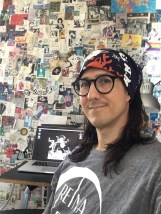
Author Allan Wolf

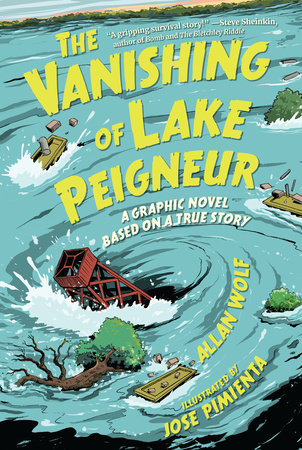
In today’s Author/Illustrator Spotlight, Landra Jennings chats with author Allan Wolf and Illustrator Jose Pimienta about their new middle-grade novel, The Vanishing of Lake Peigneur: A Graphic Novel Based on a True Story (Candlewick Press, October 7). They share the inspiration behind the novel, their creative processes and a little advice for those just starting out!

A Junior Library Guild Selection
Publisher’s Weekly Top 10 Middle Grade Graphic Novels, Fall ’25
“A riveting page-turner that will have readers eager to learn more about the topic.” —Kirkus Reviews (starred review)

Book Summary:

The strange, true tale of a Louisiana lake that vanished—taking with it every fish below and every boat and barge above—told in a gripping and accessible graphic format.
Home to catfish and crawdads, shrimp and spoonbills, even a gator or two, Lake Peigneur—pronounced “your pain,” only backward—bustles also with human life. Each day, the bean-shaped freshwater lake and its shores hum with folks going about their work: a devoted gardener’s apprentice and his dogs, fishermen, oilmen drilling at Well P-20, and the fifty-one miners employed by the Diamond Crystal Salt Mines. For most, November 20, 1980, began as “just another day on the lake.” But as the lake itself reflects, humans had, over time, left behind a honeycomb of salt highways deep beneath its surface, and water and salt mix all too well. Bracing, suspenseful, and packed with dramatic illustrations and dense end matter, this story of a catastrophic accident—narrated with the homespun voice of a “tall” tale, but true nonetheless—will amaze science and history buffs alike.


Interview with Allan Wolf and Jose Pimienta

LJ: Welcome to the Mixed-Up Files, Allan and Jose! Thanks for joining us today. I’m so intrigued by this new book and I can’t wait to hear your thoughts on its development. Let’s start with you, Allan. Where did you get the initial inspiration for The Vanishing of Lake Peigneur

AW: Back in 2007, while visiting schools and libraries in southern Louisiana, I noticed there was a chimney sticking up from the surface of Lake Peigneur, near New Iberia. So, I started asking questions.

I learned that Texaco, while exploring for oil in 1980, sent a 14-inch drill bit into the bed of a shallow1200-acre freshwater lake, piercing a salt-mine below, causing 3.5 billion gallons of water to drain like a bathtub. The resulting whirlpool and sinkhole, sucked in eleven barges, two oil derricks, a couple houses, a tugboat, a fishing skiff, and sixty-eight acres of a nearby ornamental garden. The disaster also created a 400-foot geyser and a 150-foot waterfall. The lake drained in four hours, then began to refill, via the Delcambre Canal, with saltwater drawn from the Gulf of Mexico, nine miles away! The A&E Channel featured the story in 2003 or so, but otherwise it seemed like very few people had even heard of this event. The details were so compelling, I had to tell it.

Junius Leak and the Spiraling Vortex of Doom

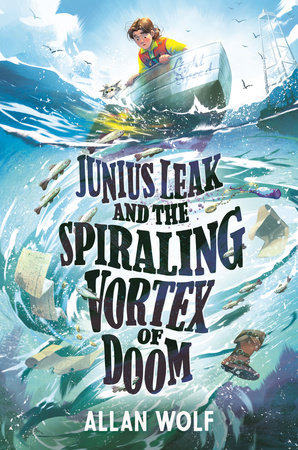
LJ: Allan, how does this title relate to your other recent release, Junius Leak and the Spiraling Vortex of Doom?

AW: The Vanishing of Lake Peigneur and Junius Leak and the Spiraling Vortex of Doom are siblings, raised together in the same house but choosing to grow in different directions. Junius Leak is a middle-grade historical fiction novel in prose, using the facts of the Lake Peigneur disaster as a backdrop for the book’s fictional characters. Junius Leak is a twelve-year-old kid sent to live with his mysterious uncle in a houseboat on Lake Peigneur near Delcambre, Louisiana.

The factual disaster becomes a symbol of Junius Leak’s own coming of age. But to make the world of Junius Leak as authentic and historically accurate as possible, I had to do a lot of research. Then to synthesize my research, I wrote a 60-page prose story of what actually happened so that I could elegantly combine my fictional plot with the factual events. My historical fiction novels often have very extensive back matter. Long-story-short, the back matter of Junius Leak was so compelling, that it demanded we turn it into a book of its own. And that’s how The Vanishing of Lake Peigneur was born. It was my editor at Candlewick Press, Katie Cunningham, who suggested we tell the story in graphic form.

On a somber note, Katie Cunningham passed away this July 4th. Just three days after Junius Leak was published. And three months before the publication of The Vanishing of Lake Peigneur. She was 43. I miss her terribly.

Learning about the Lake

LJ: I love hearing about the relationship between the two books though I am so sorry to hear about Katie. What kinds of research did you do to be true to this story?

AW: I read every newspaper article I could find from the 1980s, along with many government documents reporting and analyzing what took place. The newspapers would sometimes contradict one another, so I looked to official documents from the Mining Safety and Health Administration (MSHA) to get my final numbers. I stalked my way through a labyrinth of Cajun names on FaceBook. I looked at several hundred photographs. I interviewed, in person, a handful of survivors and their relatives—including the 95-year-old captain of the tugboat, Charlie, who narrowly escaped being flung from a waterfall formed by the collapsing earth. Since I started my research in 2007, a few interesting podcasts have added to the story as well. But the in-person conversations I had with first-hand witnesses was my most valuable research tool.

To the Heart of The Vanishing of Lake Peigneur

LJ: What do you hope readers take away from this novel?

AW: Over all I’d like readers to see how it is possible to act courageously even when we are afraid. That is the very definition of courage: to take action in spite of fear and self-doubt. In their own individual ways, both The Vanishing of Lake Peigneur and Junius Leak and the Spiraling Vortex of Doom are stories of ordinary people acting heroically in the face of extraordinary circumstances. That’s when we find out who we really are.

Also, Junius Leak models for us how we don’t have to hide our true selves to make others more comfortable. Sometimes you get tired of trying to fit in. Sometimes you just want to be yourself. It is your choice to make.

On Writing

LJ: What’s your favorite thing about being a writer and story-teller?

AW: I have always identified with “being a writer,” but the early romance has always butted heads with the mundane needs of life. Being a professional writer for kids these days requires a lot of social media, marketing, conferences, bookstore events, school visits—all of it with only a tangential relationship to the actual act of writing books. But that writing itch always lurks. We all need to be the makers of something. If that need isn’t met, we whither. I guess the thing I really love about being a writer is the writing. I can write my way to discover that place, that spot, that just-right, water-tight safe space inside my head where I can go to find myself in my imagination.

What’s Next for Allan?

LJ: Is there anything else you’d like us to know?
AW: Yes. The year 2025 has been a big one for me. In addition to the two books discussed here, I have a new poetry collection out, The Gift of the Broken Teacup: Poems of Mindfulness, Meditation, and Me. It is brilliantly and beautifully illustrated by Jade Orlando. These are fun yet thoughtful poems about self-regulation, self-care, and self-esteem. Of all my poetry collections to date, this one is the most personal. This book was my chance to explore what it means to have character and an intrinsic sense of self-worth. And it gave me a chance to share the ways I have learned to deal with anxiety and to practice self-care. The Gift of the Broken Teacup is sort of an owner’s manual for the soul.

The Illustrations

LJ: Now to you, Jose. The illustrations are phenomenal, starting with the cover. There’s so much energy that jumps right off the page. What excited you most about this project?

JP: The defining factor that excited me the most was that the story’s narrator would be the lake itself. I love stories about places, so, as much as there are many amazing people in this story, the point of view being the land drew me in, immediately.

LJ: How did this project differ from some of your other titles?

JP: This story is non-fiction, which is a first for me. Also, it involves so many people, so, keeping track of a large cast of characters was something I had never done. And! this is the first book I’ve drawn where all the characters are adults. Most of my books feature either teenagers or kids with some adults in there. This one was all grown-ups. But there’s puppies, so…

Jose’s Creative Process for Illustration

LJ: We all love puppies! What is your creative process like? What time of day do you do your best work and what medium do you use?

JP: For the most part, I like to listen to music related to the topic of the story I’m working on. I helps me to stay in the tone of the story. Unless I have errands to run or other engagements, I like to start drawing as soon as possible in the day, right after I finish cleaning up after breakfast. And I like it when drawing is the last thing I do before going to sleep. Everything in between can be different depending on the day. So, I draw a while, goof for a bit, run errands, meet with friends, draw some more, go for a bike ride, eat something, draw more, and so on.
Generally, I draw with a mechanical pencil on 9×12 Bristol board or drawing paper. Then I ink my drawings with microns and brush pens. After that, I scan the pages and letter my comics digitally, because I do a lot of re-writes, so… this helps keeping the dialogues flexible. Lastly, I color digitally because it’s faster. I also prefer to do each book in passes. I like to do the entire book in pencil and then ink the whole book, and so on. Some people prefer to work in batches or one finished page at a time, and that’s great- but I can’t. I want to minimize the amount of gear shifting I do.

For writing, my process is an entirely different story. But more on that some other time.

The Path to Becoming an Illustrator

LJ: How did you get started along the path to becoming an illustrator?

JP: I’m not sure when it started. A cliché answer is “I never stopped drawing. I’ve just been doing this my whole life.” And that’s mostly correct. But as a professional, I can’t think of a definitive starting point. I went to art school, where I met a lot of amazing people I wanted to collaborate with, and that got me some work, but I also wanted to write and draw my own stories, so I did that as well. After art school, I came to Los Angeles in the hopes to work in the film industry, and I kept getting work here and there while I was making my own comics. At some point, I realized I was making a living drawing, so “Yay!”

I guess how I got started is I just kept telling people I wanted to draw and I showed them what I was working on. Some of that lead to work and some of it didn’t. Along the way, I made cool friends and got to collaborate with wonderful artists.

Advice for Those Just Starting Out in Illustration

LJ: What advice would you have for a beginning illustrator?

JP: Hmm… first I’d ask the illustrator what their goals are. Then, I’d hope I have useful advice for their specific path, or at least point them in the direction of other illustrators who do something similar so they can get better guidance. But as a general advice, I go with this:

Explore. Try things out. Find what works for you and approach everything with genuine curiosity. Experiment with mediums and see what catches your interest. Learn as much as you can from experts, but dare to go further than they have. Also- get comfortable with failure. Learning requires it. But pay attention and ask if it’s worth trying again. Lastly, Make friends. Be friendly. Be kind. Be sincere. Most people want to collaborate with someone they know or someone they like. So, show your work. No one’s going to hire you if they haven’t seen what you do. Oh! And of course: keep practicing the fundamentals.

I hope that’s useful, but if not, ask other illustrators. (And that’s my point: Ask and talk to as many as you can. We all want to see more art. So we’d love to see yours.)

Visiting the Lake

LJ: Is there anything else you’d like us to know?

JP: Only what you’d like to ask me, hehe. I’m not sure how to answer this, other than working with Allan was fantastic and this book was a phenomenal project. I’m so happy I got to draw this. Oh! Big story I like to share. When I first started drawing this, I wasn’t sure how to research this, since it’s non-fiction. I wanted to get as many details as possible correct, so, on a whim, I went to see the actual lake and I can’t tell you how much help that was. Visiting the lake was a terrific experience. Big thank you to everyone who answered my questions and their meals are top notch. If you get a chance to visit the area, by all means, it’s a delight.

Lightning Round Questions:

No MUF interview would be complete without our lightning round, so here we go…

For Allan Wolf:

Coffee or tea? Both.

Sunrise or Sunset? Sunrise.

Favorite city (besides the one you live in): Asheville, NC

Favorite books from childhoodAre You My Mother? By P.D. Eastman and Mike Mulligan and His Steam Shovel by Virginia Lee Burton.

Favorite ice cream flavor: Banana

If you could choose a superpower, what would it be? The ability to flood others with any emotion so that emotion then becomes their own.

For Jose Pimienta:

cup of teaCoffee or tea? Tea.

Sunrise or Sunset? Sunset.

Favorite city (besides the one you live in): (In the world?) Hamelin, in Germany. But if we’re doing US only: Los Angeles (I live in Burbank).

Favorite book from childhood: “Matias y el Pastel de Fresas” by Jose Palomo.

Favorite ice cream flavor: Ube. Or anything chocolate.

If you could choose a superpower, what would it be? I’m very serious about this: Scent manipulation. Being able to control smells would amazing. Had a bad day? Not when it smells like a bakery in here. Supervillain attacking you? Make it smell so bad they’re incapable of focusing. Did you pass gas in public? No one ever has to know. OR teleporting, whichever is easier to acquire.


Thank you so much Allan and Jose for sharing with us!


About the Author and Illustrator

Allan Wolf

Two time winner of the North Carolina Young Adult Book Award, as well as Bankstreet College’s prestigious Claudia Lewis Award for Poetry, Allan Wolf is the author of picture books, poetry, and young adult novels. Booklist has named his historical verse novel, The Watch That Ends the Night, one of “The 50 Best Young Adult Books of All Time.”

Also a skilled and seasoned performer of 30 years, Allan Wolf’s dynamic author talks and poetry presentations for all ages are meaningful, educational and unforgettable. Florida Reading Quarterly calls Wolf “the gold standard of performing poetry.” Wolf believes in the healing powers of poetry recitation and has committed to memory nearly a thousand poems.

Wolf has an MA in English from Virginia Tech where he also taught. He moved to North Carolina to become artistic and educational director of the touring group Poetry Alive!. Wolf is considered the Godfather of the Poetry Slam in the Southeast, hosting the National Poetry Slam in 1994, forming the National Championship Team in 1995, and founding the Southern Fried Poetry Slam (now in it’s 27th year).

Jose Pimienta

Jo Pi’s almost full name is Jose Pimienta. They reside in Burbank, California where they draw comics, storyboards and sketches for visual development. They have worked with Random House Graphic, Iron Circus Comics, Dark Horse Comics, Disney Digital Network, and more.

During their upbringing in the city of Mexicali, Mexico Jo was heavily influenced by animation, music and short stories. After high school, they ventured towards the state of Georgia where they studied at Savannah College of Art and Design. 

For Comics work, they are represented by Elizabeth Bennet of Transatlantic Agency.