
Posts Tagged graphic novel

Author Interview and Giveaway: Kirk Scroggs – WE FOUND A MONSTER

Today, I am lucky enough to interview the multi-talented writer and artist Kirk Scroggs about his newest graphic novel,
WE FOUND A MONSTER.


Please tell us about your just-released book WE FOUND A MONSTER.

We Found a Monster is the story of a kid named Casey who has a few skeletons in his closet . . . and a She-Bat, and a zombie, some gremlins, a squid monster, and, oh yeah, Frankenstein’s in there too! Casey’s a loner who loves to draw monsters. About a year ago, shortly after his mom passed away, real monsters started showing up on his doorstep. Now he’s got a house full of them that he somehow has to keep hidden from his dad and the neighbors. He’s at his breaking point. He can’t possibly harbor one more critter. But there’s a new girl in town. Her name is Zandra and she needs Casey’s help. She’s found a monster too. A giant, furry, loveable behemoth named Spot. Spot needs a home but there are dangerous secrets lurking beneath his rainbow-colored fur. A dark past that has followed him to Casey’s sleepy little town. Someone, or some Thing, is after Spot. Casey will need Zandra’s help to protect Spot, but she is a bit of a mystery herself. Can she be trusted?


Casey’s Creature Exhibit showcases his monsters. Do you have a favorite?

It was a lot of fun mixing in some characters from DC’s vaults into this monster mash-up. She-Bat is a cool character. Half human half bat, she used to be a bat researcher before her body-altering accident. I think, for me, the favorite is an old classic- Frankenstein. Franky lives in Casey’s basement near the water heater and he’s got a few quirks. Since he was stitched together out of other classic monsters, he sports some interesting features, like an invisible arm and, when the moon is full, werewolf legs!


Casey is a bit of a monster purist – no Adorables and no Fantasticals. What about you? Do you think there’s a place for the fluffy and the fantastic?

Casey is definitely me when I was his age. I was strictly old school when it came to monsters. Dracula, Godzilla, the Wolfman. But, like Zandra in the story, I now appreciate fantasy creatures too and I’m willing to give them full monster status. I think watching the old Sinbad movies and embracing Lord of the Rings and Harry Potter has gradually opened my eyes. All monsters are cool! Even the adorables.


There’s so much happening on every page of WE FOUND A MONSTER. Could you tell our readers a little bit about how you go about creating a project like this? And, do you have any tips for budding graphic novelists?

With We Found A Monster, and The Secret Spiral of Swamp Kid, I definitely mashed a few art forms together—the graphic novel and the journal. It’s such a fun and freeform way to create a story. I like to sit with some plain white paper and just start scribbling and doodling, kind of like Casey does in the book. This journal format lets me experiment with different drawing tools and styles. If Casey is in a hurry, he just doodles out a quick black and white sketch. If he has the time, he pulls out the whole set of markers and draws a full-scale graphic novel sequence.

My advice to aspiring graphic novelists is to play to your strengths. If you’re better at drawing than writing, team up with your buddy who can’t draw so well but writes good stories. And vice versa. And remember to let the art do most of the hard work. No need to be overly descriptive when the art can convey the same information. And keep the dialogue short so it doesn’t block the cool pictures!


It’s pretty clear that you have a special affinity for monsters. Did you have a favorite when you were a kid? Do any of your childhood monster experiences come through in your stories?

I’ve always had a thing for the tragic monsters. Frankenstein, King Kong, Swamp Thing, Creature From the Black Lagoon—you kinda feel for these critters. They just want to be loved. I think everything I’ve ever written from Wiley and Grampa’s Creature Features to Swamp Kid, even the Muppet books, has woven in classic monster movie elements. I just can’t help it!


What can readers expect to see from you next?

There are certainly some follow-up ideas lurking in my head that I’d love to explore. Right now, I’m playing around with some animation proposals and I’m whipping up a top-secret graphic novel manuscript. I can’t say too much about it except robots, middle school, wolfpigs!


Thanks so much for chatting with us, Kirk. Readers, you can find WE FOUND A MONSTER at your favorite bookstores now. Be sure to follow Kirk at his website and on Twitter and Instagram.


If you love monsters as much as Kirk does, let us know your favorites in the comments below. And be sure to enter our Rafflecopter giveaway for a chance to win a copy of WE FOUND A MONSTER!

Meet the Creators of DC’s Newest MG Duo: An Interview and Giveaway

AntiHero CoverWelcome back, Mixed-Up Filers.

Today, we’re chatting with the creators of the newly released Anti-Hero from DC Comics, authors Kate Karyus Quinn and Demitria Lunetta and illustrator, Maca Gil. Thank you all for joining us today!

My first question is for all of you. Can you tell us a little bit about Anti-Hero?

Kate and Demitria: Anti/Hero is the story two 13-year-old girls. Sloane thinks she’s a villain and Piper very badly wants to be a superhero. The girls end up battling over the same stolen object, an experimental scientific device. When the device accidentally powers on, the girls switch bodies. Now Sloane and Piper must learn to work together – or risk destroying each other.

Maca: It’s also super sweet but packed with fun and crazy action involving chases, drones and giant mutant creatures. It’s pretty cool.

Another question for the group. Hummingbird and Gray are completely new characters in the DC Universe? What was the process of creating them like?

Kate and Demitria: It was amazing! To add new characters to the DC Universe is a “when lightning strikes” sort of opportunity. How often does it happen? And to be able to add two new amazing female characters is even better!

When creating them, though, we weren’t really thinking about them as DC characters. Instead, we wanted two create two multifaceted girls whose problems our readers could relate to and understand.


Maca: I think if I ever see anyone cosplaying Piper or Sloane my heart is going to melt off of my chest. This has been an amazing opportunity and I’m so happy I got to do it with this team.

Kate and Demitria, what was the process of co-writing like? Did you each choose a character’s point-of-view to write from?

Kate lives in Western New York and Demitria is in Wisconsin, so we wrote long distance, communicating via text, email, and the occasional phone call. In between all

that back and forth we wrote the script by constantly passing it back and forth. Kate would write a bit then send it to Demitria. Demitria would tweak what Kate wrote and add a bit more. Then back to Kate, to okay or change again what Demitria changed on her stuff, read what Demitria added, and then add a bit more. In the end, both are our fingerprints are on every single sentence.

Also for Kate and Demitria, there’s a lot of emphasis on family throughout the story. Was that something that you wanted to focus on early on? Or did it develop out of the body switching plotline?

We definitely wanted to focus on family, because it shaped so much of who the girls are and how they experience the world around them. Piper, despite her parents being absent, has a really strong and supportive family unit. Sloane, on the other hand, has a loving Mom, but because of work she isn’t around much. And Sloane’s grandfather…well, he’s definitely not the type of role-model you’d want a kid to have.

Maca, how did you come up with the costumes for each girl’s alter-ego?

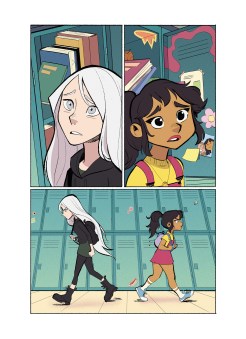
Piper loves fashion and wearing crazy colors, she is strong and full of energy. The visual cues that represent her have to be dynamic and striking. Sloane, on the other hand, is a lot calmer and hates to stand out. Visually she has long vertical lines (her hair and her height help with this!) and she loves black. When I came into the project Kate and Demitria had written such rich and alive characters that designing them was a treat. They also get even cooler costume design as the story progresses; I can’t wait for you all to see.

Also for Maca, I saw (and loved) your Batgirl illustration on Burnside. Have you always been a DC comics fan? Are there any easter eggs that readers should keep an eye out for?

Thank you! Admittedly, I only started once I was out of college and a bit older, but so many women characters in the DC universe grew on me so much and so fast. Harley Quinn, Poison Ivy, Batgirl! There are so many amazing ones, and their designs and stories are so iconic. I would completely die for Piper and Sloane to have a crossover with some of them someday.

For Demitria and Kate, this is your first MG novel. How does writing for MG differ for writing for YA and adult audiences? Also, it’s your first graphic novel. So, how did that process differ?

Writing MG was so fun because we were allowed to really let our silly and playful sides let loose. Both of us tend to write YA with darker themes, so it was really fun to play in this world where even at their worst—things were a little lighter.

Is there anything else about the story that any of you would like to share?
Kate and Demitria: We had to come up with an MG safe expletive for Sloane to use and decided on Zooterkins. We would love to see it catch on!

Maca: So many pancakes get eaten throughout this story. I had to stand up and make some for myself a couple of times due to having to think about them so much.

(Honestly, same. I definitely made some pancakes after reading this.) What’s the best piece of creative advice that you’ve received that you’d like to pass on to other writers and artists?

Kate: Even when you want to quit—don’t. Just keep writing. Or creating whatever you create.

Demitria: Writers need to read! Anything you can get your grabby little hands on.

Maca: Copy and study your favorite artists, but do it properly! As long as you keep your inspiration sources diverse, your product will end up being uniquely yours because of your own sensibilities, strengths and limitations.

What is something that people would be surprised to learn about you?

Kate: I hate horror movies. They literally terrify me.

Demitria: I make no secret of my dorkiness, but sometimes it still surprises people.

 Maca: I have played over 400 hours of Animal Crossing: New Leaf

Who is your favorite DC character (apart from the ones you’ve created)?

Kate: Wonder Woman!

Demitria: Batman!

MeetMaca: Batgirl of Burnside <3

What are you working on next?

Kate and Demitria: Hopefully more MG graphic novels!

Maca: I’m currently storyboarding for a feature film, but I can’t wait to do more comic books.

How can people follow you on social media?

Kate: I’m @KateKaryusQuinn on both Instagram and Twitter or you can visit my website www.KateKaryusQuinn.com

Demitria: I’m @DemitriaLunetta and my site is www.demitrialunetta.com

Maca: I’m @macagil on Instagram!

Thank you so much for the interview!


AntiHero is out now! Get your copy here or try your luck in our give-away!

a Rafflecopter giveaway

CUB ~ Cynthia L. Copeland Shares Her New Graphic Memoir & Enter A Giveaway!

Hi Everyone! I’m thrilled to have New York Times bestselling author Cynthia L. Copeland with us. It’s also pretty cool that we have a copy to give away, so make sure to scroll to the bottom for information on how to enter.

Okay, I can’t wait another minute to show you her latest release!

*lowers voice* It has pictures…😍

CUB by Cynthia L. Copeland


Released: January 7, 2020
Age Range: 8 – 12

A laugh-out-loud funny and empowering graphic memoir about growing up and finding your voice.

Twelve-year-old Cindy has just dipped a toe into seventh-grade drama—with its complicated friendships, bullies, and cute boys—when she earns an internship as a cub reporter at a local newspaper in the early 1970s. A (rare) young female reporter takes Cindy under her wing, and Cindy soon learns not only how to write a lede, but also how to respectfully question authority, how to assert herself in a world run by men, and—as the Watergate scandal unfolds—how brave reporting and writing can topple a corrupt world leader. Searching for her own scoops, Cindy doesn’t always get it right, on paper or in real life. But whether she’s writing features about ghost hunters, falling off her bicycle and into her first crush, or navigating shifting friendships, Cindy grows wiser and more confident through every awkward and hilarious.

“Copeland’s first graphic novel for kids successfully integrates the right balance of coming-of-age issues into those arising from her early-’70s setting; many of the latter are eerily similar to those that the country is still experiencing . . . This tale of middle-grade angst and self-consciousness is laced with humor and nostalgia.”
Kirkus Reviews, starred review

***

Doesn’t this sound like a well-rounded middle grade book? And to top it off . . . *lowers voice* It has illustrations . . . They are soooooo awesome, too.

Let’s give a huge Mixed-Up family hello to Cynthia!

Hi, Cynthia. I’m so glad you were able to stop by for a visit. I am beyond fascinated with graphic novels, and the fact that CUB is a memoir as well is made of awesomeness. Let’s begin with what inspired you to create your main character Cindy?
Cub was inspired by my experiences as a cub reporter in Connecticut in the early 1970s, and I tried to keep my character very close to the person I was in seventh grade. As the story begins, twelve-year old Cindy is very attached to her childhood best friend, Katie, even as Katie is gravitating toward the “cool and cruel” crowd. When Cindy’s favorite teacher connects her with a young, hip female journalist, Cindy begins her evolution from a quiet, somewhat insecure wallflower to a confident pre-teen who finds her voice, and is able to assert herself in both professional and social situations.

I’m sure a lot of middle schoolers will be inspired by Cindy’s fortitude.

How else do you think middle grade readers will relate to her?
Even though the story takes place nearly half a century ago, the pre-teen social issues Cindy faces are timeless. She initially tries to “play dead” to avoid the mean girls (“the predators”), but this plan falls apart when “the predators” discover she has her first boyfriend, and they try to do everything they can to break up the relationship.

Uh-oh. . .

Readers will cheer Cindy on as she finds a loyal group of friends who stand up for one another, at the same time that she becomes more proficient in and excited about newspaper reporting and looks forward to seeing her very first stories and photographs in the newspaper.

This is really inspiring.

Any suggestions on how young writers like Cindy can get involved in writing for their local communities?
Aspiring young writers should offer to cover events taking place at their schools for their local newspapers! Local news coverage is in crisis today, as advertisers spend their money elsewhere, and readers look to other (oftentimes unreliable) sources for information. Young journalists who write about school sports, club activities, or other events in a thorough and accurate way are providing a real service to the community – as they improve their own writing skills.

What do you hope young readers take with them from reading CUB?
I hope readers grasp the importance of journalists and journalism in our democracy. The truth matters, and our society can’t function without independent sources of accurate information. It’s not easy to be a journalist today – and that’s exactly why we need persistent and thoughtful journalists now more than ever.
I also hope that kids realize how important it is to pursue something they feel passionately about outside of school. Outside interests offer balance as well as perspective, and help kids see that even though daily social interactions can feel very high-stakes, there is a big world beyond the middle school hallways.

Without sharing spoilers, can you share something unique about Cindy’s story journey?
The self-confidence that Cindy gets from her experiences as a cub reporter not only help her as she covers stories and takes photos for the paper, but her newfound courage leads her to pursue a very interesting and creative summer job!

I really enjoyed this book. *lowers voice* And . . . it has graphics! 

What do you feel (or from your experience) is the importance of graphic novels in middle grade literature?
Graphic novels serve such an important role in middle grade literature, and I’m delighted that they are finally getting the attention and respect they deserve! This format helps kids read “up” because the images provide context for new vocabulary words. Visual storytelling also helps readers empathize with characters, as they look into the faces of those in the story. Young readers use critical thinking skills to understand how words and art combine to tell a complete story. And perhaps most importantly, kids naturally gravitate to graphic novels and are excited to read them!

Yes, it does help them read “up”. Love this!

What can authors do to help promote graphic novels in the classroom?
Authors can visit or Skype into classrooms and discuss the process of visual storytelling, and can help teachers find ways to incorporate their work into the curriculum. In Cub, for instance, I not only show journalists at work, but I highlight social issues that are relevant today: Earth Day, which celebrates its fifty-year anniversary this April, was intended to bring attention to environmental protection; the Equal Rights Amendment, first proposed in 1923, is still not a part of our Constitution; political turmoil at the top levels of our government persists; and unpopular wars rage on across the world.

*Readers – please read Cynthia’s answer again. It contains so much wisdom about inspire young readers and getting them to read.*

Lastly, would you share one piece of writing advice for our reading writers out there?
Read the kinds of books you think you’d like to write. And read critically: If you didn’t like a book, ask yourself why. Is it the pace you don’t like, or the character development, or the ending… ? What would you have done differently if you had been the author?

Definitely thought-provoking advice! Thank you so much for sharing Cindy and her journey through CUB. It’s been a pleasure. All the best to you always, from your Mixed-Up family…

About the Author

Cynthia L. Copeland has written over 25 books. CUB is her first graphic memoir for young readers. “I’ve always wanted to write about this period in my life,” she said. “The social pressures of middle school today (then junior high) are remarkably similar, and some of the political events feel eerily similar.” In CUB, young Cindy has a front row seat to many of the hot-button issues of the day including a shocking, protracted White House scandal, the fierce fight for gender equality, and the burgeoning environmental movement.     Website | Publisher

                                ***

Want to WIN your own paperback copy of CUB? Hop over to Twitter to retweet/follow/like THIS Tweet; giveaway US only. Winner announced on Twitter, February 7, 2020.

Thank you for reading! Now, go out and purchase CUB, and give it to a middle grade reader that needs to be inspired. You won’t be disappointed.