
Posts Tagged graphic novel

Interview with Cassidy Wasserman about Graphic Novel ON GUARD!

Today, we’re excited to have Cassidy Wasserman with us on the Mixed-Up Files. I had the pleasure of reading her graphic novel On Guard!, which is releasing tomorrow, June 10!  I also got to interview her about the book, her inspiration and process, and more. Thanks so much for taking the time to chat with us, Cassidy!Cover of On Guard by Cassidy Wasserman


The author’s note in the book shares that the original seed for this story was about a friend breakup but slowly became about the relationship between mothers and daughters. The line you shared about the real story finding you along the way was lovely, and I wondered if you could talk more about how the story on the page came to be. How did you know when that shift needed to happen?

When I started writing On Guard!, I was focused on Grace and Ava, and how they grew apart. As I wrote, I dug deep into the feelings I experienced in middle school that were likely to be a more universal experience for readers. The story of my parents’ divorce was prevalent in my mind, and I realized that there was a natural through line between Grace, Ava, and Grace’s mom. I decided the shift in focus had to come from Grace starting that school year all on her own, where her struggles at home and school are now completely intertwined. Not only do we see her struggling at home while butting heads with her mother’s personality, but even at school she’s faced with how much she believes her mother liked Ava more than her.


There is a lot of your own story inside of Grace’s (and it’s awesome that you’re both artists!). How did you approach weaving parts of your own life into the narrative?

I feel the best stories come from personal experiences. I approached adding these parts of my life to Grace’s story by picking the ones that felt the most relatable, and the ones that I hadn’t yet seen told. I mention in my author’s note that I didn’t get to see relatable stories of mothers and daughters growing up, and it was important for me that this feeling of alienation from your maternal figure would come through. I wanted to ensure the story was true to my lived experience.


Relationships are handled deftly in your work, whether it’s Grace with her mom, Grace with her dad, or Grace with her friends, old and new. It was fascinating to see how you gave all of these relationships space in the book—both in the text and in the art itself. Could you tell us how you balanced these threads?

It all comes down to pacing, and making sure every story is intertwined with another. Grace is going through quite a lot, and all of those relationships need their time on the page. I like to let the art tell the story where I can. When you can let a reader sit with a silent panel or two, it can have a big impact. I found that when the plotlines organically developed to suit the needs of Grace and the story, they all started to naturally click into place.


One of my favorite lines was when Grace admitted she mostly just wants to hold a sword—who doesn’t? There were many other powerful moments that came through analogies to fencing, like when Grace realizes she can only control her own moves, not her opponent’s. Could you tell us about how you got into fencing? Did that experience give you the idea for this book?

I could talk about fencing all day! When I was a kid, I read The Spiderwick Chronicles, and the sister in that book fences. Ever since then, I’d hoped to be able to do it myself someday. I didn’t get to fence in school, but after college I joined a local club. Epee just happened to be the only weapon they taught, as my coach was a collegiate women’s epee coach. (Go, Wellesley!) It worked out nicely, because epee is the simplest weapon to explain. Foil and saber have a few more rules. I was in love with the sport from the moment I walked into the club and heard the bell guards ringing. I had been mulling over a story about my “Ava” for a while, and after I starting fencing, it became clear.


You mentioned you’ve always loved to draw and read. Are there any favorite books or artists that have profoundly shaped you as an author-illustrator?

Lucy Knisley is a big influence on me when it comes to graphic novels. Her travelogues were my favorite thing to bring around in art school. I’ve also pored over Jen Wang’s artwork in The Prince and the Dressmaker a million times, and anything from Tony DiTerlizzi. Be Prepared by Vera Brosgol is also one of my favorites. The biggest influence on me as a writer, though, has to be Rick Riordan. I am a Percy Jackson kid through and through—it holds such a special place in my heart.


You’re also passionate about video games and work as a UX/UI artist. Do video games influence your creative process or storytelling?

Yes! Some of my favorite plots and stories to study are video games. The Last of Us in particular is incredible—I love how it deals with difficult topics and gray areas. My coworkers teach me to be a better artist and listener every day. As a UX/UI artist, I care deeply about accessibility and inclusion, and that naturally follows me to creating comics. Things like: Are the colors on the page workable for someone who is color blind? What about the font—is it easy to read for those with dyslexia? These are important questions when it comes to both comics and video games!


It sounds like book two for Grace is already underway! Will we get to see more fencing as well as more of Asher and Nia?

Yes! I cannot wait to dive deeper into their stories.


Do you have any other projects in the works we can get excited for?

I can’t say just yet, but stay tuned—I’m excited to show the world what’s next.

Cassidy Wasserman

If you could give writers any advice on how to keep writing even in the face of rejection or overwhelming odds, what would it be?

Keep going! Your story is worth telling—we need new perspectives on life. Take breaks when you need to and be kind to yourself, but don’t give up. Getting your story out there is sometimes about having it resonate with the right person, so writing something that is meaningful to you will always be worth that initial rejection.

No MUF interview is complete without a lightning round, so here it is!

Favorite place to write? My office!

Coffee or tea? Coffee, coffee, coffee!

Superpower? I want the chalk zone powers, where whatever you draw becomes real. I would draw myself so many ice cream sundaes.

Dream vacation? The Australia Zoo!

Dream job when you were a kid? I specifically wanted to be a “veterinarian, and an artist on my lunch breaks.”

House pet? Dogs and cats


Learn more about Cassidy and her projects at her website: https://www.cassidywasserman.com/

Interview with Royden Lepp

We have a problem in our house with books. Specifically, the reading of books. I know as a book blogger I should be decidedly pro-reading-of-books, but my wife and I have some safety concerns. Books can and should be read on couches, chairs, in beds, even on swings for especially adventurous types. But our boys

one of my boys demonstrating the safety hazard of a good book

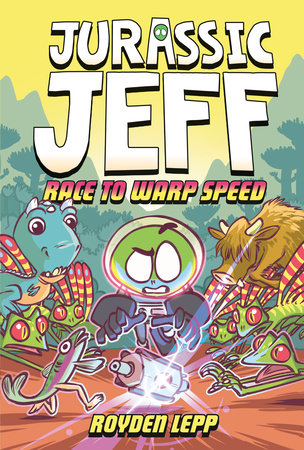
have developed the troubling habit of reading particularly engaging books while walking, eating, and most recently while traveling on staircases. Only the most exciting stories pose this risk, but with authors like Royden Lepp creating hilarious and unique graphic novels like the Jurassic Jeff series, it might be time for a family intervention. 

Royden is exactly the kind of author I’m worried about — someone who has a long history of producing highly engaging and creative work like the RUST series, as well as a huge range of creative offerings and a seemingly endless list of new ideas and concepts. With Jurassic Jeff, Royden blends dinosaurs, aliens, and world domination into an unputdownable middle grade comedy.

And much to the excitement of our boys, I recently had the opportunity to ask Royden some questions about his latest venture into the world of graphic novels. Our interview is below, and while I neglected to ask him for advice about our risky reading dilemma, his insights about the creative process are absolutely worth a look!
 

Chris: Thanks for making some time to chat with me, Royden! Jurassic Jeff is such a fun series — what gave you the idea?

Royden: I love mashing up genre’s and settings. This is a weird one, but I was sitting in a church listening to someone talk and I was doodling in the hand out paper (I like to draw while I listen to people talk). I drew an alien emerging from a flying saucer, surrounded by dinosaurs and I thought “huh, that’s kind of a fun idea”.

Chris: Jurassic Jeff really stands out as something different from a lot of your other work — the palette is really vibrant and fun! What drew you to explore this style?

Royden: Yeah, Jurassic Jeff is my first foray into comedy and middle grade. I wanted to experiment with serial content and comedy and Jurassic Jeff has been a really fun and interesting exploration into another side of me as an author. But honestly I had a son entering middle grade and I was reading some of the books he brought home. Some of them were good but some made me kinda think ‘well I could do that’. My son has a great sense of humor, so I’m always trying to see if I can make him laugh with these stories.

Chris: Well it’s certainly been a hit with the boys in my house! You seem to like blending themes of old and new (I’m thinking especially of the Rust series here)…are there other themes that show up across different projects?

Royden: I’ve never realized that but I suppose it’s true. I think there is some strong imagery across a lot of my projects; young male characters in an adventure or a fight for their lives. Nature, animals, creatures, monsters, robots, and bugs. I love that stuff.

Chris: Well, you also give yourself a lot of options by working in so many different mediums (illustration, video, photography)…do you have a favorite? How did you go about learning so many different artistic formats?

Royden: I must get bored! I think there are mediums that I find so compelling that I can’t stay away from them. Photography was a really nice divergence from drawing and comics in my early 20’s. It’s such a refreshing art form. Photography led very naturally into videography. And strangely it’s all had an influence on my drawings. In RUST I would often think about the shutter speed or the aperture setting of the image I was working on. I also have a very encouraging and supportive wife that pushes me into exploring things.

Chris: Well, speaking of exploring new things, I’d love to get your thoughts about the role of AI in the world of writing and illustration. Could you speak to the potential benefits and drawbacks as generative AI becomes more prevalent in the industry?

Royden: Yeah, everything is about to change drastically. I feel the giant ship of culture creaking and groaning as it starts to head in a new direction. I won’t lie, I’m a bit scared at the moment. Change is hard. But for now I can only keep doing what I love to do; tell stories. I hope A.I. makes it easier for me to get a book done and I hope it doesn’t discourage those who are looking forward to telling their own stories, making their own art. But ultimately, fear of the future is not the way for us to live.

Chris: Well said, and certainly something us creative folks need to hear! So, what’s next for you as an author? Can you give us any clues about new projects you’re working on?

Royden: I just found a home for a really special project that I wrote during the pandemic. I’m elated that it’s going to live a life off my hard drive and in the hands of readers. That’s all I can say about it at the moment but it’s a really special story.

Chris: Well I can’t wait to learn more! Okay…now for the lighting round:

Favorite place to write?

Ideally; Vancouver island staring out at the ocean. Realistically; in my living room with my family (but with headphones on).

Favorite authors?

I’ll say biggest influences; Michel Gagne, Jake Parker, Kazu Kibuishi, Doug Tenapel.

Best dessert?

Baklava

Do you have any pets?

Yes, at the moment my son and I are keeping a leopard gecko named Tang, and two different species of praying mantis, a ghost, and a blue papua giant. The ghost mantis is getting ready to lay eggs.

Favorite elementary school memory?

Running through the woods as fast as my lungs would let me.

Favorite dinosaur?

The Quetzalcoatlus is the most insane creature I’ve ever imagined. A flying reptile the size of a giraffe!?

Favorite piece of advice for other writers:

Find your voice. Other people might write or draw like you but only you can be YOU. Find out what makes your voice unique and lean into it. There’s nobody out there like you.

Huge thanks to Royden Lepp for the interview! Jurassic Jeff: Race to Warp Speed is available now from Penguin Random House. Until next time!

Why Writing Kid Constantine Was No Mystery for Ryan North

Mystery of the Meanest Teacher Cover

Mystery of the Meanest Teacher CoverRyan North, whose credits include an award-winning runs of Adventure Time, Jughead, and The Unbeatable Squirrel Girl recently wrote a middle grade graphic novel featuring John Constantine, one of my favorite DC Comics characters, and I got the opportunity to sit down and talk with him about it.

MUF: I’m Mimi. I write for From the Mixed-Up Files of Middle Grade Authors, a blog for people who love middle-grade books (parents, teachers, librarians, kids, writers, etc.). It’s an honor to be able to interview you. (My husband is also a fan. He’s the one who introduced me to Dinosaur Comics).  And congratulations on the Eisner nomination this year.

Ryan North: Aw thank you, Mimi!  That’s very kind.  I’m excited about it!  And say hi to your husband for me. 🙂


MUF: So, tell us about The Mystery of the Meanest Teacher?

Ryan North: The Mystery of the Meanest Teacher is a middle-grade graphic novel about a younger version of Constantine – Johnny Constantine, but he prefers you call him “Kid”.  Kid Constantine has to escape from the UK to the United States after one of his capers involving ghosts and demons goes wrong. When he arrives at his new boarding school in America, he discovers his spells don’t work as well as they used to, so he’s left scrambling, faking it till he makes it – but luckily he soon discovers he’s not the only magical kid there.  And he’s going to need all the help he can get when one of his new teachers seems to have it out for him personally, and might be a real-life witch…

It’s a stand-alone graphic novel, so you can read it knowing nothing of the character (or even DC Comics!) but if you do, there’s some fun little secrets you might pick up on.


MUF: I’ve gotta admit, Constantine is one of my favorite DC characters, but he’s not exactly kid-friendly, why did you choose Constantine for this project?

Ryan North: Right?  He’s basically the last DC character you’d ever expect to be in a middle grade graphic novel.  I was working with DC on another project that got bogged down unfortunately, and when they said “Hey, what about Kid Constantine?” I laughed at the idea – always a good sign!  And I quickly realized that he actually transforms into a 13-year-old version of himself very easily.  That idea of trying to cover for what you don’t know, trying to act like you’re super cool and in control even though you have no idea what’s going on – it’s something that I think feels pretty universal to most of us, and to both Adult and Kid Constantine.  So there weren’t actually a lot of changes I had to make!  The adult version has a lot of bad habits that we altered (instead of smoking, Kid has a lollipop sticking out of his mouth at the start of the book) but beyond that there really wasn’t a lot to change, to adapt for younger readers.  So I loved that the idea sounded so wild, and really wanted to see if we could pull it off.


MUF: You do a great job of capturing Constantine’s wit in a way that’s accessible for kids. Was writing young Johnny difficult?

Ryan North: No, it was actually pretty familiar!  Like I mentioned before, Constantine goes through some pretty relatable stuff, so all I had to do was remember what it felt like being the new kid, being somewhere where I don’t know anyone, and I could tap into that pretty easily for Constantine.  And while some of the fun is seeing him cover for what he doesn’t know, he’s also a really clever guy, and it’s always fun to write clever characters.  They get in the best zingers.

It’s funny – if you look at the Wikipedia article for John Constantine, there’s a section called “In real life“, where several (several!) of the authors who have written Constantine claim to have met him in real life.  I kept my eye out for any young kids in a trenchcoat while I was writing – it would’ve been way easier to write the book if I could just ask Kid Constantine what he’d say and do in particular situations! – but unfortunately I never spotted him. So far, anyway…


MUF: I love that you included Etrigan as a “young” demon and that his rhyming is forced. It’s such a cool nod to his lore. What other Easter eggs can eagle-eyed fans catch?Etrigan- A character in The Mystery of the Meanest Teacher

Ryan North: Haha, thank you!  Etrigan was the hardest character to write because he speaks in rhymes.  It would always slow me down when I got to him, until I finally started writing placeholder dialogue for him: it had what I wanted him to say, but didn’t rhyme, and then I got to go back and spend an afternoon composing poetry that said what I needed it to say.

Beyond the lollipop visual reference I mentioned earlier, there’s also elements in what Constantine and his new friend Anna wear that references the costumes they wear as adults.  The artist of the book, Derek Charm, told me that the challenge in designing the characters was that we wanted them to look like their adult versions, but still look credible as kids: their outfits had to be something a 13-year-old would wear.  Constantine wants to look cool all the time, so it’s no surprise to me that he’d have a t-shirt printed with a design that makes it looks like he’s wearing a tie.  I wanted a shirt like that when I was a kid.  Still do, really!


MUF:  Also, was it hard coming up with all of those rhymes and/or was it difficult to make them sound stilted?

Ryan North: Hah – well, the secret is that it’s never hard to make a rhyme sound stilted, so that was good at least!  As hard as Young Etrigan was to write, Adult Etrigan would be even harder, because there he’s got his rhymes down pat.  I tried to use iambic pentameter for his rhymes at the start until I realized Etrigan is speaking a second language here, and he’s definitely not as good at it as his adult version is, so that became a bit less precise in his speech.  But honestly, I just went for walks and tried to think of different ways to say what he wanted to say until I came up with one that worked!  I like to think out loud when doing character voice writing, so my Secret Writing Technique is to wear a headset with a mic on it when I’m walking.  That way, passers-by think I’m a very important businessperson on a very important call and not a random guy trying to make a demon in his head have better rhymes.

Kid Constantine in The Mystery of the Meanest TeacherMUF: In the book, Constantine and Anna have a few tricks up their sleeve, what do you wish that you had a magic spell for?

Ryan North: Kid Constantine mentions at one point having an anti-blushing spell, and for most of my life before 20 I would’ve loved to have that power.  But these days I’d love a spell that would let me learn faster.  Every time I try something new there’s such a gulf between what you want and what you can accomplish, and yes it just takes practice, but that means you make a lot of just okay cookies before you unlock the really good stuff.  So that’s a shortcut I’d gladly take, thanks magic!


MUF: And similarly, if you were able to sneak into an otherworldly candy shop, what would be your go-to snack?

My favourite food is ice cream, so if I could find a ghost who’s spent their entire afterlife perfecting the art and craft of ice cream production, unlocking levels of flavour and delight that simply aren’t reachable or teachable within a standard-issue human lifetime… I would be there in a heartbeat.

MUF: I read in your bio that you studied Computer Science. How do you go from Computer Science major to creating award-winning graphic novels?

Ryan North: I always kinda did both at the same time!  I started my webcomic, Dinosaur Comics, in 2003, when I was in undergrad. (It’s still running today – you can read it at qwantz.com!)  Then I kept up the comic through grad school (I studied computational linguistics) and then when I graduated I faced a choice: keep doing comics, or get a real job.  And it was really easy to keep doing comics, because all I had to do was fail to get a real job!  Super easy.  So since then I’ve used my CS knowledge to develop different services that help comic creators, and get to live the best of both worlds.  It’s an unusual career path but it’s one that I recommend!  All of us have lots of interests and I don’t think you should have to pigeonhole yourself so early in your life – do different things!  If you can, do different things simultaneously! 

MUF: What were your favorite books and/or comics as a kid? Who were your influences?

Ryan North: The earliest book I can remember loving is The Monster At The End of This Book

The Monster at the End of this Book Cover

by Jon Stone and Michael Smollin. If you haven’t read it, it’s a great Little Golden Book where the fourth wall doesn’t exist, and Grover is afraid because he knows there’s a monster at the end of the book.  He does all he can to stop you from turning the pages of the book – building walls that you smash through with your mighty page-turning strength, and so on, until you reach the end, and he finds out the monster… is him, loveable ol’ Grover!  And then he’s really embarrassed.  It just blew my mind that books could do that, that you could have this object in your hands that was physically like all the other books but told a story in a different way.  I still love that, and lots of my projects involve playing with the potential of the form like that.  That’s actually one of the things I love about comics: it’s still a young medium and there’s still discoveries about the basic form being made.  You can do things in comics that haven’t been done before, and I think that’s really incredible!


MUF: What advice do you have for someone wanting to write comics or videogames or basically just be like you?

Ryan North: The greatest advice I have for someone looking to do writing is to start doing it, keep doing it, and put that work online.  This has two benefits: it makes your commitment public, so now you have to keep writing to keep that commitment up (this is why a webcomic works so well: if you say you’re going to every day, you’ve got to do it!) and of course the more you write the better you get at it, even if you’re not trying to improve.  There’s no way you can spend a few years writing a comic and not get better at writing comics, it’s just how our brains work.  The other thing putting your work online can get you is an audience: people who like your work and want to support it.  This helps you in a bunch of ways, but one of the first things it does is make you realize you’re not alone and people are interested in hearing what you have to say.  For an early writer, that was really big for me.  It made me feel like there was a purpose to it, that it wasn’t just me talking to myself!  And of course, when your work is online people can see it and maybe, on day, say “hey, I really like the writing that person did, I wonder if I could hire them to write for me?” and that’s literally how I went from writing a webcomic for free to being paid to write comics for other people too.

Ryan North Comic Books


MUF: What would fans be surprised to find out about you?

Ryan North: I’m really tall, but also, taller than you think even if you think I’m really tall.  I’m that tall.  Other than that I don’t think I have that many secrets!  Unless of course this is a ruse to get people off the trail of my many startling secrets!


MUF: What are you working on now?

Ryan North: I’m working on a few unannounced projects I can’t really talk about, but I will say that Derek Charm and I have been trying to do more books together for a while and hopefully some of those will bear fruit soon!  I’m also working on something that’s sort of a spiritual successor to my first nonfiction book, which was called “How To Invent Everything: A Survival Guide for the Stranded Time Traveller”.  (That book has also found a lot of middle-grade readers: turns out we’re all kinda interested in seeing if we can rebuild civilization from scratch if we ever get sent back in time!)

MUF: How can people follow you on social media?

Ryan North and Noam Chompsy


Ryan North: I’m not really active anywhere but Twitter, where I’m @ryanqnorth !  I’m also @qwantz on Instagram, where I sometimes post pictures of my dog, Noam Chompsky.

MUF: And, that’s all I’ve got. Thank you for your time, and the opportunity to interview you.

Ryan North: Thanks Mimi!  These were really thoughtful questions – I appreciate it!


The Mystery of the Meanest Teacher is out now! And I enthusiastically recommend it to anyone who is interested in spooky, mysterious adventure comics with smart, sarcastic heroes, as well as anyone who is a fan of the grown-up Constantine comics.