
Posts Tagged Giveaway

Latinx Kidlit Book Festival 2021

LKBF invite

It’s almost time for  second annual The Latinx Kidlit Book Festival, a virtual celebration of Latinx KidLit authors, illustrators, and books. The festival will open its virtual doors this year from December 9-10, 2021. There festival features two free days of panels, craft sessions and illustrator draw-offs with Latinx authors and illustrators of picture books, middle grade, young adult, graphic novel, comic books and poetry. The sessions are geared towards ALL schools, educators, students and book lovers, not just those identifying as Latinx.  Everyone is welcome at this virtual festival that celebrates diversity in children’s literature and brings books and ideas straight into classrooms.

I had the opportunity to talk to two of the festival’s organisers, Ismee Williams and Alex Villasante, who shared more information about the events and opportunities for kids, teachers, and readers everywhere.

Giving Back

APP: Thank you so much for sharing this festival with us. Can you tell me a little about how the Latinx Kidlit Book Festival started?

lkbf fb 2ISMEE: In 2020, we were concerned about the effects of the pandemic on students and teachers. We wanted to give back, the best way we know how. Through the power of story. The LKBF was conceived to bring authors and illustrators into classrooms of schools everywhere. Not just schools with Latinx communities. All schools. All students. From pre-K through 12th grade and beyond. There will be something for everyone. 

APP: What a great idea! I know how much I enjoyed participating in the festival last year, and sharing it with my homeschoolers. What’s new this year?

ISMEE: In early 2021, we met with members of the NCTE to brainstorm new ideas. More interactive and engaging programming was high on the list. Craft sessions to help teachers teach. More content en Español, perfect for ESL as well as Spanish foreign language classes. We also added content for teachers and for would-be writers. The Author’s Guild is sponsoring a panel for aspiring writers. From Manuscript to Marketplace: Three Publishing Journeys in Kidlit with authors, editors and agents – on Tuesday, December 7th.

On December 8th, Penguin Random House is sponsoring a special Educator Night. Lorena German and David Bowles will talk about #DisruptTexts. Join us to learn how to bring Latinx books into classrooms.

Interactive Programming

APP: What a great opportunity for teachers and everyone interested in diversifying readings for children. I’m especially interested in the interactive programming you mentioned, what exactly does that entail?virtual field trip

ALEX: We want the LKBF to be a virtual field trip for students and educators. We expanded programming to amp the fun and engagement. We have five new craft sessions. Best-selling authors will teach how-to classes on writing, perfect for students. Meg Medina (award-winning author of Merci Suarez Changes Gears) will teach how to write from your own life experiences. That session is for grades 4 – 8, perfect for middle schoolers.

We also have a craft session on creating a picture book with Emma Otheguy, Rene Colato Lainez and Juana Medina. We have one on writing poetry with Margarita Engle. Students should come to these sessions with paper and writing utensils and be ready to have fun! We’ve also got Draw Off sessions. Illustrators compete, responding to prompts submitted by the students. Kids get to see the crazy-creations they suggest come to life! These sessions are interactive and will get students (and teachers) hooked!

APP: Sounds so fun! How can educators, parents and kids get ready to get the most out of the festival?

ALEX: Teachers, librarians and parents should check out the offerings on our educator page. We have author/illustrator introduction Flipgrid videos and educator guides to help students prepare for and engage with the festival. We have mini craft video lessons, meant to act as writing prompts. And a book database to help you find the perfect book for the perfect student. And we want to hear from students directly! Submit student questions for a chance to win a classroom set of books. Ask any book-related question you want. Maybe one of our authors or illustrators will answer it LIVE during the festival!

Middle Grade Panels

APP: As a member of a Diversity, Equity and Inclusion committee, I know how important this opportunity is for educators, authors, and kids and can’t wait to attend! Can you tell us a bit about the Middle Grade books and authors you’ll be spotlighting for our MUF readers? mg panel 1
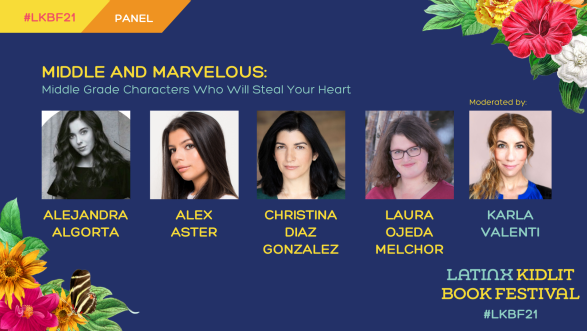
ISMEE: We have so many wonderful MG authors this year! Karla Valenti (Lotería) is moderating Middle And Marvelous: Middle Grade Characters Who Will Steal Your Heart. Karla will be joined by Laura Ojeda Melchor (MISSING OKALEE), Alex Aster (CURSE OF THE FORGOTTEN CITY), Alejandra Algorta (NEVERFORGOTTEN) and Christina Diaz Gonzalez (CONCEALED). Loriel Ryon (INTO THE TALL TALL GRASS) is moderating ¡Qué Cómicos!: Humor In Chapter Books And Middle Grade. Terry Catasús Jennings (ALL FOR ONE), Adrianna Cuevas (THE TOTAL ECLIPSE OF NESTOR LOPEZ), Donna Barba Higuera (LUPE WONG WON’T DANCE/THE LAST CUENTISTA), and Nina Moreno (JOIN THE CLUB, MAGGIE DIAZ) will join Loriel. And don’t miss our opening headlining session! Books As Teachers: Stories That Build Connection, Empathy And Imagination with educatorS Torrey Maldonado (WHAT LANE?/TIGHT) and Rebecca Balcárcel (THE OTHER HALF OF HAPPY/SHINE ON, LUZ VÉLIZ). mg panel 2

The More You Know

APP: Where can people go to get more information about the festival?

ALEX:

Want to know how best to watch the festival? Sign up for our newsletter. Links to panels will arrive directly to your inbox. The festival can be streamed live into the classroom from our YouTube channel. Students and teachers can interact with authors and illustrators via the live chat. Content will be available even after the premiere. 

Educators, don’t forget to check out our Wed night event just for you! The content will be perfect for DEI professional advancement. There will be a digital gift bag! And a certificate of attendance will be available.

APP: Wonderful! So many interesting speakers to choose from and panels to interact with! Thank you for sharing this with us and I hope that many of our readers will participate in the Latinx Kidlit Book Festival this year, I know I will!

Giveaways!

And now for giveaways! Three of the amazing MG authors that will be featured at the Latinx Kidlit Book Festival have generously agreed to give away copies of their books to our MUF readers! There will be six lucky winners for one of the following prizes!

THE LAST CUENTISTA by Donna Barba Higuera

LUPE WONG WON’T DANCE by Donna Barba Higuera

EL CUCUY IS SCARED TOO by Donna Barba Higuera

TOTAL ECLIPSE OF NESTOR LOPEZ by Adrianna Cuevas (signed)

MIOSOTIS FLORES NEVER FORGETS by Hilda E. Burgos (signed)

ANA MARIA REYES DOES NOT LIVE IN A CASTLE by Hilda E. Burgos (signed)

To enter just follow the rafflecopter below, retweet/quote tweet this post, and follow @MixedUpFiles. U.S. entries only please!

a Rafflecopter giveaway

STEM Tuesday — Animal Superpowers — Interview with Author Bridget Heos

Welcome to STEM Tuesday: Author Interview & Book Giveaway, a repeating feature for the last Tuesday of every month. Go Science-Tech-Engineering-Math!

Today we’re interviewing Bridget Heos, author of Stronger Than Steel It’s a fascinating look at biologist Randy Lewis’s work to create spider silk from genetically modified goats. Heo’s research combined with Andy Comin’s photography makes for compelling reading. Could we one day build stronger bullet proof vests? Are we one step away from duplicating the feats of Spiderman?

* * *

Christine Taylor-Butler: Bridget, I met you before you published your first book. Now you have 100 children’s books under your belt. That’s a huge accomplishment in this industry. But you didn’t start out as a writer. Can you tell me a bit about what you were doing before you dove into children’s literature?

Bridget Heos: I was an English major in college. Before I changed careers, I taught English, reading and religion at a Catholic school. I’d also been a social worker. But I’ve loved reading and writing since I was a child and eventually moved into freelance writing.

Christine: Your background in teaching helped with your transition to children’s publishing but it’s unusual to see people gravitate to science in nonfiction. Where did that come from?

Heos KidsBridget: The science part came from my son’s love of nonfiction. I read to my children all the time, but fiction didn’t engage him. At first I thought he was a non-reader. But at the library he would immediately go the nonfiction section. He loved that world. So I thought, how can I support that? Plus, I’m curious. One day I thought, “We live on a planet that has everything we need.” I would see an insect and think “ugh!” But then I started reading about them and it made me see the world in a different way. So I began writing. It changed my life and I began to relive the magic of stories. I was already writing for newspapers and magazines, but now I was passionate about writing books that would engage children.

Christine: So what was your first book?

Book_Jay ZBridget: My first book was a middle grade biography on rapper Jay-Z (Shawn Carter). That was was back in 2009. I saw an email inviting local authors to write for an editor at Rosen. I applied and was hired. Shawn Carter has such a great story. I remember spending a lot of time on it because it was my first book. I’m a journalist so I knew it had to be right. After that, I wrote more biographies. But when I had a choice, I preferred to write science books. Those were the types of books my son liked to have read to him. Even so, writing about a famous person as a first book is a show-stopper.

Christine: And then your career took off!

Bridget: I think it was partly luck and good fortune. I spent a lot of time trying to understand the business and how to make money at it. I loved writing so much I was willing to write anything. Children’s literature felt like a good fit and I began writing a lot of nonfiction. I emailed 20 publishers trying to be a good sales person. Workman hired me to write workbooks.

Christine: You also wrote: What to Expect When You’re Expecting Larvae. I remember thinking that was such a clever homage to the human series for expectant mothers and packed with so many facts. Of the sequel on marsupials, Kirkus Reviews said, “Never once dropping the pretense that this is written for pouched mammals, this manages to be both entertaining and informative.

Heos Kids What to expect

Bridget: Yes! That was first book I sold that paid royalties. I went to the library at University of Missouri – Kansas City and checked out huge books.  When I write about science I have to learn it first. I do a lot of research. It makes up for me not being the best science student when I was younger. I chose the topic because my son loved insects. But as with all things, by the time the book came out he’d moved on World War II. The book was followed by What to Expect When You’re Expecting Hatchlings (Crocodiles) and What to Expect When You’re Expecting Joeys (Marsupials).

Christine: The series is out of print now, but maybe a saavy editor will bring it back into print for eager readers now that engaging STEM and nonfiction are increasing in popularity. And especially since Kirkus loved them. They’re a hard reviewer to please.

Bridget: Yes. The books came out ten years ago and the timing might have been early for the information trend we see now.

Christine: Before we get to Stronger Than Steel, I’m going to take some artistic liberties and stray over to fiction for a minute. Can you tell us how Mustache Baby came about? It has so many good reviews and it was the winner of the 2017 Colorado’s Childrens Book Award.

Mustache baby

Bridget: Mustache Baby was my first fiction book. I had wanted to be a writer since I was a little kid. I had put the dream aside until, one day, I found a box in the attic. I realized that I’d had that dream but didn’t do anything about it. I couldn’t live with the idea that I didn’t at least try to do something about it.  but my true dream was to write fiction. I had no idea on how to proceed. People have this impression that to be a writer you have to be this beautiful serious writer, but that’s not how I am. When children were younger, I began telling them a story that had been in my head about baby who was born with a mustache that showed if he was a good guy or a villain. It made the kids laugh so I decided to write it down.

“Occasional badness has never been so good.”
Kirkus

You never know what you’ll get in the delivery room, and something isn’t quite right with this new baby. . . . Heos’s offbeat tale muses on the possibilities, playing off parental hope and panicky nightmares.”
—New York Times Book Review

The book’s sole purpose was for kids to have fun. I wrote several drafts and agonized over them. Then I mentioned it who gave me ideas then  sold to Daniel Nayeri who was at Houghton Mifflin at the time. Daniel brought on the illustrator Joy Ang. Her illustrations brought a new dimension to the story. There are now 5 books in the series. By the way, Daniel just won the 2021 Printz for his own book: Everything Sad is Untrue.

Christine: So tell me about Stronger Than Steel. I am fascinated by golden orb spiders and use them as one of the plot points in my series. I had not met anyone else in kidlit that researched them until this book so I was riveted.

Stronger book coverBridget:  I’d seen an article about spider goats and the scientist researching them. My former agent had another client who was doing a scientist in the field book and walked her through the process of proposing a book. It book was acquired by Houghton Mifflin Harcourt. That series is fun because the publisher also commissions a photographer. Andy Cumin and I traveled to Wyoming to meet with the scientist, Randy Lewis . Then Andy and I traveled to Utah State where the project was moving. It was good that we had that time to do the research. It involves learning about molecular biology. The team walked me through the process.

Christine: The goats are genetically altered to carry a gene from golden orb spiders.

Bridget: The science is fascinating. Spider silk is stronger than the Kevlar in a bullet proof vest. But you can’t farm spiders. They’re territorial. So the solution was to use goats. Randy took the gene from the spider and combined it with the DNA that creates milk in goats. I got to see the process first hand, how the team works with the goat’s milk to get to the spider silk protein. The scientists filter the milk and get it down to the protein which is a powder, then they combine the powder with a chemical. I watched the silk emerge from the process.

Spider silk

Christine: So what are the scientists doing with the silk?

Randy LewisBridget: They’re interested in it because of its toughness. In a technical sense, it’s hard to break (compression strength) and it’s stretchy (tensile strength). They’re hoping it would be a fit for fly fishing lines. The appeal is that the silk is stronger than most man made materials. But for some projects, the stretchiness is still a problem – like for bullet proof vests and parachutes. One of the other fascinating things, though, is that the spider silk can be used in the human body to repair ligaments and bones.

The book was so much work and I did so much agonizing over it. As a former journalist I wondered, “Did I get it right?” Randy read it to make sure I had not made any factual errors. I do a lot of school visits so I talk to students about the science I learned. Kids are amazing and absorb the information. They wonder if there could be a Spiderman just like there are spider goats.

Christine: So could there be a real Spiderman one day?

Bridget: You never know. The scientist isn’t raising the goats any more, Now he’s focused on comb jellies and the sticky stuff they use to catch their prey. But writing the book was a great experience. Children’s books have taken me to many states I’d never been before.

Christine: So what’s up next for you? Any books coming out we should be watching for?

Triceraopposite Treemendous Santa JawsGood Knight Mustache

Bridget: I have several books coming out in 2021: Triceratopposites, illustrated by T.L. McBeth. It’s about a dinosaur that does the opposite of what his parents say. It’s a sequel to Stegathesaurus. There’s also Treemendous: The diary of a not yet mighty oak illustrated by Mike Ciccotello. It’s the story of an oak tree from acorn to tree. Santa Jaws comes out next. It’s a rhyming book about a Christmas shark. And, or course, the next installment in the Mustache Baby series: Goodnight Mustache Baby.


Win a FREE copy of Stronger Than Steel

Enter the giveaway by leaving a comment below. The randomly-chosen winner will be contacted via email and asked to provide a mailing address (within the U.S. only) to receive the book.

Good luck!


Bridget HeosBridget Heos is the prolific author of more than 100 books for children. Most are nonfiction. A former teacher and journalist, she lives in Kansas with her three sons, daughter, a basset hound and a cat.

To learn more about Bridget and her books, please visit www.authorbridgetheos.com  You can follow her on Twitter @bridgetheos

***
Christine Taylor-ButlerYour host is Christine Taylor-Butler, MIT nerd and author of Bathroom Science, Sacred Mountain: Everest, Disasters Alert!, and many other nonfiction books for kids. She is also the author of the middle grade sci-fi series The Lost Tribes. Her article: When Failure Is Not An Option: Connecting the Dots with STEM appears in the Nov/Dec 2021 edition of The Horn Book. Follow @ChristineTB on Twitter and/or @ChristineTaylorButler on Instagram

Shining Light Onto Death: Interview and GIVEAWAY with Joanne Levy, author of SORRY FOR YOUR LOSS

Our instinct is often to want to shield kids from death, despite death being something that is difficult for adults to understand any better. And despite the chances that children will encounter it in some form—whether it’s the passing of a loved one or a close friend’s loved one, or even a tangential acquaintance.

Enter SORRY FOR YOUR LOSS, a new middle grade novel by Joanne Levy, about a girl whose family runs a funeral home. Besides being a brilliant idea, Joanne pulls it off with just the right balance between heartfelt, moving, sad, funny and respectful, as the main character Evie must navigate a friendship with Oren whose parents have just been killed in a horrific car accident. I’m so honored and excited to welcome Joanne to our blog.

MD: Hi, Joanne–welcome to …From the Mixed Up Files!

JL: Thank you so much for having me! I’ve been following along almost since the beginning so it’s a great honor to be here. And thank you so much for the kind words about SORRY FOR YOUR LOSS—I’m so pleased it resonated with you!

MD: Absolutely. Joanne, I had to laugh when your email subject line to me was “The book whose title doesn’t do well as a subject line.” I definitely can see that when you’re cold calling people to promote your book offering them condolences (“Sorry for your loss”) might get you off on the wrong foot! It’s both a funny joke but also feels like perhaps it is a metaphor for the complicated business of writing a children’s book—or any book for that matter—that is about death and the rituals and procedures surrounding it. Beyond avoiding putting the title in email subject lines, what were other challenges or complications you had to navigate when writing SORRY FOR YOUR LOSS?

JL: It wasn’t until I started sending out emails about the book that it quickly occurred to me that I might alarm people with a subject line containing the title! Of course, that pitfall was easily avoided. What was more difficult to navigate was including the right content in the book. You’re right that writing a book with such difficult topics (not just for kids, either, since as you say above, adults also struggle with death, grief, and loss) is complicated business. I didn’t want to scare kids or be overly graphic, but at the same time, I felt it was really important to be honest and pull back the curtain on death and funerals in a way that would satisfy readers’ curiosity without crossing the line into nightmare territory. I made very conscious decisions in what details to include and which to leave out and hope that I found that right balance. Even so, I recognize that some readers are going to wish there were more details and some might wish there were fewer and some won’t pick up the book at all. That’s perfectly okay, especially when it comes to difficult topics.

Still, as I’m writing this response to your question, I’ve only gotten feedback about the book from adult readers so I am very nervously holding my breath, waiting to hear from kids.

MD: Evie’s family runs a Jewish funeral home and Evie opens up to the reader (myself included) many of the mysteries of the rituals and practicalities surrounding death and burial –whatever the religion–that are often shrouded in mystery and whispers, deemed too morbid or “gory” to think about. I personally found it refreshing and eye-opening and I think other readers, young and old, will too. Were there parts though that you originally put in but had to take out?

JL: As I mentioned above, I was very conscious of the details I included in the book. I wanted to make sure that each was organic to the story and not just there for shock value. So I don’t think I had to back out any details but I will say that I struggled a little with how far I wanted to go with respect to Evie and Oren seeing a body. Slight spoiler: It wasn’t until I wrote the scene where they open the fridge that I even knew for sure what was going to happen there. Looking back, it feels inevitable that it would play out the way it did (and I strongly feel I made the right choice) but just to give you that little behind-the-scenes insight into how it happened, it took until that moment for me to know what was going to happen even though I’d known for weeks that the scene was coming.

Sidebar: if anyone is interested in my research, I have put a page on my website that tours the funeral home my dad manages – with pictures and further reading links. You’ll find it here.

MD: Great, thank you. In general, how did you balance writing a book about death and funerals with writing a book for children?

JL: My number one consideration when writing for kids is being absolutely honest. That doesn’t mean I need to put every single detail about death and funerals on the page, but I’m not hiding them, either. Kids are curious and resilient and want to know what happens to us when we die. That said, this book is about so much more—friendships and bullying and finding little joys in life, even in dark moments.

Also, I looked at the story through Evie’s eyes and how she would see the things around her. She sees funerals nearly every day and it’s just a part of her life and family business, so while many of us shy away from death and grief, for her, elements that we find taboo or strange are mundane. Caskets? She sees them as dust-collecting furniture she has to polish. It’s through her perspective that we can get past the scary symbols and rituals to the feelings underneath.

MD: To what extent did you draw from your own experiences? You mention in the promotional materials that you did research by “touring” the funeral home your father manages. Did your family manage the funeral home when you were growing up too? If so, like Evie, did you help out? And did you find that other children had difficulty accepting you and/or understanding the vital role your family played in the community? 

JL: Actually no, my parents came to the funeral business later in life. My great aunt was a member of the group of volunteers that prepares bodies for burial and I believe she recruited my dad who, in turn, recruited my mom. The manager of my hometown Jewish funeral chapel retired and my father took over that role and I believe by then he was in his sixties. So I didn’t grow up entrenched in the business the way Evie does in the book. But I’ve always been fascinated by the industry and had I been born to it, I have a feeling I’d have been the one dusting caskets and giving out tissues.

MD: One of the points that come up several times throughout the novel is the idea of respect, especially the importance of respecting the body of the person who has died. Can you talk about that?

JL: Not only is it built right into the ritual of caring for the body—there are even specific prayers that require those preparing the body for burial to beg forgiveness for any inadvertent wrongdoing–but this is how my father looks at his role. He takes great pride and care in what he does and that respect—both for the deceased and their families—never wavers. Knowing that gave me great comfort when we laid my mom to rest because I knew everyone taking care of her would treat her with that same respect. I never had to worry and I felt that it was really important for readers to know that the people behind the scenes really, really care about what they do and take it very seriously.


On Writing:

MD: This is your 6th published book. Congratulations! Did you find the process of writing this one similar or different to your previous book? Did you feel more experienced having gone through the writing, editing and publishing process before?

JL: Every book feels like its very own mountain to climb but I will say that with every book I trust my process more. That doesn’t mean books are easier to write, just less anxiety-inducing and I know that even when I feel blocked, it’ll come back and I’ll get it done. I just need to trust that process and get out of my own head (or house – long dog walks are great to unstick plots!).

That said, this book was a huge challenge because of how important it was to me to get it right. I was committed to making it readable and entertaining and maybe even educational for kids, same as all my books. But SORRY FOR YOUR LOSS is also a tribute to my dad and those like him who do such important work. I also wanted it to be accurate, accessible, and interesting to non-Jews as well. I have never worked harder, done so much research on a project, or sent out to so many beta readers for feedback, but I’m proud of the result and it feels like a job well done.


On Crafting (and writing!):

MD: I follow you on Instagram and adore all the crafty things you make and sell on Etsy. Do you find there is a connection between being a writer and the other creative things you do?

JL: That’s a great question and I think that indirectly there is a connection and it’s that creativity piece. I was always a crafty kid and I love being creative and making things with my hands. But crafting things out of wool or some other tangible medium is different than crafting worlds and characters out of thin air. Still, I think that creativity begets creativity and one type can influence another and crafts have woven their way into my books – quilling in for SORRY FOR YOUR LOSS, knitting in FISH OUT OF WATER.

That said, repetitive crafts, like needle felting (stabbing wool with special needles), give my brain space to wander while my hands are busy. I’ve detangled many a plot issue while my hands were occupied with other things. I think a lot of writers turn to other artistic pursuits either as a respite from a constantly whirling mind, or to give that mind space to work in the background.

Hmm. That feels like a convoluted answer to a very straightforward question. Let’s just say yes.

MD: Haha. As a knitter, crocheter and needlepointer myself I am smiling at that answer! 🙂

MD: Joanne, when I first met you it was at breakfast my first morning as a fellow of TENT: Children’s Literature, a week-long writing residency  I was a 2019 fellow and you was a past fellow, returning to use the time as a retreat as well as mingle and meet the new crew of authors writing children’s literature with Jewish content. I was jet lagged and bleary-eyed from my journey but I’ll never forget how I perked up when you told me you were writing a novel that is set in a Jewish funeral home, based somewhat on your own experience of being part of a family who manages a Jewish funeral home. I thought it was a brilliant idea, with so much potential, not to mention something that would definitely fill a hole in kidlit, with the practicalities of death in any religion not something often covered.

I was delighted this past month to read the finished result.  I think that readers will laugh and cry with Evie and Oren and that SORRY FOR YOUR LOSS will open up many important discussions about respect in death as well as the procedures and customs surrounding it regardless of faith or religion. Scroll down for a chance to win your own copy. Joanne, thank you so much for joining us on MUF today 🙂

JL: Meira, I remember that breakfast well and despite your jet lag and long journey, you were a joy to talk to! Thank you so much for your kind words about SORRY FOR YOUR LOSS. It means so much to me that the book resonated with you. While I wrote it from a Jewish perspective, I wrote it for ALL readers, hoping they would find relatable characters and lots to discuss. Thank you for this opportunity to chat about it here and share it with you and the MUF community!

MD: Thanks, Joanne!

Joanne can be found at www.joannelevy.com and https://www.instagram.com/joanne_levy_/

SORRY FOR YOUR LOSS came out October 10th and can be found here and wherever fine books are sold.

Giveaway!!!

Joanne has offered to send an author-signed copy of SORRY FOR YOUR LOSS to one lucky winner!

Enter here for your chance to win! Entries close October 28th 2021. US & Canada only.

a Rafflecopter giveaway

UPDATE! Congratulations to Danielle Hammelef who has won a signed copy of SORRY FOR YOUR LOSS!