
Carol Hinz is Editorial Director of Millbrook Press and Carolrhoda Books, divisions of Lerner Publishing Group in Minneapolis, Minnesota. She acquires and edits picture books, poetry, and nonfiction. Books she’s edited include Sachiko: A Nagasaki Bomb Survivor’s Storyby Caren Stelson; A Map into the World by Kao Kalia Yang, illustrated by Seo Kim; Can I Touch Your Hair? Poems of Race, Mistakes, and Friendship by Irene Latham and Charles Waters, illustrated by Sean Qualls and Selina Alko; and Tracking Pythons: The Quest to Catch an Invasive Predator and Save an Ecosystem by Kate Messner
Hello Mixed-up Filers, today we’re featuring Editorial Director Carol Hinz for our Editor Spotlight. I was fortunate enough to meet and work alongside Carol at Lerner Publishing and saw the many wonderful books she publishes for Millbrook Press and Carolrhoda Books. Thanks for joining us on the blog today, Carol!
Thank you so much for inviting me here, Karen. I’m excited to talk about all things middle grade!
Can you tell me a bit about how you ended up in your role at Lerner? And what you love about it?
Sure—as you’ll see, it evolved over time. Way back in 2003, I began working at Lerner as an editor, focusing primarily on series nonfiction for the school and library market. Lerner acquired Millbrook Press in 2004, and after Millbrook cofounder Jean Reynolds decided to scale back her role, I got the opportunity to become editorial director for the imprint, which I began late in 2007. And I added Carolrhoda’s picture books and nonfiction to my job duties a decade later.
I love that I get to be involved with such a variety of books and that I get to work closely with so many immensely talented authors, illustrators, and photographers! I also feel fortunate that since I’ve started as editorial director, there’s been increased interest in high-quality nonfiction for young people and a great deal of innovation in how authors are approaching nonfiction topics. It’s truly a fascinating time to be making nonfiction!
What was the first middle-grade book you edited? Did you have any challenges with it?
Oh, wow! If I recall correctly, it was Ghana in Pictures by Yvette La Pierre, which was part of the  Visual Geography Series. Because I was so new to editing nonfiction at the time, my big challenge was figuring out how it was supposed to be done! We had to make sure the text was at the correct reading level while also conveying important information about Ghana’s landforms, history, government, and people.
Editing that book really taught me just how challenging it is to create engaging nonfiction for young people. Authors need to present complex information while being mindful of vocabulary, sentence structure, sentence length, and what sort of background information a reader might need to fully understand the topic.
Can you tell us about your editorial process now, from acquisition to print?
Um . . . do you have all day? As a book geek, I also love the creation process, but I’ll try to keep this brief. Most of the time with MG nonfiction, I acquire based on a proposal. So once the acquisition is approved, the author needs to go off and write the full book.
After the author has written the manuscript and sends it over to me, I read through it and then ideally will set it aside for a month or more. One of the reasons for this is that I find I do my best editing after I’ve had a chance to percolate on the manuscript. The process from there always involves certain key steps, but there’s also a lot of individual variation depending on the book and the author.
For some books, my feedback will include requesting that the author write new chapters or reorganize information. Once the structure is solid, I’ll focus in on the flow of information within paragraphs as well as phrasing and word choice. I’ll also look for places where I think the author needs to fill in a little background information or context for our readership. I’m all about the track changes feature—I try to ask lots of questions and throw out lots of suggestions as I go. My goal is not for an author to simply agree with everything I say; instead, I want them to engage with my comments. I love when an author understands where I’m coming from and then responds with with an even better idea than what I suggested.
While the author and I are finalizing the text, someone in our photo research department will be searching for just the right photos. If the book needs diagrams, either our in-house illustrator or a freelance illustrator will start working on those elements. My fabulous colleagues in the art department start working on cover designs, and and after the final (well, mostly final) text is typeset, they’ll start putting the layout together. The author sees the layout at several points along the way to give input on photos and any diagrams, write captions, and just generally ensure that everything is coming together well. I really enjoy the collaborative nature of book making—both working closely with authors and working with my Lerner colleagues.
No manuscript is perfect, so what qualities make it feel right for fixing to you? What do you think can be fixed? What makes it unfixable?
Oooh, that’s a good question! No matter what, I think the premise of the manuscript needs to be solid—both what the manuscript is about and how the author wants to present that topic. And I can’t fix insufficient research or a lack of interest/enthusiasm on the author’s part. But as long as the author is up for it, I can work with them on structure, reading level, and plenty of line editing. So much really comes down to having a shared vision for the book. As long as the author and I have that shared vision—and the time to really dig deep and work together—we can create a great book!
What have been some of your favorite MG books you’ve worked on and why?
Gah, this is such a hard question!

Sachiko: A Nagasaki Bomb Survivor’s Story by Caren Stelson: Making this book was a powerful emotional journey that took me all the way to Japan. (Read about it here: https://lernerbooks.blog/2017/01/dispatch-from-nagasaki-visiting-sachiko-yasui.html)

Sea Otter Heroes: The Predators That Saved an Ecosystem by Patricia Newman (one of our STEM Tuesday contributors!): This book is a fascinating story of scientific discovery that taught me the phrase trophic cascade and makes me feel smarter every time I read it.
 Monstrous: The Lore, Gore, and Science behind Your Favorite Monsters by Carlyn Beccia: Edited by my colleague Shaina Olmanson, this book offers a unique and compelling look at famous monsters and the history and science behind them—and has awesome illustrations and infographics to boot!

Tracking Pythons: The Quest to Catch an Invasive Predator and Save an Ecosystem by Kate Messner: earlier this year, my younger son became obsessed with this book. It was magical to see a book I’d edited spark such curiosity in him! (I talk about it here: https://lernerbooks.blog/2020/03/tracking-pythons-science-up-close.html)

Journey into the Deep: Discovering New Ocean Creatures by Rebecca L. Johnson: I learned a lot about making an ambitious MG book from this book—it’s a 64-page look at recently discovered ocean creatures scientists found during the ten-year Census of Marine Life, and it’s packed with fantastic photos as well as rich text that takes readers from the ocean’s surface down to its depths. The book came out in 2010, and it’s the first book I ever edited to receive a starred review. I still remember the thrill I felt the day that review came through. (CHeck out the review here: https://www.kirkusreviews.com/book-reviews/rebecca-l-johnson/journey-deep/)
Having been at the epicenter of the George Floyd protests, how has the Black Lives Matter movement affected Lerner? And children’s publishing in general? Do you think children’s publishing has changed or is changing in response?
Lerner’s downtown Minneapolis offices were boarded up for about a week at the height of the protests, but in a lot of ways, that’s the least of it. While this is not the first time we’ve had internal conversations about publishing diverse voices and what we’re doing to make our workplace more inclusive, in the aftermath of the protests these conversations took on new urgency. And I believe that’s true across the industry as well.
In children’s publishing, the creation of We Need Diverse Books in 2014 spurred a number of important changes, but it’s clear right now that we still have more to do to make this industry more equitable.
While a lot of the conversation about diversity in children’s books has focused on picture books and fiction, I think we in the nonfiction community need to take a very serious look at just how few BIPOC authors are writing nonfiction (especially MG and YA) and find ways to bring in new authors from more diverse backgrounds. To this end, I am working on an idea that includes an open call for MG nonfiction, but I’m not ready to share specifics just yet. (Check back in the fall!)
Another outcome of the protests is that we’ve seen a surge of interest in books such as Ruth and the Green Book by Calvin Alexander Ramsey and Gwen Strauss, illustrated by Floyd Cooper; Can I Touch Your Hair? Poems of Race, Mistakes, and Friendship by Irene Latham and Charles Waters, illustrated by Selina Alko and Sean Qualls; The Book Itch: Freedom, Truth & Harlem’s Greatest Bookstore by Vaunda Micheaux Nelson, illustrated by R. Gregory Christie; and Dictionary for a Better World: Poems, Quotes, and Anecdotes from A to Z by Irene Latham and Charles Waters, illustrated by Mehrdokht Amini.


What are some under-represented MG topics you’d like to see more of?
Books about areas of science other than biology! As much as I adore animals, I’d love to see some smart authors write about chemistry, physics, engineering, and all manner of other science topics in ways that engage MG readers.
I would also like to see books that highlight the work of BIPOC scientists. We’ve published some great narrative nonfiction about individual scientists—including Sea Otter Heroes: The Predators That Saved an Ecosystem by Patricia Newman—and I’d love to see something along those lines focusing on the work of a scientist of color.
What advice can you give authors?
If you want to write truly ambitious nonfiction for kids, don’t think about your book as existing in isolation. Rather, imagine your book as being in conversation with other books that are in the same space as your book.
As an example, when I was editing Sachiko: A Nagasaki Bomb Survivor’s Story by Caren Stelson, I thought a lot about the book Bomb: The Race to Build—and Steal—the World’s Most Dangerous Weapon by Steve Sheinkin. Sheinkin’s book wraps up pretty quickly once the atomic bombs were dropped on Japan, whereas Stelson’s book covers fifty years of aftermath, as it plays out in Sachiko Yasui’s life. Reading the two books together will enrich a reader’s understanding of them both.
Do you have any upcoming middle-grade books that you’d like to tell our readers about?
 I’m really excited about a book coming out this October, Bionic Beasts: Saving Animal Lives with Artificial Flippers, Legs, and Beaks by Jolene Gutiérrez. It’s a STEM-themed book that brings together biology and engineering through the stories of five different animals from around the globe that are thriving thanks to their prosthetic body parts. There’s Lola, a Kemp’s ridley sea turtle, Mosha, an Asian elephant, Cassidy, a German shepherd, Vitória, a greylag goose, and Pirate, a Berkshire-Tamworth pig. Each of these animals was at risk of dying due to their circumstances, but humans intervened, and using a variety of techniques and technologies including surgery, 3D printing, and more, they were able to create prosthetics that enabled these animals to survive. The book also includes hands-on activities in each chapter so readers can better understand the engineering concepts involved.
Is there anything else you’d like to add
To support excellent MG nonfiction for kids, please be sure to buy these books! You can also request them from the library, review them, and share them with others.
Well, thank you for taking the time to speak with us today, Carol!
Find Carol on Twitter: @CarolCHinz.

 Welcome to STEM Tuesday: Author Interview & Book Giveaway, a repeating feature for the fourth Tuesday of every month. Go Science-Tech-Engineering-Math!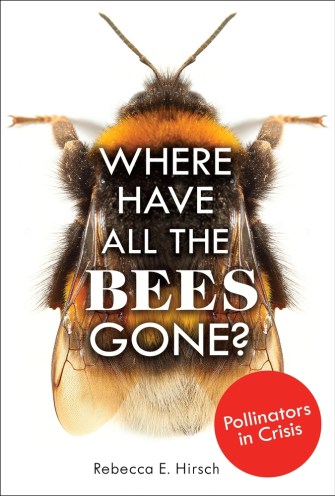


 Birds, Bees, and Butterflies: Bringing Nature Into Your Yard and Garden
 Amazing titles can come from play. Play with the language, play with the concepts, play with what your reader might be thinking. Here are a few examples: You’re Invited to a Moth Ball by Loree Burns, Something Rotten: A Fresh look at Roadkill by Heather L Montgomery, Save the Crash-test Dummies by Jennifer Swanson
 Heather L. Montgomery writes STEM books for kids. She’s had fun with her recent titles: