

This month’s theme is nuclear/atomic energy. In searching for ways to bring the arts into STE(A)M, I found books for older readers that focus on the “politics” of energy and offer opportunities for activities. Certainly that is relevant in today’s world where what we know as good science is being questioned. It’s not new. Galileo went to prison because he said the earth rotates around the sun. Scientists make discoveries and then those discoveries go out into the world in various ways. Politics, religion, culture, and economics can influence their uses and interpretations.
Each book here focuses on past consequences of scientific discoveries. My books this month are for older readers and the STEAM activities are ones which would require the students to have research, writing, and visual communication skills.
 The first is The Radium Girls: The Scary But True Story Of The Poison That Made People Glow In The Dark (Young Readers’ Edition 2020, Sourcebooks Explore) by Kate Moore. This book is not for the faint of heart, with archival photos and heart-rending accounts. It is rich with content, bibliography, and story. While the discovery of radium was useful to mankind, abuse of the substance led to tragedy.
In 1917, there was competition for the jobs at the Radium Luminous Materials Corporation in Newark, New Jersey, where the girls who worked in the watch studio made good money. They painted the numbers on watch faces with paint that glowed in the dark. Radium, discovered by Marie Curie, was a miracle of new technology. It was especially important because the watch dials could be seen by soldiers fighting in World War I.
In order to get a good point on the paint brush, so as to paint the tiny numbers, the girls used their lips to make a fine point on the brush. Some of the girls were concerned. Their clothes glowed in the dark. They got sores in their mouths and acne.
The personal stories in the book are engaging and thought provoking. Also sad and direct. Some of the photos are shocking. At over 700 pages, the book is a comprehensive collection of materials, including bibliography, archival photos, and reading group guide.

I first heard of the Radium Girls when I attended the play in 2018 at Lasell University. The young actors performed the sad and informative story with deep feeling. (https://the1851chronicle.org/2018/04/26/radium-girls-turns-the-dial-towards-feminism/).
In order to bring the A into STEAM, writing or performing a play is a great way to create a multidisciplinary educational experience for any topic. Having to explain a concept to others always helps students to a better understanding of a topic themselves. A full length script for Radium Girls is available through Dramatic Publishing.( by D.W. Gregory https://www.dramaticpublishing.com/radium-girls)
If you think of writing a play and that intimidates you (it would me!), I found a number of resources on the Teachers Pay Teachers website (https://www.teacherspayteachers.com). You can search for “writing a play” and you have many options. I haven’t used any of these but the materials I have ordered from them in the past have been useful in my teaching.
 And looking to continue the theme of including art, it amused me to think of atomic rhyming with comic. So I selected Fallout: J. Robert Oppenheimer, Leo Slizard, and the Policial Science of the Atomic Bomb ( Jim Ottaviani (Author), Janine Johnston (Illustrator), Steve Lieber (Illustrator), Vince Locke (Illustrator), Bernie Mireault (Illustrator), Jeff Parker (Illustrator), Jeffrey Jones (Illustrator) by GT Labs. This is for older readers and I think some previous knowledge of the development of the atomic bomb will help the reader to follow the story.
The comic platform, with its countless illustrations, brings the characters to life. We can feel the emotional conflicts of the scientists, especially facing the demands of the war interests. To me, the black and white drawings were reminiscent of film noir and helped to place the time frame pre-1960. It is especially valuable for reluctant readers who can get visual cues from the pictures.
To be clear, the book is more about political science (a branch of social science) and it does include information about the development of the bomb. It’s always good to bring in the humanity aspects of science to keep it in perspective.
There are studies about the effectiveness of comics in education. Comparing Effectiveness and Engagement of Data Comics and Infographics, downloadable from https://dl.acm.org/doi/10.1145/3290605.3300483. They say Our results suggest participants largely prefer data comics in terms of enjoyment, focus, and overall engagement and that comics improve understanding and recall of information in the stories. (by Zezhong Wang, Shunming Wang, Matteo Farinella, Dave Murray-Rust, Nathalie Henry Riche, Benjamin Bach).
 The Center for Cartoon Studies (https://www.cartoonstudies.org/) offers a free downloadable book called The World is Made of Cheese, The Applied Cartooning Manifesto, as well as other materials on comics. The materials are user friendly and you don’t have to be an “artist” to make a comic. Most published comics are collaborations anyway, so find a partner. And the goal is to create a page or book that tells a story (fiction or nonfiction) communicates ideas, and provides the satisfaction of being creative. In my experience, students enjoy making (and reading) comics and there are more choices available every day.

Margo Lemieux draws, paints, reads, and writes all the time. And, following her own advice, she is doing a cartoon assignment in the spring for her university class. She also does editing and publishing. Her most recent project is an anthology for her long-time witers’ group, The Magic Storymakers, titled Kaleidoscope.

 A vignette can refer to a short, standalone piece of writing; it can also mean a standalone performance, like one of a series of monologues or scenes in a nonlinear play. But vignettes appear all the time in narrative storytelling as well; look for them as brief sketches or descriptions that don’t contribute to the plot directly but work to more fully convey characterization, setting, or mood.
 occurs. Think of a vignette as a time-standing-still moment in which you get to take a good look around. Sometimes the author stops time to build suspense or prolong and heighten emotion, like in this moment early in Sharon M. Draper’s Stella by Starlight:
 Allusions are brief references to something that exists outside the scene, typically calling to mind some recognizable name or element from mythology, history, religion, culture, or another story. They are layered with meaning and rely on the reader “getting” the content based on their general familiarity with the topic. They are a quick and punchy shot-in-the-arm of interest for the reader who recognizes them, too, making them perfect for MG—middle graders enjoy coming across an unexpected mention of some bit of knowledge they already know. And you can communicate a complex idea with just a mention of an allusion—sometimes more easily than in explanation.
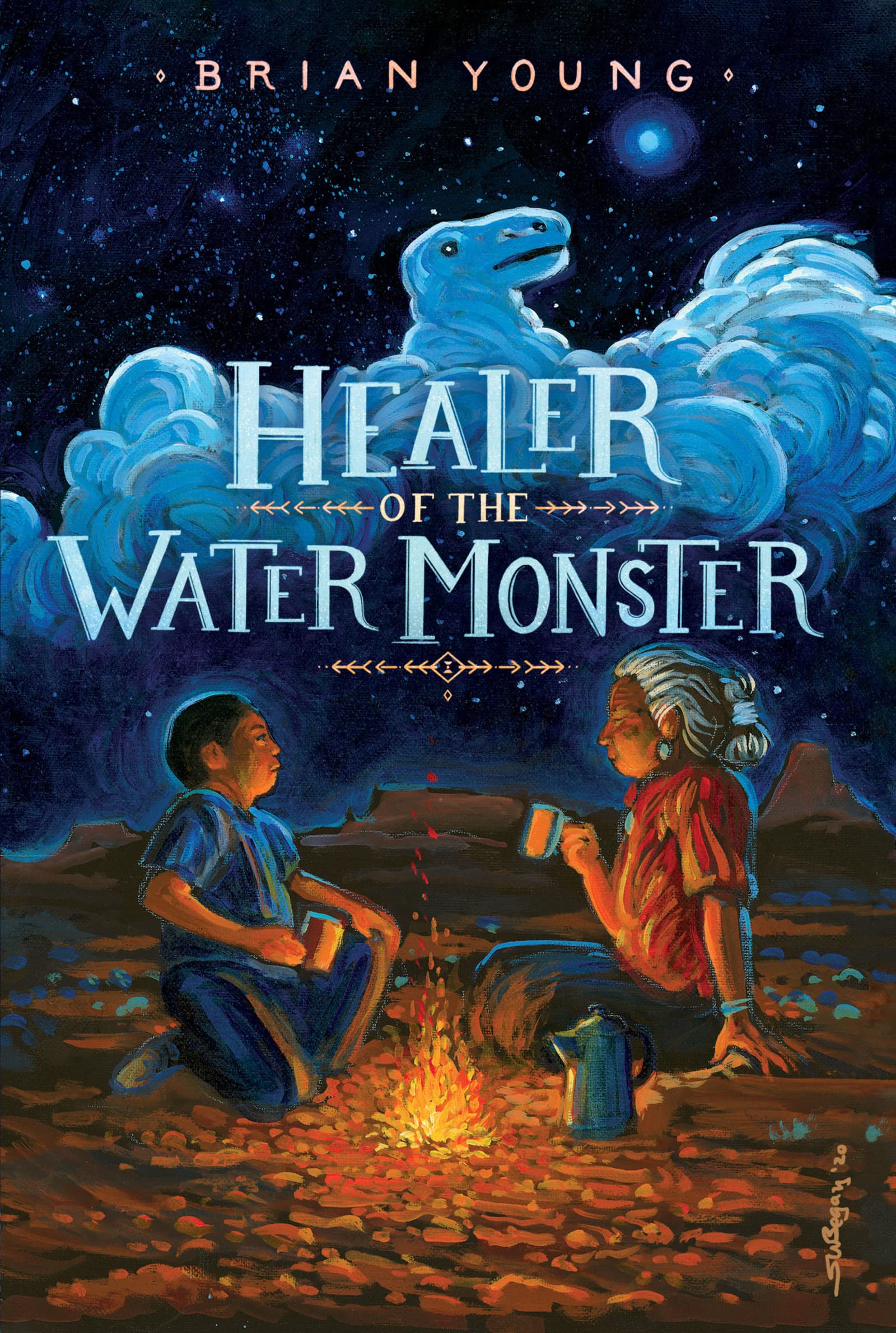 In a more recent example, Brian Young uses juxtaposition to set the stage in his Healer of the Water Monster, starting with the Navajo legend revealed in the Prologue (the gentle Water Monsters who keep the waters “tranquil” and “nourishing” become violent and destructive when Coyote kidnaps one of their infants) and continuing with protagonist Nathan’s big change in summer plans from bonding time with his father on a trip to Las Vegas to—instead—a long stay with his grandmother Nali in her mobile home in the desert. Even the chapter headings show juxtaposition of language with the number first in Navajo, then in English.
 Who Split The Atom? by Anna Claybourne Using a DK-like format, it explores the early history and research into the structure of atoms, the periodic table, radioactivity, and atomic science. Loaded with photographs, graphics, “That’s A Fact!,” “Breakthrough,” and scientific sidebars, as well as vignettes of scientists, it is an accessible and engaging introduction to radioactivity.
 Atomic Universe: The Quest To Discover Radioactivity by Kate Boehm Jerome This National Geographic book uses a running timeline across the top of the pages (from 1800 to 1971), photographs, mini-biographies, and “science booster” sidebars to interest high-low readers in an introductory overview of radioactivity, atomic science, and nuclear reactors.
 Meltdown: Earthquake, Tsunami, and Nuclear Disaster in Fukushima by Deirdre Langeland On March 11, 2011, the largest earthquake ever measured in Japan occurred off the northeast coast. It triggered a tsunami with a wall of water 128 feet high that ripped apart homes and schools, damaging Fukushima’s nuclear power plant and causing a nuclear meltdown. Chapters describe the events as well as the science of nuclear reactors. Each section begins with a readout of reactor status, from “offline” to “meltdown” with the last chapter exploring lessons learned.
 Radioactive!: How Irène Curie and Lise Meitner Revolutionized Science and Changed the World by Winifred Conkling This gripping dual biography provides an in-depth look at the discoveries, life-long personal sacrifices, and professional struggles that Irène Curie and her husband Frédéric Joliot-Curie made in discovering artificial radiation and Lise Meitner made in discovering nuclear fission. It also touches on Marie and Pierre Curie’s discovery of natural radiation, society’s grappling with radiation, World War II, and the atomic bomb. Includes a timeline, Who’s Who section, black and white photos, and fascinating sidebars further explaining the science.
