
Posts Tagged craft

Become a Book Detective by Reading Like a Writer

“If you don’t have time to read, you don’t have the time (or the tools) to write.” This famous quote by Stephen King encapsulates an important truth for writers: We should always be reading, and the parenthetical in that quote tells us why. Reading gives us tools, and the only way we gain those tools is not just passively taking in stories but looking at them analytically and critically, like book detectives. Reading like a writer is one of the best ways to strengthen your writing skills because it teaches you written storytelling, and it’s also 100 percent free. Today, we’ll talk about three ways you can start reading like a writer: character investigation, technique collecting, and impact evaluation.

Why Reading?Magnifying glass resting on a book
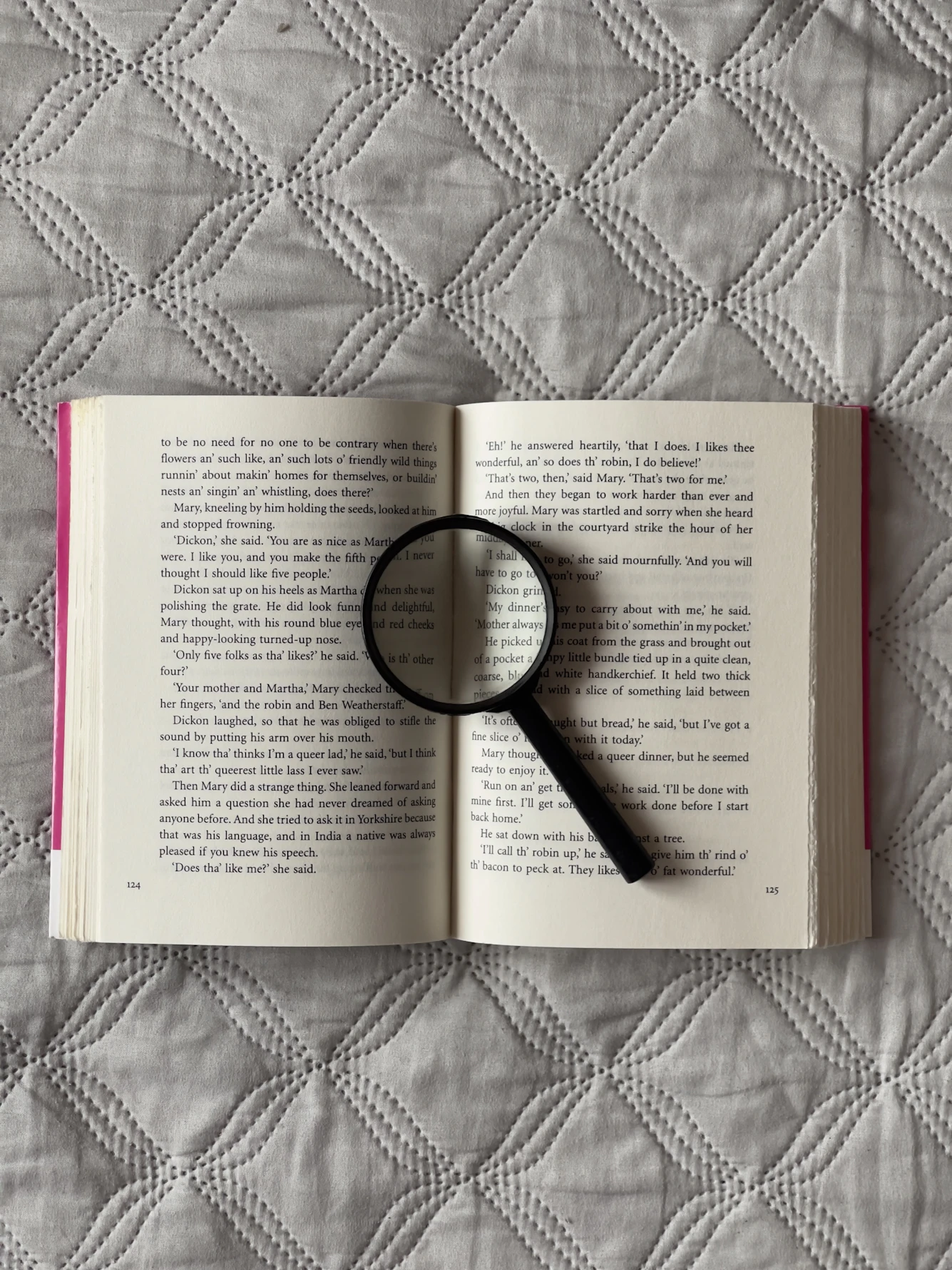
Like many authors, you might already have a question on your mind: What if I’m too influenced by what I read? This question can also be asked as What if I accidentally plagiarize another book? These anxieties can make it tempting to avoid reading entirely while you’re drafting, just to be on the safe side, but you might be surprised at how easy it is to tell when an author has stopped picking up books. This is because shows up in the writing itself.

You may not realize it, but every day, we take in tremendous amounts of storytelling through movies, music, games, ads, and even memes. Research shows that with the help of the screens that come with us almost everywhere, we absorb far more of this kind of storytelling than actual books. Everything you take in is teaching you different ways of sharing information, building interest, keeping attention, and, simply put, telling a story. These other kinds of storytelling can add unique flavor to your writing, but they are fundamentally different from written storytelling, using different techniques for different audiences for different purposes. There’s no replacement for the wealth of knowledge that comes from studying authors who are using the same medium you are, and there’s no reason to miss out on such a great education while discovering fabulous new stories!

Character Investigation

Every book you read contains characters, which makes this the most obvious place to start as you sit down to read like a writer. The simplest way to begin is to ask a simple question: Which characters stand out to you? It doesn’t matter if you like that character or dislike them. Once you’ve identified one or two characters that jump out at you, you can ask more questions. How is the author building this person on the page or making them distinct? Do they use description? Is it their dialogue or how they act? Do these characters change from beginning to end, and how would you describe that change? Asking questions about what other authors have done to make compelling characters can help you do the same in your own book.

Technique Collecting

If you’re new to reading like a writer, this approach might feel a little more advanced, but you can learn new techniques from reading with many of the same skills you use to investigate characters. If there is a part of the book you’re reading that changes how you’re reading, stop to reflect on why this has happened. For example, if you find that you’ve started reading more quickly and reached the end of the chapter faster than you expected, look at what the author was doing there. Did they use shorter sentences, punchier wording, or more dialogue? Did the author raise tension, up the stakes, or use foreshadowing? Any time you notice your reading has changed—whether you’re slowing down, rereading, or even highlighting—this is a great opportunity to take a closer look at how the author is changing how you as the reader is experiencing the story. If you can put words around what they’re doing, you can collect the technique and begin using it yourself.

Impact Evaluation

The third approach to reading like a writer is considering how the book as a whole strikes you. When you finish reading, what would you say the author set out to do, and do you think they achieved it? Thinking about the author’s purpose can help you consider the effectiveness of all the parts together. Did they use their characters and techniques well, or can you see opportunities they didn’t take advantage of? Were there chapters you felt like didn’t need to be there, or was the story a page-turner from start to finish? If this feels like too much to start with, begin by asking yourself if you liked the story. If you did, why did you like it? If not, what led you to feel that way?

Fall in Love with Reading

Reading closely is a fantastic way to discover tools and techniques and see how they’re being used. If starting with a fresh book is intimidating, pick up a book you’re already familiar with or one you love. This way, you can focus on analyzing what’s there without slipping into the way you normally read. Once you’re comfortable putting on your writer hat while you read, then you can ask these questions of books you’re reading for the first time.

If you need inspiration for good books, here at the Mixed-Up Files of Middle Grade Authors, we have lots of recommendations!
You can check out our book lists here: https://fromthemixedupfiles.com/mixed-up-files-book-lists/

For more specific lists, jump right in with these specific categories:
New releases: https://fromthemixedupfiles.com/category/new-releases/
Diversity: https://fromthemixedupfiles.com/category/diversity/

Be Curious and Pass it On — Science ROCKS!

I recently gave a speech on the importance of science education in schools. Unfortunately, studies are showing that in many elementary schools, students are getting 20 minutes of science instruction per day. For some, it might be closer to 20-30 minutes per week. To me, that seems sad. It’s important that we take the time now to understand why this is happening and figure out how we can fix this disturbing trend.

In my TEDx talk, Science is for Everyone. Even YOU!, I offer suggestions for how we can help kids to be excited about science. There are ways that we as adults can support kid’s interest in science as well as the teachers who teach science in the classroom and homeschool.


I realize that not everyone loves science as much as I do.  Ever since I started a science club in my garage when I was 7 years old, I have been been hooked! For me, science is how I view the world. But of course, not everyone sees science in that way.


Science shouldn’t be intimidating, it should be FUN! At one time, practically every kid was a scientist and asked lots of questions about how things work. The key to all of this is CURIOSITY and AWARENESS.

Let’s talk Curiosity!

  1. Notice the Science all Around You– One way to get kids curious is to encourage them to notice the science that is all around them all the time. Ask kids to look around the room, outside, or wherever they are and name 5 things that come from science. They could be grass, trees, a table, a computer… whatever. When you help kids to become aware of science and the fact that it’s in everything they do, it becomes less scary.
  2.  Fun FACTS! — Most kids LOVE fun facts! I know I do. I guess all of those years watching the Jeopardy show when I was growing up and also having my kids made me really excited to learn obscure and intriguing facts. Try to play that up with your kids, or your grown-up friends, too.

Why are facts so great?

They engage curiosity. A great fun fact can start a discussion. Get kids to ask questions. And promote family interaction. In the age where screen time is ever-increasing, being able to sit down and chat about something cool is a great way to promote family time. Or get kids to read books to discover how things work and why stuff happens. Ever wonder why developing video games is important for space exploration? Check out the Atlas Obscura’s Explorer’s Guide to Inventing the World 

Atlas Obscura Explorer's Guide to Inventing the World

They provide mini-learning moments. When you are reading something, a fun fact can make you stop and think. It can spur you on to do your own research. It can help you to learn more about something that you maybe didn’t even know you were interested in. These learning moments can take place anywhere at anytime. I can’t tell you how many times I’ve been watching television and learned something new from a show that I just had to stop and look up. Learning keeps those brain cells working and energized.


They help expand your vocabulary. Some fun facts come about because you aren’t familiar with the topic. Maybe you hear a word that you don’t understand. Or perhaps you hear it used in a way that seems strange to you . Doing the research by looking things up, allows you to not only increase your understanding of the topic, but also to learn new words, new ideas, and gives you a new perspective on the topic. Check out this book below. This book, Actual Factual Files: Ancient Egypt by Workman Publishing is filled with new vocabulary words.


Pharoah from Actual Factual Files

They increase critical thinking skills. This is probably one of the most important benefits of curiosity. Being curious can cause you to think about what you just learned.  You might consider the fact. Is it right? Is it a little off? Does it challenge your beliefs? All of these are parts of critical thinking which is incredibly important skill for how we navigate life!


Awareness is Key!

Becoming aware of science and how we interact with it on a daily basis is a great way to open up a discussion about science. It encourages people to not be afraid of it, or intimidated, but to ask questions and learn more. If we, as adults, become aware of science and point it out to our children, and each other, then it will become a natural part of our lives.

We don’t need more information about how to teach science, we just need more awareness. Do you cook? That’s chemistry. Drive a car? That’s physics and engineering. Like to go on hikes? That’s environmental, biological, and meteorology. Those are only a few types of science that you will encounter in these activities.  Want to learn about the night sky? Check out this Actual Factual Files: Outer Space book by Workman Publishing

Big Dipper in the Actual Factual Files book

Encourage everyone to be a scientist in their own right and see the world around them. For once we see ourselves as scientists, we will see how important science is. After all, science is our shared language for understanding the world.


These books, Actual Factual Files: Ancient Egypt and Actual Factual Files: Outer Space  and the Atlas Obscura’s Explorer’s Guide to Inventing the World  by Workman Publishing are excellent resources for awesome fun facts! I think they are really fun and kids love them!

So BE CURIOUS! Encourage AWARENESS! and remember Science ROCKS!

Check out my SCIENCE ROCKS APP for your iPhone and Samsung products!!

Apple App Store   

App Google play 

Jennifer Swanson is the award-winning author of over 50 STEM/STEAM books for kids. She is the creator of the STEM Tuesday blog, STEAMTeamBooks promo group, and the creator and cohost of the Solve It! Science Podcast for Kids. You can find her at www.jenniferwansonbooks.com 


STEM Tuesday– Light and Color– Writing Tips & Resources

A speckled green leaf next to a painting with a watercolor version of the leaf.

Warm, cool, bright, energetic, somber, dull, faded, vivid, pastel, glowing.

We use a lot of words to talk about colors!

Research finds that colors can change our moods, and we use color to communicate our thoughts and emotions.

I’m an illustrator (as well as a children’s author), so I use color a lot. It can set the mood for a story or add energy to an exciting moment. It’s also a fickle thing. A color may look bright on a blank page, but turn dull when it’s surrounded by a different color.

We invent fun names for colors and create color wheels to sort them into patterns. Some people can see colors that no one else is able to see. So, why not play with color a little this week?

Here are two projects to get you started!

A glass bowl of mashed beets sitting on a brown table. A wooden spoon sits on top of the bowl with a spoonful of purple-red beet pulp.

Image by congerdesign from Pixabay

Project #1: Create Your Own Colors

This project requires a little hands-on work. You may also need to spend some time outside foraging, or you can find supplies at the grocery store to make your colors.

Start by thinking about nature materials that have bright colors.

You may have some ideas already if you’ve read about the history of colors or foraging. (Two great books from this month’s list: Before Colors: Where Pigments and Dyes Come From by Annette Bay Pimentel and Madison Safer and How to Be a Color Wizard: Forage and Experiment with Natural Art Making by Jason Logan.)

If not, get creative and make a list!

Think about plants that leave a stain—beets, purple cabbage, walnut shells. You can boil and smash them to extract the juice. Once the liquid has cooled, strain out the pulp.

What about rocks or dirt? Try grinding up soft rocks like chalk. Or, you can collect dark or reddish soils to see what colors you can make. You may need to add water to soften the pigment and make grainy paint.

Collect your colors on a tray or in small jars. Now it’s time to try them out!

Paint small swatches of your color. As you do, make sure you write down your materials! What did you use? Where did you find them? What worked—or didn’t work?

Can you name the colors you created?

A speckled green leaf next to a painting with a watercolor version of the leaf.

Photo and painting by Audrey Sauble

Project #2: Journal with Your Colors

Journaling is a fun way to combine art (color) and writing. If you’ve done project #1, you’ll have a set of colors ready to go. Prefer to use ready-made colors? Watercolor paints, finger paints, or any other art tool will work fine.

First, plan your journal page—do you want to plan it first, then paint? Or can you be spontaneous?

You could:

  • Make a self-portrait
  • Paint something you noticed outside
  • Make color swatches and mix your paints to create new colors
  • Scrub your new paints across the page in an abstract pattern
  • Add backgrounds or fancy borders to your page.

As you paint, add some notes. What questions do you have about color after this project? What did you notice while working on it? Would you try something different next time? What happened when you combined two colors?

You may also want to add ‘metadata’ or information about your project: date, time, location, goals, results.

Final thoughts:

When it comes to color, there’s a whole rainbow to explore! You could try either of these projects several times and still have more to explore. So, keep playing with color! (And write down what you discover to spark new ideas for your next color adventure!)

– – –

Photo of Audrey Sauble holding one of her picture books.

Audrey Sauble is a children’s author and science illustrator with a passion for exploring nature through picture books. She started writing picture books several years ago after her oldest asked a question that turned into a conversation. Her new release, Can a Rock Grow?, is the third book in her Early Science Questions series.

You can find her books and various kid activities on her website, aesauble.com.