
Posts Tagged children’s books

STEM Tuesday — Robotics and Artificial Intelligence– Author Interview

STEM Tuesday– Robotics and Artificial Intelligence — Interview with Author Darcy Pattison

Welcome to STEM Tuesday: Author Interview, a repeating feature for the last Tuesday of every month. Go Science-Tech-Engineering-Math!

Today we’re interviewing Darcy Pattison, author of A.I.: How Patterns Helped Artificial Intelligence Defeat World Champion Lee Sedol It’s a fascinating look at the use of artificial intelligence and how a common board game was used to demonstrate that, in some cases, a computer might possess superior skill levels.

Kirkus Reviews calls it, “An enthralling, contemporary tale of man versus machine.”
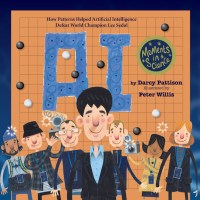
AI Cover


Christine Taylor-Butler: Darcy, you’ve been in the business for quite a while and you’ve written everything from science fiction and fantasy to contemporary stories and science. When did you know you wanted to become a writer? Were there detours along the way?

Darcy Pattison: I have always been a reader! In sixth grade, I read THE LORD OF THE RINGS (the Harry Potter of my day), and even then, I thought about being on the flip side of the story. I wanted to write stories that people love to read. But I also grew up questioning everything so science writing is a natural fit for me, too.

CTB: You’ve been published by a number of trade publishers. What lead you to create Mims House?

Darcy: In the last twenty years, publishing has changed because of technology. The introduction of ebooks and print-on-demand services means that publishing a book is a low-cost investment up-front. It meant I could publish the books that I was passionate about and bring them to market myself. I had a long history in the industry and knew what pitfalls to avoid and where to focus attention. It’s been a hard journey, but I’m thrilled to be still publishing books of my heart.

CTB: Long before STEM was a trend in children’s literature, you developed a track record for writing well received nonfiction. Where did you get the idea for writing about the board game match between AlphaGo and Lee Sedol?

Darcy: A.I.: How Patterns Helped Artificial Intelligence Defeat World Champion Lee Sedol was written when I got interested in A.I. I’m always looking kid-friendly ways to approach a topic. When I realized this story featured a world champion board game player, I thought it would appeal to kids. This game was actually a pivotal game in the development of A.I Before this, programmers tried to write rules for artificial intelligence programs. For example, they might write a rule on how to identify a photo of a cat.

Sample rules:
A cat has a round face and triangular ears.
A cat has a tail.

It worked up to a point. But what if the cat is curled up sleeping? Or perhaps, it’s stretched out to run hard as it chases a rat? It required too many rules to deal with all the positions a cat might take, and all the exceptions to the rules.

Instead, artificial intelligence today works because we provide thousands of images to a computer program, a big dataset. Each image is labeled either CAT or NOT CAT. The program analyzes the images and creates its own mathematical formula for identifying a cat.

The AlphaGo program was the first time such an A.I. program was used to challenge a human in a complicated board game. Amazingly, it won four out of five times. Also amazing—Lee Sedol, the world champion, found a way to defeat the A.I. once. The series of games redefined our relationship to A.I.

Note to readers: A documentary about the AI program and the match with Lee Sedol can be found on Youtube: AlphaGo: The Movie.

Lee Sedol 1 Overhead of Go


CTB: The illustrations are so fun, as is the layout of the book. How did you find that illustrator?

Darcy: Yes, Peter Willis is amazing! He has illustrated ten books with me now because his distinctive digital collages are fun and funny for kids. I first saw his portfolio on Behance.net, the Adobe social media program where artists display portfolios. Look for more about Peter Willis and his work here: https://mimshousebooks.com/blogs/books/willis1

Meet the man


CTB: There’s a lot of concern now about AI eventually being able to do more than play games. But I love that you explain that even the phones in our pockets are partially fueled by AI technology. For example, I’m a frequent user of “Siri” and my Mac laptops as far back as OS9 were voice activated and had a digital assistant.  Did you have any “aha!” moments when researching this book?

Darcy: It was fascinating to dig into the discussion of A.I. technology. Understanding the difference in the two types of approaches to A.I. helps me make decisions about how I choose to use A.I. The rules-based approach was ultimately unusable because there are too many exceptions to any rule. When A.I. analyzes big datasets, though, it can mathematically account for exceptions. It’s a brilliant solution that means A.I. can tackle a wide variety of questions. For example, from a photo, it can predict if a mole is likely to be cancerous. Or, it can help create a chemical formula for a new medicine.

One problem with A.I. is that need for big datasets. Where will programmers find the data to feed into the program? Current lawsuits revolve around the allegedly illegal use of their copyrighted or patented information. Artists object to their copyrighted images being used to train A.I., and authors object to their copyrighted novels and writings being used to train A.I.

For me, that “aha” moment was understanding how current A.I. works. It’s easier to see how the programs can help my work or fit into a lesson plan when I understand that it’s trained on selected big datasets.

CTB: Your book ran into a roadblock at the US Copyright office. In scanning the text the office assumed the book was illustrated by A.I. rather than a real person. Can you tell our readers a bit about that experience? 

Darcy: The US Copyright has decided to check books to see if a book might include text or images created by A.I. I applaud this careful look at the books! However for my A.I. book, they asked if A.I. had been used to create the book. Just because the topic of the book is artificial intelligence doesn’t mean I used A.I. to create it! After I answered their question, they came back again and asked about this specific page of the book.

AI Example page

Here, the illustrator Pete Willis is demonstrating that some common objects are or are not based on A.I. programing. We know that artificial intelligence can be used for some cell phones, robots, and video games. But cats, ice cream and board games are not based on A.I. The US Copyright office specifically asked, though, if the images labeled “A.I.” had been created using an A.I. program.

“No,” I answered, “Peter Willis illustrated the entire book, even those labeled A.I.”

They accepted my answer and the book’s copyright was approved without any further questions.

CTB: I love that you call yourself, “Queen of Revisions” in your biography. Do you have any advice for young writers who might want to follow in your footsteps?

Darcy: Over the years, I have learned that I need to revise many times. When kids ask me how many revisions I do for a project, I answer, “Until it’s right.”

It’s not a matter of getting it right in three tries. It’s getting it right that matters.

If you want to write, read! Read everything you can, putting information and language into your memories so that when you need it, the words are there to draw upon.

CTB: Thanks for being such a gracious guest. What’s up next? Any projects or books you’d like readers to watch for?

Magnet coverDarcy: Peter Willis and I are collaborating on a new book, MAGNET: How William Gilbert Discovered that Earth is a Great Magnet. The story goes back to the middle of the 1600s when scientists were first figuring out what a magnet was. Gilbert gathered lodestones, natural magnetic stones, from around the world: from Greece came red and black lodestones; from Spain came white lodestones; Chinese lodestones were dark blood-red, while Ethiopian lodestones were amber or yellowish.

We follow the natural phenomena of stones that attract other stones as scientists start to unravel and make sense of the strange properties of the stones. Look for the book in April, 2024.


*****

Darcy headshotDarcy Pattison is the author of science books for kids, writes award-winning fiction and non-fiction books for children. Five books have received starred PW, Kirkus, or BCCB reviews. Awards include the Irma Black Honor award, five NSTA Outstanding Science Trade Books, three Eureka! Nonfiction Honor book (CA Reading Assn.), two Junior Library Guild selections, two NCTE Notable Children’s Book in Language Arts, a Notable Social Studies Trade Book, an Arkansiana Award, and the Susannah DeBlack Arkansas Children’s History Book award. She’s the 2007 recipient of the Arkansas Governor’s Arts Award for Individual Artist for her work in children’s literature. Her books have been translated into ten languages. Always active, before her tenth birthday, she (almost) climbed the Continental Divide, turning back at the last twenty yards because it was too steep and great climbing shoes hadn’t been invented yet. She once rode a bicycle down a volcano in Bali, Indonesia and has often hiked the Rockies. She recently hiked New Zealand’s backcountry for a taste of Kiwi life, and then strolled the beaches of Australia. On her bucket list is kayaking the Nā Pali Coast of Hawaii and eating curry in Mumbai. Follow her: @FictionNotes on Twitter and @DarcyPattison on Instagram.

author christine Taylor-butler

Photo by Kecia Stovall

Your host is Christine Taylor-Butler, a graduate of MIT and author of Save the… (Tigers, Blue Whales, Polar Bears)  with Chelsea Clinton and many other nonfiction books for kids. She is also the author of the STEM-based middle grade sci-fi series The Lost Tribes. Christine was appointed as an MLK Visiting Scholar for the 2023-2024 academic year at MIT focused on STEM and children’s literacy. Follow @ChristineTB on Twitter/X, @ctaylorbutler on Bluesky or @ChristineTaylorButler on Instagram. She lives in Missouri with a tank of fish and cats that think they are dogs.

STEM Tuesday — Robotics and Artificial Intelligence– Writing Tips & Resources

AI & Robots Activities

When beginning to research this month’s topics (AI & Robots) I needed to look no further than my own writers’ group. Longtime member George Anthony Kulz is our resident technical guru with books out about both topics. And he is a prime example for the success strategies of STEAM. While he uses his technical skills and knowledge for his work, he has also been honing his creative writing skills. Combining the two has resulted in a complementary career as a children’s book author, showing how important it is to balance the sciences with the arts.

I asked George several questions about his writing and how he got there. At the end of this article, there are some resources for kid activities that combine visual art, writing, and science.

You have been asked to write a number of books about technology. How did you come by your interest and knowledge?

I have always been interested in technology since I was a kid. My dad worked as an electronics technician and loved learning about new technology. He passed that interest on to me. I mostly do my own research on new technology. I also hold a B.S. and a M.S. in Computer Engineering and have worked as a software engineer since 1993. I am currently enrolled in a computer science program at Johnson and Wales University to learn about the latest developments in computer science today and to refresh my existing knowledge.

AI in the Real World cover image

You are not only an experienced computer scientist, you are also an accomplished and imaginative writer. You write middle grade ghost stories. Do you think technology and creative writing can be partners?

There are a lot of similarities between developing technology and developing a story, and certainly knowing one can definitely help with the other.

For both, you are trying to solve a problem. When developing technology, the problem is a real-world problem, like: how do I land a rocket on the moon? When developing a story, the problem is an imaginary one and most likely your main character’s problem, like: how is Myles going to catch that ghost that’s been hanging around the graveyard down the street?

To solve a problem, you need a set of steps to get there. Related to technology, that set of steps is called an algorithm. In a story, it’s called a plot. In both the development of technology and a story, there may be a series of smaller problems that need to be overcome in order to move step-by-step to the solution. Keep in mind that, in order to stay focused, every step in building technology and building a story should take you (or your character) closer and closer to the goal of solving the problem.

Setbacks are inevitable when trying to accomplish anything. Maybe in the real world, they’re not fun and can be frustrating. In the story’s imaginary world, setbacks may not be fun for the main character. But in both cases, setbacks can build character and can make the one solving the problem more determined to succeed. Keep track of these setbacks. When building technology, it’s good to write these down so you can learn from them. In your story, it’s good to write setbacks down because it helps to build suspense and keep the reader interested in your character’s journey to get to their goal.

Most important of all, though, is that in developing both technology and a story, you need to use your imagination. Some of the best technological advances came from someone’s creativity. Just like some of the best stories.

What kinds of activities did you do as a kid that channeled you into a technology career as well as having interest in writing for kids?

One thing that most affected my decision to go into a technology field was a Christmas gift my dad gave me when I was very young. It was a kit of electronic parts that, when put together, made a real working radio. Another was playing home video games and wondering how they worked and how I could create some of my own.

My love of stories came from my mom, who read to me almost from the day I was born. My love of writing definitely came from one of my elementary school teachers. I developed a love of language because he constantly challenged me to learn new words and encouraged me to read well beyond my grade level. It was in his class that I wrote my first short story, and I fell in love with the idea of writing from that point on.

Hobby & Competition Robots cover

Do you have advice for kids who would like to do the same?

First, understand that you can do more than one thing. A person is not just a software engineer. They’re also not just a writer. In fact, there are no limits to what a person can do. Just remember to do what makes you happy. If you want to be a dancer and also fix cars, do both. If you want to be a teacher and also fly airplanes, do both. In my case, I like to create software and also like to write. When someone asked me if I could write a book about some software topics, I thought: Wow, what a great idea. I never thought of that before. I had found a way to do both of my favorite things at the same time!

Once you find those things that make you happy, learn everything you can about them, however you can, from whomever you can. Find others who share the same excitement about those things that excite you. It’s always better when you do things with others. Plus, you can always learn something from anyone you meet.

Then, once you think you know enough, go out and do those things. Don’t be afraid to fail. It builds character. You can learn from your mistakes. You can always (and probably will) do better next time. And who knows? Doing those things that you love may take you to some interesting places that you never imagined.

Thank you, George, for insightful advice! Here are the links for the two books above.

https://www.amazon.com/Artificial-Intelligence-Real-World-Set-ebook and Hobby-Competition-Robots-Robot-Innovations.

For more activities, I went to Teachers Pay Teachers, a website of sharing teaching activities. It offers both free and paid materials developed by teachers. I found a number of art, writing, and robot projects for different age groups. https://www.teacherspayteachers.com/

Friendly Robot image
Energy Robot image
Descriptive Writing image

And think about George’s advice – do what makes you happy. The arts are a path to enjoyment of sciences, as well as increased learning and invention. Remember STEAM!

Margo Lemieux and George Kulz are members of The Magic Storymakers, a children’s writing group that was started in 1998. They both have stories in Kaleidoscope for Kids, an anthology with contributions from members of the group (and Margo has art too).

Credits

The Knitted Apple (Energy Robot)


Happily Ever Elementary   

(Friendly Robot)

Redfly Classroom

(Descriptive Writing Robots)

Author/Illustrator Spotlight: Carole and Jeffery Boston Weatherford

You’ve in for a special treat, Mixed-Up friends! Joining us on the blog today are Carole Boston Weatherford and Jeffery Weatherford, the author-illustrator/mother-son duo behind the middle-grade verse novel, Kin: Rooted in Hope. The novel, which explores the history of Carol and Jeffery’s family tree, shaped by enslavement and freedom, has been hailed by Publisher’s Weekly as “a layered text that highlights the perseverance of the Weatherfords’ ancestors and the horrors that they endured,” and by Kirkus as “a striking work that reshapes the narrative around enslavement.” It’s out tomorrow, September 19, from Simon & Schuster.

A Summary of Kin: Rooted in Hope

Carole and Jeffery Boston Weatherford’s ancestors are among the founders of Maryland. Their family history there extends more than three hundred years, but as with the genealogical searches of many African Americans with roots in slavery, their family tree can only be traced back five generations before going dark. And so from scraps of history, Carole and Jeffery have conjured the voices of their kin, creating an often painful but ultimately empowering story of who their people were in a breathtaking book that is at once deeply personal yet all too universal.

Carole’s poems capture voices ranging from her ancestors to Frederick Douglass to Harriet Tubman to the plantation house and land itself that connects them all, and Jeffery’s evocative illustrations help carry the story from the first mention of a forebear listed as property in a 1781 ledger to he and his mother’s homegoing trip to Africa in 2016. Shaped by loss, erasure, and ultimate reclamation, this is the story of not only Carole and Jeffery’s family, but of countless other Black families in America.

Carole and Jeffery Boston Weatherford: The Interview

Carole and Jeffery… Welcome to the Mixed-Up Files. It’s honor to have you here! Carole: Kin is told from a fascinating array of perspectives. In addition to accounts from your ancestors, the Copper family, key figures include: Frederick Douglass and Harriet Tubman; your ancestors’ enslavers, the Lloyd family; an archeologist; Francis Scott Key, who wrote “The Star-Spangled Banner.” Non-human narrators are represented, too: Wye House; the Chesapeake Bay; a cemetery. How did you inhabit each character as deeply, and as authentically, as you did?

CBW: I realized after writing my first verse novel, Becoming Billie Holiday, which was in first person, that I had this ability to channel the voices of my subjects. I ask my characters to speak to and through me. It helped that I grew up visiting my great-grandparents’ house in the area. So, I was already rooted in the land long before writing Kin.

The Magic of Scratchboard Art

Jeffery: While we’re on the subject of illustrations, Kin features more than 40 black-and-white pieces of scratchboard art. Can you tell Mixed-Up Files readers more about this medium? What made you choose scratchboard for this particular book?

JBW: Certainly! Scratchboard art is a distinctive and evocative medium, offering a visual dance between darkness and light. At its core, scratchboard is a form of direct engraving where the artist scratches off dark ink to reveal a white or light-colored layer beneath. It’s a medium that requires precision, foresight, and an intimate understanding of light and shadow.

For Kin, I felt that scratchboard was the perfect choice because it mirrored the book’s underlying themes—the contrasting narratives of hardship and hope, of oppression and freedom, of the dark past and the light of progress. Much like our own stories where we strive to find clarity amidst confusion, scratchboard art involves meticulously carving out light from the darkness. It’s about finding and showcasing beauty, no matter how deeply it’s buried. The medium’s inherent contrasts and textures brought depth to the narrative, providing readers with not just a story to read, but an experience to feel.

Additionally, the tactile nature of scratchboard echoes the raw, visceral emotions and historical touchpoints present in Kin. Just as the book delves into the intricate tapestry of ancestry and legacy, the scratchboard technique, with its layers and intricacies, became a metaphor for the multifaceted journey of discovery and understanding.

(For more on the fascinating medium of scratchboard art, click here.)

I Call Their Names

Carole: Much of the material for Kin came from the Lloyd family’s ledgers, including the names of your ancestors, which you call out frequently—almost like an incantation: Yellow Molly; Chicken Sue; Prissy; Daphne; Old Suckey; Charity; Nurse Henny; Barnett; Peg Shaw… How do these names resonate with you? 

CBW: Wye House, the Lloyd’s flagship plantation, was once home to more than three hundred enslaved people. Their marginalized voices begged to be amplified and their stories to be told. I invoked the names of the enslaved residents of Wye House. Perhaps that was my way of asking their permission to channel their voices and conjure their stories.

Remembering… And Forgetting

Carole: Early on in the book, you reveal that your great grandfather never talked about his father-in-law, Isaac Copper, who fought in the Civil War after his enslavement at Wye House. You then pose the question: “Was forgetting less painful than remembering?” Could you elaborate on this?

CBW: I don’t know whether my great-great-grandfathers told my great grandparents about enslavement. History can be heart-rending—even traumatizing—especially when it comes to enslavement. As one formerly enslaved woman said in the 1930s, “My folks don’t want me to talk about slavery.” Sadly, many firsthand recollections of enslavement vanished before ever being passed down. On one hand is a reluctance to recall painful memories; on the other, the grief over what is forgotten or unknown. I wish I had inherited more stories.

Poetry in Motion

Jeffery: In addition to being a children’s book illustrator, you’re a performance poet. How has your experience as a poet guided your work as an illustrator—and vice-versa?

JBW: My journey as a performance poet has deeply enriched my perspective as an illustrator. Engaging in spoken word and poetry, I’ve been exposed to the raw, unfiltered emotions of an audience, and I’ve felt the weight of words in a room—the palpable tension, the riveting silences, and the roaring applause. This intimate dance with emotions and public vulnerability has emboldened me in my artistry.

It’s often said that public speaking is a fear greater than death, and if that’s true, then through my countless performances, I’ve confronted and embraced that fear many times over. This recurrent act of braving the stage has translated into an audacious spirit in my illustrations.

Art, much like poetry, is an act of audacious vulnerability. It necessitates the courage to mar a pristine canvas, to take risks, and to lay one’s soul bare for the world to witness. My poetry has taught me to speak, while my illustrations have taught me to visualize; and together, they’ve allowed me to weave narratives that are both visually and emotionally resonant. The synergy between both realms is profound—while my poetry gives voice to my emotions, my illustrations provide them a visual stage.

Fertile Ground for Creativity

Carole: You wrote many of the poems for Kin on your family’s farmstead in Copperville, Maryland. What was this experience like for you? Did this rural location help you feel connected to your ancestors in any way?

CBW: I sense ancestral spirits there. My great-great grandfather Phillip Moaney co-founded Copperville during the Reconstruction. The village is less than two miles from Wye House where my forebears were enslaved. My family’s small farm in Copperville is fertile ground not only for agriculture but also for creativity.

African Homecoming

Carole and Jeffery: In 2016, you travelled to Africa to learn more about your ancestors—some of whom descended from royalty. How did this trip deepen your understanding of your family’s history? How did it affect you personally?

CBW: The purpose of our African homecoming was to share our debut collaboration, You Can Fly: The Tuskegee Airmen. At the time, we had not begun work on Kin. Off the coast of Dakar, Senegal on Goree Island, we toured Maison des Esclaves (The House of Slaves). Shortly after our return, I learned from an art exhibition that my great-great grandfather descended from royalty and was known as the Royal Black. That knowledge filled me with pride and inspired me to research our roots.

JBW: The trip was NWA NWA, which means incredible, amazing, magnificent!  I felt like I was returning home. Getting to stand on the Goree Island I could feel the power of my ancestors and the light of their smiles. It returned something to me that I cannot explain.

It’s All in the Research

Carole: As a follow-up, what sort of research did you do for Kin? Without birth records, marriage licenses, and death certificates available to trace your family’s genealogy, it must have required a tremendous amount of time, patience, and skillful detective work.

CBW: I was researching family history long before I envisioned Kin. Once, I began work on the book, I studied plantation ledgers, letters, military records  archeological reports, the landscape and material culture to reconstruct my ancestors’ milieu. I also read Frederick Douglass’s firsthand account of enslavement at Wye House. Last but not least, I visited the burial ground for the plantation’s enslaved residents. Amidst unmarked graves in a grove of trees, I broke down and cried.

Jeffery: How did the research affect, and enrich, your artwork?

JBW: The research process has been instrumental in shaping the authenticity and depth of my artwork. By delving deep into historical accounts, personal narratives, and cultural contexts, I’ve been able to tap into a reservoir of emotions, experiences, and textures that might have otherwise remained elusive.

Family Affair

Carole and Jeffery: This isn’t your first children’s book collaboration, but I suspect it’s the most meaningful. How has Kin brought you closer, both as collaborators and mother and son? Also, how has this project differed from other books you’ve created together?

CBW: Kin was truly a family affair, conceived with collaboration in mind. Kin is the book of our hearts, an offering to our ancestors and to our offspring, born and unborn.

JBW: We have been working together for a long time, this book has allowed us to dive into family history on an entirely different level and share that experience with the rest of the family.

On the flip side, how do you handle disagreements when it comes to creative decisions? Does the mother-son dynamic ever get in the way? When it does, what are your strategies to resolve the problem?

CBW: I can’t recall a disagreement, maybe because I’m the boss. Joking! Seriously, I consider myself an illustrator’s author. My words are evocative enough for illustrators to express their vision for the art. I was blown away when I saw Jeffery’s art for Kin.

JBW: We don’t particularly argue about the process, to be honest–just about chores that need to be done for tidying up spaces. Kidding. I don’t have many chores from my mom anymore. All jokes aside, it’s been a wonderful experience working with her, and going all over the world to enrich the youth.

It’s Personal

Carole: You have written more than 70 award-winning books, but my research reveals that Kin is your most personal one yet. Was there a watershed moment, or inner force, that impelled you to share your family’s history?

CBW: In late 2016, I went to an exhibition of Depression-era paintings by Ruth Starr Rose, a white artist who came of age at Hope House, the former plantation where my great-great grandfather was the gardener. I was awestruck that Rose’s paintings depicted my relatives, whom the curator referred to as Maryland’s founding families. I suspect that one painting shows my father as a boy. The exhibition also featured a photograph of my great-great grandfather, whose face I had never before seen. The exhibition underscored for me the significance of my family’s history.

Carole and Jeffery: Thank you for chatting about KIN today. I know your book will resonate with readers as much as it did with me.

Bios

Carole Boston Weatherford

Carole has written many award-winning books for children, including You Can Fly, illustrated by her son Jeffery; Box, which won a Newbery Honor; Unspeakable, which won the Coretta Scott King award, a Caldecott honor, and was a finalist for the National Book Award finalist; Respect: Aretha Franklin, the Queen of Soul, winner of the Coretta Scott King Illustrator Award; and Caldecott Honor winners Freedom in Congo SquareVoice of Freedom: Fannie Lou Hamer, Spirit of the Civil Rights Movement; and Moses: When Harriet Tubman Led Her People to Freedom. Carole lives in North Carolina. Visit her at CBWeatherford.com.

Jeffery Boston Weatherford

Jeffery is an award-winning children’s book illustrator and a performance poet. He has lectured, performed, and led art and writing workshops in the US, the Middle East, and West Africa. Jeffery was a Romare Bearden Scholar at Howard University, where he earned an MFA in painting and studied under members of the Black Arts Movement collective AfriCobra. A North Carolina native and resident, Jeffery has exhibited his art in North Carolina, Georgia, Maryland, and Washington, DC. Visit him at CBWeatherford.com.