
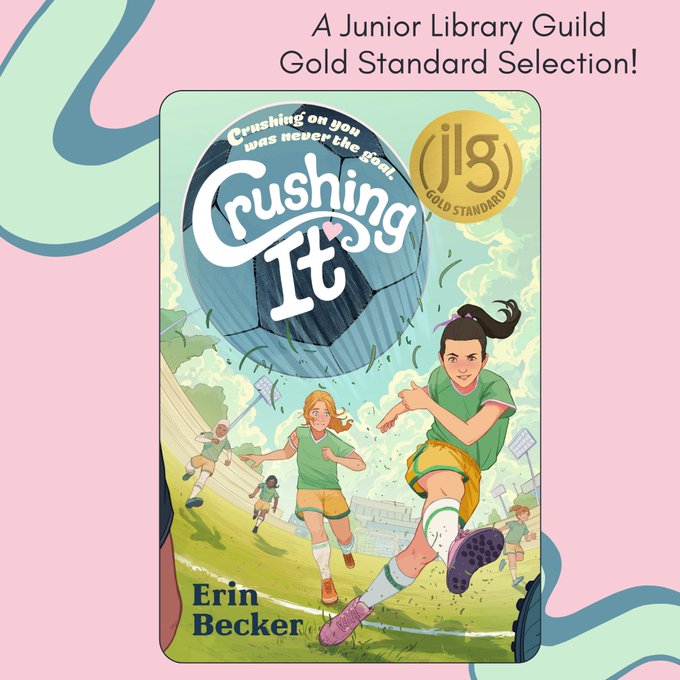
In today’s Author Spotlight, Sydney Dunlap chats with debut author Erin Becker about her middle-grade novel, Crushing It, an “enemies-to-first-crushes” story published by Penguin Random House and chosen as a Junior Library Guild Gold Standard Selection. Erin is an author and marketer living in Washington, DC. She grew up in Cedar Rapids, Iowa, studied English and creative writing at UNC-Chapel Hill, and holds her MFA from Vermont College of Fine Arts. When she’s not writing, you can find Erin at the gym or occasionally playing soccer (though not nearly as well as the protagonists of her novel). Learn more and connect with Erin at erinbecker.me.

All About the Book!
On the soccer field, Magic Mel is in her element. She’s ready to lead her team to victory at the city championship in her new role as captain. Off the field, however, is a totally different story. Mel can’t get a handle on her class presentation, her friend group has completely dissolved, and her ex-friend-current-teammate, Tory, is being the worst. The only place she feels like herself is in her text conversations where she shares her secret poetry with BTtoYouPlease.
Tory McNally, on the other hand, is keeping everything together, thank you very much. So what if her mom is more preoccupied with her craft projects and new husband than her, or that she’s down to one IRL friend because of annoying, overly peppy “Magic” Mel? She’s perfectly fine, and even when she maybe isn’t, she’s got NotEmilyD to text with.
As the championships loom closer, everything around Mel and Tory starts to get more and more complicated: the dynamics on the field, the rift between their friend group, and, as they connect anonymously online, maybe even their feelings for each other…
From debut author Erin Becker comes an action-packed but tender novel about first romance, identity, and learning how to be brave when it matters the most.
Scroll down for details about how enter a giveaway to win a signed copy of Crushing It.

Interview with Erin Becker
Sydney: I absolutely loved Crushing It. The characters were so real and so relatable. It’s such an honest, touching story that really hits the mark about what it’s like to be thirteen: the friendship and family struggles, crushes, challenges at school, in sports, so much going on. Can you tell me a little about the inspiration behind it?
Erin: First of all, thank you! I’ve had a lot of adult readers tell me the book really took them back to their middle school years. Sometimes I wonder if I should be thanking them or apologizing, since middle school is such an intense time.
The inspiration for this story actually came from the “Poetry Friday” tradition at Vermont College of Fine Arts, where I got my MFA. Each Friday, someone sends a poetry prompt to an all-school list serv, and the idea is that anyone who wants to can write a poem in five minutes and share it via email. That maybe sounds a little intimidating, but everyone is really supportive. I don’t remember exactly what the prompt was, but one Friday I wrote a poem about a girl who becomes soccer captain of her eighth-grade team. She’s excited to be given the captain’s key, which opens the shed where the team keeps the balls, the cones, and everything else they need for practice.
A friend replied to the poem, saying she felt like there was some potential there for a story. I agreed, and eventually, that girl turned into Mel and the poem turned into this book.
Points of View
Sydney: You do such a great job with narrating Crushing It in two points of view, from Tory’s and Mel’s, after their four-person friend group has been split in half. Their voices are very distinctive. How did you make them each sound so unique? And do you personally relate to one of them more than the other?
Erin: First, I want to give an answer for the poetry nerds out there. Originally, Crushing It was a novel-in-verse, so everything was written as poems. Mel’s poems were roughly in iambic pentameter and kind of flowed and were easy to read, whereas Tory was more staccato and used a lot of enjambment, cutting off the lines in unexpected places and making her poems a little more difficult to “get into.” So even on a rhythm/meter level, their voices were very different right from the start.
Later, when I rewrote this as a prose novel, I felt like I knew the girls really well, so I was able to translate that difference in their voice into the new structure.
Something that’s helped me as a writer is understanding that voice isn’t just the words on the page, but also what the character notices (or doesn’t notice). For example, Tory is really hard on herself and the people around her when it comes to appearances and being organized. But Mel would be less likely to notice details like that. So the world you’re constructing for each point of view is slightly different, because they experience everything—school, their families, their friend group—in a different way.
Sports Angle
Sydney: You describe the soccer games and practices and the experience of being on the team really authentically. Do you have a sports background? What are your favorite sports now, and what were your favorite sports as a kid?
Erin: I love sports! I played soccer and ran cross country and track and field growing up. Now, I still play soccer sometimes, but I’m getting more into the non-contact-sports world: yoga, dancing, running, walking.
Because playing sports and being on teams has been such an important part of my life, I was really excited to write a book with a focus on sports. I’ve made some of my best friends on the soccer field, going on runs together, or at the gym. It was fun to celebrate that, and to show all the complexities that emerge on teams: the highs and lows of competition, the friendship drama. And of course, there’s the built-in narrative tension, with the clock ticking down to the championship the entire book.
Other Characters
Sydney: I love the family situations that are included in your book. Do you have a favorite secondary character? Who and why?
Erin: I guess I shouldn’t play favorites, but it’s absolutely Terrance, Tory’s older stepbrother. Every draft I wrote of the book, there was more and more Terrance. I love the unexpectedness of that brother/sister relationship. Tory and Terrance are so different, and they give each other such a hard time, but they become really important to each other as the story progresses. This was totally organic and just emerged as I was writing.
Sydney: Yes, I thought he was very interesting, and I enjoyed reading about their evolving relationship.
Thematic Elements
Sydney: Shifting gears, what do you hope readers take away from this story?
Erin: It’s okay to make mistakes, and it’s okay if things get messy sometimes. You still deserve the love, friendship, and respect of the people around you.
Sydney: Those are such important themes for young readers.
Process
Sydney: Will you tell us a little about your writing process? Are you a plotter or pantser? Where/when do you prefer to write?
Erin: I usually write in the mornings for a couple of hours before I start my day job. I used to be a pantser, but I am coming around to the idea that plotting makes things a lot easier, at least for me. I need quiet to write, so I usually write at home in my office or at a coworking space, with noise-canceling headphones on. I wish I could live out my romantic fantasies of being that cool girl writing in the corner of a café. But every time I try it, I get totally distracted by the music!
Sydney: Same here. I can only write in total silence.
Influences
Sydney: What are some current books that have influenced you as a kidlit writer?
Erin: K.A. Holt’s Redwood and Ponytail was a big influence on Crushing It. Kwame Alexander’s Crossover and Booked as well. I absolutely love Erin Entrada Kelly and Rebecca Stead’s work. Also, I recently read The Language of Seabirds by Will Taylor, and that book and its absolutely beautiful, atmospheric feel will be staying with me for a long time. I’d love to capture something like that in a book I write one day.
Sydney: What a great list of authors and books. Can you give us some insights into what you’ll be working on next?
Nothing’s official yet, but I am working on something that—although it’s not a sequel to Crushing It—should very much appeal to the same readers!
And the Lightning Round:
Coffee or tea?
Coffee 100%. That’s also part of my morning routine: walking to get a coffee at an adorable café in my neighborhood first thing each day.
Sunrise or sunset?
Sunrise!
Favorite place to travel:
Chile. I lived there for a long time and, in my very biased opinion, there’s no better place in the world for backpacking.
Favorite dessert:
Chocolate chip cookies.
Superpower:
Yes please! 🙂
Favorite music:
My tastes range pretty widely, but lately I’ve been loving Karol G.
Favorite book from childhood:
I was a big reader of fantasy as a kid. But for this interview, it seems appropriate to mention that one of the childhood favorites I return to to this day is From the Mixed-Up Files of Mrs. Basil E. Frankweiler by E.L. Konigsburg.
I still fantasize about running away to live in a museum like Claudia. There are a lot of them here in DC so who knows, maybe I will someday?
Thanks again, Erin! It was so much fun to learn about you, your writing journey, and your amazing novel! Learn more about Erin on her website and follow her on Twitter and Instagram.
For a chance to win a signed copy of Crushing It, comment on the blog! (Giveaway ends November 22, 2024 MIDNIGHT EST.) U.S. only, please.


