
Posts Tagged children’s books

STEM Tuesday — Inventions that Changed the World — Author Interview with Sarah Aronson

Welcome to STEM Tuesday: Author Interview, a repeating feature for the last Tuesday of every month. Go Science-Tech-Engineering-Math!

Today we’re interviewing Sarah Aronson, author of the award winning book: Just Like Rube Goldberg The book is a fascinating look at the journey of a trained engineer who decides to take a job at a newspaper instead. His drawings of ridiculous inventions doing simple tasks became so popular, people use them as a starting point for creating their own “Goldberg” inventions.

Rube Goldberg Cover

Aronson notes that Goldberg ‘drew comics to make us look closer’; fittingly, this thoughtful, playful picture-book biography does just that, with whimsical pencil, ink, and digital illustrations capturing the machines’ intricacies.” – The Horn Book


Christine Taylor-Butler: Sarah, you are a prolific writer for both children’s fiction and nonfiction. But you didn’t start out as a writer?

Sarah Aronson: I didn’t. I taught fitness then trained to become a physical therapist.  When you are working with someone that has had a traumatic brain injury there is no book that explains how that individual person moves. You have to figure out the solution to helping that specific person being more functional. Now I think of writing and revision as rehab. When you take that sense of imagination and foresight and put it into whatever you are doing, you are doing STEM.

CTB: How did you get the idea for this book?

Sarah: When I was 7 years old, I was watching the movie, Chitty, Chitty Bang Bang. The breakfast machine is a Rube Goldberg contraption. I couldn’t believe how cool that was. I was a child with a lot of energy so I tried to make a breakfast machine with my mom’s best dishes. Here’s a tip – use plastic.

CTB: What happened to the dishes?

Sarah: I broke them all. Luckily mom wasn’t so found of that pattern. After seeing that, my dad began sharing Rube Goldberg cartoons with me. Later, while working for Jack La Lanne Health Clubs, I thought about those chain reactions when I was making my aerobics routines. How do we make a chain reaction with our bodies? How do we make ourselves stronger? I went back to college and got my Masters in Physical Therapy. I became a therapist and thought about physics while working. Once I became a writer I thought, who would I write about if I were going to write a biography? Ding! Why not Rube Goldberg?

CTB: He didn’t want to do an ordinary job.

Rube GoldbergSarah: He loved drawing. But is father didn’t want him to be a starving artist. And I remembered thinking, I’m a lot like Rube. My Dad is an economist and when I switched to writing he said, “you’re supposed to take a job that makes more money.” He was speaking out of fear. But he ultimately understood what I was trying to do and that I had something to say. I didn’t study engineering but Rube did. When he looked around he was latching on to creativity. He was worried that giving people all these machines was going to give people less opportunities for ingenuity. For thinking out of the box. He lived in the industrial age and he worried what was happening to curiosity.

We see this with our laptops and AI. Rube would go bananas. He would say “why are you giving away your brain to a machine that will never be as creative as you are.
Rube errand boy


CTB: I once read that DaVinci suggested that everyone should create art because it was a way of developing the manual dexterity needed to do their jobs. We don’t get that when we allow machines to do it for us.

Sarah: Yes – when you look at Rube Goldberg’s cartoons, you see humor. You see his desire to have fun with this idea of making machines that make simple things complicated. He’s trying to say “Use your brain!”

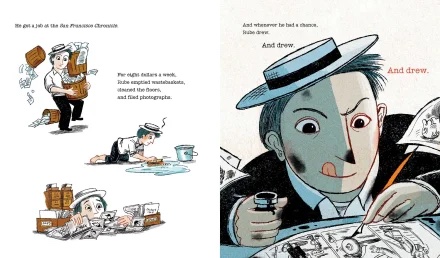
He wanted to be an artist. But like many parents his father wanted him to have a steady job. So he went to college and studied engineering. But he didn’t want to do that kind of job. So he took a job at a newspaper and worked his way up creating cartoons of complicated machines.

rube newsroom


CTB: So that’s his superpower and his appeal. These unusual drawings of inventions that do more than needed to do a simple job.

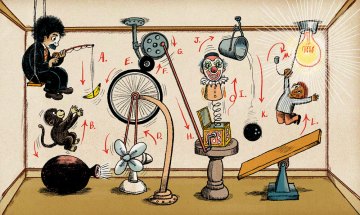
Sarah: The power of Rube Goldberg inventions is that it’s not like the machines in engineering school. These complicated contraptions weren’t practical in the real world. They weren’t there to solve real world problems. They were to tickle the imagination. Rube drew comics to make us look closer. More important than any pile of nuts and bolts, it challenged people to use their brains. He was awarded a Pulitzer Prize and he’s included in the dictionary.
Rube_32-33SS

CTB: So his goal is to give people more freedom.

Sarah: Yes. This is what we need in education – a freedom to explore, discover, be curious and creative. And to try things where we don’t know what is going to happen in the end.

When we let go of the product and engage truly in the process, that’s why Rube’s concept of making something silly endures. It taps into what we are missing in education – to give kids a voice.

CTB: We want people to see, “Look at the joy, this person got from this process!” And also the author’s joy in writing this.

Sarah: I talk about that a lot. When we address writing with joy and openness and not being wedded to the ending. We then discover something. And we can apply it. All of the scientific models apply to everything in life. You’re thinking and connecting dots. That’s STEM. You’re dreaming about something that doesn’t feel obtainable. That’s STEM. I ask teachers to give their students 5 minutes a day to write in a curiosity journal. And I ask teachers not to look at it. To let students explore on their own. For example, if they are studying Abe Lincoln, they can ask questions, or just wonder what is inside that big hat.

Sarah at school session

CTB: That’s it. Just 5 minutes each day without rules.

Sarah: Yes. Give students a way to find their path to learning. That’s something 5 minutes a day can do. That’s how I start my own day. Writing in my curiosity journal. Lately, I’ve been drawing the view from my window. They’re not good. But they’re not for anyone but me and it gets my brain swirling. That sets me up for the day. That’s STEM. So that is what I try to help my writers get to. Don’t be so serious. Enjoy every step.

Celebrate when something works.

Celebrate when it doesn’t work.

CTB: One quick shout-out to your award winning illustrator, Robert Neubecker.

Sarah: Yes. His artwork is amazing. I tell authors not to get involved in the illustrations. You often get things back you can’t have imagined. Robert’s work is beautiful.

Rube_12-13SS

CTB: So what are you working on now? Anything we should be looking forward to?

Sarah: Right now I’m working on a picture book about Christopher Reeves. He was a superhero so I’m writing it about his super powers. But in the middle I am talking about spine injury and why he couldn’t recover and walk again. Thinking about the body I’m wearing my old physical therapy hat again.

There’s a movie coming out. It’s been 20 years since he died. He died young so he’s frozen in time. He would be in his 70’s now.

CTB: Christopher Reeve’s public outlook was so positive.

Sarah: I think how I go about writing a biography . It is because I loved how a person is. Reeves is so embedded in the miraculous. He’s almost unreal. When I wrote the book Head Case it was because my patients who had head injuries couldn’t get complete coverage. Christopher Reeves was able to get everything he needed. He was inspiring.

CTB: And you have a finished picture book coming out.

AbzugSarah: I also have a book about Bella Abzug. It is gorgeous. It will be out in a few weeks. She was one of my childhood heroes. I was fascinated by this woman who was loud, and Jewish, and said what she wanted. That just blew my heart open. My first title was originally, “Bela knows everything.” She was an activist and lawyer before she ran for Congress at the age of 50. She was the first to run on a woman’s platform and she was a co-conspirator with Shirley Chisholm. They didn’t agree on everything but they worked together and that really inspired me. She was raised by parents who thought charity was good, but teaching people to help themselves is better.

A woman’s place is in the house – the House of Representatives.” – Bela Abzug

Advice from Sarah:

The most important thing I want people to get is that STEM is learning, STEM is fun, STEM is discovery and it’s integral to everything we do. I was a kid who didn’t think I could ever do STEM. I thought it was about being a doctor, or being really smart. Even when I took physics for Physical Therapy. I didn’t get it until I dissected a human. Messing up with your hands is how we learn. Crumbling a piece of paper and throwing it in the garbage is how I grow. It means I had and idea, but now I have a better one.

“Strive for something that seems impossible. Like a yoga pose. When you are striving and reaching and losing your balance, you’re gaining strength.”


Aronson

Sarah Aronson is the award-winning author of books for young people. She has earned an MFA in Writing for Children and Young Adults from Vermont College of Fine Arts. Her work includes novels and picture books, fiction and nonfiction. She also teaches writing for Highlights Foundation.

She loves working with young writers in schools, and grown-up writers at the Highlights Foundation, and Writers on the Net (www.writers.com). Sarah has served as an SCBWI mentor in both Illinois and Michigan, and is now the PAL coordinator for Illinois. She loves sports, overuses exclamation points and when she’s excited, she talks with her hands.

author christine Taylor-butler

Photo by Kecia Stovall

Your host is Christine Taylor-Butler, a graduate of MIT and author of The Oasis, Save the… Tigers, Save the . . . Blue Whales, and many other nonfiction books for kids. She is also the author of the STEM based middle grade sci-fi series The Lost Tribes. Follow @ChristineTB on Twitter/X and or @ChristineTaylorButler on Instagram. She lives in Missouri with a tank of fish and cats that think they are dogs.


Author Spotlight: Ciera Burch

Today, we’re thrilled to welcome author Ciera Burch back for her second visit to the Mixed-Up Files! Her sophomore MG novel, Camp Twisted Pine, a paranormal fantasy that mixes thrills, chills, and local legend, is out tomorrow, September 17, from Margaret K. McElderry Books.

Melissa: Hi, Ciera! Welcome back to the Mixed-Up Files. It’s great to have you here again!

Ciera: Great to be back. Thanks so much for having me!

Melissa: The last time we chatted, your MG debut, Finch House, was about to be released. Now you have a second MG, Camp Twisted Pine, launching tomorrow. How have you prepared for the big day? Was the experience similar to—or vastly different from—your debut launch?

Ciera: Ha, yes, time really flies! It’s honestly been so much different this time around. With Finch House, I had a launch event at Politics and Prose {in Washington, D.C.} and so many friends and family members came out, with my friends even coming a few days before and staying over, making a whole event of the weekend up until launch day. This time, I’m doing pretty normal things like going to the dentist and grocery shopping. I’m very glad to have had both experiences, but as an anxious introvert, I’m loving a much more relaxed launch.

Camp Twisted Pine: A Summary

Melissa: Let’s turn our attention to Camp Twisted Pine. Can you give Mixed-Up Files readers your best elevator pitch?

Ciera: Of course! Camp Twisted Pine is about Naomi, a girl who loves nature in theory but isn’t super into experiencing it firsthand, who’s being sent, along with her younger twin brothers, to summer camp in the Pine Barrens, in New Jersey, for the first time as her parents deal with their impending divorce. While she’s there, she realizes that campers have been going missing and that it might be up to her to figure out what’s wrong and to help save them…especially when one of her brothers and her cabinmate (and crush), Jackie, go missing.

Melissa: As you’d mentioned, the novel takes place at a sleepaway camp in the New Jersey Pine Barrens. What made you choose this particular location? Does the area have a special significance for you?

Ciera: I’m from New Jersey, so Jersey has always had a special place in my heart. But the Pine Barrens especially do for being the site of my first and only taste of sleepaway camp, thanks to a field trip I went on in the sixth grade. It’s also a massive swath of protected land in New Jersey that’s super important to the ecosystem and landscape of our state, and I feel like it doesn’t get enough love, especially since it’s said to be home to a mysterious creature…

Back to Nature

Melissa: Along these lines, Camp Twisted Pine has been described as an “eco-fable,” with kudzu that comes alive and other nature-based anomalies. Can you speak more to this?

Ciera: I can! I think we all know at least a bit about climate change and its effects on the world, but we don’t often—myself included—think about other potential threats to nature, of which intrusive plants, like kudzu, are one. Nature provides us with so much and it’s so easy to overlook or not recognize changes in it, but even things that are natural themselves can cause harm to our favorite spaces if we’re not vigilant. There are different native plant species in all regions and to help protect them, we should all strive to learn more about the plants that inhabit the places we call home!

Melissa: As you mentioned, Naomi, the eleven-year-old protagonist of the novel, loves to study nature but isn’t wild about the great outdoors. Is this a trait you share with her?

Ciera: I think it can be! And absolutely was when I was younger. As someone who hates the heat and isn’t a fan of bugs or being itchy, nature and I never seemed to click, especially when my main experience of it, growing up in the suburbs, was going to parks or beaches. But as I got older and traveled more, and moved to D.C, which has a wonderful amount of green space and proximity to even more, I’ve discovered that I do really enjoy nature—the songs of birds and the babbling of creeks, and just the soft rustle of leaves on trees. It’s a nice refresh from the bustle of just living.

I still can’t say I’m a big bug fan, though. I’m a nature girl in the colder months much more than I am in the warmer ones.

Melissa: As a follow-up, Naomi is a logical person who appreciates things that are “real and true and provable.” How does she reconcile this when faced with the possibility of a child-stealing cryptid—aka the Jersey Devil—at camp?

Ciera: Oh, she has a tough time! Stories and facts are in two very different folders in her mind, so the idea that a chimera-like creature can move from the “story” folder to the “fact” folder is a little bit mind bending. It definitely makes her reevaluate her definitions of “real” and whether or not things that are real need proof, or at least tangible proof.

You Gotta Have Friends

Melissa: Friendship is an overarching theme in Camp Twisted Pine. By opening herself up to new friends—including Jackie, who wears a hearing aid and teaches Naomi ASL—Naomi learns more about herself and about her core beliefs. What else were you trying to say about friendship?

Ciera: It can be so hard to make friends, as kids and as adults, and I think it’s especially true when you’re so often in your head like Naomi is. It’s hard to put yourself out there and be vulnerable with people, but being vulnerable, at least a little bit, is a part of human connection, and opening yourself up to others can lead to some really fantastic relationships and experiences.

I also wanted to touch on the fact that people are different. Some people are braver or rasher than others, and some are quieter or take time to think things through. But our differences, while important, aren’t the whole of who we or other people are and shouldn’t be an immutable barrier to friendship or connection.

Melissa: Like your debut novel, Camp Twisted Pine includes spooky, supernatural elements. What draws you to this genre?

Ciera: I just love all things spooky, the things we imagine exist in the dark the second we turn the lights out! And I love thinking about how rich and complex and vast our world is, and the idea that there can be other creatures and worlds just as vast and complex hidden within ours, or in its very seams. There’s so much possibility and excitement in the unknown to me—in the supernatural.

A’ Camping We Will Go!

Melissa: And now for the question on everyone’s mind: Did you attend sleepaway camp as a child? If so, what was your biggest takeaway from the experience? Also, what were your favorite activities? Your least favorite?

Ciera: Yes, and no! As I’d mentioned, the trip I went on in the sixth grade to the Pine Barrens—funnily called Mount Misery—was a week long and we did sleep in cabins and do traditional camp-like things, but it was also still part of school. I did beg my mom (a lot!) to go to an actual sleepaway camp for the summer, especially because I was obsessed with Percy Jackson and Camp Half Blood, but she always refused.

My biggest takeaway from my sixth grade trip, however, was just being in the middle of so much nature. There were no cars around and I could see so many more stars and hear small animals skittering about it. It was a little scary, I’ll admit, but I also felt really, really human for, I think, the first time. Part of the earth and the universe, you know?

I really loved the bonfires and the stories about the Jersey Devil we told while eating s’mores, and taking pictures of everyone and everything, but my least favorite had to be the night hike, because it was long and exhausting and also pretty dark.

Up Next…

Melissa: What are you working on now, Ciera? 

Ciera: I’m currently working on another middle grade! It’s about 13-year-old Olivia who realizes, after her brother comes out and her friends begin to gush about their recent crushes almost constantly, that she doesn’t feel quite the same way as most other people and starts to turn quite literally invisible when no one will listen to her.

Melissa: Before I let you go, I want to circle back to something you’d mentioned in your previous interview: your love of ice cream! Is mint chocolate chip still your favorite or have you added another flavor to the roster?

Ciera: I’ve definitely added another flavor recently and it’s Strawberry Cheesecake!

Lightning Round!

Melissa: Finally, no Mixed-Up Files interview is complete without a lightning round, so…

Preferred writing snack? (besides ice cream) Seaweed!

Favorite camp prank? Turning out the lights on someone in the bathroom!

Best way to roast a marshmallow: Char it to a crisp or brown it slightly? Almost burnt, but not quite! Just brown enough!

Cryptids: Real or imaginary? Definitely real!

Superpower? Teleportation!

Favorite place on earth? My mom’s backyard! She lives right next to the woods and a river and deer hang out all the time.

If you were stranded on a desert island with only three things, what would they be? Notebook and pencils (totally counting them as one); a flare gun; a big, light blanket

Melissa: Thank you for chatting with us, Ciera. It a pleasure, and I’m sure MUF readers will agree!

Ciera: Thanks so much for having me again! Happy reading!

About Ciera Burch

Ciera Burch is a lifelong writer and ice cream aficionado. She has a BA from American University and an MFA from Emerson College. Her fiction has appeared in The American Literary MagazineUndergroundFive PointsStork, and Blackbird. Her work was also chosen as the 2019 One City One Story read for the Boston Book Festival. While she is originally from New Jersey, she currently resides in Washington, DC, with her stuffed animals, plants, and far too many books. Learn more about Ciera on her website and follow her on Instagram.

Melissa Roske is a writer of middle-grade fiction. Before spending her days with imaginary people, she interviewed real ones as a journalist in Europe. In London she landed a job as an advice columnist for Just Seventeen magazine. Upon returning to her native New York, Melissa contributed to several books and magazines, selected jokes for Reader’s Digest (just the funny ones), and received certification as a life coach from NYU. In addition to her debut novel Kat Greene Comes Clean (Charlesbridge), Melissa’s short story “Grandma Merle’s Last Wish” appears in the Jewish middle-grade anthology, Coming of Age: 13 B’Nai Mitzvah Stories (Albert Whitman). Learn more about Melissa on her Website and follow her on  TwitterFacebook, and Instagram.

The Spooky Season is Almost Here! (Let’s get ready)

As Halloween creeps closer, it’s the perfect time to gather some spooky middle-grade reads to get into the eerie spirit! Here’s a roundup of five novels that will have young readers on the edge of their seats—but not too scared to sleep!

The Ghost Rules by Adam Rosenbaum

Why: Rosenbaum expertly walks the line between hilarious and heartbreaking.

Twelve-year-old Elwood McGee has the rare ability to see ghosts, and while they’re more nosy than scary, he’s determined to use his power to reconnect with his late brother. With the help of two friends, Elwood embarks on a heartwarming and humorous journey (the world of ghosts is surprisingly funny!) through the ghostly realm, learning about grief and letting go.

Hart & Souls by Lisa Schmid

Why: No one captures the middle-grade voice better than Lisa Schmid!

Stix Hart just wants to fly under the radar in middle school, but things take a spooky turn when he discovers three ghostly students who need his help. Now, Stix must summon his courage to solve the mystery of their decades-long stay and help them move on—before time runs out.

The Inn Between by Marina Cohen

Why: Scary and thought-provoking in equal measure.

Eleven-year-old Quinn embarks on a trip with her best friend, Kara, and Kara’s family, only to find themselves stranded in a creepy Victorian hotel where strange disappearances and eerie happenings unfold. As Quinn and Kara search for Kara’s missing family, they must unravel the hotel’s dark secrets before it’s too late.

Midnight at the Barclay Hotel by Fleur Bradley

Why: Bradley is a masterful mystery writer.

When JJ Jacobson’s weekend ghost-hunting trip turns into a real-life murder mystery, he must team up with his new friends to clear his mother’s name. With a killer on the loose and the possibility of meeting ghosts, this is one getaway JJ will never forget.

The Night Gardener by Jonathan Auxier

Why: Auxier creates a creepy atmosphere that leaps right off the page.

Two abandoned Irish siblings find work at a decaying English manor, only to discover a haunting specter and an ancient curse that threatens their lives. This Victorian ghost story weaves a chilling tale of greed and the power of storytelling, delivering a mesmerizing, timeless read.

These five books will add just the right amount of spooky fun to any reader’s fall reading list, making them perfect companions for a thrilling Halloween season!

This is my last post for MUF! While I’ve had a blast sharing favorite titles with you over the years, I’ll be shifting my focus to writing (and finishing!) novels and book coaching. Hope to see you out in the real world sometime soon but in the meantime visit my linktree and let’s connect! Happy reading and writing, friends!