Posts Tagged children’s books

So, Why Realistic Fiction?

Realistic Fiction in the Classroom

By Robyn Gioia

A genre that is not front and center in today’s stories of zombie, vampires, unicorns, and fairies is the world of realistic fiction. My class and I recently studied realistic fiction and what I learned was surprising.

The root word “real” in realism says it all. Are the characters regular people? Do they have problems? Do they make mistakes? Do they have real emotions? Do they grapple with pain, feel love, become utterly depressed, or bubble over with serendipity? Is the world real or is it a fantasy world with three moons and purple mountains? If it’s a made-up world, does it follow the rules of physics? If a character walks off a cliff, do they get hurt?

Plot

Probably the biggest element to examine is plot. Is it believable? Although circumstances may be extraordinary at times, is it something that could really happen? How do the characters deal with real problems? Are the solutions something that can really happen?

I noticed my students were so firmly rooted in fantasy, that when we studied our unit on realistic fiction, it took a lot of examination to decide if something could really happen. They argued that a character who miraculously survived a plane crash could climb the highest mountain, and walk a hundred miles to the next village without any food or water.

When I added that there are no super powers in realistic fiction, they stared at me. Then came the explanations. Maybe the survivor was in shape, they said. Maybe this person had a big dinner before the crash. Then the next set of “maybes” became even grander, without text evidence I might add. Maybe someone gave the person a ride. Maybe the person found a bunch of  power drinks. The “maybe” syndrome continued.

After our discussion, things got better. I breathed a sigh of relief when I heard the different reading groups asking each other, “Can it really happen and where is the evidence?”

So, why realistic fiction?

This brings us to the question. Why teach realistic fiction when other genres are vastly more popular?

Realistic fiction grounds students in real life. It lets them experience real life situations through cause and effect. It shows them the complexity of problems and how humans might react. It helps them to understand relationships. It helps students see life through the perspective of others.  It shows them how problems may or may not be solved. It exposes them to the vast differences in cultural beliefs and interactions between others.

To sum it up, realistic fiction helps students understand the way life works.

At the end of our study, something I did not expect was a comment from one of my brightest. “I haven’t found any books that I like. But I just learned that I like realistic fiction.” Grinning from ear to ear, he pulled out a copy of Hatchet by Gary Paulsen and settled down to read.


Beyond Shel Silverstein: Silly Poetry for Kids

I feel I must clarify. I adore Shel Silverstein. Who doesn’t love “Sarah Cynthia Silvia Stout Would Not Take the Garbage Out”? Or “Ickle Me, Pickle Me, Tickle Me Too”? Great stuff. But I fear that children’s poetry, particularly funny poetry, begins and ends with dear old Shel. There is a whole world out there of funny poetry for kids, and some of it even gives Shel a run for his money. These are poems that evoke giggles and guffaws, that insist on being read aloud, and that are perfect for these evenings as the weather gets colder and we want to snuggle by the fire. Check them out! And if you have other suggestions for me, please add them in the comments. I am eager for a few new titles to grab on the next snowy Sunday.

Polka Bats and Octopus Slacks by Calef Brown

Georgie Spider catches flies but never eats the little guys. Instead he cooks them up in pies. He doesn’t use the legs or eyes or any artificial dyes . . . Not far from a greenish town, the Bathtub Driver is selling cut-rate imported shampoo. Georgie Spider serves up award-winning pies, while overhead on Highwire 66 there’s a small problem causing an acrobat traffic jam. Ed’s funny smell, Eliza’s special jacket – they’re all part of the picture in Polkabats and Octopus Slacks, fourteen stories about pesky snails, sleeping fruit, and one funky snowman. In the tradition of Edward Lear, Calef Brown has fashioned fourteen nonsense poems so zany that both young and old will be unable to suppress their laughter. Brown’s invented words and sounds and their visual counterparts create both an audible and a visual feast. This is the kind of silliness children relish.

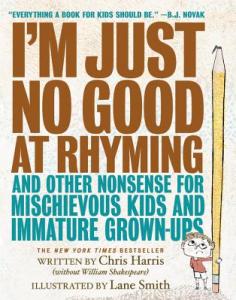
I’m Just No Good at Rhyming by Chris Harris, Illustrated by Lane Smith

Meet Chris Harris, the 21st-century Shel Silverstein! Already lauded by critics as a worthy heir to such greats as Silverstein, Seuss, Nash and Lear, Harris’s hilarious debut molds wit and wordplay, nonsense and oxymoron, and visual and verbal sleight-of-hand in masterful ways that make you look at the world in a whole new wonderfully upside-down way. With enthusiastic endorsements from bestselling luminaries such as Lemony Snicket, Judith Viorst, Andrea Beaty, and many others, this entirely unique collection offers a surprise around every corner: from the ongoing rivalry between the author and illustrator, to the mysteriously misnumbered pages that can only be deciphered by a certain code-cracking poem, to the rhyming fact-checker in the footnotes who points out when “poetic license” gets out of hand. Adding to the fun: Lane Smith, bestselling creator of beloved hits like It’s a Bookand The Stinky Cheese Man and Other Fairly Stupid Tales, has spectacularly illustrated this extraordinary collection with nearly one hundred pieces of appropriately absurd art. It’s a mischievous match made in heaven!

What are You Glad About? What are you Mad About? by Judith Viorst

From the beloved and internationally bestselling author of Alexander and the Terrible, Horrible, No Good, Very Bad Day, Judith Viorst comes a collection of wry and witty poems that touch on every aspect of the roller-coaster ride that is childhood.

Did you wake up this morning all smiley inside?
Does life taste like ice cream and cake?
Or does it seem more like your goldfish just died
And your insides are one great big ache?

From school to family to friends, from Grrrr to Hooray!, Judith Viorst takes us on a tour of feelings of all kinds in this thoughtful, funny, and charming collection of poetry that’s perfect for young readers just learning to sort out their own emotions.

Scranimals by Jack Prelutsky, Illustrated by Peter Sis

We’re sailing to Scranimal Island,

It doesn’t appear on most maps….

Scranimal Island is where you will find the fragrant Rhinocerose, the cunning Broccolions, and if you are really, really lucky and very, very quiet, you will spot the gentle, shy Pandaffodil. (You may even hear it yawning if the morning’s just begun, watch its petals slowly open to embrace the rising sun.

So put on your pith helmet and prepare to explore a wilderness of puns and rhymes where birds, beasts, vegetables, and flowers have been mysteriously scrambled together to create creatures you’ve never seen before –– and are unlikely to meet again! Your guides –– Jack Prelutsky, poet laureate of the elementary school set, and two–time Caldecott Honor artist Peter Sis – invite you to join them on an adventure you will never forget!

The Popcorn Astronauts and Other Bite-able Rhymes by Deborah Ruddell, Illustrated by Joan Rankin

Take a bite out of the calendar with this cheerful collection of delicious seasonal poems, each one an ode to a favorite food

The daring popcorn astronauts
are brave beyond compare–
they scramble into puffy suits
and hurtle through the air.And when they land, we say hooray
and crowd around the spot
to salt the little astronauts
and eat them while they’re hot.

Dive into a watermelon lake and sing the praises of mac and cheese in this playful and poetic celebration of food. In spring, bow to the “Strawberry Queen” and eat “Only Guacamole.” In summer you’ll meet Bob the Ogre, who only eats corn on the cob, and in fall, you can learn “21 Things to Do with an Apple.” And then in winter, retreat from the cold at “The Cocoa Cabana ” Stellar team Deborah Ruddell and Joan Rankin deliver a whimsical celebration of the tastiest treats of life in this palatable poetry collection.

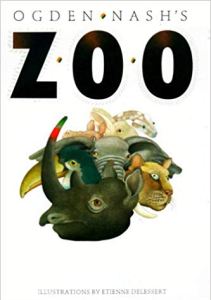
Ogden Nash’s Zoo by Ogden Nash, Illustrated by Etienne Delessert

A collection of verses about animals from the barnyard to the aquarium and the haunts of the lion and rhinoceros also includes verses about mythical animals.

Kate Hillyer is a middle grade writer and poetry lover who feeds her addiction by serving as a Cybils judge for poetry. She blogs here and at The Winged Pen. You can also find her at www.katehillyer.com and on Twitter as @SuperKate. 

STEM Tuesday: Peeking into the Mind of a Scientist/Engineer Book List

STEM TUESDAY from the mixed up files

During the month of November, we feature a list of fascinating books about famous scientists and how they think. As an extra layer, we’d like you to consider this list from the nonfiction authors’ points of view as well. What parts of these scientists lives did we focus on? What did we leave out? What do you think interested us the most? Whether you realize it or not, every nonfiction story has an angle–something that connects us AND our readers to the topic. See if you can find it in the books listed below as you dive into the minds of these scientists who have shaped their fields.

Support Independent Bookstores - Visit IndieBound.org Something Rotten: A Fresh Look at Roadkill by Heather L. Montgomery; illustrated by Kevin O’Malley

Readers will meet up with a scientist searching for a cancer cure, a boy engaged in animal anatomy, and citizens joining together to save an endangered species, with the help of roadkill. A great title for kids who enjoy a little gore with their science.


Support Independent Bookstores - Visit IndieBound.org Charles and Emma: The Darwin’s Leap of Faith by Deborah Heligman

Delve into the complex world of the Darwins in this award-winning title that introduces readers to the relationship of this famous couple.


Support Independent Bookstores - Visit IndieBound.org Isaac the Alchemist: Secrets of Isaac Newton, Reveal’d by Mary Losure

Read about the growing mind of one of the world’s greatest scientists in this award-winning nonfiction narrative of Isaac Newton. A wonderful read for budding scientists.


Support Independent Bookstores - Visit IndieBound.org Radioactive! How Irène Curie and Lisa Meitner Revolutionized Science and Changed the World by Winifred Conkling

A fascinating look at two groundbreaking and mostly unrecognized scientists who contributed to the science of nuclear energy and the race to build the atomic bomb. Readers might be more familiar with the work of Curie’s famous mother, Marie, but she was important in her own right.  A terrific read for Women’s History Month and every day after.

Support Independent Bookstores - Visit IndieBound.org Path to the Stars: My Journey from Girl Scouts to Rocket Scientist by Sylvia Acevedo

An inspirational memoir about a Latina rocket scientist whose early life was transformed by  her membership in Girl Scouts. Acevedo is currently the CEO of Girl Scouts of the USA.


Support Independent Bookstores - Visit IndieBound.org Google It! A History of Google: How Two Students’ Mission to Organize the Internet Changed the World by Anna Crowley Redding

Discover how two college students came up with an idea that has changed our world.


Support Independent Bookstores - Visit IndieBound.org The Hyena Scientist by Sy Montgomery; photographs by Nic Bishop

Noted nonfiction author debunks the stereotypes of hyenas in her latest Scientists in the Field title focused on scientist Kay Holecamp.


Support Independent Bookstores - Visit IndieBound.org Think Like a Scientist in the Gym by Christine Taylor Butler

In this title, the readers are the scientists testing their scientific thinking by performing a series of fun experiments using basic gym equipment. Consider asking students to record results in a science notebook.


Support Independent Bookstores - Visit IndieBound.org Alexander Graham Bell for Kids: His Life and Inventions, with 21 Activities by Mary Kay Carson

This 2019 finalist for the AAAS/Subaru SB&F Prize for Hands-on Science is a perfect title for budding inventors. Readers will learn about Alexander Graham Bell’s many inventions and have the opportunity to try their hand at creating some of their own.


FICTION PAIRINGS about kids thinking like scientists:

Support Independent Bookstores - Visit IndieBound.org Support Independent Bookstores - Visit IndieBound.org The Lost Tribes series by Christine Taylor Butler

Christine Taylor-Butler is a trained civil engineer, and she creates smart science-centered characters in this adventure-mystery series. Five friends team up to find their missing parents, who they discover are on a secret science mission. The friends must solve puzzles, crack codes, and think logically as they race against time to find their parents and save the universe.


Support Independent Bookstores - Visit IndieBound.org The Curious World of Calpurnia Tate by Jacqueline Kelly

Readers of The Evolution of Calpurnia Tate will enjoy this next tale of young, inquisitive Calpurnia. A wonderful fiction title to pair up with one of the above informational books.


***** And Finally, we’d like to say HAPPY BIRTHDAY TO US!! STEM Tuesday is celebrating our ONE YEAR Anniversary!! Thanks to all of our readers who have followed us faithfully the past year. We couldn’t do it without you. YAY for STEM/STEAM Middle Grade Books!!***


STEM Tuesday book lists prepared by:

Nancy Castaldo has written books about our planet for over 20 years including her Crystal Kite award-winning title, Beastly Brains: Exploring How Animals Think, Talk, and Feel, which delves into the study of cognition, both animal and human.  Nancy’s research has taken her all over the world from the Galapagos to Russia. She enjoys sharing her adventures, research, and writing tips with students during her author visits. She strives to inform, inspire, and educate her readers. Nancy also serves as a Regional Advisor for SCBWI. Her 2018 title is Back From The Brink: Saving Animals from Extinction. www.nancycastaldo.com

Patricia Newman writes middle-grade nonfiction that inspires kids to seek connections between science, literacy, and the environment. Her Sibert Honor-winning Sea Otter Heroes dives inside the mind of marine biologist Brent Hughes as he solves a food chain mystery. Other titles include:  Zoo Scientists to the Rescue, a Bank Street College Best Book and Plastic, Ahoy!, a Green Earth Book Award winner. New in 2018:  Eavesdropping on Elephants: How Listening Helps Conservation. Educators describe her author visits as “phenomenal,” “fantastic,” “passionate,” and “inspirational.” Visit her at www.patriciamnewman.com.