Posts Tagged books

Author Matt McMann Gets Monsterious!

I was so excited when Escape From Grimstone Manor, book one in Matt’s new series Monsterious, showed up at my house. While book mail is always a thrill, this spooky read was high on my list. And of course, Matt did not disappoint. I read it in one sitting!

Monsterious is pitch-perfect middle grade, ideal for both reluctant and avid readers, and fans of Goosebumps and Five Nights at Freddy’s. Each book comes in at fewer than 200 pages, and every chapter ends with a chilling cliffhanger that will keep kids turning the pages. With the first two books publishing simultaneously, each book in the series completely stands alone, with a different setting and main characters—and different monsters—in each installment, and can be read in any order. I see these books as a great addition to summer reading lists.

And fortunately for us, Matt was up for chatting about Monsterious and how it came to be.


Welcome, Matt! Thank you so much for taking the time to talk to us over here at Mixed Up Files! Let’s start at the beginning. What inspired the Monsterious series? Can you remember the spark?

My wife, author Lisa McMann, was reading an article aloud and mispronounced the word “mysterious” saying “monsterious” instead. I said, “That would be a great middle grade book title,” and she replied, “No, it’s a whole series, and you should write it.” So I did! I loved the idea of crafting a series of spooky middle grade monster mysteries.


In Escape from Grimstone Manor (series book #1) is there one character you identify with the most?

Escape from Grimstone Manor features three best friends who are trapped overnight in a haunted house amusement park ride and discover the monsters are real. Taylor is outgoing, brave, and spontaneous to a fault. Zari is cool, level-headed, and intellectual. Mateo is timid, cautious, and artistic. While there’s a bit of me in all of them, I definitely relate the most to Mateo. I was a scared, artistic kid like he is!


The books in the Monsterious series can also stand alone. What made you decide on this approach? What are the challenges of starting over with a whole new cast of characters each time? 

Since the idea for Monsterious came as a series concept vs. an individual book concept, I took the opportunity to choose the type of monster mystery series I wanted to write before thinking of the stories themselves. A dynamic series features the same characters in a multi-book story arc (ex: Lord of the Rings). A static series features the same characters in episodic adventures (ex: Nancy Drew). In an anthology style series, the books are tied together by a place or an idea or a theme, but each entry is a standalone story with a unique cast of characters (ex: Goosebumps).

I chose an anthology style series because I liked the freedom it gave me to write about any monster, anywhere, with anyone. Since it’s a less common format, I thought it might help me stand out to editors in a crowded marketplace. Not being constrained by a single meta story arc was also appealing—I knew if I could sell Monsterious to a publisher and find an audience, then I could write in this series for a long time, which I would love.

The challenge with this type of series is needing to write new characters for each installment who are both interesting and well-rounded. There’s also a lot of names to come up with! It definitely takes additional work and imagination, but it’s totally worth it.

What do you hope young readers will take away from your books?

I was a scared kid. I grew up being afraid of almost everything—the dark, bullies, the woods, our basement. But I loved spooky stories. Seeing the characters in those books face their fears gave me the courage to face my own. And they were just so cool! I hope readers will find the same courage and fun in Monsterious books that I found when I was that age.

What was your favorite book as a kid? Did you like scary stories?

I had so many! I read a lot of adventure and sci-fi books when I was quite young, then got hooked on fantasy with the Earthsea trilogy by Ursula K. LeGuin and Tolkien’s Lord of the Rings. Frankenstein by Mary Shelley was a game changer for me. I was captivated. That led me to Bram Stoker’s Dracula, and then I checked out every book in the library on Bigfoot, the Loch Ness Monster, werewolves, vampires, you name it!

What do you mostly read now?

I’m reading a lot of great middle grade to steep myself in the voice and emotions of that age group. Lindsay Currie writes incredible spooky middle grade, and Starfish by Lisa Fipps was fantastic. I’m reading a lot of standout realistic contemporary work from my 2023 debut middle grade author group, including Good Different by Meg Eden Kuyatt, It Happened on Saturday by Sydney Dunlap, and Miracle by Karen Chow.

Talk to me about your path to publication. Did you encounter surprises or unexpected twists in the road?

I wanted to be author since I was a kid, but studied music in college and was a professional musician for twenty-six years. When I burned out on music about five years ago, Lisa suggested I go after my dream of writing books. We went to a hotel for a weekend getaway, and she said we couldn’t leave until I wrote my first chapter!

I had a chance to pitch that first book to an agent over dinner and he requested the manuscript. After reading it, he said it had potential but needed a lot of work, and if I was willing to make significant edits, he’d read it again. I did everything he suggested, and after that second reading, he signed me!

We went on an exclusive submission to an editor at a Big Five publisher, and she said the same thing—it had potential but needed a lot of work, and if I’d do some edits, she’d read it again. I made her changes, she liked it, and said she was taking it to her team. I was floored. What I thought was going to be a throw-away practice novel not only got me an agent, it was going to get me a book deal on my first submission! And then it didn’t. The team wasn’t excited, and she passed. The manuscript went out on multiple waves of submissions for over a year and never sold.

During that time, I wrote a second book. That went out and got rejected by everyone. I wrote a third book that never even went out on sub. Then I came up with the idea for Monsterious, and my agent loved it. He took it on an exclusive submission to Penguin Random House, and it sold immediately in a four book deal. My childhood dream has come true!

You have the good fortune to be married to New York Times bestselling author Lisa McMann. What did you learn from watching her journey that helped with your own?

I was the luckiest aspiring author in the world to have Lisa as my mentor and writing coach. I’ve learned too many lessons from her to count, but one of the biggest was that being an author is business. If you want a long-term career, you need to know as much about marketing and admin as you do about writing. I think that’s where a lot of really talented writers struggle—to think and operate like a small business. Lisa is the most creative person I know, but she also has a great business sense, so I’m trying to emulate that in my own career.

What advice would you offer to aspiring authors of all ages?

  1. Read great authors
  2. Write what you love
  3. Find a supportive writing community
  4. Share your work with writers you trust and believe their critiques
  5. Listen to good writers talk about writing (podcasts, videos, webinars, books, live events, etc.). I highly recommend the Writers With Wrinkles podcast for craft, inspiration, and entertainment value!
  6. Write! Practice, practice, practice, and don’t give up

Do you have any writing rituals you swear by?

When drafting, I write at least 1000 word a day. Having that as a minimum gives me a clear sense of accomplishment and, when I know my target book length, allows me to map out how long it will take me to complete a first draft. I also start each drafting session by editing what I wrote the previous day. It gets me back in the flow of the story and when the draft is completed, I’ve already finished one round of edits.

Where can readers best find you if they want to reach out?

I really pumped about my newly revamped website MattMcMann.com (thank you Deena at deenawarnerdesign.com!). Readers can contact me there and get my free spooky short story for signing up for my newsletter. I’m also @matt_mcmann on Instagram and Twitter.

Thank you, Matt!

STEM Tuesday– Material Science– Book List


Materials Science is the field of researching and discovering materials. Not only is this field changing the face of sports and medicine; but it’s making strides in other places as well. Take a look at the titles below to discover more.


Amazon.com: Stuff Matters: Exploring the Marvelous Materials That Shape Our Man-Made World: 8601405513199: Miodownik, Mark: Books


Stuff Matters: Exploring the Marvelous Materials That Shape Our Man-Made World

by Mark Miodownik

Why do materials look and behave the way they do? This book speaks about the amazing properties of the materials all around us that we take for granted.


Molecules: The Elements and the Architecture of Everything

by Theodore Gray and Nick Mann (photographer)

In this book, the author explains how chemical structures work, and goes on to show how molecules make up the wonderfully wide variety of materials in our world.


Let’s Investigate Everyday Materials

by Ruth Owen

Readers will discover the properties of materials and how they’re suitable for specific tasks. In addition, they’ll learn how they’re made! Get up close to the worlds of wood, metal, plastic, glass, rock, and wool and discover how these items work for us regularly.


Working with Materials

by Sonya Newland and Diego Vaisberg.

This series takes a look at the different engineering fields. Hands-on activities encourage readers to develop their own skills after they examine the properties of basic materials. In addition, readers will learn more about how materials are made or mined, and how engineers decide to use them. The fascinating world of material science is here for discovery!


Experiments with Materials (Read and Experiment) by [Isabel Thomas]

Experiments with Materials

by Isabel Thomas.

The science of materials is the focus of this series which uses fun experiments to get readers involved. As they get hands-on with science, readers will be introduced to scientific concepts, analytical thinking, and so much more.


Discover Nanotechnology (Searchlight Books ™ — What's Cool about Science?)


Discover Nanotechnology

by Lisa J Amstutz

All about how scientists work with the tiniest objects imaginable to build wonderful things!


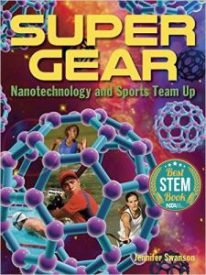
Super Gear 2017 STEM Book Award

Super Gear – Nanotechnology and Sports Team up 

by Jennifer Swanson.

Nanotechnology is an innovative science done at an atomic level. It’s used to create high-tech equipment for sports in ways we can only dream of! This book takes an in-depth look at the fascinating achievements of nanotechnology in sports and how it’s changing the game.


Nanomedicine

by Martin Gitlin, Alexis Roumanis

With this book, readers will learn about technological innovations and the world of nanotechnology. This world is tiny but fascinating, with applications in the field of medicine that might just surprise you.


Nanotechnology and Medicine 

by Don Nardo

Advances in nanotechnology are changing the world of medicine. This book speaks about how scientists and doctors are using tiny nanoparticles to give people longer, healthier lives.


Susan Summers is a wildlife enthusiast and an author. Contact her at: https://susan-inez-summers.weebly.com/


Shruthi Rao is an author. Her home on the web is https://shruthi-rao.com


STEM Tuesday– Architecture– Interview with Nancy Castaldo!

Welcome to STEM Tuesday: Author Interview, a repeating feature for the last Tuesday of every month. Go Science-Tech-Engineering-Math!

Today, I’m delighted to interview a founding member of STEM Tuesday, Nancy Castaldo!

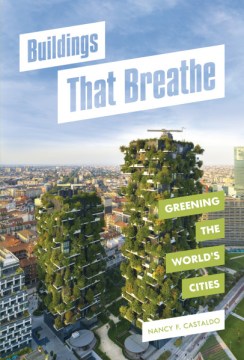
Nancy’s most recent book is an exploration of a very cool topic – green buildings! And not painted green. No, these buildings are growing, thriving, and . . .  breathing!

BUILDINGS THAT BREATHE: GREENING THE WORLD’S CITIES takes young readers on a journey around the world to discover ecological, sustainable architecture practices such as incorporating trees and other forms of native vegetation into buildings.

Why design buildings that breathe? Because it’s healthier – for humans, wildlife, and the planet. And, these buildings are beautiful!

Learn more about Nancy’s research and writing process:

cover Buildings That Breathe

Andi Diehn: What a great title – what sparked the idea for this book?

Nancy Castaldo: As an Italian-American, I have Italian news stories on my radar. I was excited when I came across the story of Bosco Verticale in Milan. In addition, I studied architecture in graduate school after all my earlier science studies. This project dovetailed with both of those interests. I wasn’t sure what direction the book would take until I attended the United Nations Forum in Urban Forestry in Mantua, Italy in 2018. The book formed out of that participation. I had the opportunity to meet with so many global leaders in urban greening.

AD: Boeri refers to a “new Renaissance” when talking about the future of cities. What does he mean by this?

NC: The Italian Renaissance was a period of recovery from disasters that occurred in the 14th century and a period of tremendous innovation. Milan was home to Leonardo da Vinci, a Renaissance master of innovation. Boeri, the architect for Bosco Verticale, is calling for the opportunity for tremendous innovation in the world’s cities today. His design and his collaborations in Milan and elsewhere are at the forefront of that innovation.

AD: The story of Seneca Village was fascinating – why is it important to remember the people who lived there before the land became Central Park?

NC: Seneca Village and the dissolution of it is important to everyone everywhere. It is an historical example of social injustice that went on and that still occurs in gentrification projects. The residents of Seneca Village that were displaced had their lives disrupted just as many still do today.

green skyscraperAD: Boeri’s vision of a building that incorporates trees and essentially becomes one great tree that “incidentally houses humans” is a real shift from our traditional way of thinking of architecture as serving humans—these buildings serve the land. Why do you think that shift is happening now?

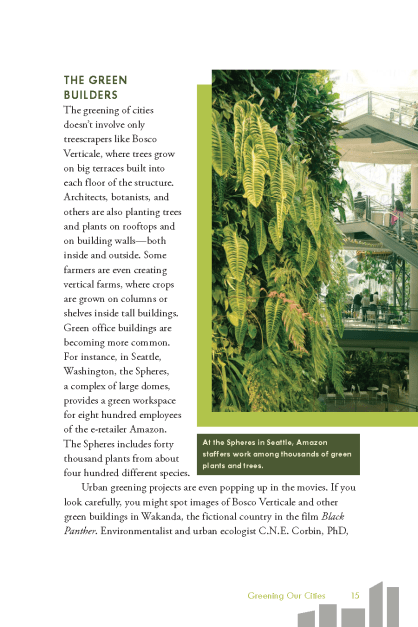
NC: Cities need to be made more livable for residents and healthier for our planet. Urban greening projects do both. The shift is important to combat human-caused climate change that damages our planet and individual health. Cities produce three-quarters of carbon dioxide emissions along with many other pollutants. As city populations increase, so do those emissions. We can do better. Urban greening is one big tool in our toolbox.

AD: You write about Boeri’s team members and their backgrounds, including Laura Gatti and Emanuela Borio. Is it important to have many voices contributing to the plans? Why?page from Buildings That Breathe

NC: Everyone has their own specialties in creating such extraordinary, innovative designs. All contribute to the project’s success. I’m hoping that young readers, of all genders, will find inspiration from these individuals in STEM careers.

AD: I had no idea that growing trees and bushes on buildings was so complicated! What are some of the things the designers have to consider?

NC: The book describes how the team had to deal with issues of wind and weight on the structure and its trees. When groundbreaking projects like Bosco Verticale are constructed, lessons can be learned for all buildings going forward.

AD: In March, the Intergovernmental Panel on Climate Change announced that we’d be crossing a critical global warming threshold in the 2030s if we didn’t make major changes—how do books like yours help younger generations understand the climate situation?

NC: I hope that Buildings That Breathe can not only inform my readers but inspire them to think about other creative solutions to our global climate crisis. I’ve included ways readers can also get involved in their own communities throughout the book and in the backmatter.

AD: I love the idea of making our living spaces more welcoming to wildlife and birds. How do we balance the benefits of living near and among animals with the possible risks?

NC: Coming to the realization that humans and wildlife are all sharing the same spaces on the planet is the first step. Respecting those creatures that inhabit our world comes next. Learning how to live with wildlife can be a fulfilling and a healthy way to enhance our lives. Do your homework. Think of things like adding bird feeders and native plants to yards and terraces.

AD: I like how you discuss modern innovations alongside ancient technology like sod roofs. What can we learn from looking at old ways of doing things?

page from Buildings that Breathe

NC: If it isn’t broke, don’t fix it. That old adage is often true. A look back at traditional solutions might inspire how we develop new ideas, like green roofs.

AD: I love the story about people celebrating rooftop gardens and posting their pictures to social media. Why is this kind of connection an important part of combatting climate change?

NC: Good news should be spread, don’t you think? It’s one of the best uses of social media. Let’s hope it will inspire action and change.

AD: You include a discussion of pros and cons in most chapters – why is it important to look at innovations from all different sides?

NC: All voices need to be heard. In that way, solutions can be addressed. Everyone’s voice matters. And we all know that “there is no free lunch.” Solutions are not always 100% risk free. We should acknowledge that and attempt to make the best decisions going forward to mitigate any problems.page from Buildings That Breathe

AD: I like that you discuss green architecture happening in lower-income areas, and the problem of eco-gentrification. How are innovators addressing the need to reach all populations, not just the wealthy? How might they work with existing neighbors to ensure no one is forced out of their home for the sake of green building?

NC: This is a huge topic, but one that needs to be addressed. I included it because all stakeholders in urban projects need to be considered. Sadly, not all city neighborhoods have the same amount of parks and greenery. More parks are needed to even this out and create healthy places for all city residents. In addition, residents who suffer from eco-gentrification projects need to have their voices heard and their properties considered. Suggestions for how readers can attend public forums and ways to turn your community green are included in Buildings That Breathe.


Nancy Castaldo has written award-winning books about our planet for over 20 years from New York’s Hudson Valley. Her love of reading and writing outdoors began in her childhood, when she wasn’t searching for frogs, turtles, and salamanders, and climbing trees. Her curiosity led her to study science. As an environmental educator, Nancy combined all of those interests. She still enjoys spending her time exploring in the wild as she did while researching over two dozen books and many articles.

***

Andi Diehn grew up near the ocean chatting with horseshoe crabs and now lives in the mountains surrounded by dogs, cats, lizards, chickens, ducks, moose, deer, and bobcats, some of which help themselves to whatever she manages to grow in the garden. You are most likely to find her reading a book, talking about books, writing a book, or discussing politics with her sons. She has 18 children’s books published or forthcoming.