
Posts Tagged books

Perspective in MG Lit: Lessons in Empathy

I read an APA article recently that quoted a Stanford psychologist who referred to empathy as the “psychological ‘superglue’” that helps us all to react with kindness, understanding, and support. Empathy is one of greatest, most important life lessons for anyone, any age, any background; it fosters cooperation, inclusivity, forgiveness, and volunteerism; it can serve as both a preventative and an antidote for conflicts and disagreements on matters personal, political, familial, environmental, and worldly.

Many schools and classrooms actively or subtly coach the development of empathy. The middle grade ELA classroom offers prime opportunities for coaching empathy because many MG readers are still developing the cognitive and social tools needed to perceive someone else’s point of view. And let’s face it, the middle grades (well, school in general) can be a hazardous proving ground to navigate with the potential for strong emotions, communication struggles, and impulsivity; generally speaking, middle graders can benefit from lessons in empathy to better weather the storm.

Since the ability to perceive issues and conflicts from another’s perspective is key to an empathetic reaction, teachers, librarians, and homeschooling parents have consistent opportunities to coach empathy in group study by introducing, reviewing, and analyzing point-of-view as a story element. Discussing the viewpoints and perspectives of fictitious characters (rather than friends, family, and other real people) can provide and promote a safe space for exploring emotions and observing the empathetic reactions of peers. In thinking how that article and others might be useful in MG lit instruction and the coaching of empathy, here are some interpretations and takeaways:

  1. Offer the chance to students to practice empathy toward a variety of characters. It might be easy to empathize with the comfortable familiarity of the I-voice character, the character who looks and speaks in ways similar to their own appearance and speech, or the central character whose conflict is often made clear. Discuss instead why readers might try to empathize with the antagonist, with a character who is different from the reader in multiple ways, or with a character whose actions cannot easily be explained by a clearly stated conflict. Readers should strive to see implied motivations, points of connection, and new, potentially challenging perspectives.
  2. It’s actually not about “stepping into someone’s shoes.” Readers shouldn’t try to empathize by imagining themselves (as exactly who they are) in the problem or conflict, because each reader’s experiences, being different, have the potential to change or remold the problem or circumstances around their own preferences, needs, and background. Instead, practice “other-oriented” empathy, which would encourage the reader to focus closely on how and what and why the character is feeling—and how, therefore, the character’s actions might be explained or interpreted.
  3. As teachers, librarians, writers, and parents, we want readers to have an appropriate emotional reaction to a book; readers shouldn’t, though, let themselves become burdened with a character’s suffering or sadness.

Some classroom activities that may help to develop empathy:

  • Rewrite a scene from a secondary character’s perspective.
  • Focusing on a character’s drastic or surprising decision, create a “Top 5 Reasons Why” list to explain implied or explicit reasons for the choice.
  • Represent a character’s emotions in a symbolic, stylized collage, design, piece of music, or poem.
  • Review the subtext of a scene and a character’s movements and body language to practice interpreting nonverbals.
  • Extend reader understanding of a character’s role in the story (or a key figure’s role in nonfiction) with a character interview (crafting that character’s first-person responses) or a diary entry (written as that character).

Some works that offer the potential for empathy-building strategies, discussion, and activities (though, happily, most MG reads in general fit this bill 😊):

Jacqueline Woodson’s Remember Us: Almost-seventh grader Sage must balance the comforts of the past with the inevitable (and sometimes exciting) potential for new changes.

Landra Jenning’s Wand: Eleven-year-old Mira struggles under the heavy weight of grief since her father died and feels unhappily out of place with her stepmother and stepsisters. When a mysterious girl steps out of the woods and offers Mira three wishes, she hopes fervently that magic might be real.

Jarrett Lerner’s A Work in Progress: In a mix of prose, verse, and sketches, middle schooler Will seeks acceptance from peers and a crush named Jules; plagued with body image concerns, Will determines to transform his physical appearance.

June 2023 releaseJ. Anderson Coats’s A Season Most Unfair: Set in medieval times, Tick—short for Scholastica—is proud to help with her father’s candlemaking business, even though she isn’t permitted to take the role of an official chandler (candlemaker) apprentice. When her father allows a boy named Henry to apprentice the trade, Tick knows she must prove to her father that she is a capable chandler—in spite of being a girl.

STEM Tuesday: Snow and Ice– Book List


Kids of all ages wonder at the world of snow. Listed here are some great resources to learn more about it. From blizzards to ice ages, these books have something for everyone fascinated by snow and ice.

Curious About Snow (Smithsonian) - Kindle edition by Shaw, Gina. Children Kindle eBooks @ Amazon.com.


Curious About Snow

by Gina Shaw

The very basics of ice and snow. With great photographs, this book starts with the basics, right from what ice is, how it is formed, what snowflakes are, right up to blizzards and snowstorms and how people have fun in the snow!


Ice: Chilling Stories from a Disappearing World - DK: 9781465481702 - AbeBooks


Ice: Chilling Stories from a Disappearing World

by various authors (DK publishers)

This beautiful big book full of stunning photographs is a deep dive into the frigid regions of our earth. It gives readers a complete picture of our icy world, from prehistory, to the geography of these lands, to the flora and fauna, and how humans have adapted to living in cold regions.


Meltdown: Discover Earth's Irreplaceable Glaciers and Learn What You Can Do to Save Them: Sanchez, Anita, Padula, Lily: 9781523509508: Amazon.com: Books

Meltdown: Discover Earth’s Irreplaceable Glaciers and Learn What You Can Do to Save Them

by Anita Sanchez (Author), Lily Padula (Illustrator)

This kids’ guide to glaciers is packed with information to give readers an exciting overview of glaciers and how important they are. With graphs, charts, photographs and more, this book will dive into the secrets of glaciers, teach readers how to become climate activists, and share ways to save the glaciers.


Mission: Arctic: A Scientifc Adventure to a Changing North Pole: Weiss-Tuider, Katharina, Schneider, Christian: 9781771649568: Amazon.com: BooksMission: Arctic: A Scientific Adventure to a Changing North Pole
by Katharina Weiss-Tuider and Christian Schneider


Until now, the world of the Arctic was a mystery. This guide follows the 2019 MOSAiC expedition whose mission was to let their vessel freeze in the sea ice and drift to the north pole. Why? To study how the Arctic is changing. Featuring photographs, facts, diagrams and more; the thrilling world of the Arctic will come alive as readers discover its secrets.


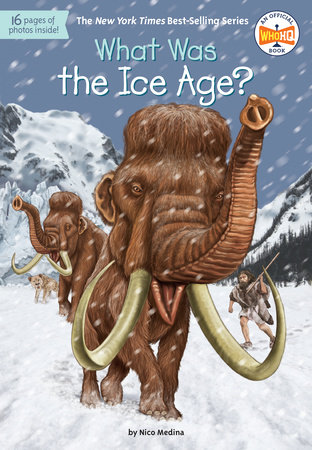
What Was the Ice Age? by Nico Medina and Who HQ


What Was the Ice Age?

by Nico Medina

A part of the “What Was” series, this book is a look at our world 20,000 years ago when glaciers and ice covered most of our planet.


Explore The Ice Age!: With 25 Great Projects: Blobaum, Cindy, Stone, Bryan: 9781619305816: Amazon.com: Books

Explore The Ice Age!: With 25 Great Projects

by Cindy Blobaum (Author), Bryan Stone (Illustrator)

What exactly is an ice age? How do organisms and ecosystems deal with them? How do they affect the Earth? Explore the Ice Age illustrates with activities what happens during and after such an event. Filled with illustrations and fun facts, this book will be a welcome addition to your library.


Out of the Ice: How Climate Change Is Revealing the Past: Eamer, Claire, Shannon, Drew: 9781771387316: Amazon.com: Books


Out of the Ice: How Climate Change Is Revealing the Past

by Claire Eamer and Drew Shannon

A fascinating look into how unexpected things have been emerging from ice melting due to global warming. The book  discusses glacial archaeology, a scientific field in which researchers study these finds and discover new things about our past.


X-Books: Weather: Snow

Snow (X-books: Weather)

by Bill McAuliffe

Take a look at the five most devastating snowstorms recorded and discover fascinating information about the wonders of snow.


Blasted by Blizzards Book by Jill Keppeler | Epic

Blasted by Blizzards (Natural Disasters: How People Survive)

by Jill Keppeler (Author)


Want to learn the basics of blizzards? Blasted by Blizzards focuses on why they occur, what happens afterwards and what to do to prepare for a blizzard-shaped disaster.


Ice! Poems About Polar Life Book Review and Ratings by Kids - Douglas Florian


Ice! Poems About Polar Life

by Douglas Florian

With poetry, wordplay and lots of humor, poet Douglas Florian introduces children to animals that live in the polar region, and also explores scientific concepts like global warming, animal adaptations, and much more.


Susan Summers is a wildlife enthusiast and an author. Contact her at: https://susan-inez-summers.weebly.com/


Shruthi Rao is an author. Her home on the web is https://shruthi-rao.com


Book Renovations

My three little boys are very vigorous tub-takers. They jump, splash, stick things to the walls, and in some cases, tear those same things off the walls with enough force to pull tiles straight out of the mortar. To their credit, they began the repair work right away, and by the time they confessed to my wife and me, the tiles in question were expertly smooshed back into place.

our lovely bathroom in mid-edit

Anyone who lives in an old house knows that when something breaks, it’s usually just the beginning of a much larger project. In my case, the wall behind the tiles was damaged, so those tiles couldn’t be repaired, which meant other tiles had to come out, which meant the whole wall was coming out. I’m planning to petition my state senator to outlaw all toys with suction cups.

Around this time last year, I wrote an article about new beginnings and the editing process. I was redrafting the opening of my new book at the time, and I’m happy to say I’m now wrapping up what I hope is the last major round of revisions before that book goes out on submission. Between that process and the bathroom renovation, I’ve got edits on the brain again, and I honestly don’t think the two projects are all that different. Sometimes you start an edit thinking you’re just replacing a few tiles, only to find that there are issues that run deeper into the plot. Before you know it, you’re redrawing characters and reorganizing scenes, taking everything back down to the studs. 

In the world of home renovations, there are thousands of very helpful YouTube videos for this purpose (I’m shocked at the number of channels devoted entirely to tiling bathrooms). But editing a book is a lot more nuanced, and much more specific. No one can tell you exactly how to shift the tone of a scene and make it work better for your main character’s overall arch. 

Of course that doesn’t mean there aren’t resources available, so for this post I thought I’d share a few of my favorite books on the subject (and if you’re looking for tiling guidance, shoot me a message and I can probably help there, too).


Self-Editing for Fiction Writers, by Renni Brown and Dave King

Hitting its 30th anniversary this year, this classic text is a highly engaging one-stop shop full of examples and non-examples (think features like “what’s wrong with this paragraph?”). Even if you’re not an avid writer, there’s something tantalizing about peeling back the curtain on famous books and getting at the heart of why they work (or in some cases why they don’t). The authors even cover complex and difficult to articulate topics like character voice and beats in dialogue.


The Plot Clock by Jamie Morris, Tia Levings, and Joyce Sweeney

Full disclosure — Joyce is my literary agent, but that’s not why I shamelessly promote this book whenever I get the chance. I’ve been through three novels with Joyce in the last three years, and each time, my first round of notes on the manuscript is an echo of the themes in this text — things like timing and setting up the third act. The plot of a story can feel like a monstrous, unapproachable thing, but this book reigns it in and gives writers a much-needed confidence boost, not unlike a friendly email from your favorite literary agent. 


The Magic Words by Cheryl B. Klein

Cheryl has been a kid lit authority for many years now, and she has had many roles in the writing and publishing world. What makes this book especially exciting for us middle grade folks is that her advice is tailored to writing for young audiences. Concepts like pacing are highly specific to the audience (most adolescent boys aren’t crazy about the slow-burning whodunit). Cheryl also covers very practical concepts like using other people as a lens on your characters and turning a situation into a story. It’s the sort of book you can open randomly and learn something, which I frequently do.


Hopefully by the time you’re reading this, I’ve finished renovating my bathroom walls. Maybe I’ve even finished editing my book and sent it off to Joyce. But of course there are more stories and more inevitable edits waiting around the bend, so these books will stay where they’ve been for the last few years — right in the corner of my writing desk. Maybe I’ll add a porcelain tile to the collection as a reminder that big or small, every fix brings me closer to a finished project.