
 Many kids in this age group can rattle off more dinosaur names and the details about more species than most other twelve people put together. And they have learned much of this on their own, through eager reading! What could be more exciting during this pandemic, when schools are closed and normal summer activities are limited, than for young readers to find books that hold their avid interest for hours and days?
More books on the ever-hot topic of dinosaurs come out every year. I’ve been writing a book about extinct American animals and have been looking at just about everything available for middle-grade readers on the subject. I recommend the following page-turners:
Stephen Brusatte is a leading young paleontologist, but also an engaging author of books for children and adults. In his Day of the Dinosaurs: Step Into a Spectacular Prehistoric World (Wide-Eyed Editions, 2016), readers witness over 100 prehistoric creatures of the land, sea and air through 2nd-person narrative. Older middle graders might also enjoy his best-selling adult book, The Rise and Fall of the Dinosaurs (William Morrow, 2019)
 Kelroy Pim and Jack Horner both fell in love with dinosaurs as kids and now have become leading scientists in the field. In their book, Dinosaurs—The Grand Tour: Everything Worth Knowing About Dinosaurs from Aardonyx to Zuniceratops (The Experiment, 2nd Ed., 2019), readers will find many of the mind-changing latest discoveries. The book also includes Jack Horner’s working field notes and suggestions for how and where readers might go to make their own prehistoric finds.
Extraordinary animals lived and went extinct millions of years before and after those great dinosaur beasts. This may be a whole new area for dino-fans to explore. Fortunately there are a number of wonderful books to help them get a sense of our vast natural history.  One is Matt Sewall’s Forgotten Beasts: Amazing Creatures That Once Roamed the Earth ( Pavilion Children’s , 2019). The well-known and little-known creatures featured in this stunningly illustrated book span half
 a billion years, ending with the extinction of the Tasmanian Tiger in the 1930s.
In their well-researched, humorous, and visually compelling book, Prehistoric Ancestors of Modern Animals: If Extinct Beasts Came to Life, (Hungry Tomato, 2017), Mathew Rake and Simon Mendez use digital photography to show what modern animals might be like if they still had the attributes of their prehistoric ancestors. See also their Prehistoric Giants, Prehistoric Sea Beasts, and Prehistoric Predators, all published in 2017.
For comprehensive, visually appealing reference books for this age group, you can’t miss with anything published by the Smithsonian or by DK Eyewitness books. 
 Some examples: William Lindsay, Prehistoric Life: Discover the Origins of Life on Earth from the First Bacteria to the Coming of Humans (DK Eyewitness Books, Reprint ed., 2012). Or Paul Taylor, A History of Life in 100 Fossils (Smithsonian Books, 2014).
Would readers like to dig up some fossils of their own? Thousands of prehistoric animal and plant remains lie underfoot waiting to be found all over this country (except maybe in Rhode Island where, because of glaciation, fossil hunters may only come up with a trilobite or two and some Carboniferous cockroaches). Amateur fossil hunters, (including children!), have made many scientifically important finds 

Mathew Rake and Dan R. Lynch’s Fossils for Kids: Finding, Identifying and Collecting (Adventure Publications, 2020) covers all those topics, but also explains how to collect responsibly so that you preserve the scientific record. Albert Dickas‘s 101 American Fossil Sites You’ve Gotta See (Mountain Press Publishing, 2018) shows state-by-state where to see prehistoric animals on display, or observe expert digs in progress, or dig on your own.
Would they like to read fiction about fossils? Try Monica
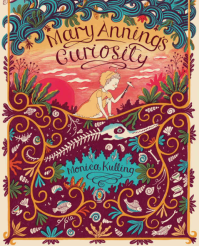 Kulling’s Mary Anning’s Curiosity (Groundwood Books, 2017), a fictionalized account of the childhood of the 19th century shell-collector who revolutionized paleontology
 with her discoveries. Or read Roger Reid’s Time: A Jason Caldwell Mystery (NewSouth Books, 2011) set in a world-famous Paleozoic Footprint site in northern Alabama.
At a moment when there is much uncertainty in the present and about the future, it may be refreshing for readers to focus on the long time of Earth’s natural past. At the very least, they can have fun reading about some fascinating ages and creatures. Please pass this list of books along to any middle-graders you know. There are many more titles that I could have included, but they will find them. I wish there were a reading equivalent of “Bon appétit!”


 Where Have all the Bees Gone? Pollinators in Crisis, by Rebecca E. Hirsch
 Bugs in Danger, by Mark Kurlansky
 Turn this Book into a Beehive, by Lynn Brunelle
 Attracting Native Pollinators: The Xerces Society Guide, Protecting North America’s Bees and Butterflies, by The Xerces Society
 How to Raise Monarch Butterflies: A Step-by-Step Guide for Kids (How It Works) by Carol Pasternak
 Pollinators: Animals Helping Plants Thrive by Martha London
 Know Your Pollinators: 40 Common Pollinating Insects including Bees, Wasps, Flower Flies, Butterflies, Moths, & Beetles, with Appearance, Behavior, & How to Attract Them to Your Garden by Tim Harris
 National Geographic Birds, Bees, and Butterflies: Bringing Nature Into Your Yard and Garden by Nancy J. Hajeski
 The Pollinator Victory Garden: Win the War on Pollinator Decline with Ecological Gardening; Attract and Support Bees, Beetles, Butterflies, Bats, and Other Pollinators by Kim Eierman
 Bug Lab for Kids: Family-Friendly Activities for Exploring the Amazing World of Beetles, Butterflies, Spiders, and Other Arthropods (Lab Series), by John W. Guyton
 Maria is a children’s author, blogger, and poet passionate about making nature and reading fun for children. She’s been a judge for the Cybils Awards from 2017 to present. And a judge for the #50PreciousWords competition since its inception. Her poems are published in The Best Of Today’s Little Ditty 2017-2018, 2016, and 2014-2015 anthologies. When not writing, critiquing, or reading, she bird watches, travels the world, bakes, and hikes. Visit her at
 No matter your actual travel outcomes, keep the adventurous spirit alive in your middle grader’s heart and mind with some virtual trips connected to “destinations” in these excellent MG reads. These ideas might inspire you as a Middle Grade parent, librarian, or teacher to seek out more “travel” locations in your readers’ favorites books. Better yet, challenge your kids, students, and MG library patrons to dream up virtual itineraries connected to books they’ve enjoyed and want to share.
 In Elijah of Buxton by Christopher Paul Curtis, Elijah is the first child born into freedom in the community of Buxton. Buxton was a town in southwestern Ontario, Canada where many freed and escaped slaves settled during American slavery. The child of escaped slaves, Elijah sees the value of freedom when newly escaped slaves arrive in Buxton, and he learns it more deeply when he takes a dangerous trip across the border into America to help a neighbor. Readers can explore Buxton through this
  Reading Jennifer Holm’s Full of Beans? Head south on a photo journey to old Key West. It’s the 1930’s during the Great Depression, and New Deal representatives have arrived to bring tourism to the area in its new role as “Recovery Key.” Beans—cousin of Turtle, title character in Holm’s Turtle in Paradise—tries to sort out an honest role in his community amidst a host of adult untruths.
  And here’s one more! Head to the Big Apple and take a peek at some of the (modernized) sights that Claudia and Jamie Kincaid might have seen during their great adventure at