Posts Tagged authorinterview

WNDMG Author Interview: Khushboo Patel on her Verse Novel ALL THAT CHANDNI KNOWS


Author Interview – Khushboo Patel

I’m so excited to be able to introduce you to author Khushboo Patel today. Khushboo is a debut author of a gorgeous new middle grade novel in verse as well as a couple picture books, and I had the honor of reading (and blurbing) her gorgeous MG book! Her title is called “All That Chandni Knows” which launches from G.P. Putnam’s Sons Books for Young Readers/ Penguin Kids on March 31, 2026.

I absolutely loved every bit of this book— the verse, the plot, the character, the voice. I find myself always searching for new verse novels, and I promise you—this one is magical!

 I was enthralled from the very first page of the book, and I know everyone will adore it too!

I encourage everyone to buy a copy for themselves and their classrooms and libraries.

About ALL THAT CHANDNI KNOWS:

Description taken from online:

A powerful middle-grade novel in verse set in India at the turn of the millennium that follows a 12-year-old girl as she navigates new beginnings, difficult truths and a crush.

Perfect for fans of The Night Diary; Red, White and Whole; and Remember Us. 

For twelve-year-old Chandni, 1999 is the year everything must be perfect. And why shouldn’t it be?

Her parents are well-respected doctors in the community, she’s the leader of her friend group, and her crush is even hinting at liking her back. She also has her sights set high on a spot at India’s most prestigious boarding school for girls. If she stays focused and works hard, the dream just may be in reach.

But as the boarding school selection looms closer, Chandni is overwhelmed by a devastating secret that’s threatening to tear her family apart. With life and relationships spiraling around her, Chandni will have to decide between pursuing her ambitions and protecting her family.

Set against the vibrant turn of the millennium in India, this debut middle-grade novel in verse is a beautiful and vulnerable story about the seismic events that life throws at us and the love that helps us brave it all.

Interview with Khushboo:

I loved getting to talk to Khushboo about her new book and I know you will enjoy meeting her and Chandni as well.


SSS: What a wonderful book. I was interested right away, from the very first page and Chandni’s teasing of her secret! What is the inspiration behind Chandni’s tale (and only what you feel comfortable sharing) ?

KP: Thank you, Shifa! I so appreciate the care with which you asked this question.

This story started for me with these questions: What happens when the world as we know it is upended? What do we fear? What do we rely on? Where do we find comfort or relief? How do we navigate the push-pull between ambition and protection, and acceptance and agency, and perfection and freedom?

And as I was writing, more questions showed up (some that I wasn’t expecting), and I loved exploring and grappling with them. 

This book is very much a work of fiction, but like Chandni, I grew up in Vadodara in the late ‘90s, and I struggled with some of the things she struggles with. And while it is a story of pain, it is also a celebration of so many things I love—coming-of-age stories, mother-daughter stories, first-person stories, poetry, music, my childhood city, language, food and culture, middle-grade friendships and crushes, all the games we played, and just getting to show kids today—a life before the internet.

SSS: As a mom of three girls, I wanted to reach out and hug Chandni! Her voice and her personality are so sweet, and yet full of strength, and the clear care you took to craft a story that was both important and compelling was absolutely remarkable! How did you balance such a strong voice with such a heart-wrenching story?

KP:I think when you are dealing with some pain, it is easy for the character to slip into a complaining or whining tone. And when you are trying to write a flawed character, it can sometimes come across as brash or annoying. It’s all so tricky! I certainly see that now when I look back at the beginning of my first draft, and I think that’s normal because setting up the story is so hard craft-wise, and in the first draft, you are just trying to figure out the characters and the story problem on the page. Good thing we get to revise and revise and revise!

Voice can be such an elusive and inexplicable thing and it’s so often a writer’s unique way of looking at and expressing things, but I think a part of it is also working on craft and story.

I think what helped the voice here is the fact that Chandni is a complex character. She has such different roles at home and at school and so much is changing around and within her, that she is forced to act, even if she is doing some things all wrong. I think it helps to have a character with agency and enough things happening with the plot, which are not things one would usually think of when thinking about voice. Chandni came into her own when I put her through the wringer, and she had to react and do things.

And I am forever grateful to my brilliant critique partner and friend Lisa Carter, who told me that the trick is going to be conveying this story through the eyes and voice of a protagonist who is in pain, YET is innately positive, proactive, and making the best of her situation. It’s advice that I held close while revising.

SSS: I loved reading all the details about Chandni’s life, her food, her culture, and even the historical time frame that was so relatable to myself as a kid growing in America in the 90s/2000s!

How does Chandni’s setting of 1999 India impact her life, her friendships, and her family?

KP: This is such a good question, because the fact is that the story would not have worked if it was not set in this time period in this particular society. She would probably not have kept this secret as long as she did, or would maybe have felt less scared of societal expectations and norms, and then the stakes just wouldn’t be there in the same way.

And yet, the story also lives in a place that maybe feels liminal and timeless and relatable because a lot of these societal conversations (colorism, women’s safety, patriarchy, religious tensions, etc.) are still relevant today, not just in India, but in many parts of the world.


SSS: I absolutely loved how the mother was a doctor! I loved how you both critiqued society for the misogyny present in some spaces but also showed the resilience and strength of women that have always persevered and taken up space throughout any time and place. How did you strike this balance?

KP: I loved exploring that in this book—that mirroring of ambition and the pull of dreams, and staying true to oneself, even for the mother. How the conditions are always difficult, but we try to push boundaries for ourselves and future generations. And also, the tension of how that sits alongside the demands of motherhood. Life and society are not perfect, so then, what is the perfect choice? Which also ties into one of the main themes of the book.


Link to order here.

Writing Process


SSS: When did you start writing the story and was the process a long one?

KP: I wrote just one chapter in prose in September, 2022 and shared it and the premise with Joyce (my lovely agent), who immediately cheered it on. Then the story mostly just sat in my head and in the form of a list of scenes as notes. In February, 2023, I did a workshop with SCBWI on beginnings and endings, and I then started drafting more seriously, this time in verse. From there, the first draft came out pretty quickly, and I shared it with some writing friends and then with Joyce in April, 2023, who loved it. I also sent it out for more critiques and then again, I just sat with the feedback and the story. So much of writing for me is also just thinking about the story and the many directions it could go in and working things out in my head before I put them on paper. I wasn’t feeling ready to put it out and wanted to revise more, but didn’t know how to begin, and I was also working on my other picture books and taking more courses and learning craft. Simone (my brilliant editor) acquired it in May, 2024, and it went through several intense rounds of revisions after that! Writing is never easy for me, but the whole process has been so rewarding, and I will forever cherish these years I spent working on it.


SSS: How is the process of writing a historical novel in verse? Was there anything specific you had to research, or did you write it from mostly your personal memories?

KP: Since it’s not a fact/history-heavy story, it was mostly from personal memories and mining memories of friends and family. It was so fun to go down memory lane! In terms of research, I did do some general search to nail down the specific year that would work best for the story, and I also spent a lot of time listening to music from that time, to find exactly what I needed for certain scenes.

SSS: Any advice for fellow middle-grade authors?  

KP: I’m not sure I know enough to give advice, but one thing that has really helped me is the support of my writing friends, so I’d say, find your writing community.

The writing process is so personal, so the best advice seems to betry different things and do what works for you.

And here are some things I routinely tell myself:

Just try. This is a long game, rejection/ block is a part of the process, and endurance/ giving yourself grace is key. Read deep and wide and engage with different types of art (paintings, music, architecture, movies, etc.). See what you like, don’t like, lean into your taste, and trust your gut. Try new things and keep your mind open. Keep learning craft. Do the deep work. Ask for help. Let go of perfection, get past the cringe, and be okay with ‘failing’ publicly. And don’t forget to have fun!

All easier said than done!

Bonus!

SSS: Bonus question! Is there anything I haven’t asked that you’d like to share with us?

KP: No, I think you covered it all. You asked such great, thoughtful questions!

SSS: What else can we look forward to from you?

KP: My picture book Stolen Colors, illustrated by Tara Anand (who also did the beautiful cover art for Chandni!) is out from Levine Querido on March 3, 2026. It is a book about body safety and consent, and I can’t wait for the world to see Tara’s stunning, powerful art.

And I have another picture book My House is a Muddy River coming out from Putnam/ Penguin Kids in Spring 2027, illustrated by Lavanya Naidu, which was actually my first book deal!  It’s a flood story set in India and I recently got to see the gorgeous first sketches.

I feel so grateful to get to work with such amazing artists and editors.


Thank you Khushboo for joining us- and again, I reiterate to everyone to go READ THIS BOOK!!!


KP: Thank you for having me! I so appreciate your kind words and support. You and your work are an inspiration, Shifa! All my best to you.


About Khushboo Patel:

Khushboo Patel is an Indian American author of children’s books. Before she found the courage to write, she was a lawyer and an entrepreneur. She currently lives in Florida with her husband and two children. All That Chandni Knows is her debut novel.


Website: https://www.khushboo-patel.com/

INSTAGRAM: https://www.instagram.com/khushboo_.patel._/

Bluesky: https://bsky.app/profile/khushboopatel.bsky.social


WNDMG Author Interview with Lynnette Mawhinney about her New Book

WNDMG Author Interview with Lynnette Mawhinney about her New Book

I’m so excited to be able to introduce you to author Lynnette Mawhinney today. Lynnette’s book is titled Mamie Phipps Clark, Champion for Children (Magination Press), which is was published February 6, 2024.

I absolutely love graphic novels, and this one is nonfiction too! It is so important, with themes of fighting against segregation, of historical events in America like the Brown vs. Board of Education case, and an amazing Black woman who can inspire all of us.

I encourage everyone to buy a copy for themselves and their classrooms and libraries.

About Mamie Phipps Clark, Champion for Children:

Description taken from online:

This inspiring graphic novel tells the story of groundbreaking psychologist and civil rights activist Mamie Phipps Clark, PhD and her research in the racial identity and development of self in Black children, the work that ultimately played a vital role in the landmark Brown v. Board of Education case.

Part of American Psychological Association’s Extraordinary Women in Psychology series.

Mamie was born and raised in Hot Springs, Arkansas, during a time when United States laws intentionally disadvantaged Black people and permitted racial segregation. This profoundly impacted her life and work and instilled in her an unstoppable force to champion for Black children. Mamie made a difference with science – she studied math and psychology at Howard University. She was first the Black woman to graduate from Columbia University with a doctorate degree in psychology. Mamie expanded her earlier master’s research into the famous black-doll/white-doll experiments that exposed the negative effects of racial segregation in children. Along with her research partner and husband, Kenneth Clark, Mamie became expert witnesses in several school desegregation cases, including Brown vs. Board of Education in 1954, which effectively ended racial segregation in school. Mamie dedicated her life to advocate for children who deserved more than what society offered them and she built the Northside Center in Harlem, NY to support children with special needs, academic programs, and mental health services.

Filled with interesting news stories and thought-provoking activities, this book encourages readers to carry on Mamie’s legacy and become champions for themselves and others in their community.

Interview with Lynnette:

I loved getting to talk to Lynnette about her new book and I think you will enjoy meeting her as well.


SSS: What a description! This book sounds SO important, and I cannot wait to read Mamie’s inspiring story. What inspired you to write about Mamie?


LM: Magination Press approached me to write this book, as it was the next in the series Extraordinary Women in Psychology. I knew about Dr. Clark from the doll test, but after that, I didn’t know much about here. Deep diving into the research to bring her to life, I was just taken aback as to how much her work has influenced all of us—even today. The more I learned about her, the more, the more she inspired me, and the more motivated I was to bring her story to light.

SSS: How do historical events and laws impact society today? What can Mamie teach us about the world today?

LM: Dr. Clark’s story teaches us that change can be a long process, but it also has lasting impacts. I think Dr. Clark teaches us to stay the course, keep justice and youth at the forefront. When we advocate for justice-oriented change, the historical events and laws need to be simultaneously embraced, analyzed, and challenged for continued and lasting change.

SSS: I love graphic novels. How was it like to collaborate with an artist on this project?

LM: In this world, I don’t get to collaborate directly with the illustrator, as all requests go through our editor. But working with Neil was great, as he graciously took any feedback I had given the editor. His artwork and truly gift was the key to bringing Dr. Clark’s story to life, and I am forever grateful.


SSS: The subject of segregation is so important, and teaching anti-racism is a must in classrooms. How can nonfiction help teach students to advocate for justice?


LM: My immediate response is, “when we know better, we do better.” That, I hope, is one of the lessons that history teaches us. We can learn from our past in order to do better for and with humanity in the future. Dr. Clark’s story tells us how youth can continue to be advocates for change, and how being a visionary can help to change make a difference for justice.

SSS: Do you have any more incredible book recs for us?

LM: I am currently in the middle of reading When the Stars are Scattered by Victoria Jamieson and Omar Mohamed. It is also a non-fiction graphic novel/memoir about Omar’s life growing up as a refugee in Kenya. I haven’t finished reading it yet, but so far, the book has been wonderfully done! It’s a compelling read. 

SSS: Thank you so much for this beautiful rec.


Link to order Lynnette’s Book here.

Writing Process

SSS: When did you start writing this book? How do you think your background of being a Professor of Urban Education help you in writing?

LM: I stared the research process in 2021. Dr. Clark was NOT easy to research, as she was often pushed to the side because she was a woman. I often joked that this research process was like “Where’s Waldo” and trying to find Dr. Clark’s legacy and story.

As a scholar, I honestly had to use all my research skills I have been trained in with this process. I interviewed people, spent LOTS of hours in libraries, and went to museums to collect data. As a matter of fact, this project pushed me to learn new research skills with exploring archival research and helped to build me up as a researcher.


SSS: How is the process of writing a graphic novel different from writing a picture book, or an adult book in prose? (I noticed you are so prolific!)

LM: This was an extremely new and different process of writing. For a graphic novel, I would say it is equal to writing a screenplay. In a graphic novel, I had to not only write the story and dialogue, but I also had to write out each scene. It was like writing “stage direction” or in this case “visual direction” along with the dialogue. It was fun, as it really got to push my visualization of Dr. Clark’s life.

SSS: Any advice for fellow authors?


LM: Keep writing and keep exploring. Don’t be afraid to try new ways of writing or contributing your voice to this world because what we all have to say and share with the world matters.

Bonus!

SSS: Bonus question! Is there anything I haven’t asked that you’d like to share with us?

LM: Dr. Clark was a visionary and way before her time. I hope that readers enjoy the book and get to see just how her work continued to influence all our daily lives.

Thank you so much Lynnette for answering my questions! I hope everyone picks up a copy of your beautiful book.

About Lynnette Mawhinney PhD:

LYNNETTE MAWHINNEY, PhD, is an award-winning writer, creator, and long-time educator. Dr. Mawhinney was a former high school English teacher at the School District of Philadelphia and transitioned into teacher education. She has conducted teacher trainings in the U.S., Vietnam, Taiwan, Thailand, South Africa, Bahrain, and Egypt. Dr. Mawhinney is Professor of Urban Education and Senior Associate Dean for Strategic Academic Initiatives at Rutgers University-Newark. As a secret artist, she applies her craft of visual-based approaches to her research and scholarship on the recruitment and retention of teachers of Color. She is the author and editor of five academic books.

In 2020, Dr. Mawhinney was the recipient of the American Educational Studies Association’s Critics Choice Book Award for her co-written book, There Has to be a Better Way: Lessons from Former Urban Teachers.


Aside from academic books, Dr. Mawhinney is a children’s book author. Her first book, Lulu the One and Only, received an acclaimed starred Kirkus Review, along with awards such as the Notable Social Studies Trade Book Award by the National Council for Social Studies and the Children’s Book Council. Her new book, Mamie Phipps Clark: Champion for Children, is a biography graphic novel for youth.

Dr. Mawhinney is also the Founder and President of Gaen Knowledge, LLC, a consultancy firm that performs traditional and visual-based evaluation and equity audits for organizations (e.g. PreK-12 schools, higher education institutions, and clinical health settings).

Links:

Website: www.lynnettemawhinney.com

Instagram: @lkmawhinney


Spooky, Scary Stitchers

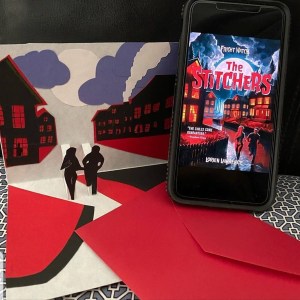
For those of you who love spooky, scary middle grade, I have a treat for you. The Stitchers (ABRAMS/Amulet 2020), by debut author Lorien Lawrence, releases this week, and alongside that spooky scary goodness, it’s SO. MUCH. FUN.

The Stitchers Cover

About The Stitchers:

Thirteen-year-old Quinn Parker knows there’s something off about her neighbors. She calls them “the Oldies” because they’ve lived on Goodie Lane for as long as anyone can remember, but they never seem to age. Are they vampires? Or aliens? Or getting secret experimental surgeries? Or is Quinn’s imagination just running wild again?

If her dad were still around, he’d believe her. When he was alive, they’d come up with all sorts of theories about the Oldies. Now, Quinn’s determined to keep the investigation going with the help of Mike, her neighbor and maybe-crush. They’ll have to search for clues and follow the mystery wherever it leads–even if it’s to the series pond at the end of the street that’s said to have its own sinister secrets. But the Oldies are on to them. And the closer Quinn and Mike get to uncovering the answers, the more they realize just how terrifying the truth may be.

Interview with Debut Author Lorien Lawrence

Welcome, Lorien Lawrence, to the Mixed-Up Files! As I often do, I shared your book with my son, who’s a middle grade and young adult reader.  He loved the Stitchers–which meant he and I got to collaborate on these interview questions.  NOTE: This interview has been edited slightly in order to group topics and transitions.

HMC: I am always curious about origin stories – where did you get the idea for the Stitchers?

LL I think I say this in another!er interview, but there’s nothing scarier than losing someone you love. I wrote this story after my dad suddenly died. I had just moved back to my hometown with my husband, and we would go for these really long walks and try to make sense of what happened. Eventually, my childhood streets brought back happy memories and feelings of nostalgia instead of sadness. And we started to play a “what if” sort of game, where we took turns wondering “what if that house was haunted?” or “what if that pond was magical?” Eventually, one of these “what ifs” turned into THE STITCHERS. So I guess writing Quinn’s story helped me come to terms with my own grief.

Writing About Loss for MG

HMC: (As you just mentioned,) your main character, Quinn, is coping with the loss of her father … and picking up where he left off, investigating the same mystery. Loss and fear are pretty scary subjects no matter how old you are … how did you balance respecting your middle-grade readers’ maturity with knowing when the subject matter needed to be age-appropriate?

Finding this balance was probably the most difficult part of the writing experience for me. I knew I needed to show Quinn coming through the other side, so to speak. She doesn’t miss her dad any less, but she learns how to live a new kind of normal. Her dreams continue, her friendships continue, even though she herself has changed. But the change isn’t all bad: she’s stronger. She’s braver. She’s more determined and more vulnerable. And she realizes that she’s still surrounded by people who love her.

Questions from HMC’s Son

HMC’s Son: What was your favorite part of this book to write? 

LL: Great question! My favorite part to write was the scene in the basement of the funeral home. I won’t give it away, but it was delightfully gruesome and fun to imagine!

HMC’s Son: What did you like most about Quinn? 

LL: Another great question! I like that Quinn is flawed. She lies. She hides the truth. She hides her true feelings. But these are things that normal 12 year olds do. And by the end of the book, she makes things right.

HMC’s Son: This book is the beginning of a series. Can you give us any hints about what is coming up next for Quinn and Mike?

LL: The next book in the series is called THE COLLECTORS, and it comes out next fall. It follows Quinn once again as she and Mike launch into a new supernatural investigation – but I don’t want to give too much away! 😊 I can say that it picks up directly where THE STITCHERS leaves off.

Stitchers Fan Art

                                                                                Stitchers Fan Art, by Elle Jauffret

Eternal Youth, Monsters, and Witches

HMC: Another interesting theme in your book is about the eternal quest for youth … and how it can make people do strange things. (!!) What takeaways do you think this element in your plot has for the middle-grade reader?

I think I was inspired by the day-old conundrum of kids wanting to be older, and adults wanting to be younger. In reality, we need to just learn to appreciate where we are in the moment.

HMC: In this book, I found lots of literary and theater connections, from Frankenstein to the Crucible. Did any of those influence your writing?

LL: Oh my gosh, I’m thrilled that you noticed! YES! I’ve always been taken with Frankenstein and The Crucible – really the whole idea that society creates the monsters, not the other way around.

Open Mic Question

HMC: What do you want us to know about The Stitchers that we haven’t asked?

LL: A quick fun fact: I have tiny clues hidden in THE STITCHERS and THE COLLETORS that hint towards future books in the series!

THE PANDEMIC QUESTIONS

HMC: I’ve begun a new line of pandemic questions in all my interviews because I’m curious about how we as kidlit authors are going to handle the pandemic in our writing going forward. You’re a middle school teacher in New England – will you be going back into the classroom to teach this fall, or will you be teaching virtually?

LL: As of right now, I still don’t know where or how I will be teaching. I am assuming that I’ll be teaching virtually as I did in the spring. I’m from Connecticut, and our state got hit with the virus early, so my school closed in early March and remained closed for the year. Whatever I end up doing, I’ll try to make the best of it!

HMC: How has the coronavirus pandemic affected your writing life?

LL: I grew up with (and still struggle) with anxiety, and writing has always been a coping mechanism for me. So I’ve actually been writing a lot! I wrote two new manuscripts during quarantine. I don’t know if these books will ever see the light of day, but it helps me to throw myself in a made-up world when times are scary.

HMC: Will Quinn and Mike have pandemic related conversations in your new book?

LL: This is a great question! I honestly don’t know the answer! They won’t be talking about it in the first two books in the series, but if I’m able to publish more adventures of Quinn and Mike, I’ll have to have a serious think about what to do with that. Maybe I’ll ask my students if they would be interested in reading about something so scary and recent. I’m sure they’ll have strong opinions either way!

((More about pandemic writing in this archived post on Writing Prompts for a Pandemic))

HMC: Thanks so much, Lorien. Congratulations on your debut and best of luck to you!

Debut Author Lorien Lawrence

Lorien Lawrence

Lorien Lawrence is a writer and middle school English teacher from Connecticut. When she’s not reading or writing, she can be found hunting ghosts with her family. The Stitchers is her debut novel.

Where to find the Stitchers:

  1. Bookshop.org
    1. Click on this link, then search for THE STITCHERS — or any other book.
  2. Amazon