

Mixed-Up Files posts monthly interviews with the owners of children’s-only bookstores and there are still many more of those to feature, but I’ve recently discovered [words] bookstore in Maplewood, N.J. (wordsbookstore.com), a general independent bookstore with a strong emphasis on children’s books, and most importantly with a unique and hopeful mission. This is a bookstore with a heart, and I’m eager to spread the news. Today I’m talking with [words]Co-owner Jonah Zimiles.
![[word] Co-owners Jonah and Ellen Zimiles](https://i0.wp.com/fromthemixedupfiles.com/wp-content/uploads/2013/02/screenshot_626.jpg?resize=300%2C227&ssl=1)
[word] Co-owners Jonah and Ellen Zimiles
Jonah: Thank you. We have lived in Maplewood for twenty-three years and raised our two children here. When the economy deteriorated in the Fall of 2008, we wanted to find a way to help our community. My wife and son were walking in town when she saw a sign saying that the bookstore was closing in a month. Ellen thought that we should buy the bookstore, even though we did not have retail or book industry experience.
MUF: Your store has also taken on the unique mission “to help Maplewood become a model community of inclusion” by acknowledging and serving a special community, families with members on the autism spectrum. How did that come about?
Jonah: In addition to assisting our community buffeted by the recession, we were interested in providing a model vocational training program for young people with autism. Our hope is that through our bookstore, we will inspire other for-profit businesses to hire employees with autism. Our son, who is now 17, has autism. We have always found Maplewood to be a warm and welcoming community, and we wanted to play our part in furthering that culture.
MUF: Tell us about your “Second Sundays.”
Jonah: Our Second Sundays programs were created to provide parents of special needs children the opportunity to sample for free many activities that are often available for typical children but unfortunately not for the special needs population. At the same time, it allows us to acknowledge and publicize service providers who are offering these services or to give new ones considering this market a chance to try out working with our kids at our store. Activities include: yoga, karate, arts & crafts, drama, sewing and cooking, to name a few.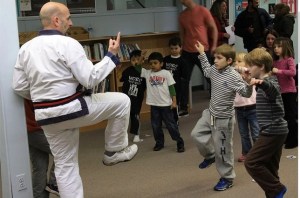
MUF: Not only do you welcome autism syndrome kids in your store and provide programs they can take part in, you also employ them as part-time workers and provide vocational training. Tell us how that works.
Jonah: Most of our kids come to us through job sampling programs in their school. They come in small groups with job coaches once or twice per week and progress through a series of jobs depending upon their skill levels and interests. We also have paid employees on our staff with autism.
MUF: Say a ten-year-old comes into your store looking for “a good book.” Do you have some favorite titles, fiction or nonfiction, that you are especially recommending to middle-graders right now?
Jonah: Our middle graders love Rick Riordan, Jeff Kinney and Dan Gutman. One of our favorite books is R. J. Palacio’s Wonder.
MUF: I’ve just re-read Marcello in the Real World for a workshop. It seems there have been a slew of original and engaging novels for children in the last few years whose main characters are somewhere along the autism spectrum——Mockingbird, London Eye Mystery, The Blue Bottle Mystery, Colin Fisher — and that these stories have the positive side-effect of creating insight and understanding in the general reader. Are these books popular at your store? Have any of their authors come for a visit?
 Jonah: We have seven or eight autism authors visit our store for readings during April for Autism Awareness Month but these authors so far have been non-fiction authors. We have tried unsuccessfully to get Jodi Picoult to our store. Some of our favorites have included practitioners like Ricki Robinson, author of Autism Solutions, researchers like Martha Herbert, author of The Autism Revolution, and parents, like Priscilla Gilman, author of The Anti-Romantic Child: A Story of Unexpected Joy.
MUF: [Words] became an instant community center in another sense after Hurricane Sandy hit, didn’t it?
![[words], a haven during Sandy](https://i0.wp.com/fromthemixedupfiles.com/wp-content/uploads/2013/02/screenshot_6233.jpg?resize=300%2C200&ssl=1)
[words], a haven during Sandy
MUF: If a family from out of town came to visit your store, would there be a family-friendly place nearby where they could get a bite to eat after browsing?
Jonah: Yes, dozens! Arturo’s across the street is extremely popular and delicious, and the Laurel offers a terrific relaxed atmosphere with great food.
MUF: And if they could spend some time in Maplewood, are there some family activities or sights in the area that they shouldn’t miss?
Jonah: In addition to our quaint village with many fine shops, we have a beautiful park in our town that is well worth a visit, as well as a gigantic nature preserve, the South Mountain reservation. Of course, the best reason to come to Maplewood is to meet the Maplewoodians!
MUF: Any exciting programs coming up in March?
Jonah: Many! Two are of particular note. On Saturday, March 2, we celebrate Read Across America, with a kids’ Pitchapalooza featuring four local children’s authors. On March 20, Harlan Coben kicks off his publicity tour for his exciting new thriller, Six Years.
MUF: Thank you so much , Jonah, for sharing the goals and programs of your store with us.
Readers, if you’re as inspired as I am to read about what Jonah and Ellen are doing at [words], I’m sure they’d love to hear your comments–and have you visit!
Sue Cowing is the author of the middle-grade puppet-and-boy novel, You Will Call Me Drog, published in 2011 by Carolrhoda Books and in 2012 by Usborne UK


