I’m pleased to welcome author Kate Hannigan to the Mixed-Up Files today. Her debut middle grade book, Cupcake Cousins, was published yesterday from Disney-Hyperion! Books 2 and 3 are scheduled to release in 2015 and 2016.
Q: What inspired you to write Cupcake Cousins? Do you have a fondness for cupcakes…or cousins?
A: The short answer is my kids and their cousins, and the beauty of Michigan, are what inspired this story. Cupcake Cousins is set during a week-long summer vacation for an entire extended family — grandparents, kids and cousins, aunts and uncles, all together under one roof. And that’s just where I got the idea for the story. My fondest memories are of my wonderful cousins and big Irish Catholic family gathering at my grandparents’ old house in Philadelphia. My three kids adore their cousins and they can’t wait for the vacations we spend together each summer, when everybody piles into a rented house on the coast of Lake Michigan.
 Cupcake Cousins is a celebration of those summer moments when kids are outdoors running around all day, eating meals in the fresh air, unplugged from the daily grind. I love the specialness of the cousin relationship — they’re as close as siblings but without the petty quarrels. As for baked goods, yes! I’m a sucker for any kind of pastry! My own daughter and her cousin spent a lot of time baking when they were almost 10-year olds, like the two main characters in the story, Willow and Delia. I wanted to write a book where kids could engage in their interests and discover what they’re good at.
Q: How long did it take you to write the manuscript? How did you react when you found out it would be published?
A: I worked on the manuscript for about a year before finding an agent. And when I showed it to her, I was so grateful that she liked what she saw. We tinkered with it a bit before going out to publishers. The thing about shopping a manuscript is, it’s a whole lot like falling in love — you need just one. And thank goodness, one editor did fall in love! My editor has been a huge supporter of this story from day 1. She’s asked for two more books, so Cupcake Cousins will be a three-book series, with book 2 coming spring 2015 and book 3 in winter 2016. As for my reaction, I am completely superstitious so when we were going back and forth with the contract, I was worried that they might not take the manuscript after all. But as my editor and I were on the phone one day, a hummingbird fluttered to my window. Well, that was the sign I needed! I feature hummingbirds in Cupcake Cousins, so after I saw my own, and then the deal finally went down, I felt a cosmic sense that everything was all right in the universe!
 Q: You live in Chicago, but the story is set in Saugatuck, Michigan. Tell us why you chose that as the setting.
A: Western and Northern Michigan are crazy beautiful destinations! For our family, we spend every summer picking fruit and riding our bikes all over the state! It’s a quick drive from Chicago for us, and easy for our cousins from Detroit to meet us. So it was natural for the cousins in the book to do the same. I also love the Midwest and want to celebrate this part of the world as best I can. I wanted to write a timeless sort of book that had none of the trappings of the digital world. Nothing that would date it, but everything that would make it endure. The idea of kids chasing fireflies and picking blueberries, those are the rites of summertime.
Q: I understand that dogs are a big part of your life — your real dog that serves as your “writing companion,” and the fictional dog in Cupcake Cousins. Did you know from the start that this story had to include a dog?
 A: Yes, absolutely. What is life without a big, drooly dog at your side? Really? I cannot write a book where the dog dies! I can barely stand to read them! When I was reading Island of the Blue Dolphins to my youngest, I had to pass the book over to my husband to finish the part where her dog dies. So, spoiler alert: Bernice the Bernese mountain dog in Cupcake Cousins does not die!
My own dog is a quirky Australian shepherd named Bella. She is an amazing writing companion. She likes to stay close to me, so she often plops down under my desk and lies on my toes as I type. When it’s time to pick up my kids from school, she paces around the room and stares up at me, as if saying, “Seriously, why aren’t you getting the keys?”
Q: What was your favorite book as a child, and how did it influence your writing?
A: I was not a voracious reader as a child. I liked running around outside, playing from morning to night. And when I did read, I re-read the same stories again and again. Then I would act out the story in my backyard. When I think about my favorite books for children, Island of the Blue Dolphins, Anne of Green Gables, The Penderwicks, I will say that the characters’ resourcefulness is what appeals to me. I like how they use their wits to get themselves out of a jam, and I tried to do that with Willow and Delia in Cupcake Cousins. And, the emphasis on family appeals to me in those stories.
Q: Are you a good cook? Tell us about the malted milk ball cake pictured on your Twitter page.

A: I’ve been lucky enough to live in two amazing restaurant cities: San Francisco and Chicago. So I definitely enjoy following the foodie scene and getting to good restaurants. But I do cook pretty much all of our meals. “Good” is a relative thing; I’m more like an “enthusiastic” cook! Evolving. In my early days, I was pretty dangerous — there were stove fires, that sort of thing! So I identify with the main characters in Cupcake Cousins, who have their share of kitchen disasters. Somewhere along the way, with the help of Food Network and Pinterest, I got the hang of it. I found the recipe for the malted milk ball cake on Pinterest. Cupcake Cousins features fun recipes that I’ve made with my kids over the years.
Q: Your second middle grade novel, a historical fiction book titled, The Detective’s Assistant, will be published next year. Tell us how and why you switched gears from a contemporary story to a historical one. What inspired this particular book?
A: When I stumbled on a juicy historical nugget, I knew I wanted to write about it. So when Cupcake Cousins was in the long process of back and forth editing, I got to work on this new idea. Writers are always advised to have a next project to focus on, and I think that’s fantastic advice. I was able to throw myself into writing and researching The Detective’s Assistant during the downtime with Cupcake Cousins. And thankfully, it sold to Little, Brown. There is a Lincoln angle to the story, so it will publish in April 2015, at the 150th anniversary of Lincoln’s assassination.
Q: I’m always curious how writers balance their time. Do you have any secrets to share?
A: I treat my writing time like I’m clocking in and out of the office. I drop my kids at school, then get down to it until school lets out, five days a week. I don’t have any secrets, but I do think it’s important to take yourself seriously. If you want to accomplish things as a writer, you have to treat writing as your job and commit to it fully. I love being able to get up each day and do the writing and researching. Not everyone feels that way about their job, so I am deeply grateful for what I’ve got. But working and writing at home can be challenging. I’ve had to put a fence around what I call my sacred writing time.
Q: What are you working on now?
A: I’m hustling to get books 2 and 3 done for the Cupcake Cousins series, and The Detective’s Assistant is still in production. I have a third project I’m hoping to complete. It’s another historical middle grade, about the Easter Rising in Ireland.
Q: And now for the lightning round! Where would we find you on a Sunday afternoon? What’s your favorite ice cream flavor? Were you ever a flower girl?
A: Sunday afternoons, I would likely be hanging out with my family, cooking, at the gym, or walking Bella. As for ice cream, I’m pretty particular. Haagen-Dazs Ducle de Leche and nothing less. Once you taste it, there’s no going back! I also love Sherman’s Dairy Bar in South Haven, Michigan. I was never a flower girl but I was a bridesmaid in six weddings before I was the bride! My daughter was a flower girl just a few years before I wrote the book, and I’m sure the joy of that experience was still in my mind.
Thanks, Kate, for stopping in today! Visit Kate’s website here, and her terrific blog, where she somehow finds the time to post interviews with numerous authors. We’re giving away ONE AUTOGRAPHED COPY of Kate’s delightful, charming book, so if you’d like to enter the giveaway, please post a comment below!
Michele Weber Hurwitz is the author of two middle grade novels for Wendy Lamb Books. Visit her at micheleweberhurwitz.com.

 Sue Cowing for Mixed-up Files: If only every state had a lively book shop on the main street of it’s capital city! Today it’s a pleasure to be chatting with Jane Knight of Bear Pond Books (www.bearpondbooks.com ), which has been called “one of the great independent book stores on earth.”
 MUF: What do you hope people will experience when they walk into Bear Pond Books and browse?


 Fiction: The Evolution of Calpurnia Tate by Jacqueline Kelly, Okay For Now by Gary D. Schmidt, anything by Linda Urban, The Bartimeaus Trilogy by Johnathan Stroud, the Bone series by Jeff Smith, Clementine by Sara Pennypacker, Nation by Terry Pratchett, the Guys read series… please stop me now!!!!
  For Non-fiction: Bomb: The Race to Build and Steal the World’s MostDangerous Weapon by Steve Sheinkin, Shipwreck at the Bottom of the Sea ; The Extraordinary Story of Shackleton and the Endeavor by Jennifer Armstrong, Courage Has No Color: The True Story of the Triple Nickles, America’s First Black Paratroopers, by Tanya Lee Stone, anything by Steve Jenkins. New
  Titles: The Glass Sentence by S.E. Grove, The Meaning of Maggie by Megan Jean Sovern, Under the Egg by Laura Marx Fitxgerald, The Great Greene Heist by Varian Johnson, The Return of Zita the Spacegirl by Ben Hatke.
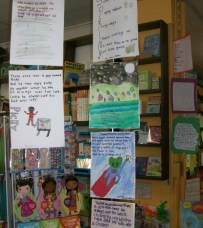 And as we speak I am planning a writing workshop for kids this fall with the wonderful Sarah Stewart Taylor, author of the Expeditioners series.
  We have also hosted events with several VCFA faculty, visiting faculty and students, including Leda Schubert, Emily Jenkins (E.Lockhart), An Na, A. S. King, and Tim Wynne-Jones. We also hosted a super fun Reader’s Theater with a group of VCFA alumni who performed some of their new work.


 A Black Hole Is Not a Hole by


