
 I’m excited to interview one of our very own Mixed-Up Files authors who recently had two book releases in her middle-grade series about the irrepressible Ellie May—Hillary Homzie. So let’s get started…
Hi, Hillary, so happy to have this chance to have you with us today. First of all, I always enjoy your books, and I especially love the humor in the Ellie May books. The illustrations by Jeffrey Ebbeler definitely add to the fun.
Can you tell us a little about the chapter books?
Absolutely! The books feature Ellie May who—whenever she tries to do something great—things tend to get a little mixed up. However, the exuberant second grader never gives up. In Ellie May on Presidents’ Day, she would give anything to be flag leader during the Pledge of Allegiance. After all, she has a really loud voice, knows how to stand super straight, and knows cools facts about the presidents. In Ellie May on April Fools’ Day, she wants more than anything to be funnier than Mo, the class clown.  Right away, she begins practicing her practical jokes—with ants and all. The question becomes—will she take her mission too far?
Many teachers and librarians look for holiday stories. It’s not hard to find books for the major holidays, but you’ve picked two unusual ones. How did you choose those holidays and why?
I’ve always been fascinated with presidential history. It’s probably because I grew up in Virginia, birthplace to eight presidents and four of the first five. Presidents’ Day seemed like a great start for the series. Then my editor at Charlesbridge asked me to pick another holiday that would follow Presidents’ Day. She actually suggested April Fools’ Day, since she knew I had a background in performing sketch comedy and love all things comedic!
Can you tell us what inspired you to write these stories?
Honestly, my favorite year in school was second grade, and I had just to write about it. A friend of mine once told me—Hillary do you want to write for kids or be a kid? I’m not sure of that answer, lol!
Your books always seem to include humor. Can you give some tips for writing humorous stories?
- Have your protagonists unaware of their own missteps. In other words, consider making him or her an innocent or a fish out of water. 2) Keep things tight. 3) Try to create an audience for your protagonist’s humiliation as it increases the stakes. I actually have a comedy writing guide, and anyone interested can just contact me by going to my website.
What do you hope readers will take away from the books?
I hope that readers will see the power of perseverance, and most of all have fun. I’m convinced when the youngest readers associate books with joy, they will turn into life- long readers.
As a former librarian and teacher, I definitely agree with that! Humor really hooks kids, especially reluctant readers.
Did you base your character on anyone you know?
Ellie May is based a little bit on the spirit and enthusiasm of my middle son. As a primary school student, he was always so eager but sometimes didn’t know how to direct his energies. Inadvertently and enthusiastically, he took some missteps in the classroom. Luckily, my son had some great teachers to help him to channel all of his energy.
Ellie May has a great voice. How do you capture a character’s voice and make it distinct?
Ah, that’s such a great question. I find that if I’m in a more relaxed state and let the character talk and react versus me trying very hard to be this impressive writer—something just works. For me, it boils down to trusting myself and just, well, listening.
I like how Ellie May grows and changes. How did you decide what problems she’d face and how they would affect her?
I actually never decided, at least with my rational mind. Ellie May sprang into being and then so did the kids in her classroom. The situations in the books were based on the characters’ personalities and how each one might react to a common classroom assignment.
Did you love to read as a child? If so, can you tell us some favorite books?
Oh, yes, I was an avid reader! As a second grader, my favorite books were A Secret Garden, Little Women, The Witch’s Buttons, Seven True Dolphin Stories, and anything by Beverly Cleary.
You’ve listed some of my favorites as well.
When did you know you wanted to be a writer?
Probably in second grade when my teacher Mrs. McCrone wrote on my story—Hillary, you are a writer!
Aww… It’s awesome when a teacher’s encouragement leads to a future career. You never know what your influence might be when you compliment a child.
Did you have any childhood dreams for what you’d be when you grew up? If so, did they come true?
I wanted to write books and become a children’s author—and it looks like it happened! I feel so grateful.
Have you had any careers besides writing?
Lots! I’ve been a journalist, a sketch comedian, publicist and, in addition to writing books, I teach media writing at Sonoma State University during the academic year and children’s writing in the summer graduate program at Hollins University.
That must keep you busy, and it allows you to encourage a new generation of writers. I know you’re a great teacher!
What is your favorite part of being a writer?
My favorite part of being a writer is when I’m swept up in the start on a new project as well as visiting schools.
What are you working on now?
A couple of picture books, an upper middle-grade fantasy, and more chapter books.
Can you tell us a bit about some of your other books?
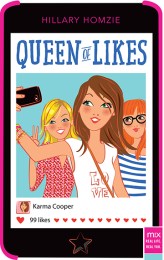 I’ve written a half dozen books for tween girls. Queen of Likes (Simon & Schuster/Aladdin) was recently selected by the Association of Jewish Libraries for the Love Your Neighbor List. The list was created in response to the Pittsburgh tragedy and attempt to create a bridge of understanding into the lives of Jewish kids. I feel really strongly that if more children had access to books about kids from diverse cultures there would be fewer hate crimes. One of my recent light-hearted middle-grade books Pumpkin Spice Secrets seems to be a favorite among reluctant readers and was featured this fall on the front cover of Scholastic Tab
 —which was a true thrill!
Very cool about both features! And it’s so true that reading can help you understand others who have different customs, cultures, and personalities. I read a study that showed voracious readers are much more likely to be empathetic to others. I suspect it’s because they learn to put themselves in others’ places and see the world in a different light. It’s great when authors not only share their storytelling but also their lives and culture.
To find out more about Hillary and her other books, you can visit her website.


 Heather L. Montgomery writes books for kids who are wild about animals. The wilder, the wackier, the better. She’s tried on each of these organizing tools: Her Wild Discoveries: Wacky New Animals used chunked text that functions like cubbies and compartments; her Little Monsters of the Ocean used totally traditional chapters; her Something Rotten: A Fresh Look at Roadkill is organized by outfit. Learn more at


 Jodi Wheeler-Toppen is a former science teacher and the author of the