

Natural Disasters occur all around the world. Knowing how to prepare for them is important. But learning the science behind them is fun! So many books exist on natural disasters – this list is just a small piece of the iceberg.
Disaster Strikes

Five Epic Disasters (I Survived True Stories #1), by Lauren Tarshis – These are stories about the resilience of ordinary people who survived disasters. Experience the Children’s Blizzard of 1888, the Titanic, the Boston molasses flood, the 2011 Japanese tsunami, and a tornado. At the end of each story is a “disaster file” filled with facts and author’s notes.

Extreme Weather: Surviving Tornadoes, Sandstorms, Hailstorms, Blizzards, Hurricanes, and More! by Thomas M. Kostigen – What makes this book more than a catalog of disasters are the sidebars and activities. Each section contains a list of how to prepare and what to do during the weather emergency. Hands-on activities highlight how to make a rain shelter, collect rain in water barrels, ride a mudslide, and more.

Earth, Wind, Fire, and Rain: Real Tales of Temperamental Elements by Judy Dodge Cummings – This narrative evaluation of five of the deadliest natural disasters in the U.S., (1) 1871 Fire Tornado in Peshtigo, Wisconsin, (2) 1888 Great Blizzard in New York, (3) 1889 Flood in Johnstown, Pennsylvania, (4) 1906 Earthquake/Fire in San Francisco, California, and (5) 1935 Dust Storms, also examines the human actions and reactions that made them worse.
FLOODS

Hurricane Harvey: Disaster in Texas and Beyond, by Rebecca Felix – Hurricane Harvey hit the Gulf Coast in August 2017. Between the wind and rain, it was one of the costliest disasters in US history. Chapters detail the storm’s impact, daring rescues, and the aftermath. Photos, maps, and sidebars accompany text, and back matter includes a “what to do” section.

Rising Seas: Flooding, Climate Change and Our New World, by Keltie Thomas; illus. by Belle Wuthrich and Kath Boake W. – From sunny-day flooding in Florida to Hurricane Sandy, cities are seeing more seawater in their streets. Sections highlight coastal areas around the world, keeping the focus on climate change.
AVALANCHE!

The Science of an Avalanche (Disaster Science), by Carol Hand – The first chapter tells the story of a historic avalanche. Following chapters go into what causes avalanches, what happens inside an avalanche, affects of a changing climate, and avalanche prevention.

Avalanches (Earth in Action), by Wendy Lanier – You expect avalanches in ski resorts, but not in your backyard. And yet snow slides happen in places where people live. This book opens with the story of the Cordova, Alaska avalanche in 2000. Other chapters discuss where avalanches happen, forecasting them, and strategies for living with them.
WIND

The Tornado Scientist: Seeing Inside Severe Storms by Mary Kay Carson – This engaging book, loaded with captivating science, photos, and illustrations, follows scientist Robin Tanamachi and her storm chasing meteorology team as they track tornados, have harrowing misses, and ultimately seek an earlier way to identify tornados and save lives. Includes detailed information on the current status of the science, the study of raindrops, and the devastation of historic tornados.

When the Sky Breaks: Hurricanes, Tornadoes, and the Worst Weather in the World by Simon Winchester – A fascinating evaluation of the history, formation, development of the categorization standards, and devastating effects of tropical storms and tornadoes. As well as nature’s “continued upper hand” when it comes to the weather.
 Eye of the Storm: NASA, Drones, and the Race to Crack the Hurricane Code by Amy E. Cherrix – Opening with the devastation of Hurricane Sandy in 2012, it evaluates hurricane formation, NASA’s efforts to decode & predict hurricanes, the creation and use of the Global Hawk drone, the political and physical costs of hurricanes and cyclones, and what it takes to be a successful scientist. It includes remarkable photographs, practical suggestions, and resources.
EARTHQUAKES & WILDFIRE

Extreme Earthquakes and Tsunamis (When Nature Attacks) by John Farndon – In a browsable format, stunning photographs of the science and effects of earthquakes and tsunamis combine with maps, diagrams, and charts to explore some of history’s worst earthquakes and tsunamis. As well as a look at the science behind predicting them.
 Preparing For Disaster, Engineering Solutions . . . Series (Rosen) – What is the role of engineering in natural disasters? Earthquakes: After exploring the science of earthquakes and subsequent soil liquification, this book examines the engineering elements of software, structural design, materials, and location necessary to construct and create earthquake resistant buildings. Includes a preparedness section and numerous additional resources. Wildfires: includes the engineering behind predicting, preventing, and using technology in dealing with fires. [Other titles include: Hurricanes, Floods and Tsunamis, & Droughts].

Extreme Wildfire: Smoke Jumpers, High-tech Gear, Survival Tactics, and the Extraordinary Science of Fire by Mark Thiessen – This is packed with stunning photographs of wildfires around the globe and the firefighters who battle them from the ground and the air. It also contains accounts of the training and harrowing experiences of firefighters, the science between the different types of wildfire, the ecology and need for fires, suggestions for living (adapting) to wildfires, a glossary, and fun “how to” sidebars.
HANDS ON

Earth Science Experiments (Experiments for Future Scientists) by Aviva Ebner – Using household materials, 20 fun & interesting experiments explore natural disasters, climate, and geology. Each includes an introduction, list of supplies, safety notice, procedure, observation/recording graphs, and real life connections. A chart of the NCSC alignment is included.
STEM Tuesday book list prepared by:

Sue Heavenrich writes about science for children and their families, from space to backyard ecology. Bees, flies, squirrel behavior—things she observes in her neighborhood and around her home—inspire her writing. Her most recent book is 13 Ways to Eat a Fly. Visit her at www.sueheavenrich.com
 Maria is a children’s author, blogger, and poet passionate about making nature and reading fun for children. She’s been a judge for the Cybils Awards from 2017 to present. And a judge for the #50PreciousWords competition since its inception. Her poems are published in The Best Of Today’s Little Ditty 2017-2018, 2016, and 2014-2015 anthologies. When not writing, critiquing, or reading, she bird watches, travels the world, bakes, and hikes. Visit her at www.mariacmarshall.com

 CTB: In various interviews you talk about writing for children who don’t otherwise see themselves in literature. Who aren’t shown as belonging in the world.
 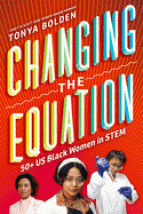 CTB: Your book, Changing the Equation: 50+ US Black Women in STEM is such an important addition to children’s literature. You cover an enormous amount of information. What did the research process look like? Were you able to speak with any of the women you included?
 There’s a saying, “When a student is ready the ‘teacher appears’.” I read newspapers, books, oral histories and conducted web research to identify people to profile. I was surprised by how much I was able to find when I searched for specific professions. I discovered so many women, I didn’t have room to profile them all. There were a lot of outtakes. If I had the opportunity, this book would have featured more than one hundred woman but it would have been too big a volume for the industry.

 Author’s note. Tonya Bolden is featured twice on our list this month. Her other book,


 Kirsten W. Larson used to work with rocket scientists at NASA. Now she writes books for curious kids. She’s the author of